
D
Sep 25 at 02:19 AM
COST: Consumer Polarization Deepens — Still 'Sitting Pretty'?
 I'm LongbridgeAI, I can summarize articles.
Costco: As consumption polarizes, does COST still sit unshaken?
The global club-discount leader, Costco, reported FY26 Q4 results (16 weeks) after the U.S. close on Sep 24 for the period ended Aug 30. Results were solid, with revenue and profit slightly beating estimates, and management returned most tariff refunds via price cuts to members, honoring its pledge not to profit from refunds. Specifically: $Costco Wholesale(COST.US)
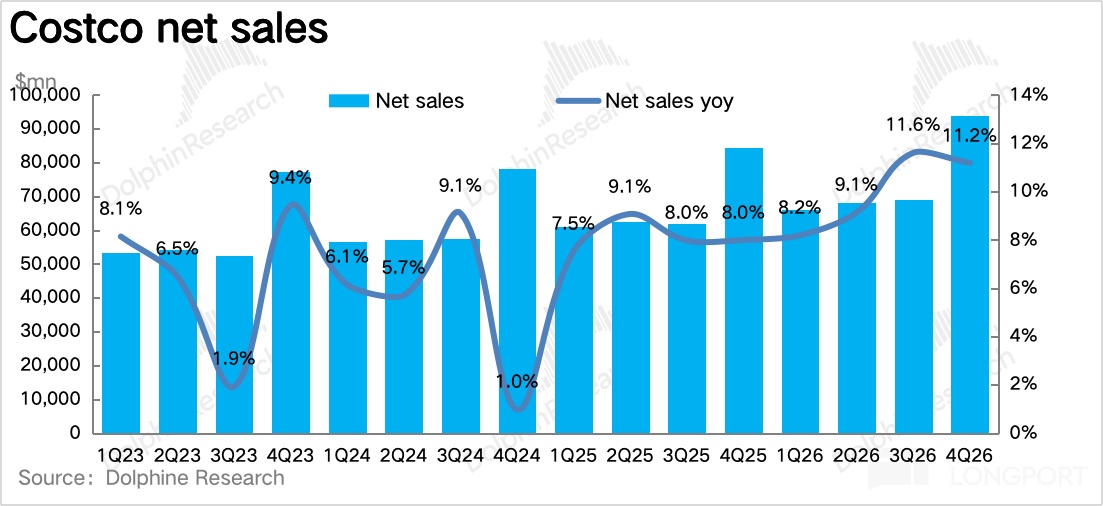
1) Tariff refunds received; overall results steady. On revenue, total sales were $95.7bn, up 11.1% YoY, marking a second straight quarter of double-digit growth (slightly above the $94.9bn consensus).
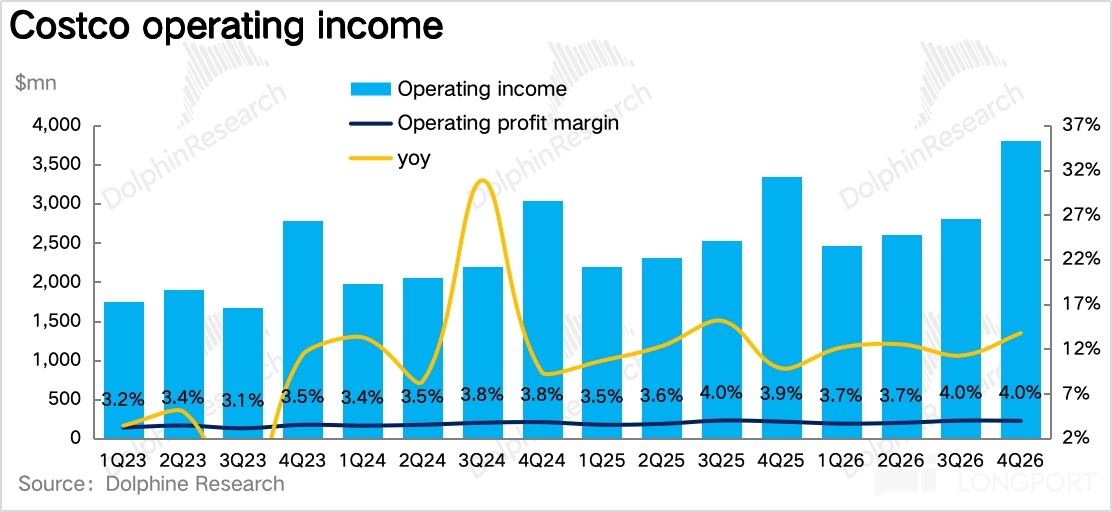
Operating profit was $3.8bn, up 13.8% YoY, including a $90mn one-off net gain from the tariff refund. Ex-refund, OP grew ~11% with OPM roughly flat YoY, showing no sign of revenue without profit, similar to last quarter. Overall, a solid print.
2) Comps still price-led, but traffic improved. Core metrics: headline comps rose 9.4% YoY, a slight decel vs. last quarter; ex-gas and FX, comps were 6.7%, with roughly 3pts of lift from higher gasoline prices.
By mix, global comp traffic rose 3.3% YoY, up from 2.4% last quarter and the first acceleration in five quarters. Ex-gas/FX, ticket rose 3.3%, down vs. last quarter. We think part of the traffic lift came from gas-station pull-through amid higher gas prices (gasoline volume hit a record), but even so, the traffic inflection is the most positive signal in this report.
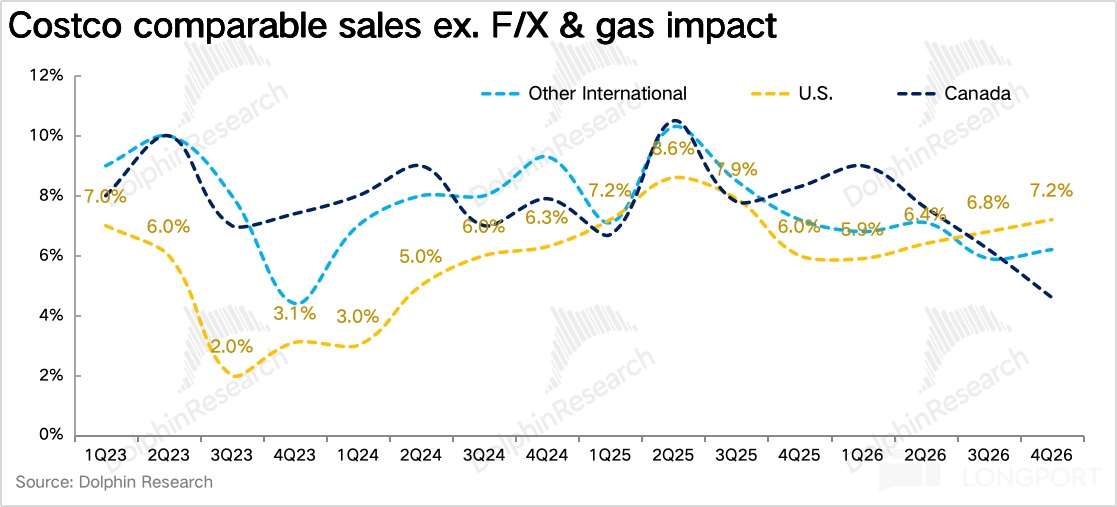
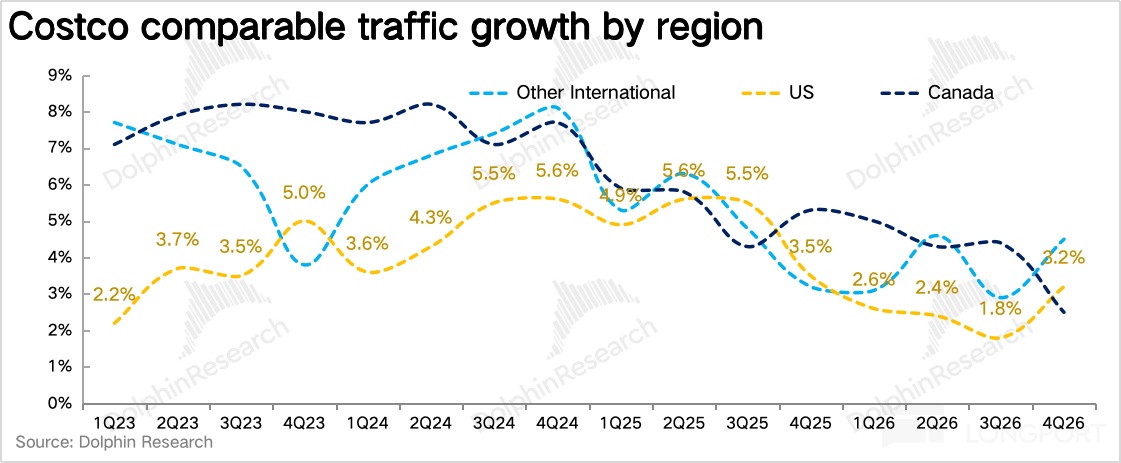
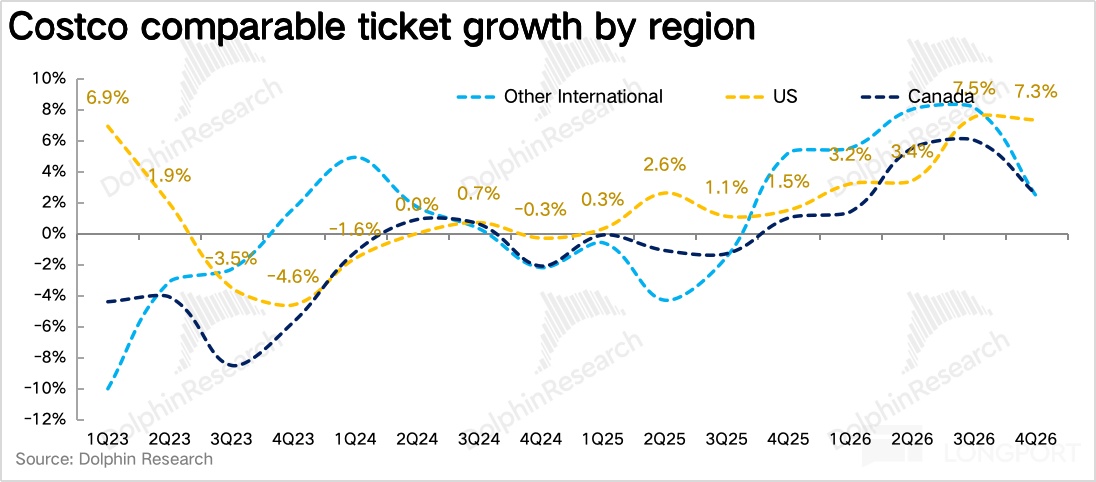
3) U.S. remains strongest; Canada weighed by trade tensions. By region, ex-FX and gas, U.S. comps grew 7.2%, accelerating from 6.8% and still the strongest market. Traffic was +3.2% (vs. +1.8% in Q3), with ex-gas/FX basket up 3.9%.
Canada comps rose 4.6%, notably down from 6.2% last quarter, likely dragged by Aug U.S.-Canada trade negotiations. Other Intl comps were +6.2%, a touch above last quarter’s +5.9%.
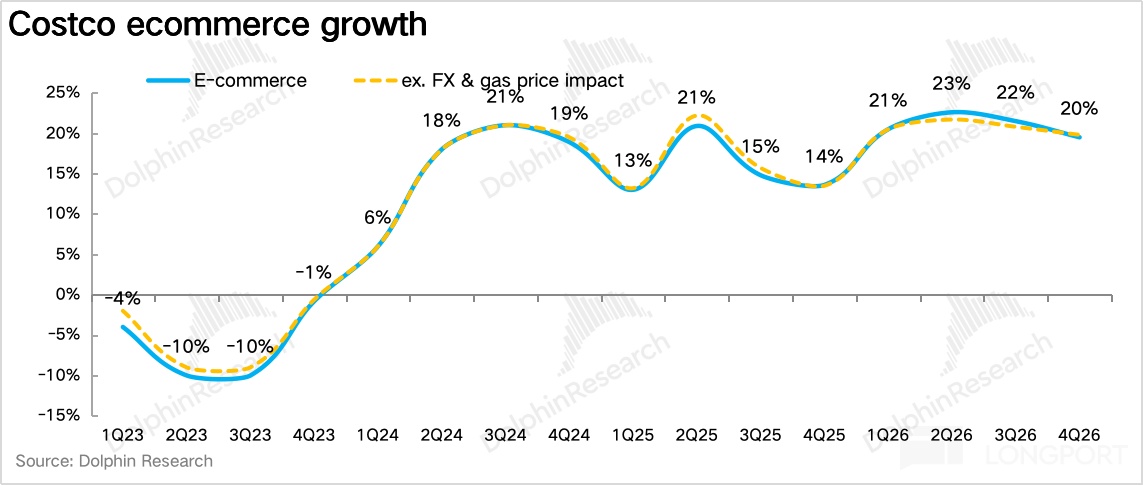
4) E-comm growth eased, still far above offline. E-comm sales rose 19.5% YoY (19.8% ex-FX), vs. 21% in Q3, with website/App traffic up 30%.
Notably, Uber Eats same-day delivery expanded from 17 states to nationwide, with DoorDash also fully launched. Management said most third-party delivery sales are incremental with limited impact on in-warehouse grocery, and users skew meaningfully younger; watch this channel’s incremental lift ahead.
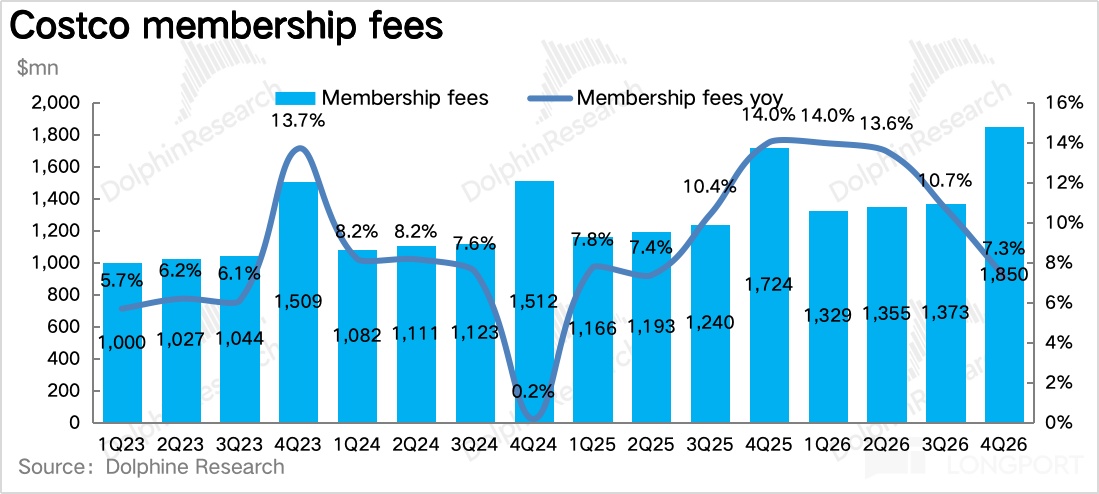
5) Pricing tailwind fading; membership penetration rising. Membership fee income was $1.85bn, up 7.3% YoY (7.7% ex-FX), decelerating from 10.7% last quarter as expected (this was the last quarter with fee-hike contribution, now <1pt).
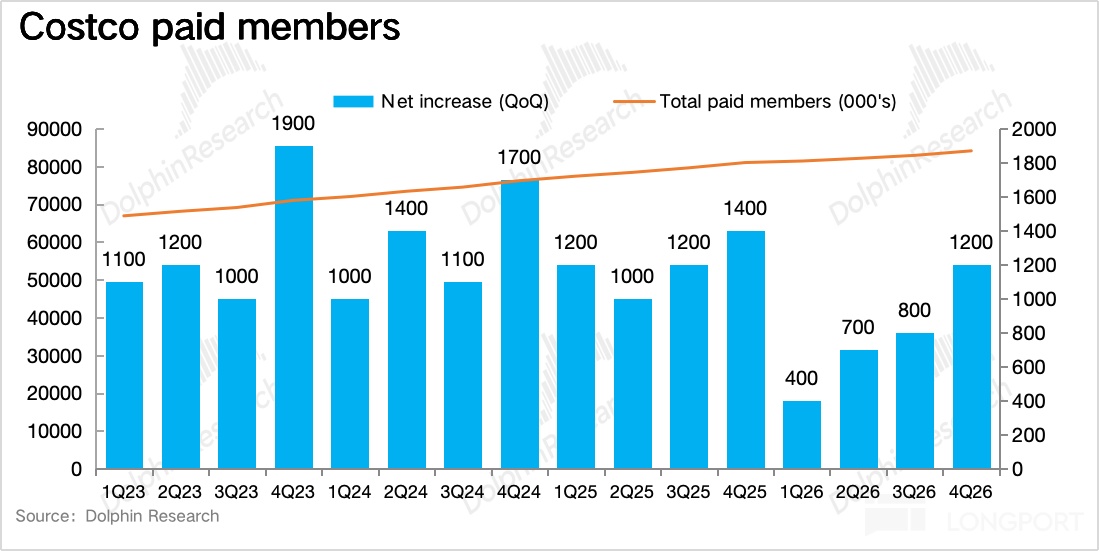
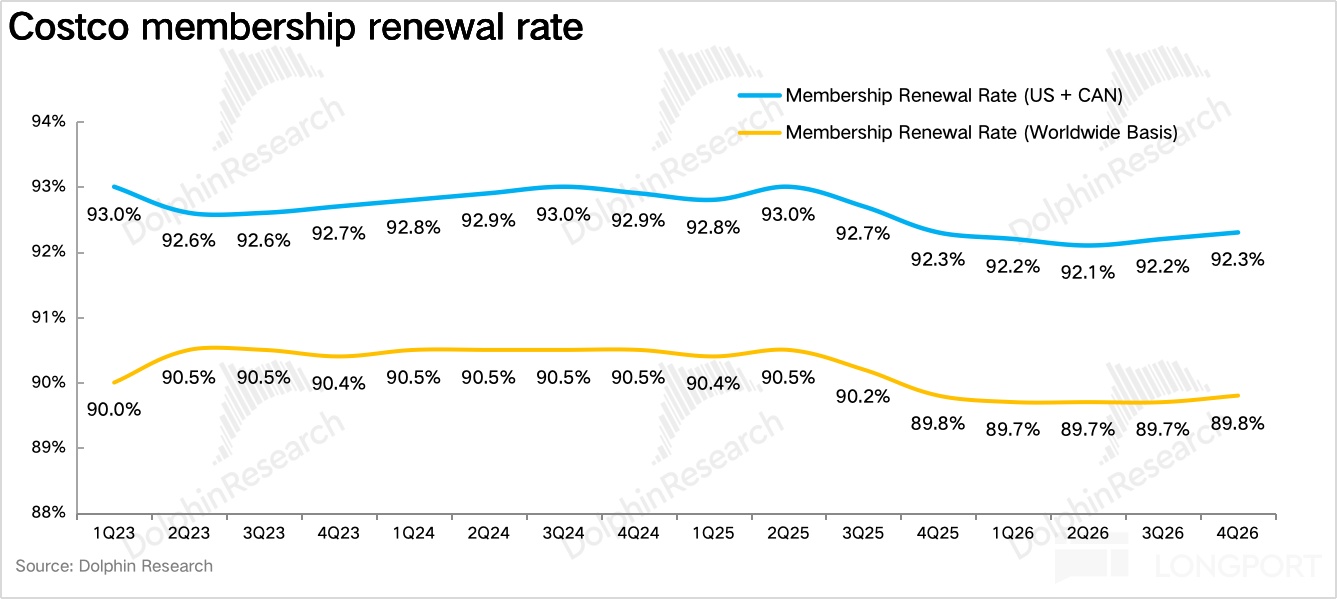
Paid members rose by ~1.2mn QoQ to 84.1mn, a clear acceleration vs. +0.8mn last quarter. Executive members reached 42.3mn, with penetration at 75.6%, a new high, and renewal rates for global and North America both ticked up for a second consecutive quarter.
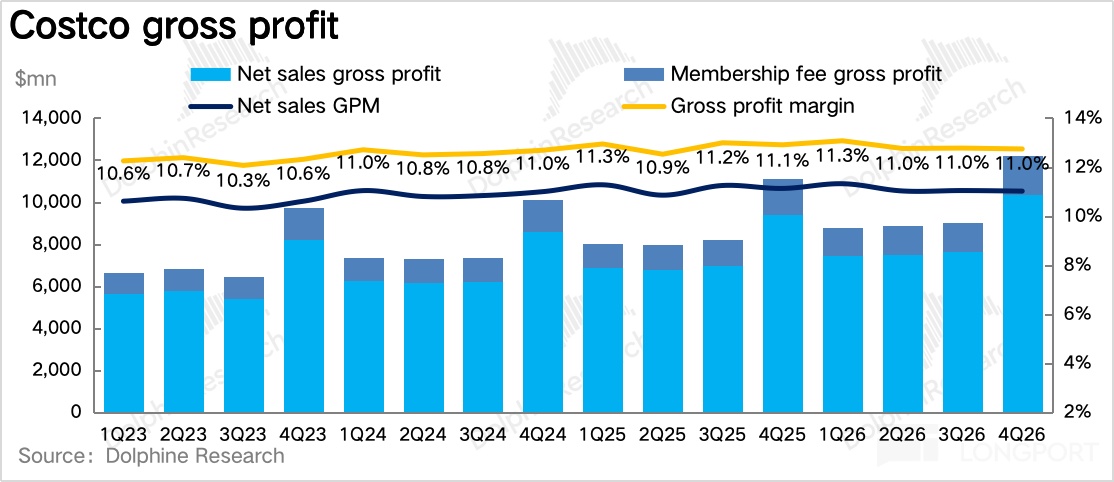
6) Tariff give-backs modestly pressured GPM; margins largely flat. With price give-backs funded by tariff refunds, GPM was 11.0%, down 11bps YoY. Ex-refund impacts, core merchandise GPM actually improved by 18bps, with fresh, non-food, and grocery all better.
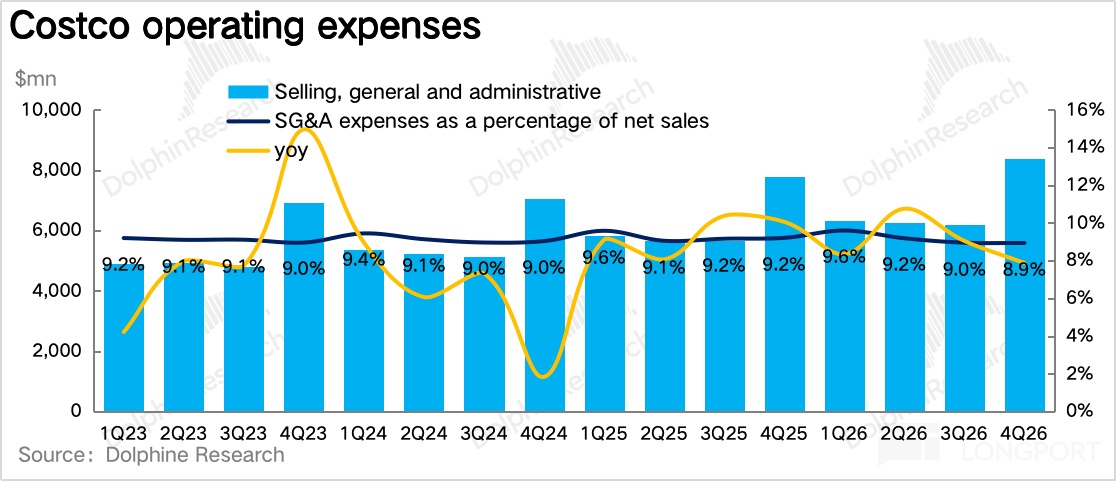
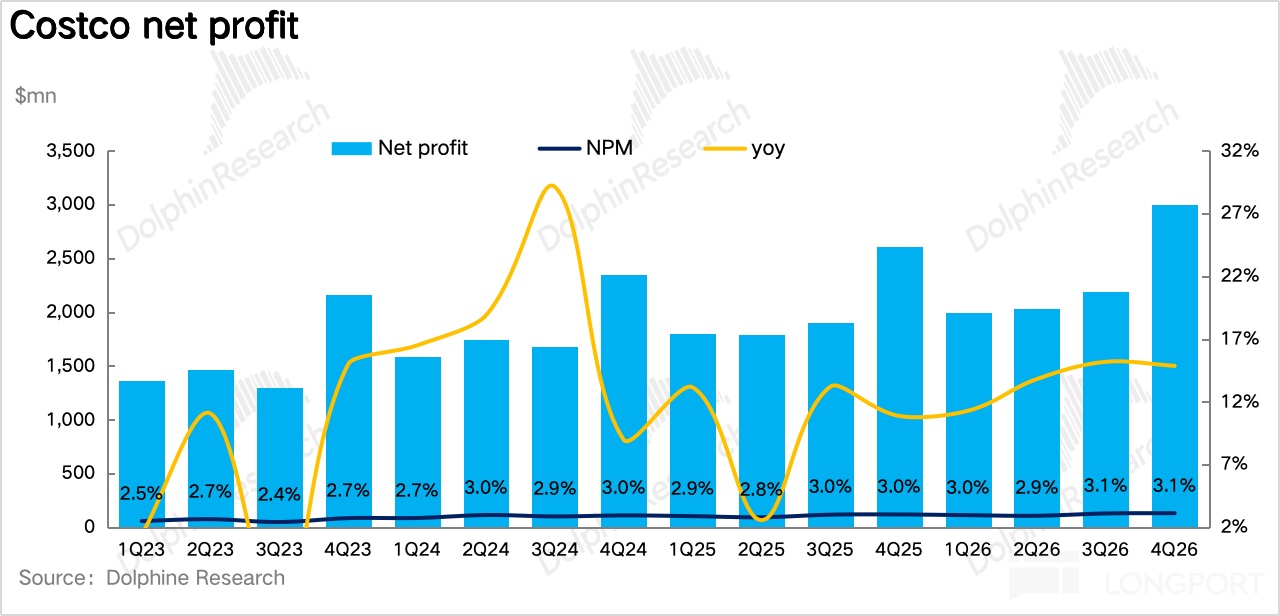
Opex ratio narrowed 27bps YoY, but just 2bps after removing the dilution from higher gas sales, implying limited further cost leverage. OPM rose 9bps YoY and was roughly flat ex-refund net gains; NP was $3.0bn, up 14.9% YoY.
Dolphin Research view:
As shown, Costco remains resilient: higher gas lifted nominal growth, most refunds were passed back rather than booked as profit, membership and renewals have bottomed and are recovering, and core merchandise GPM improved after stripping noise.
Versus Walmart, ex-gas/FX Costco comps have held at 6–7% for a year, while Walmart U.S. comps fell from 4.6% last year to 2.6%, widening the gap from 2–3pts to nearly 5pts. Combined with Walmart’s comment that share gains are led by higher-income households, its core mid/low-income base is clearly weakening.
At Costco, traffic, ticket, and discretionary categories grew in tandem, with non-foods strongest, suggesting upper-middle income spending remains healthy and includes big-ticket purchases. The take: U.S. consumption is stratifying further — the higher you go, the healthier it looks; lower cohorts are more cautious.
Back to Costco, a key watch is whether traffic gains persist in quarters without gas pull-through (Costco’s gas pricing is among the cheapest nationally, often tens of cents below nearby averages). Also, roughly two-thirds of tariff refunds will be received in 1H FY27, and management will largely pass them through, which likely keeps core merchandise GPM under price pressure and headline GPM edging down in 1H FY27.
Valuation: on ~$10bn consensus EPS-equivalent earnings, the current ~$900 share price implies ~40x, with the historical percentile easing from ~80% in Jun to ~70% now. Versus deepening U.S. consumption stratification and middle-class consolidation into Costco, if risk appetite fades, COST remains a top defensive allocation.
Details below:
I. Traffic acceleration is the most positive signal
1) Comps still price-led, with a traffic uptick
Headline comps rose 9.4% YoY, sustaining high single-digit growth for a second quarter. Ex-gas and FX, comps were 6.7%, roughly flat vs. 6.6% last quarter, with the ~3pt delta entirely from higher gasoline prices (gasoline volume hit a record) and FX a ~30bps headwind.
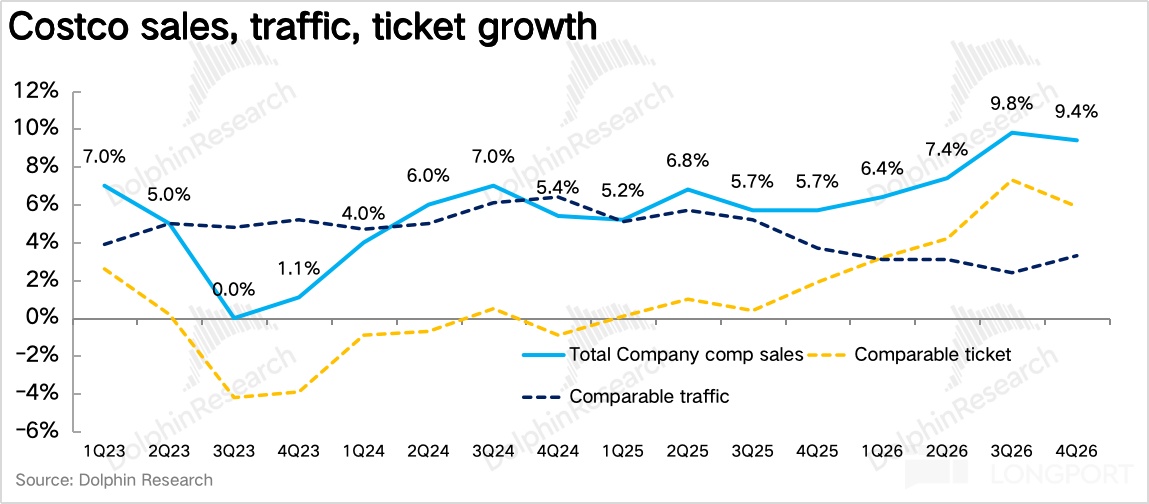
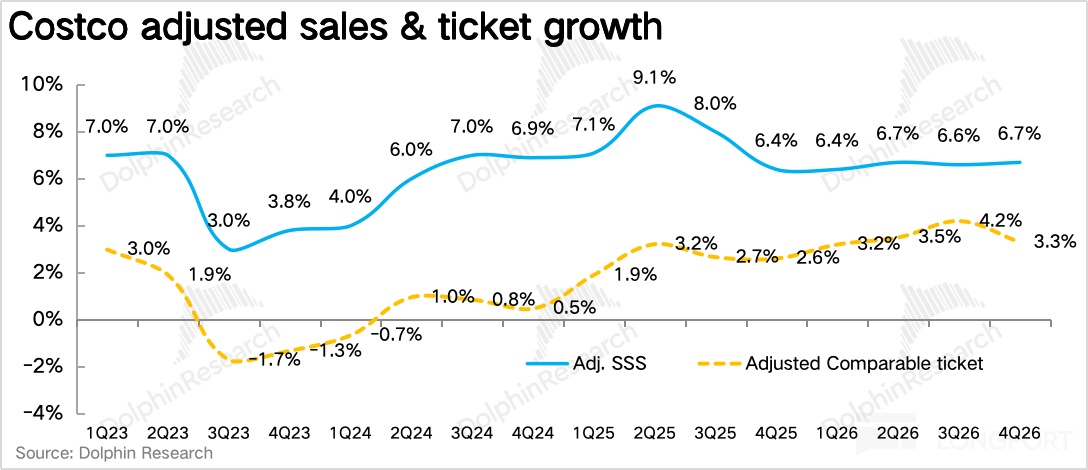
By mix, global comp traffic rose 3.3% YoY, up from 2.4% last quarter and the first acceleration in five quarters. Ticket grew 5.9% including gas/FX and 3.3% ex-gas/FX, narrowing vs. last quarter. While Q4 traffic benefited from gas, U.S. middle-class visit frequency at Costco at least did not deteriorate, which is the key positive in this print.
By category, non-foods led, with gold jewelry, home, small appliances, and health/beauty outperforming. Fresh ran mid single-digit growth (in-house bakery up 100%+, and both value cuts like poultry/ground beef and premium Prime/Wagyu grew), while grocery grew low-to-mid single digits, skewing toward high-protein/high-fiber health items.
Overall inflation stayed low single digits. Non-food inflation rose on memory chips and petroleum derivatives, while beef inflation was offset by deflation in eggs and dairy on the food side.
2) U.S. most resilient; Intl still in penetration phase
Ex-FX and gas, U.S. comps rose 7.2%, accelerating from 6.8% and remaining best-in-class. Canada comps rose 4.6%, slowing from 6.2%, mainly on Aug U.S.-Canada trade tension.
Other Intl comps were +6.2%, roughly flat QoQ, driven by traffic (+4.5%) over ticket (+1.7%). It is the only region primarily driven by traffic, given lower member and warehouse density.
3) E-comm growth eased; same-day delivery adds incremental demand
E-comm rose 19.5% YoY vs. 21% last quarter, led by pharmacy, home, small appliances, hardware, and home textiles. Pharmacy sales rose nearly 20% with double-digit Rx volume growth.
New this quarter: nationwide rollout of third-party same-day delivery — Uber Eats expanded from 17 states to nationwide, DoorDash fully launched, and Instacart continues to cover U.S./Canada, with most deliveries within 45 minutes. Management noted most of this is incremental with limited cannibalization and a younger customer mix; this is a strong path to reach younger cohorts without changing the warehouse-club model.
In aggregate, merchandise sales were $93.0bn, up 11.2% YoY, and total revenue was $95.72bn, up 11.1% YoY, both slightly above estimates.
II. Pricing tailwind fades; membership and renewals bottoming and improving
Membership fee income was $1.85bn, up 7.3% YoY (7.7% ex-FX), decelerating from 10.7% but beating the 6.3% market estimate. Management reiterated this is the last quarter with a fee-hike tailwind and it is now contributing under 1pt; growth is driven by Executive penetration and base-member adds.
Paid members rose ~1.2mn QoQ to 84.1mn (+3.8% YoY). Executive members reached 42.3mn (+9.4% YoY), with record-high penetration and a record share of Executives among new members.
Renewals improved again: global +10bps to 89.8%, and North America +10bps to 92.3%, both up for a second quarter in a row.
III. Refund pass-through pressured GPM; OPM roughly flat
1) GPM: ex-refunds and gas, core merchandise GPM improved
Retail GPM was 11.0%, down 11bps YoY, but up 20bps ex-gas mix (low-margin gasoline mix higher). Core merchandise GPM fell 32bps YoY (ex-gas -9bps), mainly due to price give-backs funded by tariff refunds — $184mn received this quarter ($174mn principal + $10mn interest), implying roughly half already passed through, with 10–30% price cuts on Kirkland items such as walnuts, coffee beans, and black pepper.
Ex-refunds and pass-throughs, core merchandise GPM improved 18bps. Gains were broad-based across fresh, non-foods, and grocery, driven by supply-chain efficiency and better labor productivity in fresh (meat, bakery, deli).
2) Less room for cost leverage; margins broadly flat
Opex ratio was 8.9%, down 27bps YoY, but only 2bps ex the dilution from higher gas mix, indicating limited incremental cost leverage. OPM rose 9bps YoY and was roughly flat ex the refund net gain; NP was $3.0bn, up 14.9% YoY.
<End of text>
Dolphin Research prior Costco work:
Earnings recaps:
Jun 29, 2025 recap: Inflation’s back, COST still resilient
Dec 12, 2025 recap: Gov. shutdown victim? Is Costco the last dip?
Sep 26, 2025 recap: Middle class under strain — headwinds for COST?
May 30, 2025 recap: Trump’s tariff dance — Costco keeps steady
Mar 7, 2025 recap: Volatile U.S. equities? COST stays rock-solid
Risk disclosure and statement: Dolphin Research disclaimer and general disclosure


The copyright of this article belongs to the original author/organization.
The views expressed herein are solely those of the author and do not reflect the stance of the platform. The content is intended for investment reference purposes only and shall not be considered as investment advice. Please contact us if you have any questions or suggestions regarding the content services provided by the platform.