AI Investing 2026: A Guide to AI Trading with LongbridgeAI
In the data-driven landscape of 2026, the primary challenge for investors has shifted from acquiring information to processing it effectively. This article explores the evolving world of AI in investing, dissecting how AI trading leverages machine learning to eliminate human bias and enhance operational precision. By highlighting the capabilities of LongbridgeAI, we demonstrate how intelligent summaries and 24/7 market monitoring can bridge the gap between retail and institutional intelligence, allowing modern investors to formulate strategies grounded in data rather than hype.
When AI enters investing, where is the position of mankind?
Throughout the history of financial markets, the efficiency of information transmission has always been the ultimate arbiter of profit and loss. From the early days of ticker tapes to the ubiquity of Bloomberg terminals, every technological leap has reshaped the rules of wealth distribution. As we move through 2026, AI in investing is no longer a walled garden reserved for Silicon Valley tech giants or Wall Street hedge funds. As of April 2026, the landscape has reached a tipping point. In terms of active trading, 60% to 70% of the total market volume is now estimated to be driven by automated or algorithmic systems, according to a research from the LSE.
This statistical dominance confirms that the revolution in the 'democratisation of decision-making' has arrived; the only question remains whether you are prepared to seize the opportunity.
What is AI trading, and why does it matter?
Artificial Intelligence (AI) has undoubtedly become the most compelling narrative in global capital markets. As algorithms iterate at breakneck speed, AI has transitioned from a laboratory gimmick into an indispensable co-pilot for investors, playing a pivotal role in high-stakes decision-making. When AI meets the world of finance, we are no longer merely observing data; we are redefining the interface between human intuition and market complexity.
In simple terms, AI trading is the process of using Machine Learning (ML) and Natural Language Processing (NLP) to extract non-linear patterns from vast datasets. Unlike traditional technical indicators that rely on historical price action, AI intelligent investing can process financial statements, social media sentiment, and even geopolitical breaking news in milliseconds, translating them into quantifiable coordinates for action.
Does AI trading really work?
AI consistently outperforms humans in specific high-pressure environments. However, to determine if it truly ‘works’ for your portfolio, one must weigh its inherent advantages against its logical limitations.
The Edge: Why use AI for trading?
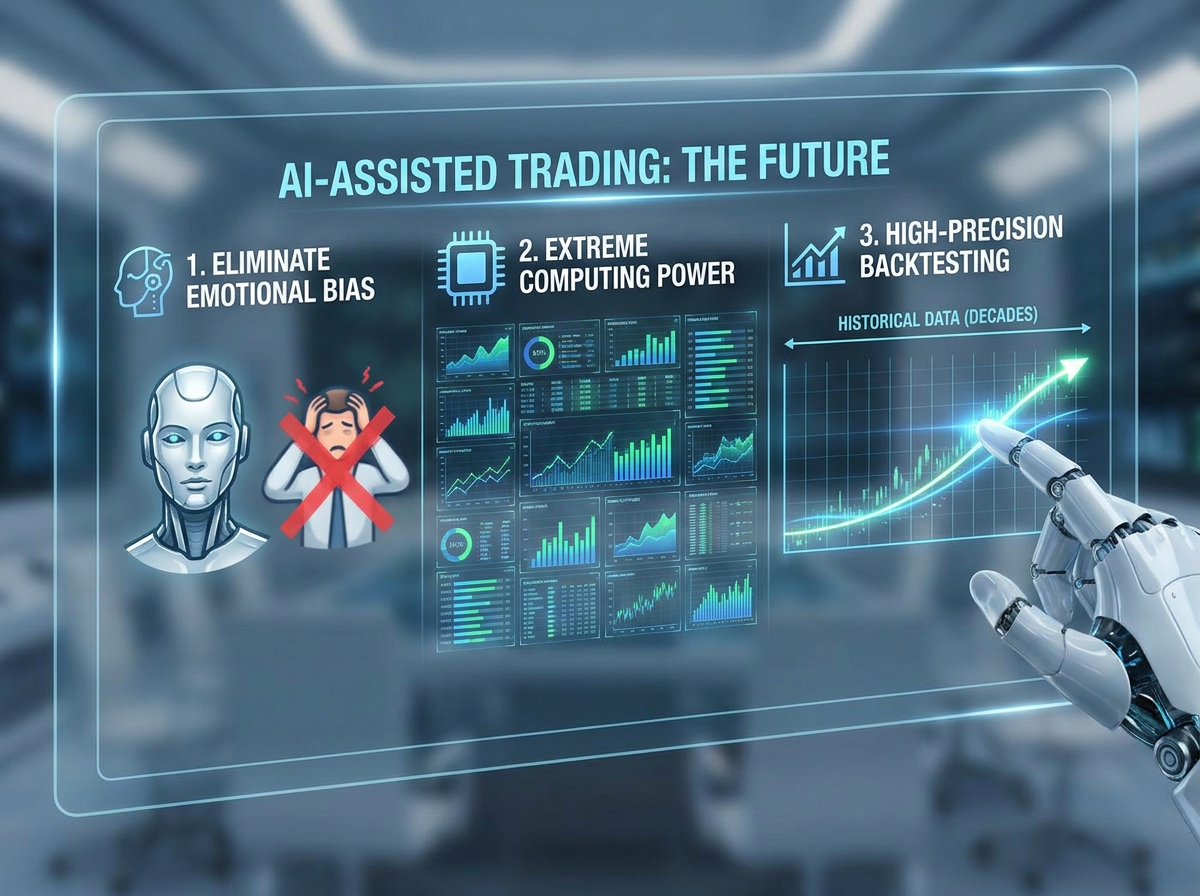
- Emotionless Execution: AI eliminates human biases such as "loss aversion" or "revenge trading", sticking strictly to the data-driven plan.
- Processing Power: It can monitor thousands of assets across multiple markets simultaneously—a feat impossible for any human analyst.
- Backtesting Precision: AI can validate a strategy against decades of data in seconds, ensuring a strategy is grounded in historical probability.
Understanding the Limitations: What are the risks?
- Over-optimisation (Curve Fitting): An AI model might become too focused on past data patterns that may not repeat in a changing macro environment.
- The "Black Box" Risk: Some complex algorithms can be difficult to interpret, making it hard to understand why behind a specific trade.
- Lack of Intuition: AI struggles with "Black Swan" events or unprecedented geopolitical shifts where historical data offers no guidance.
Ultimately, AI is not a crystal ball; its core value lies in risk management and operational efficiency. It works best when viewed as a powerful filter that removes the "noise" of the market, allowing the investor to focus on high-level strategy.
The Versatility of AI: Diverse Trading Strategies
To truly understand the power of this technology, one must recognise that there is no "one-size-fits-all" approach. The market currently offers a vast array of AI trading strategies tailored to different risk appetites and time horizons:
- Arbitrage Strategies: AI can identify price discrepancies for the same asset across different exchanges, executing trades faster than any human could.
- Trend Following & Momentum: By analysing historical cycles, AI identifies the early stages of a market trend, allowing for systematic entry and exit.
- Sentiment-Based Macro Trading: High-level algorithms scan global news outlets to gauge the "mood" of the market, adjusting portfolios before the headlines even hit the mainstream.
- Predictive Mean Reversion: These strategies use AI to calculate when an asset’s price has strayed too far from its historical average, betting on a return to the norm.
The availability of these diverse methodologies validates the use of AI as a standard pillar of modern portfolio management.
Getting Started: Can I start trading with AI?
For many beginners, the immediate question is: How do I make passive income using AI? It is vital to dispel a common myth—AI is not a "money-printing machine", but rather a high-performance engine. To start this engine, an investor requires the right toolkit.
Previously, engaging in investing AI models required proficiency in Python programming or a robust background in mathematical modelling. However, the evolution of FinTech has significantly lowered these barriers. By leveraging platforms that integrate sophisticated AI trading logic, retail investors can now access the kind of deep-dive analytics previously available only to institutional players.
The Practical Edge: How AI Reshapes the Trading Workflow
The application of AI in modern trading has shifted the focus from "guessing" to "calculating". Below are two primary ways AI is currently being utilised, followed by an expansive look at its other capabilities.
Case Study 01: Rational Decision-Making (Company a vs. b)
When comparing two industry leaders, such as Company a and Company b, AI replaces "gut feeling" with a rigorous logical chain:
- Sentiment Filtering: Auditing linguistic nuances in market reactions to Company a to distinguish fundamental growth from speculative noise.
- Cross-Sectional Analysis: Rapidly benchmarking Company b’s R&D efficiency against global peers to identify long-term growth drivers.
- Scenario Simulation: Forecasting how specific macro shifts, like a 25-basis-point interest rate change, impact the cash flow of both a & b.
Case Study 02: Quantitative Execution for Individuals
AI democratises high-frequency institutional tools, allowing individuals to execute with precision:
- Backtesting: Validating a strategy (e.g., buying Stock a based on technical and social triggers) against a decade of data in seconds.
- Dynamic Position Management: Automatically adjusting the weighting of a & b assets based on real-time volatility (VIX) to preserve capital.
- Latency Elimination: Executing complex orders the moment conditions are met, removing human reaction lag.
Beyond the Basics: Other AI Applications in Trading
While the above are foundational, AI’s utility in the current market extends much further. Other high-impact applications include:
- Pattern Recognition: Identifying complex chart formations across thousands of tickers simultaneously.
- Alternative Data Mining: Analysing satellite imagery or credit card trends to predict retail performance.
- Real-Time Risk Scoring: Generating a live ‘safety score’ for portfolios based on unfolding news.
- Automated Tax-Loss Harvesting: Identifying losing positions to sell and offset capital gains, optimising post-tax returns.
LongbridgeAI: Empowering the Modern Investor
In practice, investors often struggle with "information overload". A single quarterly report can span over a hundred pages, hiding critical details that could pivot a stock's trajectory. For the professional aged 20-50, finding the time to digest this is a significant challenge.
Through LongbridgeAI, investors no longer need to "wrestle" with raw data. The AI Summary feature allows users to instantaneously capture the crux of Earnings Calls and identify latent risks. Furthermore, its 24/7 intelligent monitoring system decodes market anomalies in real-time and provides personalised execution suggestions—while the investor retains ultimate control. For the middle-class professional balancing a career with wealth management, this is a powerful tool for eliminating information asymmetry.
Conclusion: Maintaining Rational Techno-Optimism
The rise of AI in investing does not signal the retirement of the human intellect. On the contrary, it requires investors to shift from "manual labour" (filtering data) to "intellectual labour" (formulating strategy). Technology is an excellent servant but must never become a master upon which we blindly rely.
In this data-driven epoch, staying ahead often comes down to having the right instruments at your disposal. LongbridgeAI provides professional-grade market analysis and real-time monitoring to help you capture opportunities amidst the noise.