Building a Global ETF Portfolio: US, SG, HK Allocation
Discover how to structure a global ETF portfolio across US, Singapore, and Hong Kong markets to reduce concentration risk while capturing growth across developed and emerging economies.
TL;DR: A global Exchange-Traded Fund (ETF) portfolio combining US, Singapore, and Hong Kong markets helps reduce concentration risk while capturing growth across developed and emerging economies. Strategic allocation across these three regions provides exposure to different sectors, currencies, and economic cycles.
Investing in a single market exposes your portfolio to concentration risk. When that market experiences a downturn, your entire portfolio suffers. A global ETF portfolio spreads investments across multiple regions, sectors, and asset classes to manage this risk while positioning for long-term growth. For Singapore-based investors, combining exposure to the US, Singapore, and Hong Kong markets creates a balanced approach that leverages each region's strengths. This guide explains how to structure your global ETF portfolio allocation across these three key markets.
Understanding Global ETF Portfolio Diversification
Diversification is a core investment principle that spreads risk across different assets rather than concentrating on a single stock, sector, or country. When you build a global ETF portfolio, you gain instant exposure to thousands of companies across multiple geographies through a handful of funds.
Why Geographic Diversification Matters
Each market operates within its own economic cycle. While the US market may experience slower growth during certain periods, Asian markets could show stronger returns. By allocating across regions, you reduce dependence on any single economy's performance.
The Three-Market Advantage
Combining US, Singapore, and Hong Kong markets offers distinct benefits. The US provides access to global technology leaders and diverse sectors. Singapore delivers dividend-focused opportunities with lower volatility. Hong Kong serves as a gateway to Chinese companies and broader Asian growth.
The US Market: Growth and Innovation
The US market represents approximately 60% of global market capitalisation, making it essential for any global ETF portfolio. Exchange-traded funds tracking US indices provide exposure to sectors that may be underrepresented in Asian markets.
Key Sectors and Opportunities
US-focused ETFs offer access to technology, healthcare, consumer discretionary, and financial services sectors. This complements Singapore's concentration in financials and Real Estate Investment Trusts (REITs). According to S&P Dow Jones Indices data, the information technology sector alone accounts for roughly 30% of the S&P 500, providing exposure to sectors that may be less represented in regional markets.
Currency Considerations
Investing in US-denominated ETFs introduces currency exposure. When the Singapore dollar weakens against the US dollar, your returns increase in SGD terms, and vice versa. This currency diversification can serve as an additional layer of portfolio protection.
The Singapore Market: Stability and Yield
Singapore-listed ETFs provide a foundation of stability for regional investors. The local market offers familiarity, regulatory clarity, and attractive dividend yields that complement growth-focused US positions.
Dividend-Focused Investing
Singapore equities have historically provided higher dividend yields compared to US counterparts. Local REITs and established financial institutions distribute regular income, making them suitable for investors seeking passive returns alongside capital appreciation.
Home Market Benefits
Trading in Singapore dollars eliminates currency conversion requirements for local investors. Additionally, familiarity with local companies and economic conditions provides a level of comfort when evaluating investment decisions. You can explore Singapore market opportunities through the Longbridge investment products page.
The Hong Kong Market: Asian Exposure
Hong Kong serves as a bridge between developed and emerging markets. ETFs listed on the Hong Kong Stock Exchange provide access to Chinese companies along with broader Asian opportunities.
Gateway to China
Many Chinese companies list in Hong Kong through H-shares or dual listings. This allows investors to access mainland China growth stories through a regulated, transparent exchange. ETFs tracking Hong Kong indices capture this exposure efficiently.
Regional Diversification
Beyond China, Hong Kong-listed ETFs may include companies from other Asian economies. This regional diversification adds another layer of geographic spreading within your global ETF portfolio.
Sample Allocation Framework
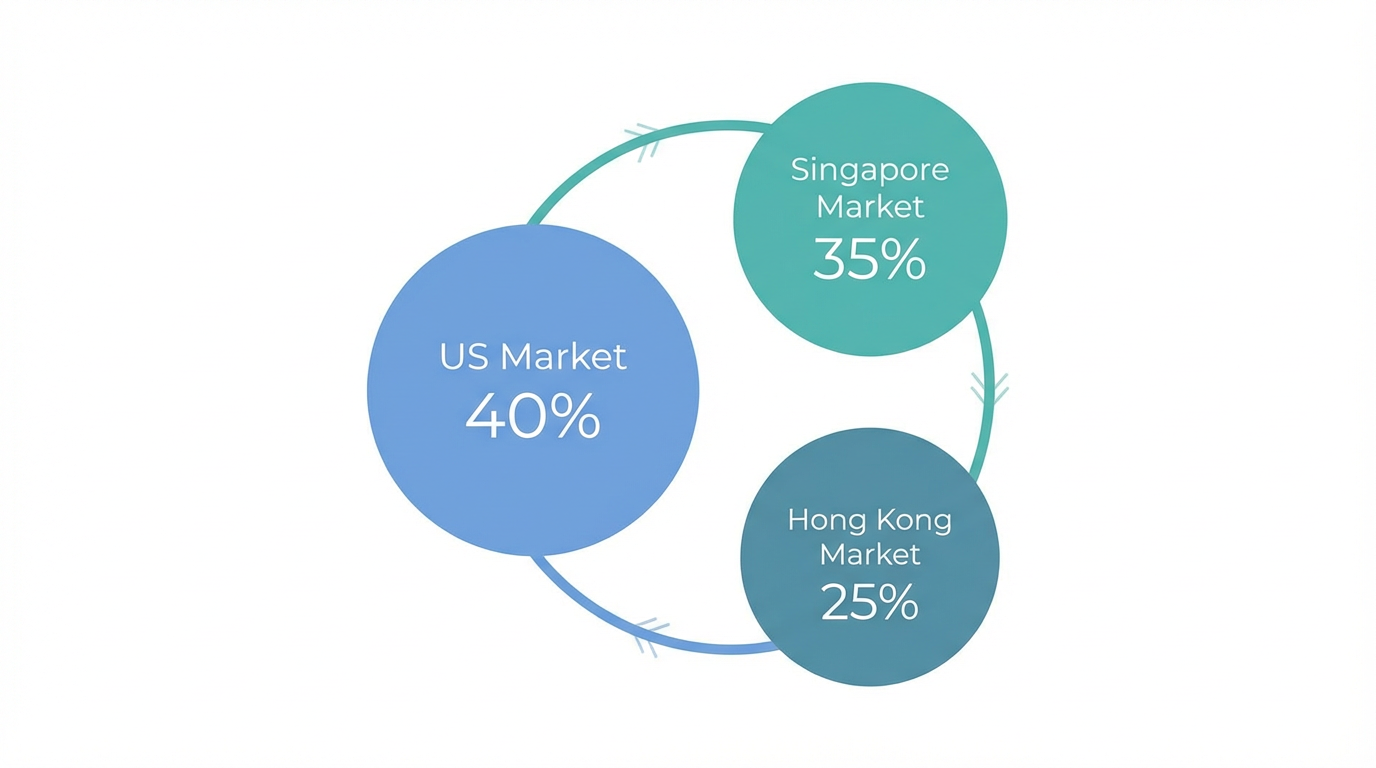
Building a global ETF portfolio does not require dozens of funds. Many investors achieve comprehensive diversification with three to five ETFs. The following framework illustrates one approach to structuring allocations across US, Singapore, and Hong Kong markets. (These allocation examples are for illustration purposes only and do not constitute investment advice. Actual allocations should be based on individual circumstances.)
Conservative Allocation
For investors prioritising stability:
-
Singapore Market: ~40-60%
-
US Market: ~25-40%
-
Hong Kong Market: ~10-20%
This allocation emphasises local income-generating assets while maintaining meaningful international exposure.
Balanced Allocation
For investors seeking growth with moderate risk:
-
US Market: ~35-55%
-
Singapore Market: ~25-45%
-
Hong Kong Market: ~10-25%
This structure tilts toward US growth potential while retaining a significant Singapore base and Asian market exposure.
Growth-Oriented Allocation
For investors with higher risk tolerance:
-
US Market: ~45-65%
-
Hong Kong Market: ~15-30%
-
Singapore Market: ~10-25%
This allocation emphasises exposure to international markets while maintaining local currency holdings.
Tip: Your allocation should reflect your investment timeline, risk tolerance, and income needs. These frameworks serve as starting points rather than prescriptions.
Rebalancing Your Global ETF Portfolio
Market movements cause allocations to drift from your target percentages over time. Rebalancing brings your portfolio back to its intended structure.

Calendar-Based Rebalancing
Review and adjust your portfolio at regular intervals, such as annually or semi-annually. This systematic approach removes emotional decision-making from the process.
Threshold-Based Rebalancing
Alternatively, rebalance only when allocations deviate significantly from targets, typically by 5% or more. This approach reduces unnecessary trading while still maintaining your desired structure.
Practical Rebalancing Steps
-
Review current allocation percentages
-
Compare against target allocation
-
Calculate required trades to rebalance
-
Execute trades, considering transaction costs
-
Document changes for future reference
You can track market performance to monitor when rebalancing may be necessary.
Managing Risk in a Multi-Market Portfolio
A global ETF portfolio introduces considerations beyond single-market investing. Understanding these factors helps you make informed decisions.
Currency Risk Management
Holding assets in multiple currencies creates exposure to exchange rate movements. Some investors accept this as additional diversification. Others may consider currency-hedged ETF options where available.
Market Timing Considerations
Different markets operate in different time zones. US markets open after Singapore markets close. This affects when you can react to global news and execute trades.
Monitoring Multiple Markets
Staying informed across three markets requires attention. Consider using platforms that consolidate news and market data from multiple regions in one interface.
Frequently Asked Questions
How many ETFs do I need for a global portfolio?
Most investors can achieve comprehensive diversification with three to five ETFs. Adding more funds often creates unnecessary complexity and potential overlap in holdings. Focus on broad-market ETFs that cover each target region efficiently.
What percentage should I allocate to international markets?
Some investment frameworks suggest allocating roughly 30% to 40% of equity holdings to international markets as a starting point for diversification. However, individual circumstances vary based on income needs, risk tolerance, and investment timeline.
How often should I rebalance my portfolio?
Annual or semi-annual rebalancing works well for most investors. Alternatively, consider rebalancing when any allocation drifts more than 5% from your target. Frequent rebalancing increases transaction costs without proportional benefits.
Are there tax implications for investing across multiple markets?
Different markets have varying tax treatments for dividends and capital gains. Singapore does not impose capital gains tax, but withholding taxes may apply to dividends from US or Hong Kong investments. Consult the Inland Revenue Authority of Singapore (IRAS) guidelines or a tax professional for specific guidance.
Building Your Global ETF Strategy
Creating a global ETF portfolio spanning US, Singapore, and Hong Kong markets provides geographic diversification, sector variety, and exposure to different economic cycles. Start by defining your risk tolerance and investment goals. Then select broad-market ETFs that efficiently capture each target region. Establish a rebalancing schedule to maintain your desired allocation over time.
The choice of financial instruments depends on your investment objectives, risk tolerance, market outlook, and experience level. Regardless of the method selected, it is essential to fully understand its mechanics, risk characteristics, and execution rules, while maintaining a robust risk management plan. You can learn more about investment strategies through the Longbridge Academy or by downloading the Longbridge App.