ETF Management Fees in Singapore: A Guide to Fund Costs
Discover how ETF management fees work in Singapore, from expense ratios to hidden costs. Learn to evaluate total fund costs and make informed investment decisions.
TL;DR: ETF management fees in Singapore typically range from 0.09% to 0.70% annually, expressed as the Total Expense Ratio (TER). These fees are deducted automatically from fund assets, reducing your net returns over time. Understanding both visible and hidden costs helps you make informed investment decisions.
When evaluating Exchange Traded Funds (ETFs) for your portfolio, management fees deserve careful attention. These costs directly impact your investment returns, and even small percentage differences compound significantly over time. For Singapore investors accessing ETFs listed on the Singapore Exchange (SGX) or international markets, understanding the full cost structure is essential to making informed decisions.
This guide breaks down the types of ETF management fees you will encounter, explains how they are calculated and deducted, and provides practical guidance for evaluating total fund costs.
What Are ETF Management Fees?
ETF management fees are the operational expenses charged by fund managers to run an ETF. These costs cover portfolio management, administrative services, custodian fees, legal compliance, and marketing. Rather than receiving a separate bill, investors pay these fees indirectly through reduced fund returns.
The primary measure of these costs is the expense ratio, which expresses annual operating expenses as a percentage of the fund's assets under management (AUM). For example, a 0.20% expense ratio means you pay approximately SGD 20 annually for every SGD 10,000 invested. (This example is for illustration purposes only and does not constitute investment advice.)
How Fees Are Deducted
ETF fees are not charged directly to your brokerage account. Instead, they are accrued daily and deducted from the fund's net asset value (NAV). This means the ETF's price already reflects these deductions. If an ETF generates a 10% gross return but has a 0.50% expense ratio, your net return would be approximately 9.50%.
This automatic deduction makes fees less visible but no less impactful. Over a 10-year holding period, a 0.50% annual expense ratio on a SGD 50,000 investment could reduce your total returns by thousands of dollars compared to a fund charging 0.10%. (This example is for illustration purposes only and does not constitute investment advice.)
Understanding the Total Expense Ratio
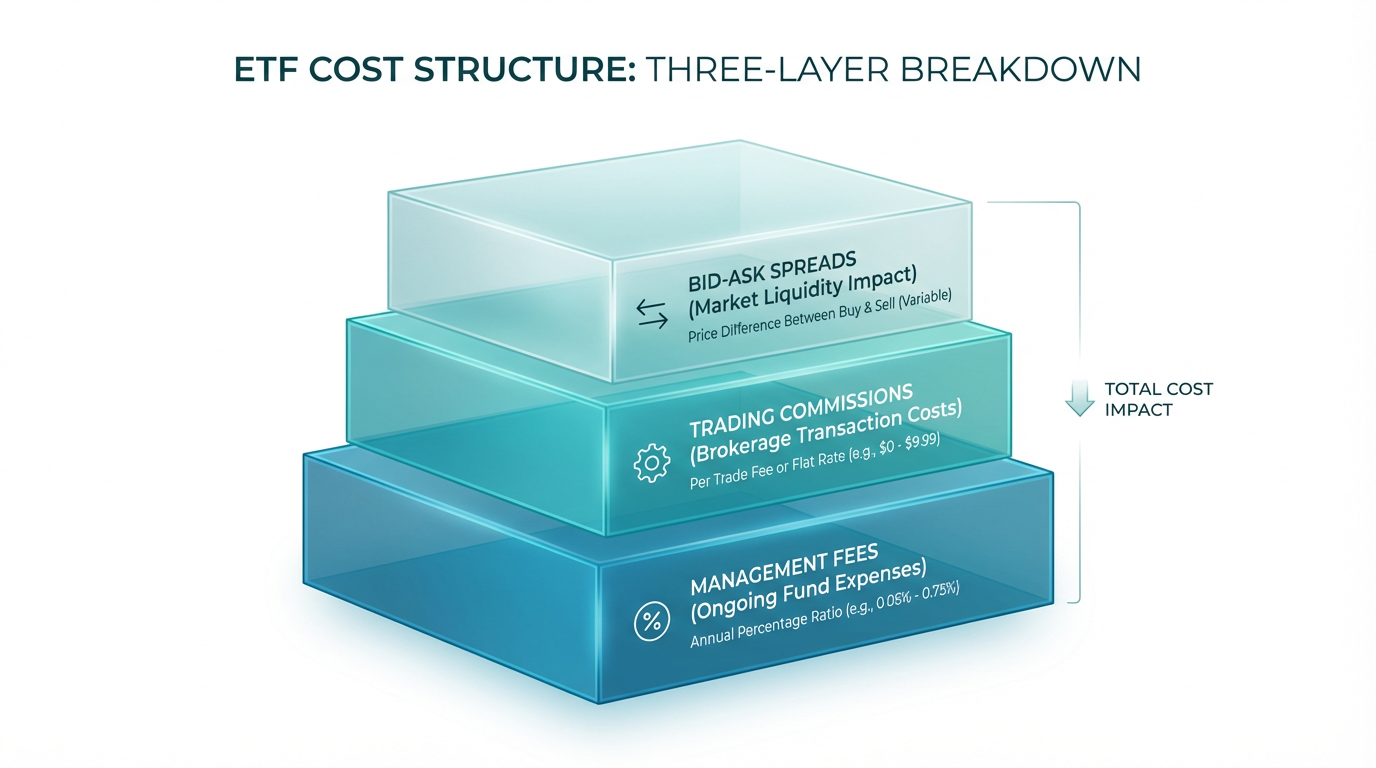
The Total Expense Ratio (TER) is the most comprehensive measure of an ETF's ongoing costs. It includes management fees, administrative costs, custodian fees, audit expenses, and other operational charges. When comparing ETFs, the TER provides the clearest picture of recurring costs.
Typical TER Ranges in Singapore
According to data from the Singapore Exchange, ETFs listed on SGX have expense ratios ranging from as low as 0.09% to over 1.40%. Here is a general breakdown:
-
Low-cost index ETFs: 0.09% to 0.30%
-
Regional and thematic ETFs: 0.30% to 0.70%
-
Specialized or actively managed ETFs: 0.70% to 1.50%
For context, the global average ETF expense ratio sits around 0.14% according to Morningstar data, though this figure is weighted toward large, highly competitive markets like the United States.
Gross vs Net Expense Ratio
Some ETF providers distinguish between gross and net expense ratios. The gross ratio reflects total operating costs before any fee waivers or reimbursements. The net ratio, which is what investors actually pay, accounts for any temporary discounts the fund manager may offer. When evaluating costs, focus on the net expense ratio but be aware that promotional waivers may expire.
Additional Costs Beyond the TER
While the expense ratio captures ongoing fund management costs, it does not include all expenses associated with ETF investing. Investors should account for these additional costs:
Trading Commissions
Since ETFs trade on exchanges like stocks, you pay brokerage commissions when buying or selling. These fees vary by brokerage platform and can range from a few dollars to a percentage of the transaction value. For smaller investments, commissions can represent a meaningful portion of total costs.
Bid-Ask Spreads
The bid-ask spread is the difference between the price buyers are willing to pay and the price sellers are asking. This spread represents an implicit cost of trading. ETFs with higher trading volume typically have narrower spreads, reducing this cost. For less liquid ETFs, spreads can exceed 0.50%, adding significantly to transaction costs.
Foreign Exchange Costs
For Singapore investors purchasing ETFs denominated in foreign currencies, foreign exchange (FX) spreads add another layer of cost. These spreads typically can range from 0.30% to 0.70% per transaction, depending on your brokerage platform and the currency pair involved.
Tip: When investing in international ETFs, consider the total cost including FX fees. Some platforms offer more competitive currency conversion rates than others.
Custody and Account Fees
Some brokerages charge custody fees for holding your assets or account maintenance fees if your balance falls below certain thresholds. While these are not ETF-specific, they contribute to your total cost of ownership.
ETF Fees vs Mutual Fund Fees
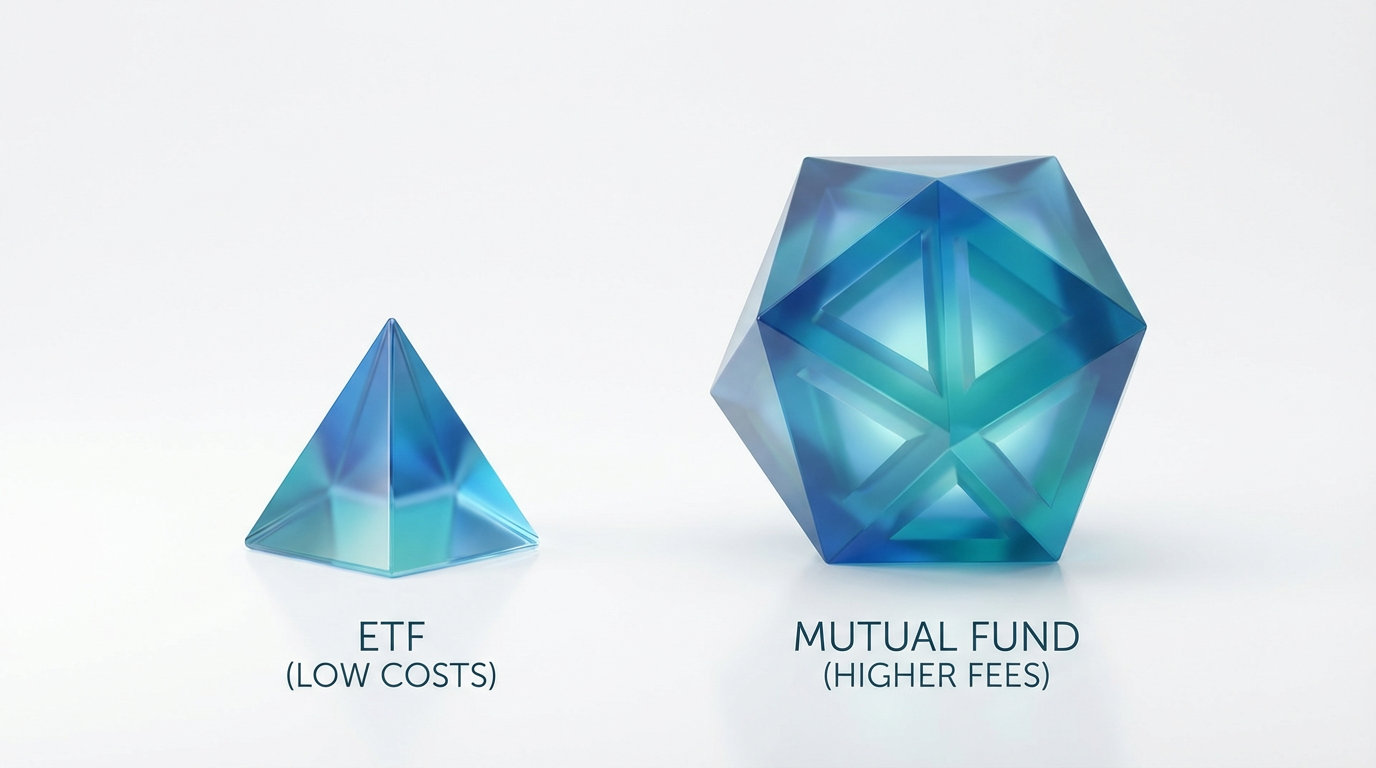
ETFs generally carry lower expense ratios than actively managed mutual funds. This cost advantage stems from structural differences between the two investment vehicles.
Why ETFs Cost Less
Most ETFs are passively managed, tracking an index rather than attempting to outperform the market through active stock selection. This passive approach requires less research and trading activity, resulting in lower management costs. Additionally, ETFs trade directly on exchanges without intermediary processing, which further reduces expenses.
In Singapore, actively managed unit trusts typically charge TERs ranging from 1.50% to 2.00% annually, while comparable index-tracking ETFs may typically charge 0.20% to 0.50%. Over a 20-year investment horizon, this difference significantly impacts wealth accumulation.
Fee Considerations for Active ETFs
Actively managed ETFs do exist and typically charge higher fees than their passive counterparts. These funds aim to outperform a benchmark through active portfolio management. When evaluating active ETFs, assess whether the higher fee is justified by the fund's strategy and track record relative to lower-cost alternatives.
How to Evaluate ETF Costs
When selecting ETFs, consider the total cost of ownership rather than focusing solely on the expense ratio. Here is a practical framework:
Step 1: Compare Expense Ratios
Start by comparing the TER of similar ETFs tracking the same index or asset class. A difference of 0.10% or more can meaningfully impact long-term returns.
Step 2: Assess Trading Costs
Consider how frequently you plan to trade. If you are a buy-and-hold investor, the expense ratio matters more than trading costs. For more active strategies, brokerage commissions and bid-ask spreads become more significant.
Step 3: Factor in Currency Costs
For international ETFs, calculate the FX spread your brokerage charges. This cost applies each time you convert currency for purchases or when dividends are paid.
Step 4: Review Fund Size and Liquidity
Larger, more liquid ETFs typically have lower bid-ask spreads and are less likely to deviate from their benchmark. Check the fund's average daily trading volume as an indicator of liquidity.
Step 5: Check for Hidden Fees
Review the fund's prospectus for any additional charges not captured in the headline TER. Some funds may have performance fees or other conditional charges.
Getting Started with ETF Investing
Understanding fee structures is one component of successful ETF investing. Beyond costs, consider how ETFs fit within your broader investment strategy and risk tolerance. Investment products including ETFs can help you build a diversified portfolio aligned with your financial goals.
When evaluating any investment, remember that fees represent just one factor. Fund performance, tracking accuracy, underlying asset allocation, and your personal investment timeline all contribute to the decision-making process.
Frequently Asked Questions
What is a good expense ratio for an ETF?
A good expense ratio depends on the ETF type. For broad market index ETFs, look for ratios below 0.20%. Thematic or regional ETFs may reasonably charge 0.30% to 0.60%. Expense ratios above 1.00% warrant scrutiny unless the fund offers a unique strategy not available at lower cost.
How are ETF management fees charged?
ETF management fees are deducted automatically from the fund's assets on a daily basis. This reduces the fund's net asset value, which is reflected in the ETF's price. You will not see a separate fee charge in your brokerage account.
Do I pay ETF fees if I hold for less than a year?
Yes, but proportionally. Since fees are accrued daily, you only pay for the period you hold the ETF. If the annual expense ratio is 0.20% and you hold for six months, you effectively pay approximately 0.10%.
Are ETF fees tax-deductible in Singapore?
ETF management fees are not directly tax-deductible for individual investors in Singapore. However, Singapore does not impose capital gains tax on investment returns, which provides a different form of tax efficiency for ETF investors.
Conclusion
ETF management fees directly affect your investment returns, making cost evaluation an essential part of the selection process. By understanding expense ratios, trading costs, and hidden fees, can help investors make more informed decisions that align with your investment goals.
For Singapore investors, ETFs offer a cost-efficient way to access diverse markets and asset classes. Whether you are building a long-term portfolio or exploring specific market segments, paying attention to total costs may help preserve more of your returns over time.
The choice of financial instruments depends on your investment objectives, risk tolerance, market outlook, and experience level. Regardless of the method selected, it is essential to fully understand its mechanics, risk characteristics, and execution rules, while maintaining a robust risk management plan. You can learn more about investment strategies through the Longbridge Academy or by downloading the Longbridge App.