ETF or Stocks: Which Should Singapore Investors Buy First?
Discover whether ETFs or individual stocks are the right starting point forSingapore investors. Compare diversification, costs, control, and practical stepsto begin.
TL;DR: For most Singapore investors starting out, Exchange Traded Funds (ETFs) can offer a more diversified and easier-to-manage starting point for new investors, though individual stock investing may suit those with specific expertise or higher risk tolerance. The choice depends on your investment goals, risk tolerance, time commitment, and market knowledge.
Starting your investment journey can feel overwhelming when faced with the fundamental question: should you buy ETFs or individual stocks first? This decision shapes your portfolio foundation and long-term experience. For Singapore investors with access to multiple markets, understanding the practical differences between these investment vehicles is essential.
An Exchange Traded Fund (ETF) allows you to purchase a diversified basket of securities in a single transaction, while individual stocks give you direct ownership in specific companies. According to S&P Global data, more than 87% of actively managed funds performed worse than the S&P 500 index over the last 15 years. This article breaks down key considerations to help you make an informed decision.
Understanding the Core Differences
What Are ETFs?
An Exchange Traded Fund is a basket of securities that trades on stock exchanges like individual stocks. When you buy one ETF share, you gain exposure to dozens or thousands of underlying assets including stocks, bonds, commodities, or Real Estate Investment Trusts (REITs). For example, an ETF tracking the Straits Times Index gives you proportional ownership in multiple Singapore blue-chip companies through a single purchase.
What Are Individual Stocks?
Individual stocks represent direct ownership in a specific company. When you purchase shares listed on the Singapore Exchange (SGX), New York Stock Exchange (NYSE), or Hong Kong Stock Exchange (HKEX), you become a partial owner. Your returns depend entirely on that company's performance. Stock ownership gives you voting rights and potential dividend income, but your portfolio's performance is directly tied to the specific companies you select.
Why ETFs Are Often Better for Beginners
For most Singapore investors taking their first steps into the market, ETFs present compelling advantages.
Built-In Diversification Reduces Risk
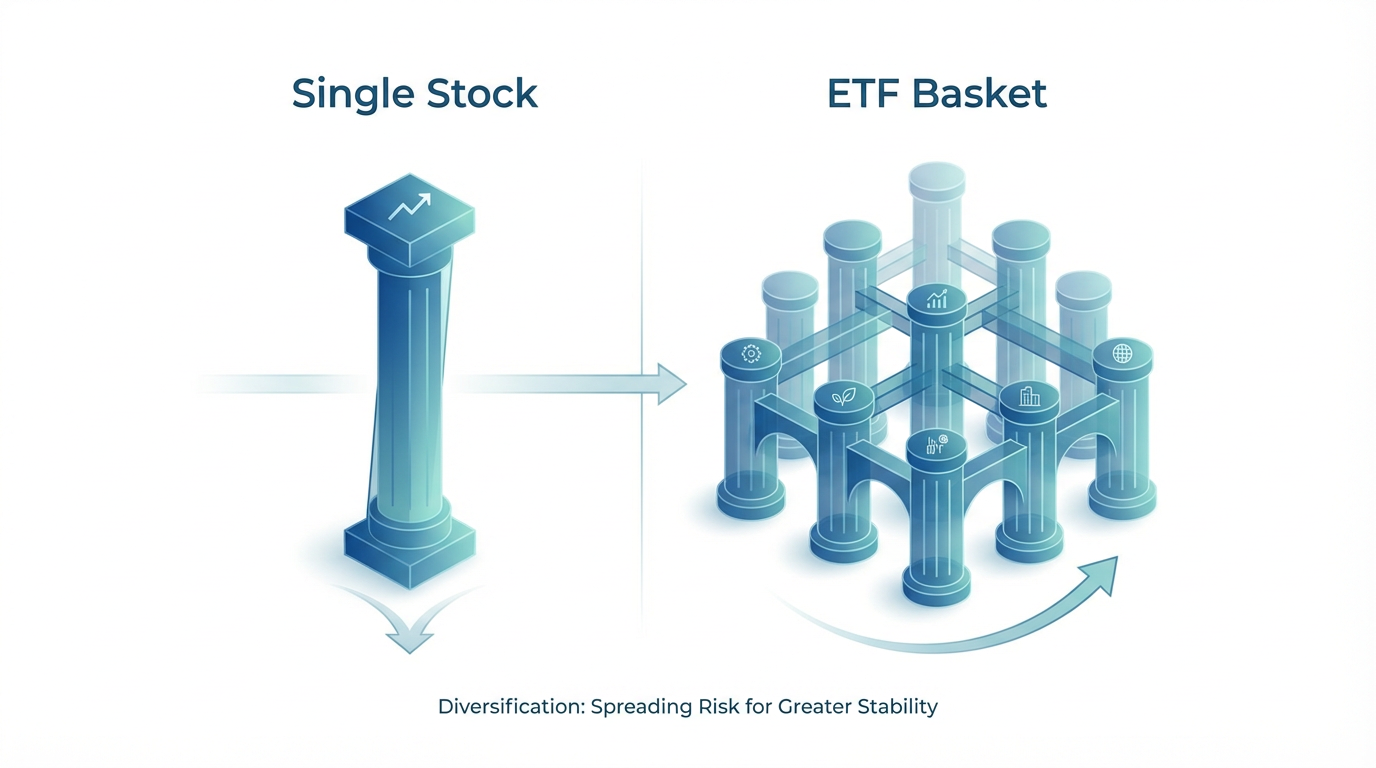
The primary advantage of ETFs is instant portfolio diversification. When you buy a broad-market ETF, you spread your investment across many companies, sectors, and countries. If one company underperforms, others in the basket buffer its impact. This is valuable for beginners who lack experience to assess individual company risks or capital to build a diversified stock portfolio.
Lower Research Requirements
Choosing individual stocks requires substantial research into company financials, competitive positioning, and industry trends. ETFs simplify this dramatically. Instead of analyzing dozens of companies, you select an ETF based on broader criteria like market exposure or sector, making it practical for investors developing their analytical skills.
Cost Efficiency for Smaller Portfolios
Building a diversified portfolio with individual stocks is challenging with limited capital. ETFs provide broad market exposure with a single purchase. Many broad-market index ETFs charge less than 0.10% annually, offering favorable cost structures compared to building equivalent diversification through individual stocks.
Individual Stocks: When Direct Ownership Makes Sense
While ETFs suit most beginners, individual stocks offer advantages for certain investor profiles.
Potential for Higher Returns
Individual stocks can deliver substantially higher returns when you identify quality companies before they're widely recognized. However, this potential comes with proportionally higher risk. The same concentration enabling outsized gains can produce significant losses if selections underperform.
Greater Control and Flexibility
Owning individual stocks gives you complete control over portfolio composition. You decide which companies to own, when to trade, and how to allocate capital, aligning investments with your values and market views. For Singapore investors interested in particular sectors, selective ownership enables targeted exposure. Platforms offering real-time market data and price tracking make monitoring positions manageable.
Learning Through Direct Engagement
Individual stocks create stronger investment engagement. Holding shares in specific companies encourages following earnings reports and strategic decisions, building investment knowledge more effectively than passive ETF ownership.
Key Factors to Consider When Deciding
Your Risk Tolerance
Risk tolerance represents your emotional and financial ability to withstand portfolio volatility. If market downturns would cause significant stress or force unfavorable sales, diversified ETFs better match your risk profile. Individual stocks experience wider price swings requiring both financial capacity and emotional resilience.
Available Time for Research and Monitoring
Individual stock investing demands ongoing attention to monitor announcements, earnings, and trends. If your schedule doesn't accommodate regular review, ETFs provide market exposure without intensive management. Many beginners underestimate research hours required for confident stock selection.
Investment Knowledge and Experience
If terms like price-to-earnings ratios, free cash flow, or competitive moats are unfamiliar, ETFs allow you to begin investing while developing analytical skills. As knowledge grows, you can add individual positions to complement ETF holdings.
Capital Available for Investing
With limited capital, building adequate diversification through individual stocks is challenging. ETFs provide broad exposure regardless of investment size.
Cost Considerations for Singapore Investors
Trading Commissions and Platform Fees
Both ETFs and stocks incur trading commissions. The impact differs based on strategy. Regular monthly investing accumulates commissions, so Singapore investors should review transparent fee structures carefully. Some platforms offer commission-free ETF trades for selected funds.
Expense Ratios and Management Fees
ETFs charge annual expense ratios typically ranging from 0.03% to 0.75%, with passive index-tracking ETFs charging less. While small, these compounds over decades. Individual stocks don't have ongoing expense ratios.
Tax Implications in Singapore
Singapore offers favorable tax treatment with no capital gains tax and no dividend tax for Singapore-incorporated companies. Foreign dividends may face withholding tax. US-domiciled ETFs may face up to 30% withholding tax on dividends, while Ireland-domiciled ETFs often face a lower rate due to tax treaties.
Practical Steps to Start Your Investment Journey
Opening Your Investment Account
Singapore investors need a Central Depository (CDP) account and a brokerage account. Modern digital brokerages offer streamlined opening through MyInfo or SingPass integration. Look for platforms providing access to the range of ETFs and stocks across Singapore, US, and Hong Kong markets.
Starting with a Core ETF Position
Investors may consider starting with a few broad-market ETFs to build foundational exposure. Popular options include Singapore market ETFs tracking the Straits Times Index, United States market ETFs tracking the S&P 500, or global ETFs. Avoid purchasing too many overlapping ETFs. One to three core funds provide adequate diversification.
Gradually Adding Individual Positions
As skills and confidence grow, consider adding selective stock positions to complement your ETF core. A common approach allocates 70-80% to ETFs and 20-30% to individual stocks representing highest-conviction ideas.

Implementing a Systematic Investment Plan
Consider systematic investing through regular monthly contributions. Dollar-cost averaging reduces market timing impact and builds discipline. Many Singapore brokers offer Regular Savings Plans automating monthly ETF purchases from SGD 100.
Common Mistakes to Avoid
Over-Diversifying with Too Many ETFs
Excessive diversification through too many ETFs creates unnecessary complexity. Five different broad-market ETFs likely contain overlapping companies, diluting positions while increasing tracking difficulty. Focus on clear allocation goals.
Under-Diversifying with Too Few Stocks
Stock investors holding only two or three positions face extreme concentration risk. Some investors choose to hold ten to fifteen stocks to achieve meaningful diversification.”
Chasing Performance
Buying recent top performers assuming past returns continue typically results in buying high and selling low as trends reverse. Focus on consistent, methodical investing based on long-term strategy.
Neglecting Ongoing Education
Investment success requires continuous learning. Markets evolve, and your circumstances change. Dedicate time regularly to improving financial knowledge through reading, courses, or analyzing portfolio performance.
Frequently Asked Questions
Can beginners invest in both ETFs and stocks simultaneously?
Yes, many investors combine ETFs and stocks. A common approach uses ETFs as core holdings for broad exposure while adding selective stocks for specific opportunities. This hybrid strategy provides diversification while allowing you to pursue higher conviction ideas.
How much money do I need to start investing in ETFs versus stocks?
You can start with relatively small amounts. Many Singapore brokers allow purchases from SGD 100 through Regular Savings Plans for selected ETFs. For general purchases, you might need several hundred SGD for cost-effective trades after considering commissions.
Are ETFs safer than individual stocks?
While ETFs are generally less exposed to individual company risk, they are still subject to market fluctuations and can lose value. Broad-market ETFs still experience volatility. However, diversification across many companies reduces company-specific risks like poor earnings or management failures that can devastate individual holdings.
Do ETFs or stocks provide better returns over time?
Neither inherently provides better returns; it depends on specific securities and market conditions. Broad-market ETFs deliver market returns. Individual stocks can outperform or underperform significantly. Research shows most active stock pickers fail to beat market indices consistently over long periods.
Should Singapore investors prefer Singapore ETFs or international ETFs?
A balanced approach serves Singapore investors well. While Singapore ETFs provide familiar exposure and favorable tax treatment, concentrating exclusively creates geographic risk. Combining Singapore exposure with United States and international ETFs provides global diversification.
Conclusion
The decision between ETFs and individual stocks depends on your circumstances. For most Singapore investors starting out, ETFs provide diversified exposure that may reduce company-specific risk compared to holding a small number of individual stocks. They allow you to begin investing while developing knowledge and confidence.
However, if you have time for research, specific industry knowledge, or higher risk tolerance, starting with selective individual stocks can work well. The key is matching your approach to your actual capabilities rather than perceived potential.
This decision isn't permanent. Many successful investors begin with ETFs and gradually incorporate individual stocks as skills develop, creating balanced portfolios capturing advantages from both approaches. The most important step is beginning your investment journey with a clear understanding of what you're buying and why it aligns with your financial goals and risk tolerance.
The choice of financial instruments depends on your investment objectives, risk tolerance, market outlook, and experience level. Regardless of the method selected, it is essential to fully understand its mechanics, risk characteristics, and execution rules, while maintaining a robust risk management plan. You can learn more about investment strategies through the Longbridge Academy or by downloading the Longbridge App.