How to Buy Gold ETF in Singapore
Discover how to buy gold ETFs in Singapore, including platform options, costsinvolved, and comprehensive comparison with physical gold ownership for informedinvestment decisions.
TL;DR: Gold ETFs (Exchange-Traded Funds) provides Singapore investors exposure to gold prices without the storage and security concerns of physical gold. You can buy gold ETFs through online brokerage platforms with as little as a few hundred dollars, enjoying benefits like high liquidity and transparent pricing while considering factors such as expense ratios and currency risk.
Investing in gold is often viewed by market participants as a defensive asset during periods of economic uncertainty. For Singapore investors looking to diversify their portfolios with gold exposure, gold ETFs present an accessible and an alternative to purchasing physical gold bars or coins. This guide walks you through how to buy gold ETF in Singapore, exploring the platforms available, costs involved, and how they compare with owning physical gold.
What Are Gold ETFs?
Gold ETFs are investment funds that trade on stock exchanges, similar to individual stocks. These funds aim to track the price of gold by holding physical gold bullion in secure vaults. When you purchase units of a gold ETF, you gain exposure to gold price movements without the need to physically own, store, or insure the precious metal.
According to the Singapore Exchange, gold ETFs is one of several available approaches for investors to participate in the gold market with the same ease as trading stocks. This makes them gold ETFs an alternative for retail investors who want gold exposure without the complexities of physical ownership.
How to Buy Gold ETFs in Singapore: Step-by-Step Guide
Purchasing gold ETFs in Singapore is straightforward once you understand the process.
Step 1: Choose Your Gold ETF
Begin by researching which gold ETF aligns with your investment goals. Consider factors such as expense ratio, liquidity, fund size, and currency denomination.
Step 2: Select a Brokerage Platform
Your choice of platform significantly impacts your overall investment costs and experience. Singapore investors have several options:
Traditional Bank Brokers operated by DBS, OCBC, and UOB typically provide strong customer support and seamless integration with existing bank accounts. However, trading fees can reach SGD 25 per trade or more, which can significantly reduce effectiveness for smaller investment amounts.
Digital Online Brokers have transformed the landscape by offering competitive pricing and advanced trading tools. These platforms typically charge much lower commissions, often between SGD 1 to 2 per trade for SGX-listed ETFs. When selecting a digital broker, verify that it supports the specific gold ETF you want to purchase and check whether it is licensed by the Monetary Authority of Singapore (MAS).
Longbridge, as an MAS-licensed broker, provides comprehensive access to diverse investment products including ETFs across Singapore, US, and Hong Kong markets through user-friendly mobile and desktop platforms.
Step 3: Open and Fund Your Account
Most platforms offer streamlined digital account opening processes that can be completed within minutes, especially if you use MyInfo or SingPass for identity verification. After your account is approved, deposit sufficient funds to cover both your intended ETF purchase and any associated transaction fees.
For SGD-denominated ETFs like GSD.SI, a simple bank transfer suffices. For USD-denominated ETFs, you will need to convert Singapore dollars to US dollars, which typically involves a foreign exchange spread of 0.3% to 0.5%.
Step 4: Execute Your Purchase
With your account funded, you can place your order using market orders (executed immediately at current market price) or limit orders (executed at your specified price).
Step 5: Monitor Your Investment
After purchasing your gold ETF, investors may monitor their holdings to stay informed. Gold prices fluctuate based on various factors including global economic indicators, inflation expectations, central bank policies, and geopolitical events. Consider using market data services to track significant price movements.
Understanding the Costs of Gold ETF Investing
Cost considerations extend beyond the initial purchase price. Key costs include expense ratios (typically 0.09% to 0.40% annually for physically backed gold ETFs), brokerage commissions (typically ranging from SGD 1 to 2 for digital brokers or SGD 25+ for traditional bank brokers), and currency conversion spreads typically ranging from 0.3% to 0.5% for USD-denominated ETFs. These costs can affect long-term performance over time, particularly for frequent traders or those making regular small investments.
Key Risks of Gold ETF Investment
While gold ETFs offer numerous advantages, understanding their risks ensures you make balanced investment decisions.
Market Volatility
Gold prices can experience significant volatility, influenced by factors such as US interest rate movements, inflation expectations, and shifts in investor sentiment. During periods when risk assets perform well, gold may underperform relative to equities. According to the World Gold Council, historical data shows gold prices can fluctuate 10% to as high as 30% or more within a single year.
Currency Risk
Most gold ETFs price gold in US dollars. For Singapore investors, currency fluctuations between the Singapore dollar and US dollar introduce additional risk. A strengthening SGD can reduce your investment performance in local currency terms, even if gold prices in USD remain stable or increase.
Lack of Income Generation
Gold produces no dividends or interest, relying solely on capital appreciation. During periods of stable gold prices, your investment generates no yield while you continue to pay expense ratios. This opportunity cost becomes significant in rising interest rate environments when bonds and other fixed-income assets offer attractive yields.
Gold ETF vs Physical Gold: A Comparison
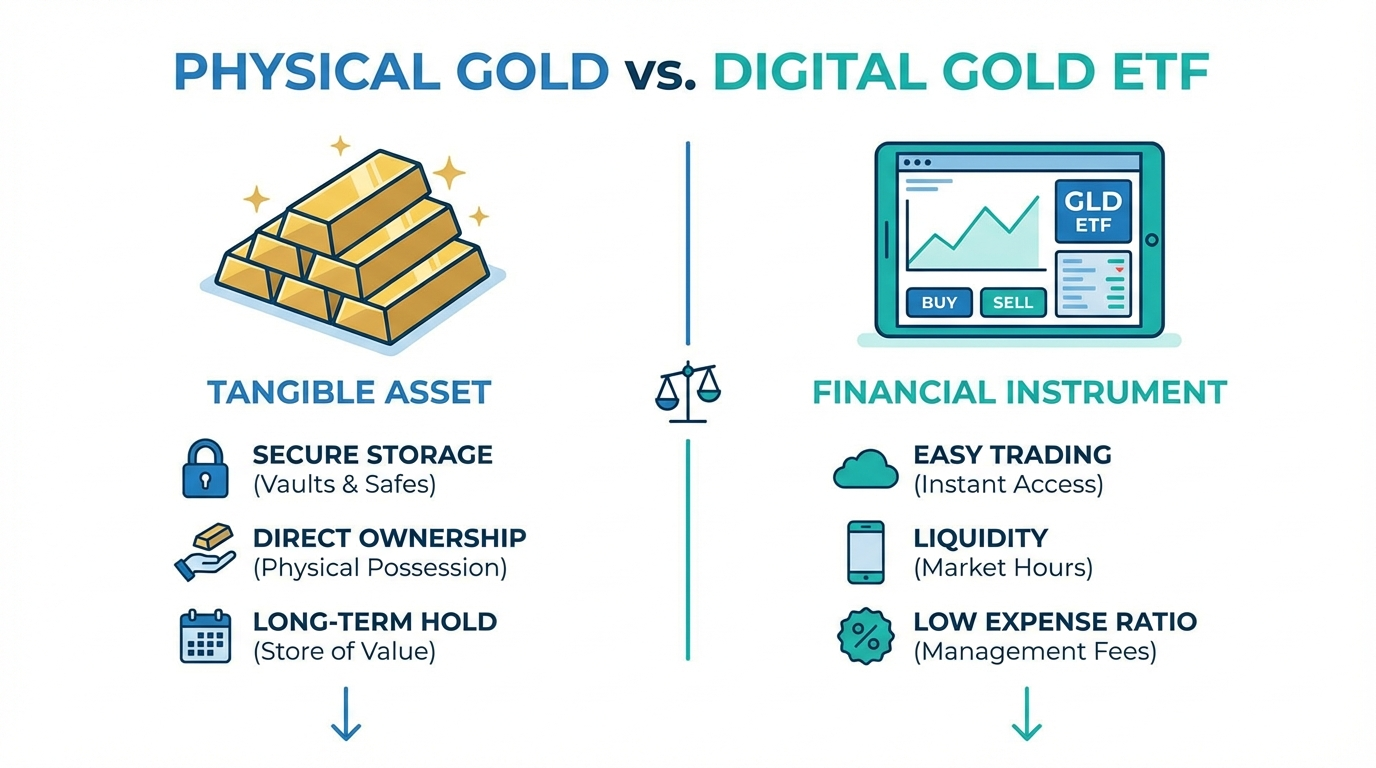
Choosing between gold ETFs and physical gold depends on your investment objectives, capital availability, and preferences.
Accessibility: Gold ETFs may offer lower entry requirements depending on product. For example, you can start with approximately SGD 250 to 300 for SPDR Gold Shares, while physical gold bars typically start at 100 grams (about SGD 8,000).
Liquidity: Gold ETFs trade throughout market hours with instant execution. Physical gold requires finding buyers and verifying authenticity, which can take days or weeks. Dealers often purchase at discounts to spot prices.
Storage: Physical gold requires secure storage at home, in bank safe deposit boxes, or specialized facilities, all with associated costs. Gold ETFs eliminate these concerns, with fund managers handling storage and security.
Costs: Physical gold dealers typically charge 2% to 5% premiums over spot prices, plus storage and insurance fees. Gold ETF costs are more transparent, with expense ratios typically ranging from 0.25% to 0.40% plus brokerage commissions.
Tax Treatment: In Singapore, investment-grade gold is GST-exempt, benefiting both physical gold and gold ETFs. There is also no capital gains tax on profits from selling gold or gold ETFs.
Ownership: Physical gold provides tangible ownership and independence from financial systems. Gold ETFs represent a claim on fund-held gold, not direct ownership of specific bars.
Frequently Asked Questions
Can I use my CPF to buy gold ETFs in Singapore?
Yes, certain gold-related investment products are included under the CPF Investment Scheme (CPFIS) as approved instruments. These may include gold-backed exchange-traded funds (ETFs) that meet the eligibility criteria set by the Central Provident Fund Board.
You can invest using your CPF Ordinary Account (OA) or Special Account (SA), subject to the applicable investment limits, eligibility requirements, and risk classifications under CPFIS. Availability may vary depending on the product and platform, so it’s important to verify that an investment is CPF-approved before proceeding.
What is the minimum amount needed to invest in gold ETFs?
The minimum investment depends on the ETF price and lot size. For example, SPDR Gold Shares have a lot size of one unit, meaning you can start with approximately SGD 250 to 300 based on current gold prices. This may make gold ETFs accessible even for investors with modest capital.
Are gold ETFs safe investments?
Gold ETFs carry investment risk like all securities. The price of gold can fluctuate significantly based on economic conditions, interest rates, and market sentiment. However, physically backed gold ETFs from reputable providers hold actual gold in secure vaults with regular audits, providing transparency and security in the fund structure.
How are gold ETFs different from gold savings accounts?
Gold savings accounts offered by banks allow you to buy and sell gold at bank-determined prices, with the bank holding the gold on your behalf. Gold ETFs trade on stock exchanges with transparent market pricing throughout trading hours, typically offering better liquidity and price transparency.
Do gold ETFs pay dividends?
No, gold ETFs do not pay dividends because gold itself generates no income. All potential gain from gold ETF investment comes from price appreciation when you sell the ETF units. This differs from equity ETFs that may distribute dividends from underlying stocks.
Conclusion
Understanding how to buy gold ETFs in Singapore provides access to an alternative defensive asset for portfolio diversification. Gold ETFs provide exposure to gold price movements without the logistical challenges of physical ownership, combining accessibility, liquidity, and transparent pricing in a single investment vehicle.
The process typically involves several steps: select an appropriate gold ETF based on expense ratios and features, choose an MAS-licensed brokerage platform that suits your needs, fund your account, and execute your purchase. While gold ETFs offer numerous advantages over physical gold including lower entry barriers and being generally more liquid, they also carry considerations such as expense ratios, currency risk, and lack of income generation.
The choice of financial instruments depends on your investment objectives, risk tolerance, market outlook, and experience level. Regardless of the method selected, it is essential to fully understand its mechanics, risk characteristics, and execution rules, while maintaining a robust risk management plan. You can learn more about investment strategies through the Longbridge Academy or by downloading the Longbridge App.