Smart Beta ETFs Across Three Markets: A Guide for Singapore Investors
Explore how smart beta ETFs combine passive investing with factor-based strategiesacross Singapore, US, and Hong Kong markets to enhance portfolio diversification.
TL;DR: Smart beta ETFs (Exchange-Traded Funds) combine the low-cost structure of passive investing with rules-based strategies that target specific factors like value, momentum, and quality. For Singapore investors with access to Singapore, US, and Hong Kong markets, these funds offer a systematic approach to portfolio diversification beyond traditional market-cap-weighted indexes.
Smart beta ETFs represent a growing segment of the global investment landscape, with assets reaching USD 1.56 trillion globally as of early 2024, according to ETFGI research. For Singapore investors seeking to build diversified portfolios across multiple markets, understanding how these factor-based funds work can help inform investment decisions. This guide explores what smart beta ETFs are, the key factors that drive them, and how they function across the Singapore, US, and Hong Kong markets.
What Are Smart Beta ETFs?
Smart beta ETFs sit between traditional passive index funds and actively managed funds. Unlike conventional ETFs that weight holdings purely by market capitalization, smart beta ETFs follow transparent, rules-based methodologies that tilt portfolios toward specific characteristics, or factors. These factors have historically been associated with certain risk and return profiles, according to academic research in financial economics.
The term "smart beta" emerged as an alternative to pure market-cap weighting, which some investors argue overweights the largest companies simply because of their size. By contrast, smart beta strategies apply systematic rules to select and weight securities based on fundamental or technical criteria.
How Smart Beta Differs From Traditional ETFs
Traditional market-cap-weighted ETFs allocate more capital to companies with larger market values. A company representing 5% of an index's total market cap receives 5% of the ETF's allocation. Smart beta ETFs break this pattern by weighting securities according to alternative criteria, such as:
Equal weighting across all holdings
Fundamental metrics like revenue, earnings, or dividends
Factor characteristics like volatility, momentum, or value
This rules-based approach provides transparency similar to passive funds while seeking outcomes that differ from standard market-cap indexes.
Understanding the Five Key Smart Beta Factors
Academic and industry research has identified five factors that have historically demonstrated persistence across different time periods and markets: value, quality, momentum, size, and minimum volatility.
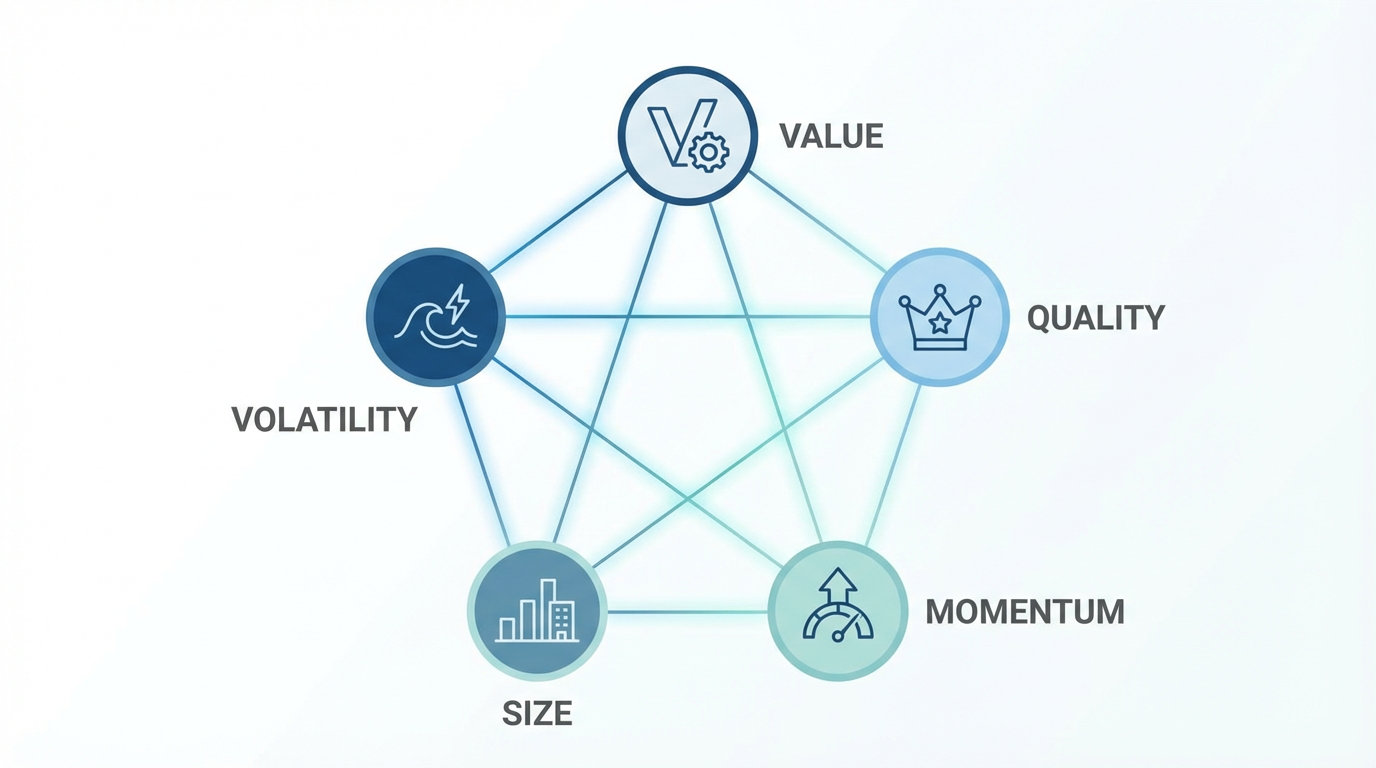
Value Factor
Value-based smart beta ETFs target stocks that appear undervalued relative to their fundamentals. These strategies typically use metrics such as price-to-earnings ratios, price-to-book ratios, and dividend yields to identify securities trading below their perceived intrinsic worth.
Quality Factor
Quality-focused funds select companies exhibiting strong balance sheets, consistent earnings, and high profitability metrics like return on equity. These characteristics may indicate business stability and financial health.
Momentum Factor
Momentum strategies identify stocks demonstrating strong recent price performance, based on the observation that securities with positive price trends tend to continue performing well over intermediate time horizons.
Size Factor
Size-based strategies tilt toward smaller companies. Academic research has documented a size premium, suggesting smaller firms have historically delivered higher returns than larger ones, though with greater volatility.
Minimum Volatility Factor
Low-volatility strategies prioritize stocks with lower historical price fluctuations. These funds aim to provide equity exposure with reduced drawdowns compared to the broader market.
Tip: Different factors tend to perform differently under various market conditions. Value and momentum have historically shown strength during economic expansion, while quality and low volatility may provide relative stability during downturns.
Smart Beta ETF Access Across Three Markets
Singapore investors can access smart beta ETFs listed on three major exchanges, each offering distinct characteristics and investment opportunities. Through platforms that provide comprehensive market access, investors can explore available investment products across these markets.
United States Market
The US hosts the largest and most diverse selection of smart beta ETFs globally. Major providers offer factor-focused funds targeting value, momentum, quality, and low volatility exposures. The US market trades from 9:30 AM to 4:00 PM Eastern Time, which corresponds to 10:30 PM to 5:00 AM Singapore Time, or 9:30 PM to 4:00 AM during US daylight saving time.
US-listed smart beta ETFs generally offer high liquidity and competitive expense ratios due to the market's size and competition among fund providers.
Hong Kong Market
Hong Kong has seen growing adoption of smart beta strategies. Smart beta adoption among institutional investors in Greater China has grown significantly in recent years. The Hong Kong Stock Exchange (HKEX) trades from 9:30 AM to 4:00 PM Hong Kong Time, with a midday break.
S&P Dow Jones Indices has examined how factors like size, value, low volatility, momentum, quality, and dividends perform specifically within the Hong Kong equity market, providing research relevant to factor investing in the region.
Singapore Market
Singapore's SGX operates from 9:00 AM to 5:00 PM Singapore Time. While the local smart beta ETF selection is smaller than in the US, cross-border listing arrangements have expanded options. Recent developments include cross-listed ETFs connecting Singapore with other Asian exchanges, broadening access to regional smart beta strategies.
Hong Kong and Singapore share the same time zone (GMT+8), allowing investors to monitor both markets simultaneously during overlapping trading hours.
How to Use Smart Beta ETFs in Your Portfolio
Incorporating smart beta ETFs requires understanding how these strategies complement existing holdings. Investors may use them as satellite positions around a broad-market core, allowing targeted exposure to specific factors while maintaining overall diversification, however, investors should consider reviewing their methodology before investing.

Core-Satellite Approach
A common framework involves maintaining a core allocation in broad market-cap-weighted ETFs while using smart beta funds as satellite holdings. This limits concentration risk while allowing factor tilts that align with an investor's objectives.
Multi-Factor Considerations
Because different factors have low or even negative correlations with each other, combining multiple factor exposures may help smooth portfolio returns. For example, value and momentum have historically exhibited low correlation, meaning underperformance in one may be offset by the other.
Investors can track market performance across different regions to monitor how various factors behave under current conditions.
Time Horizon and Patience
Factor strategies require patience. Short-term underperformance is common, as factors move through cycles. Smart beta strategies are generally designed to be applied consistently over longer time horizons rather than through tactical timing.
Risks and Considerations
Smart beta ETFs carry distinct risks that investors should understand before investing. According to FINRA, these products may be more complex than broad-market ETFs, and their returns can differ significantly from market-cap-weighted alternatives.
Factor Cyclicality
Factors go through periods of underperformance. Value, momentum, and low volatility strategies do not outperform consistently. During certain market environments, traditional market-cap-weighted ETFs may deliver stronger results.
Complexity
Understanding the methodology behind a smart beta ETF requires reviewing its rules for security selection and weighting. Investors benefit from reading fund documentation to understand what they are purchasing.
Trading Costs and Liquidity
Some smart beta ETFs, particularly newer or niche strategies, may have lower trading volumes. This can result in wider bid-ask spreads and higher implicit trading costs.
Frequently Asked Questions
What is the difference between smart beta and active management?
Smart beta follows transparent, rules-based indexes rather than relying on fund manager discretion. Active managers make subjective decisions about security selection, while smart beta applies systematic criteria. This rules-based approach typically results in lower fees than traditional active management.
Do smart beta ETFs always outperform traditional index funds?
No. Smart beta ETFs are designed to target specific factors, but these factors experience cycles of outperformance and underperformance. During some market conditions, market-cap-weighted ETFs may deliver superior returns.
Are smart beta ETFs suitable for beginner investors?
While accessible, smart beta ETFs are more complex than broad-market funds and investors may benefit from researching how the specific factor works and what conditions may affect its performance.
How do expense ratios compare between smart beta and traditional ETFs?
Smart beta ETFs typically have higher expense ratios than basic market-cap-weighted ETFs but lower costs than actively managed funds. The difference reflects the additional research and rebalancing involved in factor-based strategies.
Conclusion
Smart beta ETFs offer Singapore investors a systematic approach to factor-based investing across three major markets. By understanding the five key factors, value, quality, momentum, size, and minimum volatility, investors can evaluate how these strategies might complement their existing portfolios. However, factor investing requires patience, as short-term underperformance is common even when the long-term rationale remains sound.
The choice of financial instruments depends on your investment objectives, risk tolerance, market outlook, and experience level. Regardless of the method selected, it is essential to fully understand its mechanics, risk characteristics, and execution rules, while maintaining a robust risk management plan. You can learn more about investment strategies through the Longbridge Academy or by downloading the Longbridge App.