IPO Grey Market: Understanding Pre-Listing Price Indicators
Explore the IPO grey market, where shares trade unofficially before listing. Discover how Grey Market Premium works, what it indicates, and the important risks investors should know.
TL;DR: The IPO grey market is an unofficial, unregulated market where shares trade before official listing. Grey Market Premium (GMP) serves as a pre-listing price indicator but carries significant risks including lack of regulatory protection, counterparty risk, and limited accuracy. Investors should use grey market information cautiously and focus on fundamental analysis when evaluating IPOs.
When an Initial Public Offering (also known as IPO) approaches its listing date, shares may begin trading in an unofficial market before the official debut. This is referred to as the IPO grey market, which some market participants view as an early sentiment indicator but carries substantial risks. Understanding how this market operates and its limitations is essential for informed IPO investing.
What is the IPO Grey Market?
The ipo grey market refers to an unofficial, over-the-counter market where IPO shares or applications are bought and sold before the shares officially list on stock exchanges. This market operates entirely outside regulatory frameworks, with no oversight from authorities like the Securities and Exchange Board of India (SEBI) or the Monetary Authority of Singapore (MAS).
Unlike regulated exchanges where transactions are recorded and protected by investor safeguards, grey market trading happens through informal networks of dealers and brokers. These transactions are typically cash-based, rely on word-of-mouth agreements, and operate purely on trust. There is minimal documentation—often just small paper slips serving as informal contracts.
The grey market emerges during the IPO subscription period and continues until official listing. During this window, traders speculate on potential listing prices, creating an informal pricing mechanism that reflects pre-listing sentiment.
Official exchanges provide transparency, regulatory protection, and standardized settlement. In contrast, the grey market offers none of these protections. Transactions are private, unrecorded, and if disputes arise, investors have no legal recourse.
Key Grey Market Pricing Mechanisms
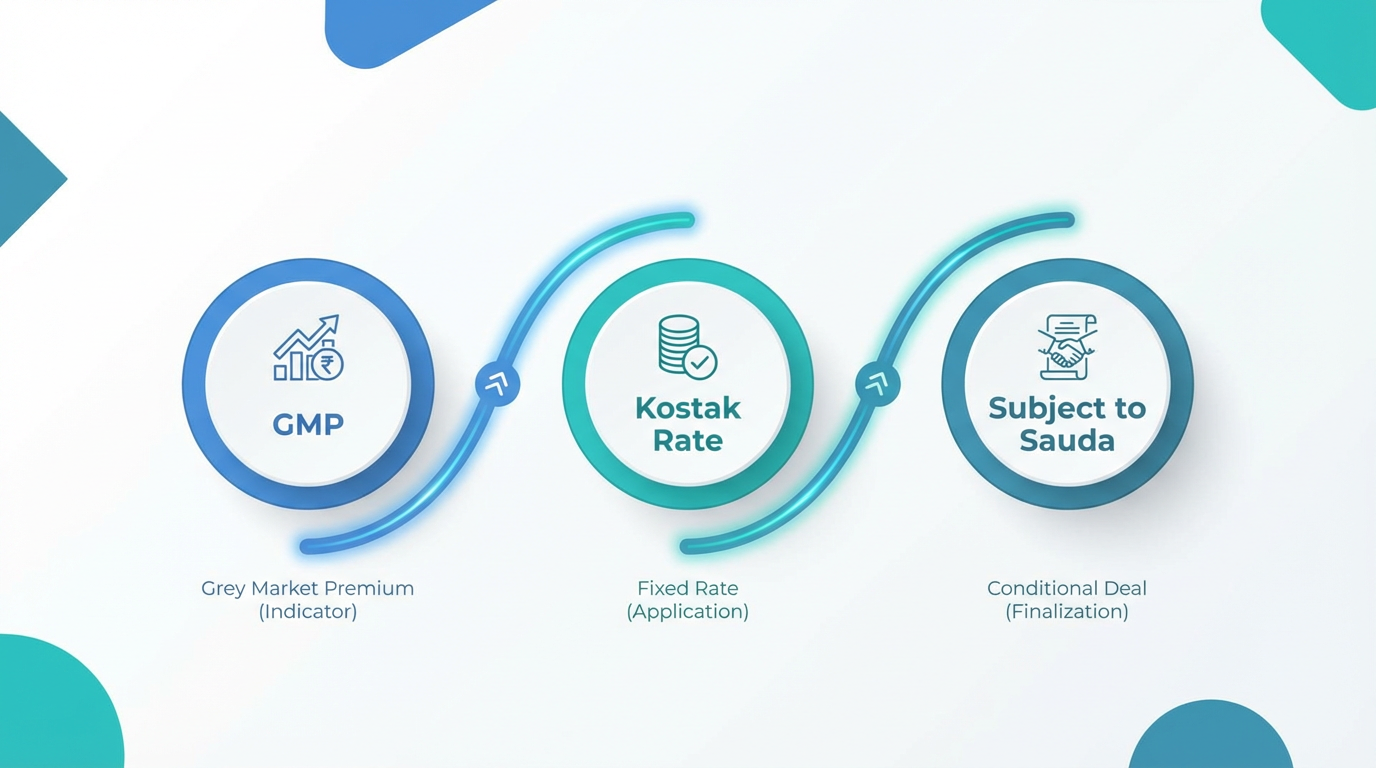
The ipo grey market operates using three distinct pricing mechanisms that reflect different aspects of pre-listing trading. Understanding these terms is essential for interpreting grey market information correctly.
Grey Market Premium (GMP)
Grey Market Premium, or GMP, is the premium amount at which IPO shares trade in the grey market above the official IPO issue price. If an IPO has an issue price of $100 and the GMP is $25, the estimated listing price would be $125 ($100 + $25).
GMP represents the additional amount buyers are willing to pay beyond the issue price to acquire shares before listing. A positive GMP suggests strong demand and bullish sentiment, while a negative GMP indicates weak investor confidence.
Kostak Rate
The Kostak rate represents the price at which IPO applications or lots are sold in the grey market before allotment results are announced. This is essentially the price someone pays to purchase the right to an IPO application, regardless of whether shares are actually allotted.
For example, if the Kostak rate is $50 per lot, an investor can sell their IPO application for $50 even before knowing if they will receive an allotment. If the application receives no allotment, the buyer loses the $50 paid.
Subject to Sauda
Subject to Sauda (also called Sub2) refers to the premium paid specifically for applications that receive allotment. Unlike Kostak rate, which applies to all applications, Subject to Sauda only applies when shares are actually allotted. If no allotment occurs, no payment changes hands. This mechanism reduces risk for buyers compared to Kostak transactions.
What Grey Market Premium Indicates
Grey Market Premium serves as one of several pre-listing indicators that can provide insights into market sentiment, though it should never be the sole basis for investment decisions.
A high positive GMP typically indicates strong investor interest and optimistic expectations about the company's post-listing performance. Several factors can drive elevated GMP:
-
Strong fundamentals: Companies with solid revenue growth, profitability, and promising business models tend to generate higher grey market interest
-
Attractive pricing: IPOs priced below perceived fair value relative to comparable companies often command premium grey market prices
-
High subscription rates: When IPOs are significantly oversubscribed, grey market premiums typically rise as demand exceeds supply
-
Favorable market conditions: Bullish market environments generally inflate grey market premiums across the board
-
Quality anchor investors: Strong participation from reputable institutional investors boosts confidence and drives up GMP
A negative or minimal GMP suggests weak investor sentiment and concerns about the IPO's prospects. However, low GMP does not automatically mean an IPO will perform poorly. Sometimes fundamentally strong companies list successfully despite muted grey market activity, particularly when the broader market reassesses value after the initial subscription period.
How to Monitor IPO Performance
For investors interested in following IPO developments through official channels, several approaches provide reliable information without the risks associated with grey market participation.
Singapore investors can track market performance and stock prices through comprehensive market data platforms that provide real-time information on newly listed stocks. Additionally, staying informed through latest market news and IPO announcements from reputable financial media helps investors make timely, well-informed decisions based on factual information rather than unofficial market speculation.
Important Risks and Limitations
While grey market information can provide insights into pre-listing sentiment, the risks associated with actual grey market participation are substantial and should not be underestimated.

Lack of Regulatory Protection
The most significant risk is the complete absence of regulatory oversight. Grey market transactions fall outside the purview of securities regulators. If disputes arise, investors have no legal recourse or regulatory body to appeal to for resolution. This creates an environment where fraud and default can occur without consequences.
Counterparty Risk
Grey market transactions rely entirely on trust between parties. There is no guarantee that the other party will fulfill their obligations. If a seller fails to deliver shares after receiving payment, or a buyer refuses to pay after receiving shares, there are limited options for recovering losses.
Limited Accuracy of Grey Market Signals
While grey market premiums can indicate sentiment, they have limitations as predictive tools. Many factors affect actual listing performance including market conditions on listing day, sentiment shifts, institutional investor demand, last-minute news, and economic developments.
High grey market premiums have preceded flat or negative listing performances in numerous cases. The grey market is a relatively small, illiquid market that may not accurately reflect broader investor sentiment or listing day dynamics.
Important: Grey market trading is unofficial and unregulated. While not explicitly illegal in most jurisdictions, it operates outside the formal regulatory framework and offers no investor protections. Participation carries substantial risks that could result in complete loss of investment.
Making Informed Investment Decisions
For Singapore investors interested in participating in IPOs through legitimate channels, a common approach is to focus on thorough fundamental analysis.
Rather than relying on grey market signals, thorough analysis of company fundamentals provides a more reliable basis for investment decisions. Key factors include financial performance, revenue growth, profitability metrics, competitive positioning, management quality, use of proceeds, and valuation relative to comparable companies.
Singapore investors can participate through regulated brokerages that provide IPO access with full regulatory protection. Platforms like Longbridge offer investment products available on Longbridge including IPO access across Singapore, United States, and Hong Kong markets with transparent pricing.
Regulated platforms ensure proper documentation, regulatory oversight, dispute resolution, and secure settlement—protections entirely absent in grey market trading.
Building Your IPO Investment Knowledge
Understanding how IPOs work, the risks and opportunities they present, and how to evaluate offerings is fundamental. Educational resources provide structured learning paths covering IPO mechanics, valuation techniques, and risk assessment.
A disciplined approach that emphasizes fundamental analysis over speculation might typically produce better long-term results compared to chasing grey market trends or hot IPO momentum.
Frequently Asked Questions
Is grey market trading legal?
Grey market trading is not explicitly illegal in most jurisdictions, but it operates outside regulatory frameworks. While participants typically face no legal penalties simply for engaging in grey market transactions, these trades have no legal standing or regulatory protection. Investors should understand that participating in grey market activity means accepting complete lack of regulatory safeguards and legal recourse in case of disputes.
How accurate is Grey Market Premium in predicting listing prices?
Grey Market Premium has shown approximately 78 percent directional accuracy in predicting whether an IPO will list above or below its issue price. However, GMP does not accurately predict exact listing prices or subsequent performance. Many factors influence actual listing outcomes including market conditions on listing day, institutional demand, and developments not reflected in grey market pricing.
Can I participate in IPOs through regulated platforms?
Yes, investors can participate in IPOs through licensed brokerages that provide regulated IPO application services. These platforms operate under regulatory oversight from authorities like the Monetary Authority of Singapore (MAS) for Singapore markets, providing transparency, documentation, and investor protections that grey market trading lacks.
What factors should I consider before applying for an IPO?
Before applying for an IPO, evaluate the company's financial health, revenue, and growth trajectory, assess the industry outlook and competitive landscape, review the management team's track record, understand the use of proceeds, analyze the valuation compared to peers, and assess overall market conditions. The IPO prospectus contains essential information for informed decisions.
How do I know if an IPO is fairly priced?
Determining fair IPO pricing requires comparing the offer price to valuations of comparable companies using metrics like price to earnings ratio (PE ratio), price to sales ratio, and enterprise value to EBITDA ratio. Consider the company's growth rate relative to peers, industry dynamics, and how similar companies are valued in the market.
Conclusion
The ipo grey market offers a window into pre-listing sentiment, with Grey Market Premium serving as an unofficial indicator of investor expectations. However, this market operates entirely outside regulatory frameworks, carrying substantial risks including lack of legal protection, counterparty risk, and limited predictive accuracy.
For investors interested in IPO opportunities, they may consider focusing on thorough fundamental analysis, understanding company financials and business prospects, and participating through regulated platforms that provide transparency and investor protection. While grey market information can be noted as one data point among many, investment decisions should never rely primarily on unofficial market signals.
Explore the Longbridge app to access IPOs across Singapore, United States, and Hong Kong markets. Learn more about IPO investing through our educational resources.