IPO Allotment: How Shares Are Allocated in Singapore
Understand how Singapore IPO allotment works, including the balloting system, CDP account setup, public offer tranche, and what happens after shares are distributed.
TL;DR: IPO allotment in Singapore is the process by which shares are distributed to investors who applied during a public offering. Retail investors participate through a balloting system, where shares are allocated by random draw when demand exceeds supply. Understanding how this works — including the role of the Central Depository (CDP) account, the public offer tranche, and the basis of allotment — helps you apply confidently and set realistic expectations.
When a company lists on the Singapore Exchange (SGX), it offers a window for retail investors to participate in its Initial Public Offering (IPO). However, securing an allocation is rarely a certainty. Most successful IPOs attract significantly more applications than available shares, leading to an allotment process that determines who receives shares and in what quantity. Deciphering this process helps you avoid common application errors and manage your investment expectations.
This guide explores the mechanics of Singapore IPO allotment, from the structural tranches to the balloting process and the final distribution of shares to your account.
The Two Tranches: How Singapore IPOs Are Structured
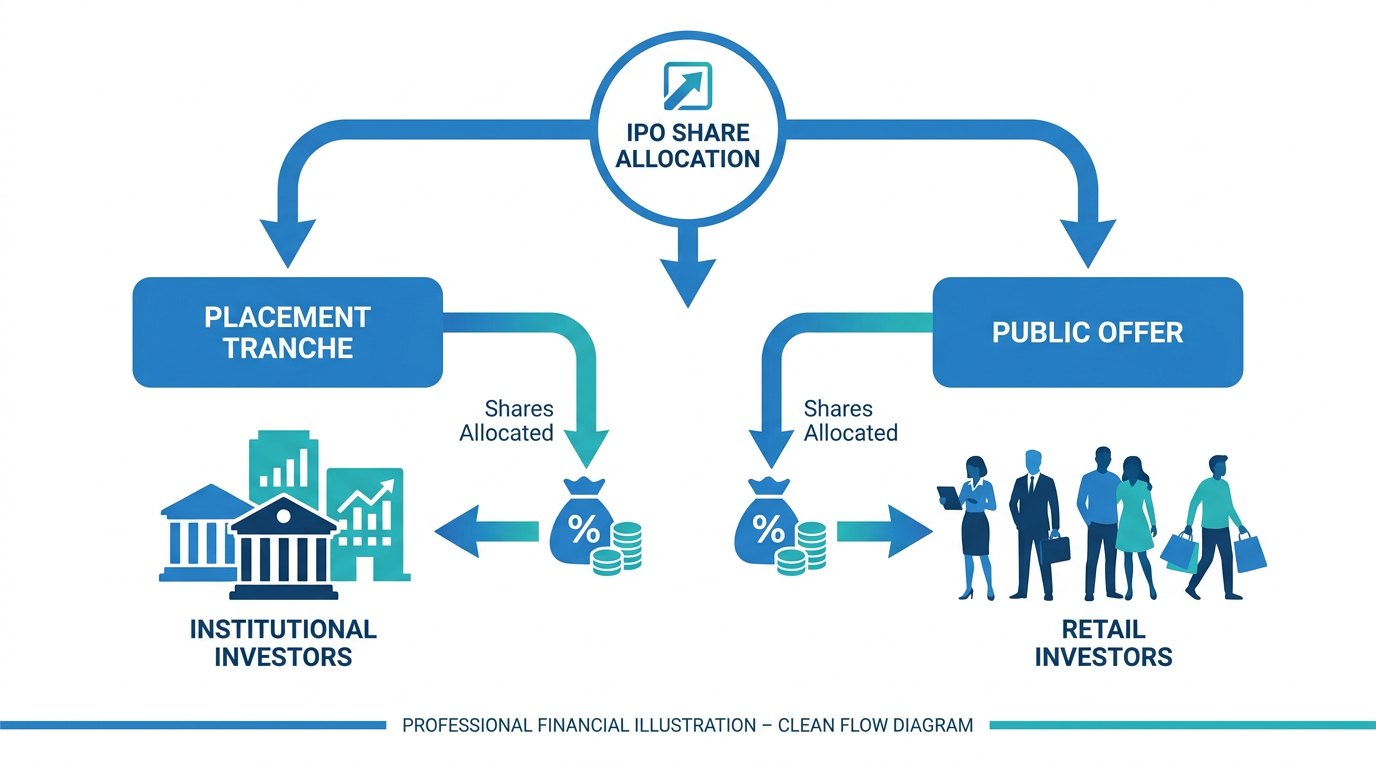
Every Singapore IPO is divided into two distinct pools of shares. Knowing the difference between them sets the foundation for understanding allotment.
The Placement Tranche
The placement tranche is the portion of the IPO reserved for institutional and sophisticated investors, such as hedge funds and asset managers. Unlike the public offer, these shares are usually allocated at the discretion of the underwriters based on the strength of the investor's interest.
The Public Offer Tranche
The public offer tranche is the portion designated for retail investors in Singapore. Per SGX listing rules, issuers must generally set aside at least 5% of the offer or SGD 50 million in value (whichever is lower) for the public. This relatively small allocation often leads to high oversubscription ratios, making the balloting process a critical stage of the IPO.
What Happens When an IPO Is Oversubscribed
Oversubscription occurs when total applications exceed the number of shares available in the public offer. This is common in Singapore IPOs, particularly for well-known issuers or attractive valuations.
The Balloting Process Explained
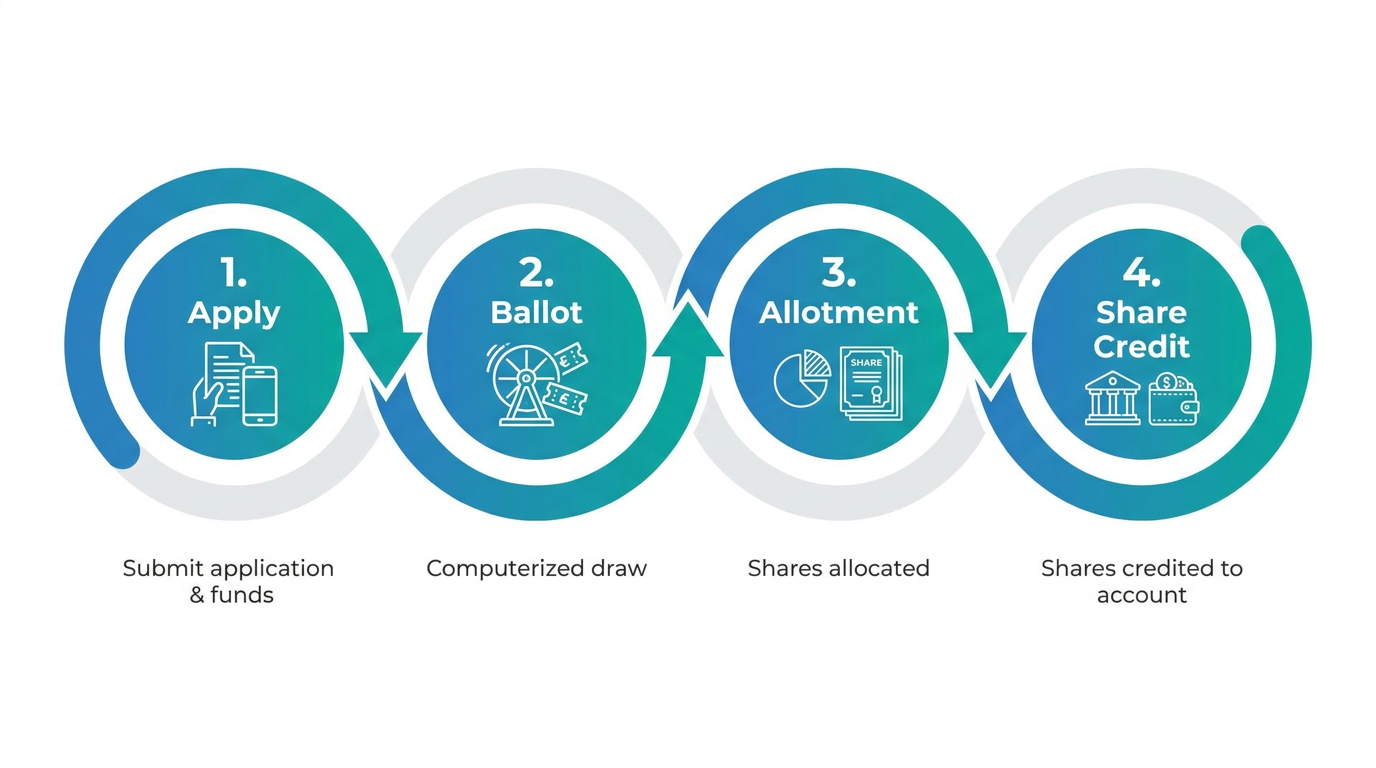
When oversubscription happens, the allotment process uses a ballot — a random draw conducted by the company's registrar. Every valid application receives an equal chance of being selected, regardless of the number of shares applied for. This means applying for more shares does not increase your probability of being selected in the initial ballot.
Once ballot winners are selected, any remaining shares may be distributed proportionately among those winners. The result is that successful applicants may receive fewer shares than they applied for, and those who are not selected receive no shares at all.
Tip: Since the ballot is random, applying correctly — with a valid CDP account, sufficient funds, and no duplicate applications — matters far more than applying for more lots.
Reading the Basis of Allotment
After the offer closes, the issuer publishes a basis of allotment document through SGX. This details the allotment method, the number of valid applications, and how shares were distributed across different application sizes. Reviewing it helps you calibrate expectations for future IPO applications.
How to Apply for a Singapore IPO
Step 1: Open a CDP Account
To participate in any Singapore IPO, you need a Central Depository (CDP) account, operated by SGX. Your CDP account acts as the central store for your SGX-listed securities. Each investor may hold only one direct CDP account, and applying without one will result in application rejection.
You can apply for a CDP account through SGX's website. Setup takes approximately 10 business days after submission, so it is worth opening your account well before any IPO you plan to apply for.
Step 2: Link Your Bank Account
Applications are made through the Electronic Securities Application (ESA) system, supported by DBS/POSB, OCBC, and UOB. You will need a linked bank account with one of these institutions, and you must be at least 18 years old and a Singapore citizen, Permanent Resident, or a foreigner currently residing in Singapore.
Step 3: Submit Your Application
You can apply via ATM or internet banking through your participating bank's platform. A SGD 2 application fee applies per transaction. Note these key rules:
You may only submit one application per CDP account across all banks. Using DBS iBanking and OCBC iBanking for the same IPO counts as duplicate applications and will result in both being rejected.
Applications must meet the minimum lot size as specified in the prospectus (commonly 1,000 shares or multiples thereof).
Sufficient funds must be available in your bank account at the time of application, as the amount is blocked pending the allotment outcome.
Step 4: Wait for Balloting Results
After the offer closes (which must remain open for at least two market days), the registrar processes the data. Results are typically released the evening before the listing date. You can verify your status via your bank’s investment portal or the SGX "Investor Portal."
After the Ballot: Shares, Refunds, and Trading
If Your Application Is Successful
Allotted shares are credited directly to your CDP account. From there, you can sell them through any CDP-linked brokerage account, either on the listing day or at any point after. The listing typically takes place one to two business days after allotment is finalised.
If Your Application Is Unsuccessful or Partially Filled
If you are not selected in the ballot, the full amount blocked in your bank account is released automatically, usually within 24 hours after results are announced. If you received a partial allotment — for instance, you applied for 10 lots but were allocated 2 — the unused funds are similarly unblocked and returned.
Tip: There is no need to take any manual action to receive your refund. The ESA system handles this automatically for applications made through the three local banks. The SGD 2 application fee is generally not refunded regardless of the outcome.
What to Do With Your Allotted Shares
Once shares appear in your CDP account, you can hold or sell them through any CDP-linked brokerage platform. Investors looking to track performance and manage a broader portfolio spanning Singapore, US, and Hong Kong markets benefit from having an integrated platform that consolidates their holdings in one place.
Common Reasons for IPO Application Rejection
Knowing what causes rejection helps you avoid these errors.
Duplicate applications: Submitting more than one application using different banks but the same CDP account will result in rejection of all applications.
Insufficient funds: If the blocked amount cannot be processed due to insufficient account balance, your application is void.
Invalid lot size: Applications must be in the exact lot multiples specified in the prospectus.
Incorrect CDP account details: Any mismatch between your application and registered CDP details (name/NRIC/FIN) can disqualify the application.
Eligibility issues: Applicants who do not meet the age, residency, or account requirements as stated in the prospectus will be rejected.
Reviewing the IPO prospectus carefully before applying helps avoid most of these pitfalls. The prospectus is publicly available through SGX during the offer period.
The Role of Institutional Investors in Price Discovery
Institutional demand is gathered through a book-building process during the investor roadshow period. Underwriters collect indications of interest from institutional investors to gauge demand and set the final offer price. This pricing applies to both the placement tranche and the public offer tranche.
Some IPOs also include cornerstone investors — large institutions that commit to purchasing a fixed number of shares at the offer price before the public offer opens. They are typically subject to a "lock-up periods", meaning they cannot sell their shares immediately after listing. Understanding these dynamics helps retail investors interpret oversubscription levels, though past demand does not predict post-listing performance.
Frequently Asked Questions
How do I check my IPO allotment results in Singapore?
Log in to your internet banking platform (DBS/POSB, OCBC, or UOB) and navigate to the securities or investments section. Results are typically available from around 6pm on the evening after the IPO offer closes. You can also check announcements on the SGX website.
Can I improve my chances of getting IPO shares in Singapore?
Statistically, no. Because the ballot is a random draw, the only way to "improve" your chances is to ensure your application is valid so that it isn't disqualified before the draw happens.
Do I need a brokerage account to apply for a Singapore IPO?
No. The application is done through your bank's ATM or iBanking. However, you do need a CDP-linked brokerage account to sell those shares once they are listed on the SGX.
What is the minimum amount needed to apply for a Singapore IPO?
The minimum application quantity is specified in the prospectus, often starting from 1,000 shares (or multiples of the standard 100-share board lot). The total amount required depends on the IPO offer price. Additionally, a non-refundable SGD 2 application fee is charged per transaction by the participating bank.
What is the public offer clawback mechanism?
Clawback allows shares to be reallocated between the placement tranche and the public offer tranche. If the public offer is significantly more oversubscribed while the placement tranche is less so, the issuer may shift some placement shares to the public offer. This mechanism is designed to balance supply across investor categories.
Conclusion
The Singapore IPO allotment process is designed to be equitable, but it remains a competitive environment for retail investors. By ensuring your CDP account is ready, following the application rules to the letter, and understanding that balloting is a matter of chance, you can participate in the market with a grounded perspective.
Success in an IPO is only the beginning; the real work lies in managing that position within a broader, well-diversified portfolio.
The choice of financial instruments depends on your investment objectives, risk tolerance, market outlook, and experience level. Regardless of the method selected, it is essential to fully understand its mechanics, risk characteristics, and execution rules, while maintaining a robust risk management plan. You can learn more about investment strategies through the Longbridge Academy or by downloading the Longbridge App.