Cash-Secured Put vs Covered Call: Comparing Two Entry Strategies
Cash-secured puts and covered calls are both options income strategies, but they serve opposite purposes. Understand how each works and the position it is built around.
TL;DR: A cash-secured put and a covered call are two widely used options income strategies that serve different purposes. A cash-secured put lets you earn premium while waiting to buy a stock at a lower price; a covered call lets you earn income from shares you already own. The right choice depends on your starting position: cash or existing shares.
Options trading can feel complicated at first, but two strategies stand out for their practical simplicity: the cash-secured put and the covered call. Both generate income through option premiums, and both are considered conservative relative to many other options approaches. Yet they work from opposite starting points. When weighing a cash secured put vs covered call, the right choice depends on where you are in your investment journey — holding cash and looking for an entry, or holding shares and seeking extra returns. This article breaks down how each strategy works, when to use each one, and how they can work together.
What Is a Cash-Secured Put?
A cash-secured put (CSP) involves selling a put option on a stock you would be willing to own, while setting aside enough cash to purchase 100 shares if the option is exercised (known as assignment). You collect the option premium upfront, which is yours to keep regardless of the outcome.
How It Works
When you sell a put option, you give the buyer the right to sell their shares to you at the agreed strike price on or before expiry. If the stock remains above the strike price at expiry, the option expires worthless and you keep the premium. If the stock falls below the strike, you are obligated to buy 100 shares at that strike price — though your effective purchase cost is reduced by the premium already received. Understanding how option exercise and assignment work when an option is in the money is central to choosing an appropriate strike.
Why Investors Use It
The cash-secured put is useful when you have a target entry price in mind for a stock but the current market price is higher than you would like to pay. By selling a put at or near your target price, you collect income while you wait. If the stock never falls to that level, you still profit from the premium. If it does fall, you acquire shares at your target price, with your net cost further reduced by the premium collected.
Important: Cash-secured puts carry real downside risk. If the underlying stock declines sharply, you are still obligated to purchase the shares at the agreed strike price, which may be significantly above the current market value. Always select stocks you genuinely want to own at the strike price you choose.
What Is a Covered Call?
A covered call involves selling a call option on shares you already own — at least 100 shares per contract. By selling the call, you collect a premium and agree to sell your shares at the strike price if the buyer exercises the option before or at expiry.
How It Works
If the stock price remains below the strike price at expiry, the call expires worthless and you keep the premium and your shares. You can then sell another call in the next expiry period and repeat the process. If the stock climbs above the strike price, the buyer may exercise the option, and you would sell your 100 shares at the agreed price — capping your upside at the strike regardless of how high the stock rises.
Why Investors Use It
A covered call is a straightforward way to generate income on a stock position you already hold, particularly when you expect the stock to trade sideways or appreciate only modestly. It is also useful when you have a specific exit target; placing the call strike near that level means you collect premium while waiting for the stock to reach your intended selling price.
Tip: Covered calls work most effectively in flat to moderately bullish market conditions. In strongly rising markets, you risk having your shares called away and missing out on additional gains above the strike price.
Key Differences at a Glance
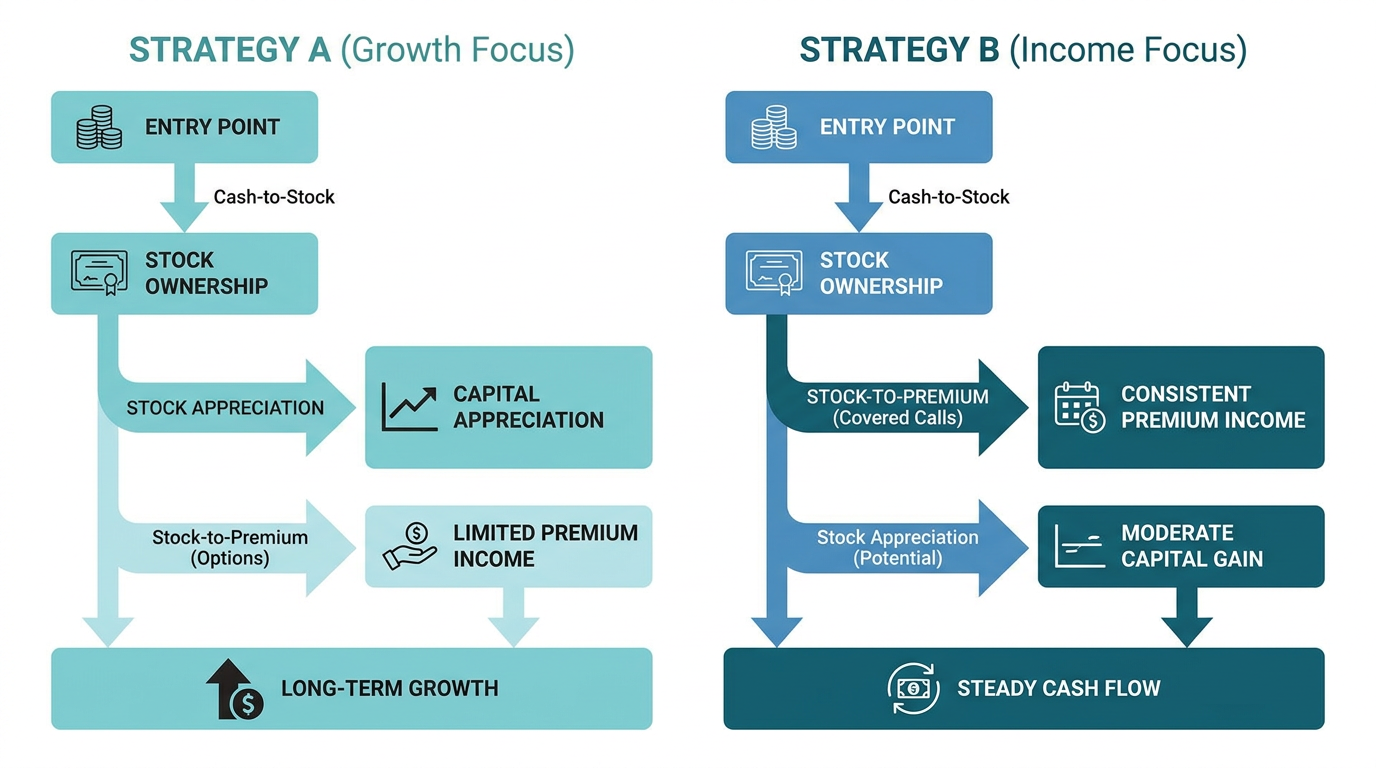
While the two strategies have nearly identical profit-and-loss profiles, the key differences lie in your starting position and the direction of the potential transaction.
| Feature | Cash-Secured Put | Covered Call |
|---|---|---|
| Starting position | Hold cash | Own 100+ shares |
| Objective | Acquire stock at a lower price while earning premium | Earn income from existing shareholding |
| If assigned or exercised | You buy 100 shares | You sell 100 shares |
| Market outlook | Neutral to mildly bullish | Neutral to mildly bullish |
| Upside potential | Capped at premium collected | Capped at strike price plus premium |
The core distinction is directional: a cash-secured put is an entry strategy, while a covered call is an income or exit strategy on an existing holding.
When to Use Each Strategy
Cash-Secured Put: Commonly Used for Entry
A cash-secured put suits situations where you have idle cash and a stock you want to own, but prefer a better entry point than the current market price. Consider it when:
- You have researched a stock and are willing to own it at a specific price below the current market rate.
- You want to put idle cash to work rather than leave it unproductive.
- Implied volatility is elevated, which tends to make option premiums higher and more attractive to sellers.
Covered Call: Commonly Used for Existing Positions
A covered call makes sense when you already hold shares and want to generate additional returns. Consider it when:
- You own at least 100 shares and want supplementary income from that position.
- You expect the stock to move sideways or modestly higher in the near term.
- You have a clear exit price in mind and want to be compensated while you wait.
The Wheel Strategy: Combining Both
One of the more practical insights from experienced options traders is that these strategies are not simply alternatives — they are naturally complementary. Used in sequence, they form what is commonly known as the Wheel Strategy.

How the Wheel Works
- Sell a cash-secured put on a stock you want to own, collecting the premium. If the option expires worthless, repeat.
- If assigned, you now own 100 shares. Begin selling covered calls against that position.
- If the covered call is exercised, your shares are sold at the strike price. You return to cash and restart from step one.
This creates a continuous income cycle: earning premium while waiting to buy, then earning premium while waiting to sell. You can explore more about options approaches through Longbridge Academy, which offers educational content for investors at all experience levels.
Note: The Wheel Strategy involves genuine equity risk. If the stock declines sharply after assignment, losses on the shares can outweigh the premiums collected. This approach is not suited to speculative or highly volatile stocks.
Risk Considerations
Both strategies carry downside risk driven primarily by the underlying stock's price movement. For cash-secured puts, the maximum loss occurs if the stock falls to zero after assignment, offset only partially by the premium collected. For covered calls, your shares can still fall in value; the premium provides limited protection against a meaningful decline.
Neither strategy eliminates the possibility of loss, and neither should be applied without clear stock selection and sensible position sizing. A stock screener can help you evaluate underlying stocks before committing to a position, and in-depth research can offer additional context on market conditions.
Frequently Asked Questions
Is a cash-secured put the same as a covered call?
They are not the same trade, but they share a nearly identical profit-and-loss profile. The key difference is the starting point: a cash-secured put begins with cash and may result in you buying shares, while a covered call begins with share ownership and may result in you selling them.
How do these strategies compare for those new to options?
Both are often described as more conservative than many other options strategies, but they still carry real financial risk. Anyone new to options should develop a solid understanding of how options work before committing capital, and practising on an options paper-trading platform can help test these strategies without real money at stake. The Longbridge Academy offers educational resources to help build that foundation.
Can these strategies be used together?
Yes. The Wheel Strategy combines both in sequence: sell cash-secured puts until assigned, then sell covered calls on the acquired shares. Longbridge provides options trading in US markets as part of its range of investment products, making it straightforward to execute both strategies from a single platform.
Do these strategies protect against a falling market?
Neither strategy is designed as a hedge against significant market downturns. Both face challenges when the underlying stock declines sharply. The premium collected offers only partial cushioning against a falling share price.
Conclusion
When comparing a cash secured put vs covered call, neither is inherently superior — each serves a specific purpose depending on your starting position. A cash-secured put is a disciplined entry tool: you collect premium while waiting for a stock to reach your target price. A covered call is a practical income tool: you generate returns from shares you already hold. Used together through the Wheel Strategy, they can form a systematic, income-focused approach to managing equity positions.
As with any investment activity, understanding the mechanics and risks of each strategy is essential before committing capital. Selecting the right underlying stock, maintaining realistic premium expectations, and sizing positions prudently all matter as much as the strategy itself.
The choice of financial instruments depends on your investment objectives, risk tolerance, market outlook, and experience level. Regardless of the method selected, it is essential to fully understand its mechanics, risk characteristics, and execution rules, while maintaining a robust risk management plan. You can learn more about investment strategies through the Longbridge Academy or by downloading the Longbridge App.