ETF Options Guide: Build Diversified Exposure
Master ETF options trading to build diversified exposure while managing risk and generating income through covered calls, protective puts, and collar strategies.
TL;DR: ETF options combine the diversification benefits of Exchange Traded Funds (ETFs) with the flexibility of options contracts, allowing investors to manage risk, generate income, and gain exposure to multiple assets with a single position. Whether through options-based ETFs that employ strategies internally or trading options on ETF shares directly, these instruments can be used to modify portfolio exposure and manage certain types of risk.
Building a diversified investment portfolio is essential for managing risk and achieving long-term financial goals. ETF options provide an additional approach that investors may use when combining diversification with options strategies. Exchange Traded Funds already provide instant diversification by holding baskets of securities, and when combined with options strategies, they unlock additional ways to protect portfolios, generate income, and navigate different market conditions.
Understanding how to use ETF options effectively can transform your approach to portfolio construction. Unlike individual stock options that concentrate risk in single companies, ETF options spread exposure across entire sectors, indices, or asset classes. This guide explores how ETF options work, the strategies available, and how Singapore investors can leverage these tools through platforms like Longbridge to build more resilient portfolios.
Understanding ETF Options: The Basics
ETF options are standardized put and call options contracts where the underlying asset is an Exchange Traded Fund rather than an individual stock. Each standard contract typically represents 100 shares of the underlying ETF, giving investors control over a diversified basket of assets with a single options position.
There are two distinct approaches to incorporating ETF options into your portfolio. The first involves options-based ETFs, which are funds that actively invest in equities and use options strategies internally to seek specific outcomes such as income generation or downside protection. The second approach involves directly trading options contracts on ETF shares, giving investors hands-on control over their strategies.
Call and Put Options Explained
Call options give the holder the right, but not the obligation, to buy the underlying ETF at a specified strike price before expiration. Investors purchase calls when they expect the ETF to rise in value or sell covered calls to generate income from holdings they already own.
Put options provide the right to sell the underlying ETF at the strike price before expiration. These serve as insurance policies against portfolio declines, allowing investors to establish a floor price for their holdings. ETF options have grown significantly in trading volume, with over 430 equity ETFs now offering options contracts representing more than $160 billion in total assets under management (source: Options Clearing Corporation).
Trading options on ETFs rather than individual stocks reduces single-company risk. Corporate earnings surprises, management changes, or company-specific news can create dramatic price swings in individual stocks. ETF options smooth out this volatility by spreading exposure across dozens or hundreds of securities.
Core ETF Options Strategies for Diversified Exposure
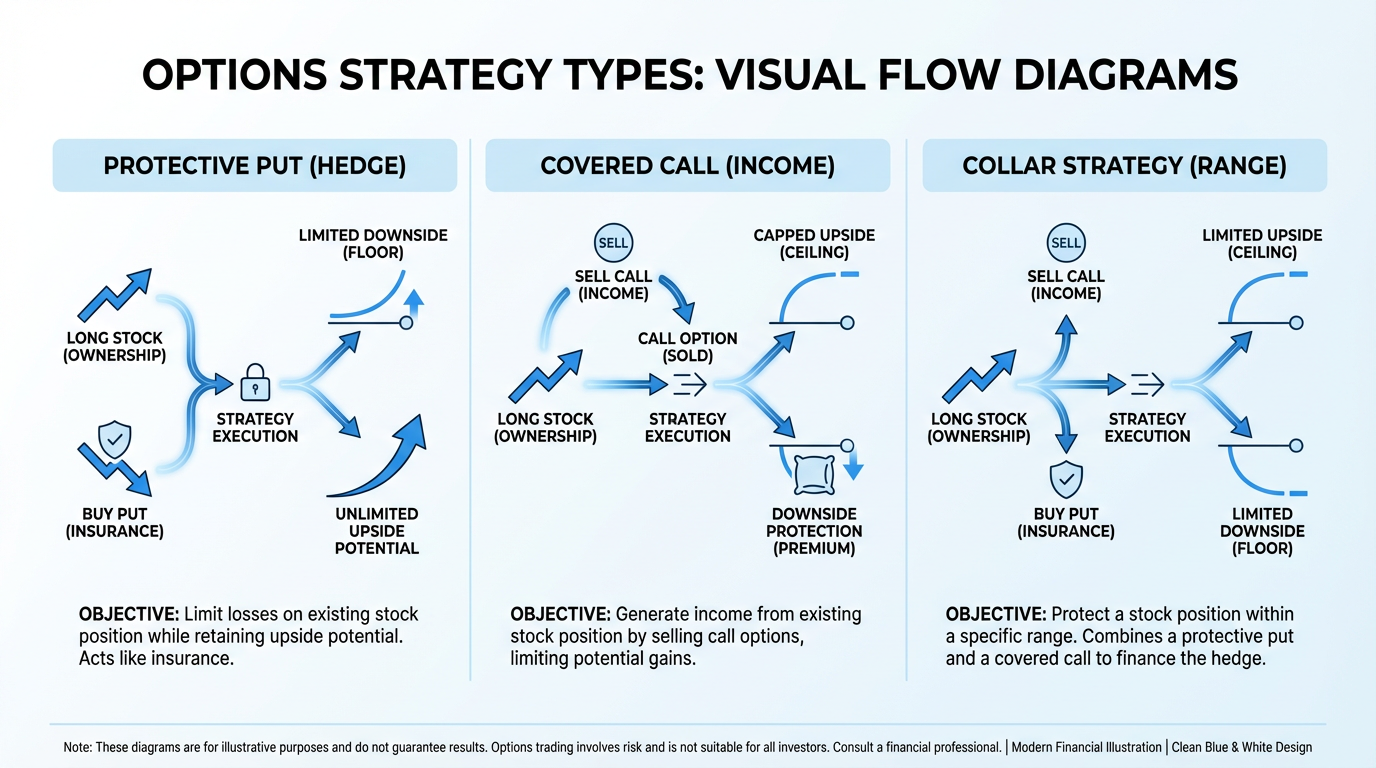
Implementing ETF options strategies requires understanding how different approaches serve distinct investment objectives. The three primary strategies each address specific portfolio needs, from income generation to risk mitigation.
Covered Call Strategy: Generating Income
The covered call strategy involves holding a long position in an ETF while simultaneously selling call options on those shares. This approach generates immediate income through the option premium collected, making it particularly attractive in sideways or moderately bullish markets.
When you sell a covered call, you agree to sell your ETF shares at the strike price if the option is exercised. The premium you collect provides income regardless of whether the option expires worthless or gets exercised. For Singapore investors using Longbridge's platform, covered calls on US market ETFs can generate monthly income streams. However, this strategy sacrifices unlimited upside potential in exchange for current income.
Protective Put Strategy: Portfolio Insurance
Protective puts function as insurance policies for your ETF holdings. By purchasing put options while holding the underlying ETF, you establish a minimum price at which you can sell your shares, regardless of how far the market falls.
This defensive strategy proves valuable during periods of uncertainty or when you want to maintain long-term exposure while protecting against short-term declines. The cost of this protection is the premium paid for the put option, which acts similarly to an insurance premium. During periods of high market volatility, protective puts become more expensive, reflecting increased demand for downside protection.
Collar Strategy: Balancing Protection and Cost
The collar strategy combines protective puts and covered calls to create a defined range of outcomes. You simultaneously buy a put option for downside protection while selling a call option to offset the put's cost. This creates a price "collar" around your position.
Collars prove effective when you want protection but find pure protective puts too expensive. The call premium you collect reduces or eliminates the cost of buying the put, though you sacrifice upside potential beyond the call's strike price.
Options-Based ETFs: Professional Management of Options Strategies
Options-based ETFs bring professional options management to retail investors who may lack the time or expertise to implement complex strategies themselves. These funds actively employ options strategies within their portfolio construction, focusing on either income enhancement or defensive positioning.
Income-focused options-based ETFs systematically sell covered calls or cash-secured puts to generate premium income distributed to shareholders monthly or quarterly. Assets flowing into options income ETFs have increased substantially since 2020, appealing to income-seeking investors.
Defensive options-based ETFs use protective puts or collars to reduce portfolio volatility during market declines. During sharp selloffs, hedged portfolios may decline less than unhedged benchmarks, though ongoing protection costs typically result in underperformance during bull markets.
Risk Management Considerations

While ETF options provide powerful tools for portfolio management, they also introduce specific risks that investors must understand before implementation.
Complexity and Learning Curve
Options represent derivative contracts with features like time decay, implied volatility, and strike price selection that affect their value. Unlike simply buying and holding an ETF, options strategies require active management and ongoing decision-making.
New investors should start with basic strategies like covered calls on small positions before progressing to more complex approaches. Educational resources, such as those available through Longbridge's Academy, can help build foundational knowledge before committing capital.
Cost and Tax Considerations
Options-based ETFs typically carry higher expense ratios than passive index ETFs, reflecting the active management required for options implementation. Direct options trading involves commissions and bid-ask spreads that can add up, particularly for frequent traders.
Options strategies can create tax complexity. Options-based ETFs may distribute income as ordinary dividends rather than qualified dividends, potentially increasing tax liability. Singapore investors should consult with tax professionals to understand how their specific strategies might be treated under local tax regulations. While Singapore does not impose capital gains tax on most investment income, the Inland Revenue Authority of Singapore (IRAS) may treat certain trading activities differently.
Building Your ETF Options Strategy
Developing an effective approach to ETF options requires aligning strategy selection with your investment objectives, risk tolerance, and market outlook.
Begin by clarifying what you want to achieve. Covered call strategies are commonly associated with income generation because they involve collecting option premiums while protective put strategies are often used to establish a minimum exit price for holdings. Your time horizon matters, as options are time-limited instruments with most contracts expiring within weeks or months.
Some investors choose to begin with smaller positions when learning how options strategies behave. Most financial advisors recommend limiting options-based positions to a minority of your overall portfolio, using options strategies tactically to achieve specific objectives.
Options positions require ongoing monitoring as expiration approaches. Setting clear rules for position management helps remove emotion from decision-making.
Accessing ETF Options Through Longbridge
Singapore investors can access US market ETF options through Longbridge's comprehensive trading platform, with options trading on a wide range of US-listed ETFs from broad market index funds to sector-specific products.
Longbridge offers multiple platforms across iOS, Android, Windows, and macOS, ensuring you can monitor positions on the move. For investors new to options trading, start with small positions on highly liquid ETFs tracking major indices. Track market performance and access industry news to inform your strategies.
Frequently Asked Questions
What is the difference between options-based ETFs and trading options on ETFs?
Options-based ETFs are funds that internally use options strategies managed by professional portfolio managers, distributing results to shareholders. Trading options on ETFs means you directly buy or sell options contracts, giving you control over strike selection and expiration. Options-based ETFs offer convenience, while direct options trading provides flexibility.
Are ETF options suitable for beginning investors?
ETF options involve complexity that can challenge beginners. However, basic strategies like covered calls can serve as educational starting points for committed learners. Before trading options, ensure you understand how they work, the risks involved, and your specific strategy. Educational resources and paper trading build competence before committing real capital.
How do ETF options provide better diversification than stock options?
ETF options provide exposure to baskets of securities rather than single companies. An option on a technology sector ETF spreads risk across dozens of companies, while an individual stock option concentrates risk in one firm. This diversification reduces the impact of company-specific events like earnings surprises that can dramatically affect individual stock options.
What are the main costs associated with ETF options strategies?
Costs include options premiums paid when buying contracts, commissions charged by brokers for options trades, and bid-ask spreads between buying and selling prices. Options-based ETFs charge ongoing expense ratios that typically exceed passive index funds. Additionally, consider opportunity costs from capped upside potential in strategies like covered calls and collars.
Can I lose more money than I invest with ETF options?
Your maximum loss depends on the specific strategy. Buying put or call options limits loss to the premium paid. Selling covered calls carries limited risk since you own the underlying shares. However, selling naked options can expose you to substantial losses. Understanding each strategy's risk profile before implementation is essential.
Conclusion
ETF options provide additional mechanisms for managing exposure and implementing options strategies. By combining the inherent diversification of ETFs with the flexibility of options contracts, these strategies address multiple portfolio objectives within a single framework.
Success requires understanding how different strategies work, their associated costs and risks, and how they align with your investment goals. Starting with basic approaches, properly sizing positions, and committing to ongoing education helps navigate the learning curve while building competence.
Investors interested in learning more about options trading can explore educational resources available through the Longbridge Academy or review the features offered on the Longbridge Platform.