Options Trading Terms Explained: Your Complete Glossary
Master options trading terms with this comprehensive glossary. Learn calls, puts, Greeks, and strategies explained in simple language for Singapore investors.
TL;DR: This options glossary breaks down essential trading terms into simple, understandable language. From basic concepts like calls and puts to advanced terms like the Greeks and complex strategies, this guide helps Singapore investors navigate options trading with confidence.
Options trading opens up powerful investment strategies, but the terminology can feel overwhelming at first. Whether you are exploring calls and puts for the first time or trying to understand what "delta" and "theta" mean, this comprehensive options glossary will help you decode the language of options trading.
Understanding options terminology is not just about learning definitions. It is about building the foundation you need to make informed trading decisions and manage risk effectively. This guide organizes options terms into clear categories, making it easier to find what you need when you need it.
Let us break down the jargon and demystify the world of options trading.
Understanding Options Basics
Before diving into complex strategies, you need to grasp the fundamental building blocks of options contracts.
What Are Options?
An option is a financial contract that gives the buyer the right, but not the obligation, to buy or sell an underlying asset at a predetermined price before or on a specific expiration date. Unlike stocks, options are derivative instruments, meaning their value derives from an underlying security such as shares, Exchange Traded Funds (ETFs), or indices.
The underlying asset refers to the financial instrument (typically a stock or ETF) on which an options contract is based. The option's value moves in relation to changes in the underlying asset's price.
Calls and Puts
A call option gives the holder the right to buy the underlying asset at the strike price. Investors purchase call options when they expect the underlying asset's price to rise.
A put option gives the holder the right to sell the underlying asset at the strike price. Traders buy put options when they anticipate the underlying asset's price will fall.
Contract Specifications
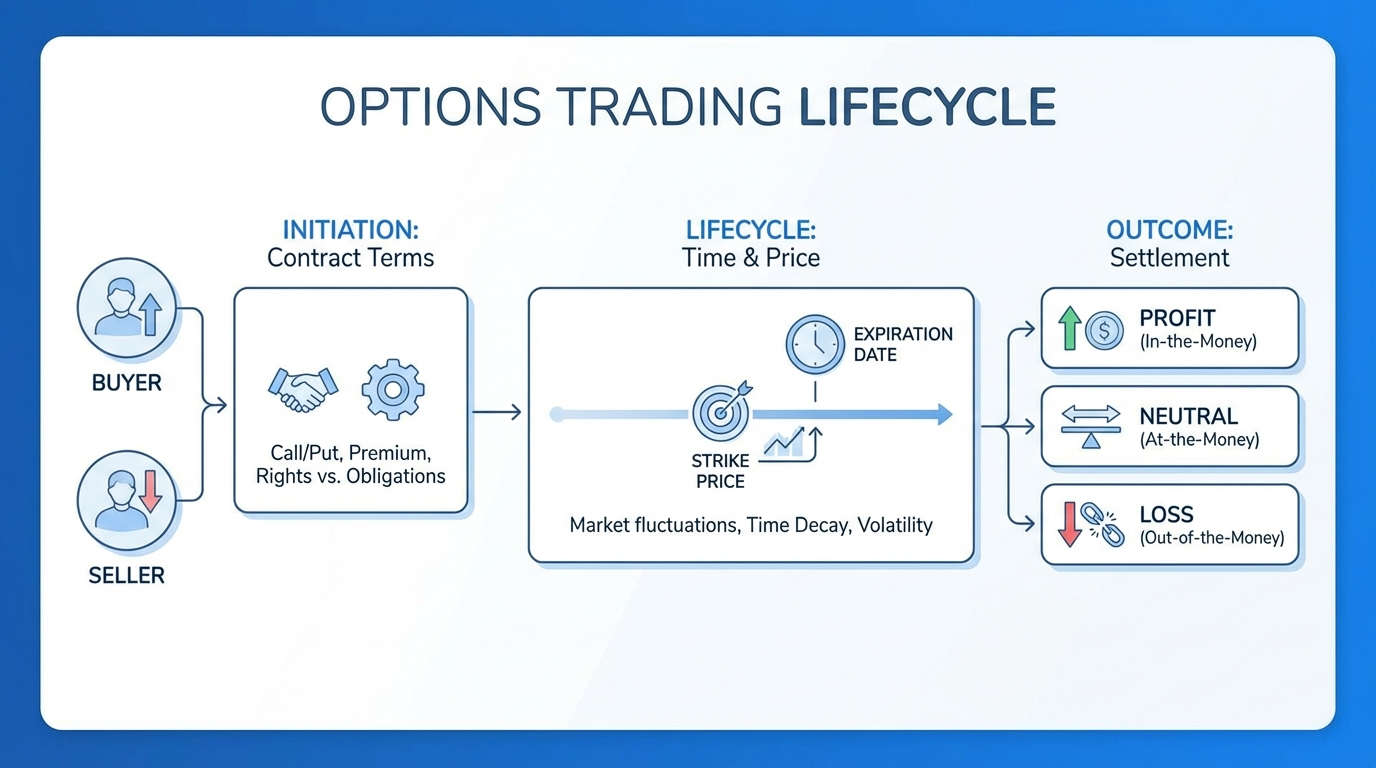
The strike price (also called the exercise price) is the predetermined price at which the option holder can buy (for calls) or sell (for puts) the underlying asset. Choosing the right strike price is crucial for your options strategy.
The expiration date is when the options contract becomes void. Options are time-sensitive instruments. US options typically expire on the third Friday of the expiration month, though weekly options provide more frequent expiration dates.
The premium is the price the buyer pays to the seller (also called the writer) for the options contract. This cost represents the maximum loss for option buyers.
Each standard options contract controls 100 shares of the underlying stock, known as a contract size or contract multiplier. When you see an option quoted at $2.50, the actual cost is $250 ($2.50 × 100 shares).
Key Players and Position Types
Understanding who participates in options markets helps clarify how these contracts work.
An option holder (or buyer) purchases an options contract and pays the premium. Holders have rights but no obligations. An option writer (or seller) sells the options contract and receives the premium. Writers have obligations if the holder exercises the option.
A long position means you have purchased an option. Long positions have limited risk (the premium paid) but potentially unlimited profit. A short position means you have sold or written an option, with limited profit potential but substantial risk.
A covered call is when you own the underlying stock and sell call options against it. This generates income but caps your upside. A naked option is when you write an option without owning the underlying asset, carrying significant risk.
Moneyness: Measuring Option Value
Moneyness describes the relationship between the strike price and the current price of the underlying asset.
In-the-money (ITM) means the option has intrinsic value. For calls, this occurs when the underlying price exceeds the strike price. For puts, this happens when the underlying price falls below the strike price.
At-the-money (ATM) describes options where the strike price approximately equals the current underlying price. These options have no intrinsic value, only time value.
Out-of-the-money (OTM) means the option has no intrinsic value. For calls, the underlying price is below the strike price. For puts, the underlying price is above the strike price.
Intrinsic value is the amount an option is in-the-money. It represents the profit you would realize if you exercised the option immediately. An option's total value equals intrinsic value plus time value.
Extrinsic value (also called time value) is the portion of an option's premium beyond its intrinsic value. This value decreases as expiration approaches, a phenomenon called time decay.
The Greeks: Measuring Risk and Sensitivity
The Greeks are risk measures that describe how options prices change in response to various factors. These metrics help traders understand and manage options positions.
Delta measures how much an option's price changes for each $1 move in the underlying asset. Call options have positive delta (0 to 1), while put options have negative delta (-1 to 0). A delta of 0.50 means the option price will move approximately $0.50 for every $1 change in the underlying stock.
Gamma measures the rate of change in delta. High gamma means delta changes quickly, creating more risk and opportunity as the underlying price moves.
Theta measures time decay, showing how much an option's value decreases each day as expiration approaches. Options sellers benefit from positive theta, while buyers face negative theta.
Vega measures sensitivity to implied volatility changes. When implied volatility increases, option premiums rise. Vega is highest for at-the-money options with longer expirations.
Rho measures sensitivity to interest rate changes. While less influential for short-term options, rho becomes more significant for LEAPS (Long-Term Equity Anticipation Securities).
Volatility and Pricing
Volatility plays a central role in options pricing and strategy selection.
Implied volatility (IV) represents the market's expectation of future price movement. Higher implied volatility leads to higher option premiums. Traders often buy options when implied volatility is low and sell when it is high.
Historical volatility measures actual past price movements of the underlying asset over a specific period. Comparing historical and implied volatility helps identify potential trading opportunities.
The VIX (Volatility Index) measures expected volatility in the S&P 500 over the next 30 days. Often called the "fear gauge," the VIX tends to spike during market uncertainty.
Options Strategies and Spread Trading
Options can be combined in numerous ways to create strategies with different risk-reward profiles.
A protective put involves buying a put option while owning the underlying stock, acting as insurance to limit downside risk. A cash-secured put means selling a put while holding enough cash to purchase the stock if assigned, generating income.
A spread involves simultaneously buying and selling options of the same type with different strikes or expirations. A vertical spread combines options with the same expiration but different strike prices. A horizontal spread uses the same strike price but different expiration dates.
A straddle involves buying both a call and put with the same strike price and expiration, profiting from significant price movement in either direction. A strangle is similar but uses different strike prices, costing less but requiring larger price movements.
An iron condor combines a bull put spread and a bear call spread, profiting when the underlying stays within a specific price range. A butterfly spread uses three strike prices with a 1:2:1 ratio, profiting from minimal price movement.

Exercise and Assignment
Exercise occurs when the option holder invokes their right to buy (for calls) or sell (for puts) the underlying asset at the strike price. Assignment happens when an option writer is obligated to fulfill the contract terms because the holder has exercised their right.
American-style options can be exercised any time before expiration (most US stock options). European-style options can only be exercised on the expiration date (many index options). Automatic exercise occurs when options finishing in-the-money are automatically exercised at expiration.
Trading Mechanics and Order Types
Bid is the highest price a buyer will pay for an option. Ask is the lowest price a seller will accept. The difference is the spread.
Open interest represents outstanding options contracts that have not been closed or exercised. High open interest typically indicates better liquidity. Volume shows how many contracts traded during a specific period.
Liquidity refers to how easily you can enter or exit positions without affecting the price. Liquid options have narrow bid-ask spreads and high volume.
A market order executes immediately at the best available price. A limit order only executes at your specified price or better, giving you price control but no execution guarantee.
Frequently Asked Questions
What is the difference between options and stocks?
Stocks represent ownership in a company, while options are contracts granting rights to buy or sell stocks at predetermined prices. Options have expiration dates and lose value over time, whereas stocks do not expire. Options allow leveraged exposure with limited upfront cost but carry different risks than stock ownership.
How much money do I need to start trading options?
The minimum varies by broker and strategy. Buying options requires enough capital to purchase at least one contract (premium × 100 shares), which could be as little as $50-$100 for some options. Selling options typically requires more capital for margin requirements.
What are the main risks of options trading?
Options buyers risk losing the entire premium paid if the option expires worthless. Options sellers face potentially unlimited losses on naked calls or substantial losses on naked puts. Time decay erodes option value daily. Leverage magnifies both gains and losses. Understanding these risks is crucial before trading.
Should beginners trade options?
Beginners can trade options; however, it is common to focus on basic strategies like covered calls or cash-secured puts after thoroughly understanding the mechanics. Complex multi-leg strategies and naked options generally carry higher risks and require significant experience to manage effectively.
The choice of financial instruments depends on your investment objectives, risk tolerance, market outlook, and experience level. Regardless of the method selected, it is essential to fully understand its mechanics, risk characteristics, and execution rules, while maintaining a robust risk management plan. You can learn more about investment strategies through the Longbridge Academy or by downloading the Longbridge App.