Strike Price Selection: ITM vs ATM vs OTM Options
Discover how to choose between ITM, ATM, and OTM options based on risk tolerance, trading objectives, and market conditions for better options trading results.
TL;DR: Strike price selection in options trading involves choosing between In-the-Money (ITM), At-the-Money (ATM), and Out-of-the-Money (OTM) options based on your risk tolerance, trading objectives, and market outlook. ITM options offer lower risk with higher upfront costs, ATM options provide balanced leverage and probability, while OTM options deliver maximum leverage at lower cost but require significant price movements to profit.
Selecting the right strike price is one of the most critical decisions in options trading, yet many traders focus solely on finding the cheapest option available. This approach overlooks the fundamental relationship between strike price, risk, and probability of success.
Understanding how In-the-Money (ITM), At-the-Money (ATM), and Out-of-the-Money (OTM) options behave can transform your trading results. This guide explores the practical differences between these strike types, helping you make informed decisions that align with your trading objectives.
Understanding Option Moneyness: The Foundation of Strike Selection
Option moneyness describes the relationship between an option's strike price and the current market price of the underlying asset. This relationship determines whether an option has intrinsic value and how it will respond to price movements.
In-the-Money (ITM) Options Explained
An ITM option has intrinsic value, meaning it would be profitable if exercised immediately. For call options, this occurs when the strike price sits below the current stock price. For put options, ITM status means the strike price exceeds the current market price.
ITM options behave more like the underlying stock itself. They offer higher delta values, meaning they move more closely with the underlying asset's price changes. This characteristic makes them less speculative and more predictable, though they require greater capital investment upfront.
At-the-Money (ATM) Options: The Balanced Approach
ATM options have strike prices that match (or sit very close to) the current market price of the underlying asset. These options contain no intrinsic value—their entire premium consists of time value and implied volatility.
ATM options typically display a delta around 0.50 for calls, offering balanced exposure to price movement. This characteristic makes them popular among directional traders who want meaningful leverage without excessive risk.
Out-of-the-Money (OTM) Options: Maximum Leverage
OTM options have no intrinsic value and would result in a loss if exercised immediately. Call options are OTM when the strike price exceeds the current stock price, while put options are OTM when the strike price falls below the market price.
These options offer the highest leverage potential, as small movements in the underlying asset can produce significant percentage gains. However, this leverage cuts both ways—OTM options also face the highest risk of expiring worthless.
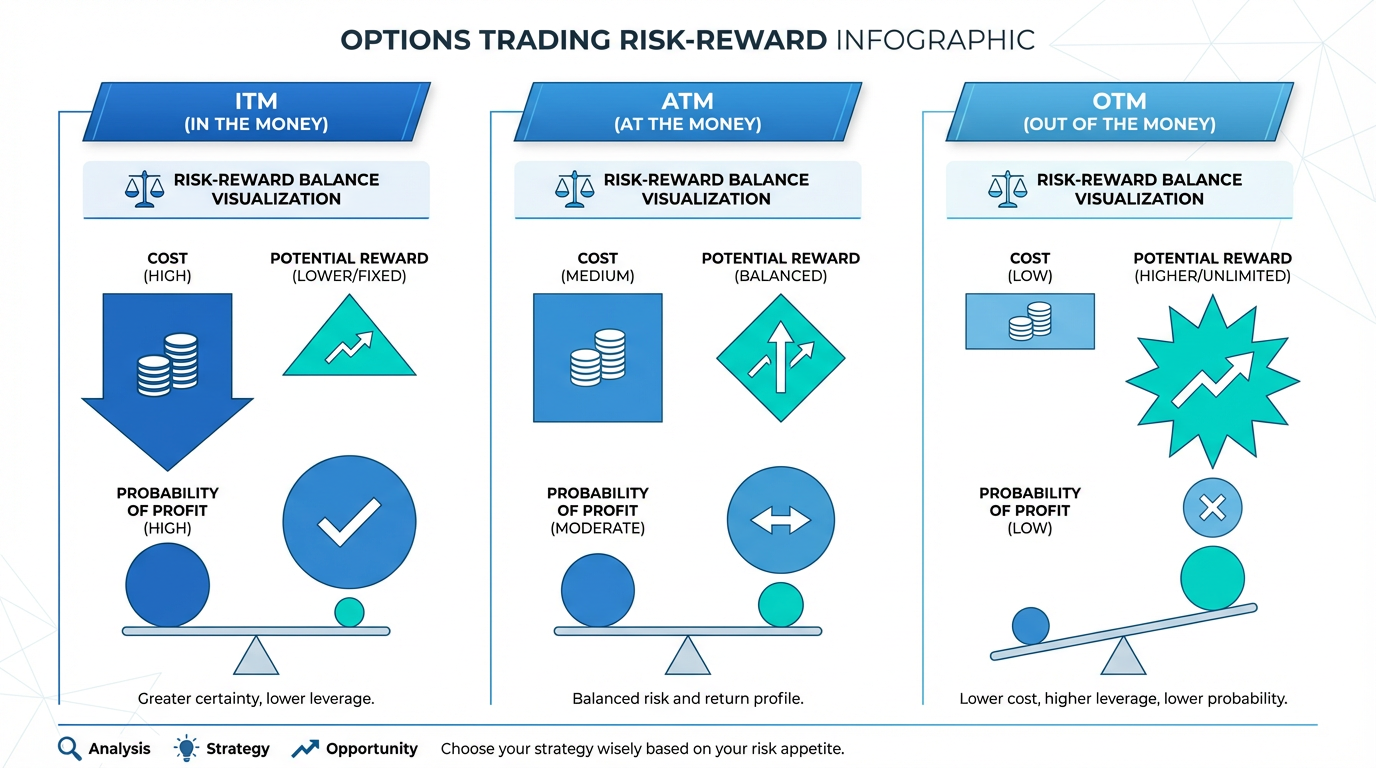
Cost and Probability: The Trade-Off Every Trader Faces
Strike price selection fundamentally involves balancing cost against probability of success. Understanding this trade-off helps you align your choices with your capital constraints and risk tolerance.
Premium Costs Across Different Strike Prices
ITM options command the highest premiums because they possess intrinsic value. ATM options typically cost less than ITM options but more than OTM alternatives.
OTM options appear attractive because of their low upfront cost. However, the low cost reflects the low probability of the option finishing in the money. A cheaper option is not necessarily a better value.
Probability Analysis and Delta
Delta serves as both a sensitivity measure and a probability indicator. An option with a delta of 0.70 suggests approximately 70% probability of finishing in the money at expiration.
ITM options typically display deltas between 0.70 and 1.00 for calls, indicating high probability of maintaining their in-the-money status. ATM options cluster around 0.50 delta, representing roughly equal chances of finishing in or out of the money. OTM options show deltas below 0.50, reflecting their lower probability of profitability.
Time Decay Considerations
Time decay, measured by theta, affects each strike price category differently. ATM options experience the most significant time decay in absolute dollar terms because they contain the highest time value. OTM options suffer the most painful decay in percentage terms—their entire value consists of time premium, which erodes rapidly as expiration approaches.
ITM options show more resistance to time decay due to their substantial intrinsic value component, making them suitable for longer-term positions.
Strategic Applications: When to Use Each Strike Type
Different trading objectives and market conditions call for different strike price selections. Matching your strike choice to your strategy significantly impacts your probability of success.
Directional Trading with Conviction
When investors have strong conviction about market direction and timing, ATM options often provide the optimal risk-reward balance. ATM strikes offer meaningful exposure to price movement while costing less than deeper ITM alternatives.
For traders with very high conviction but limited capital, slightly OTM options can amplify returns when both direction and timing align correctly.
Income Generation Strategies
Income-focused traders selling covered calls or cash-secured puts typically target OTM strikes with 65% to 75% probability of expiring worthless. The strike selection depends on whether investors prioritize premium collection or asset retention—further OTM strikes reduce assignment risk but also reduce premium income.
Portfolio Protection
When purchasing protective puts, the strike price determines the protection level and cost. ATM puts provide comprehensive protection but command higher premiums. OTM puts cost less but function as a deductible, leaving investors exposed to losses between the current price and the strike price. Many investors select strikes 5% to 10% below the current market price.

Key Factors Influencing Strike Price Decision
Beyond the basic categories of ITM, ATM, and OTM, several factors should inform the strike price selection process.
Trading Timeframe
Time horizon significantly impacts appropriate strike selection. Short-term trades spanning days or weeks typically perform better with ATM or slightly ITM options because they need smaller moves to generate profits. Longer-term positions benefit from ITM strikes that provide more time for the thesis to develop while offering greater resistance to time decay.
Implied Volatility Environment
When implied volatility is elevated, option premiums increase across all strikes. In high volatility environments, traders often wait for volatility to decline before entering positions. During low volatility periods, options become cheaper, making it more affordable to purchase ATM or even ITM strikes.
Liquidity and Bid-Ask Spreads
Trading costs extend beyond the option premium. Prioritizing heavily traded strikes with tight bid-ask spreads is a common practice to minimize costs.
ATM options typically offer the best liquidity and tightest spreads. As you move further ITM or OTM, liquidity often decreases and spreads widen.
Capital Requirements and Position Sizing
Available capital is a key constraint in strike selection. ITM options typically require higher capital outlay per contract, which may limit position size. OTM options allow for controlling more contracts with the same capital, though this increased leverage also amplifies risk. Avoid the temptation to overleverage by purchasing excessive quantities of cheap OTM options.
Common Strike Selection Mistakes to Avoid
Understanding what not to do can be as valuable as knowing the correct approach.
Chasing the Cheapest Premium
The most prevalent mistake involves selecting strikes based solely on affordability. While OTM options require less capital, their low cost directly reflects their low probability of success. An option that costs one-tenth the price of an ATM alternative but has one-twentieth the probability of profiting represents poor value. Focus on probability-adjusted returns rather than absolute premium costs.
Ignoring Your Win Rate Requirements
Every trading strategy requires a minimum win rate to remain profitable after accounting for costs. If the strike selection consistently produces trades with 30% probability of success, investors need winners to generate returns exceeding 3.3 times the investment just to break even over many trades.
Selecting Extreme Strikes
Strikes positioned far from the current market price often present challenges. Deep ITM options may offer limited liquidity and wide spreads, while far OTM options require improbable market moves to generate profits. Most successful traders focus their strike selection within a reasonable range around the current market price.
Making Strike Selection Work for Trading Goals
Effective strike price selection requires aligning multiple factors: market outlook, trading timeframe, risk tolerance, and capital constraints.
Create a consistent framework for strike selection based on investors’ typical holding period and risk tolerance. For example, establish guidelines such as only trading strikes with minimum 40% probability of success, or limiting OTM selections to situations with strong technical support.
Longbridge provides comprehensive options trading capabilities in US markets, with analysis tools to help you analyze strike prices and manage risk.
Frequently Asked Questions
What is the difference between ITM, ATM, and OTM options?
ITM (In-the-Money) options have intrinsic value and would be profitable if exercised immediately. ATM (At-the-Money) options have strike prices near the current market price, containing only time value. OTM (Out-of-the-Money) options have no intrinsic value and require the underlying asset to move before becoming profitable.
Which strike price is best for beginners?
Beginners typically benefit from ATM or slightly ITM options, which offer balanced probability of success and manageable risk. These strikes provide meaningful exposure to price movements while avoiding the high cost of deep ITM options or the low probability of far OTM alternatives.
How does time to expiration affect strike price selection?
Longer time to expiration allows greater flexibility in strike selection, as you have more time for your market thesis to develop. Shorter-term trades typically perform better with ATM or ITM strikes that require smaller price moves to generate profits.
Should I choose different strikes for calls versus puts?
The same principles apply to both calls and puts, but the direction reverses. For calls, ITM means the strike is below the market price; for puts, ITM means the strike is above the market price. Select strikes based on your market outlook, risk tolerance, and trading timeframe regardless of option type.
How important is liquidity when selecting strike prices?
Liquidity significantly impacts your trading costs and ability to exit positions. Strikes with high trading volume and tight bid-ask spreads reduce transaction costs and provide better execution. Prioritize strikes with strong liquidity, typically those closest to ATM.
Conclusion
Strike price selection represents one of the most consequential decisions in options trading, directly influencing your probability of success, capital requirements, and risk exposure. ITM options offer security and predictability at higher cost, ATM options provide balanced leverage and probability, while OTM options deliver maximum leverage with corresponding risk.
The optimal strike price is not the cheapest available, but the one that best aligns with your trading objectives, market outlook, and risk tolerance.
The choice of financial instruments depends on your investment objectives, risk tolerance, market outlook, and experience level. Regardless of the method selected, it is essential to fully understand its mechanics, risk characteristics, and execution rules, while maintaining a robust risk management plan. You can learn more about investment strategies through the Longbridge Academy or by downloading the Longbridge App.