Hong Kong Warrants: Trading Guide for Singapore Investors
Discover how Hong Kong warrants work and learn practical strategies for Singapore investors to leverage these derivative instruments across Asian markets.
TL;DR: Hong Kong warrants are derivative instruments that give investors the right to buy (call) or sell (put) underlying assets at predetermined prices. These leveraged products offer Singapore investors opportunities for amplified returns but carry significant risks including time decay, credit risk, and potential total loss of investment.
Hong Kong warrants represent one of the most actively traded derivative instruments in Asian markets, with daily turnover consistently ranking among the highest globally. For Singapore investors seeking to explore investment products beyond domestic markets, understanding how these leveraged instruments work is crucial before committing capital.
Unlike traditional stock investments where you own shares of a company, Hong Kong warrants provide exposure to price movements through derivatives issued by financial institutions. This fundamental difference creates unique opportunities and risks that demand careful consideration.
What Are Hong Kong Warrants?
Hong Kong warrants are financial instruments that grant holders the right—but not the obligation—to buy or sell an underlying asset at a predetermined strike price on or before a specified expiry date. According to the Investor and Financial Education Council, these instruments function as a special form of options where investors can only take a long (buy) position.
The Hong Kong market features two distinct categories: subscription warrants and derivative warrants. Subscription warrants are issued directly by listed companies with validity periods between one and five years. Derivative warrants dominate the market, issued by financial institutions with typical lifespans of six months to two years.
All derivative warrants currently traded on the Hong Kong Exchange (HKEX) follow European-style exercise rules, meaning they can only be exercised at expiry. Settlement occurs exclusively in cash—no physical delivery of underlying assets takes place. The Hong Kong Exchange requires designated liquidity providers for every derivative warrant, ensuring sufficient trading volume.
Understanding Call and Put Warrants
Hong Kong warrants come in two fundamental types, each serving opposite market expectations.
Call Warrants
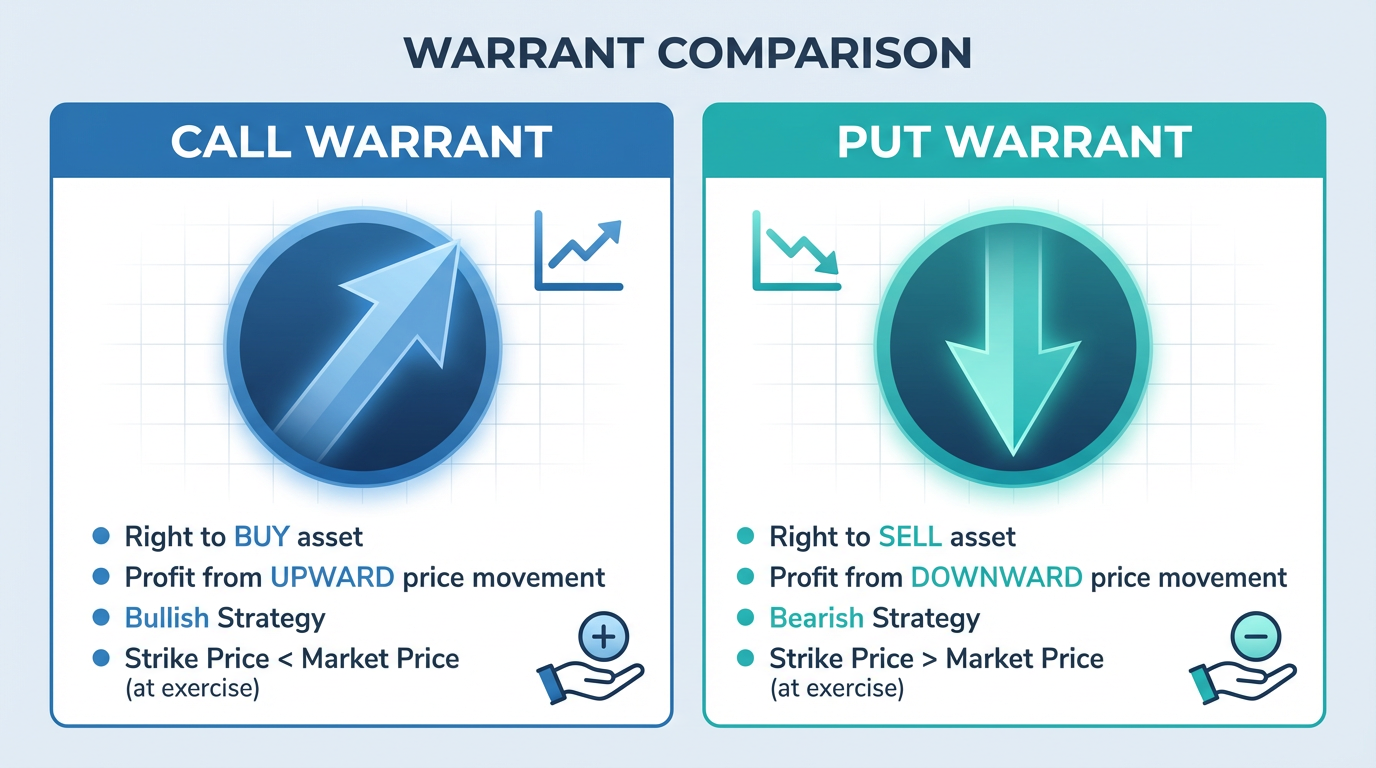
Call warrants give holders the right to purchase the underlying asset at the strike price. Investors buy call warrants when anticipating the underlying asset's price will rise. As the underlying asset appreciates beyond the strike price, the call warrant's value increases proportionally—amplified by leverage.
Put Warrants
Put warrants provide the right to sell the underlying asset at the strike price. These instruments gain value when the underlying asset declines. Singapore investors use put warrants to speculate on market downturns or hedge existing long positions.
The underlying assets for Hong Kong warrants span four main categories: equity indices, individual stocks, exchange-traded funds (ETFs), and commodities paired with foreign exchange.
The Mechanics of Warrant Leverage
Leverage represents the defining characteristic of Hong Kong warrants, offering both amplified gains and magnified losses.
Simple Gearing vs Effective Gearing
Simple gearing calculates as: underlying stock price divided by (warrant price multiplied by entitlement ratio). However, effective gearing provides a more accurate measure of actual price sensitivity. Effective gearing equals simple gearing multiplied by the warrant's delta (hedge value).
An effective gearing of 10 times means a 1% increase in the underlying asset theoretically translates to a 10% increase in the warrant price. Similarly, a 1% decline would cause an approximate 10% drop in warrant value.
Important: Effective gearing displayed on trading platforms represents theoretical calculations based on formulas. These figures reflect the impact of underlying price changes but do not account for time decay or implied volatility shifts, which significantly affect actual warrant performance.
Critical Risks Every Investor Must Understand
Hong Kong warrants carry substantial risks that can result in total investment loss. The Hong Kong Exchange product information sheet emphasizes these products are complicated, high-risk instruments suitable only for those who fully grasp their features.
Time Decay (Theta)
Time decay represents one of the most significant risks. As expiry approaches, the time value component progressively diminishes—and this erosion accelerates near expiry. Unless they finish in-the-money, warrants expire worthless regardless of how much you initially paid.
Credit Risk and Issuer Dependency
Unlike stocks that represent ownership in companies, warrant holders are unsecured creditors of the issuing financial institution. If the issuing financial institution faces insolvency or defaults, investors may not recover amounts due—even if the warrant is in-the-money.
Major issuers in the Hong Kong market include UBS, Goldman Sachs, Macquarie, and HSBC. While these institutions maintain strong credit ratings, evaluating issuer creditworthiness remains critical.
Total Loss Potential
The maximum loss equals your entire initial investment. If the underlying asset moves against your position and the warrant expires out-of-the-money, your investment becomes worthless. However, this limited downside represents an advantage over futures contracts, which can generate losses exceeding initial investments.
Getting Started with Warrant Trading
Singapore investors can access Hong Kong warrants through brokers offering cross-border trading capabilities. Longbridge provides access to Hong Kong markets, including warrants and structured products.
Trading Mechanics
Hong Kong warrants trade on the HKEX during regular trading hours, similar to stocks. Transactions occur in board lots, and settlement follows the standard T+2 cycle. The last trading day differs from the expiry date—three settlement days separate them, so investors can only trade on or before the last trading day.
Before trading warrants, familiarize yourself with key metrics:
Delta: Measures how much the warrant price changes relative to underlying movements
Implied Volatility: Reflects market expectations of future price fluctuations
Moneyness: Indicates whether the warrant is in-the-money, at-the-money, or out-of-the-money
Days to Expiry: Remaining lifespan affecting time value
Trading Strategies for Singapore Investors
Developing a structured approach helps manage inherent risks while positioning for opportunities.

Directional Trading
The most straightforward strategy involves taking directional positions based on market outlooks. Investors typically buy call warrants when anticipating rallies and purchase put warrants when expecting declines. This approach is often used around clear market catalysts—earnings announcements, economic data releases, or policy changes.
Time Horizon Matching
Given time decay acceleration near expiry, select warrants with sufficient time remaining. If anticipating a move within two weeks, choose warrants expiring in at least two months to provide buffer. Longer-dated warrants cost more but decay more gradually.
Leverage Selection
Higher effective gearing amplifies returns but increases risk proportionally. Beginners should favor moderate leverage rather than maximum leverage options. Lower leverage reduces volatility, making it easier to maintain discipline during adverse movements.
Position Sizing and Risk Management
Never allocate more than you can afford to lose completely. Within your warrant allocation, diversify across multiple positions.
Establish predetermined exit criteria—both profit targets and stop-loss levels—before entering positions.
Regulatory Considerations for Singapore Investors
Cross-border trading requires awareness of regulatory frameworks governing both jurisdictions.
MAS Regulations
Singapore investors accessing foreign markets must comply with Monetary Authority of Singapore (MAS) regulations. Ensure your broker maintains appropriate MAS licensing for offering Hong Kong market access. Licensed brokers like Longbridge provide compliant pathways for Singapore residents to trade Hong Kong warrants.
Tax Implications
Capital gains from warrant trading may carry tax implications depending on your residency status. While Singapore generally does not impose capital gains tax on individual investors, frequent trading could potentially be classified as business income subject to taxation. Consult qualified tax professionals and maintain detailed records of all transactions.
Frequently Asked Questions
What is the minimum investment required for Hong Kong warrants?
Hong Kong warrants trade in board lots, with lot sizes varying by specific warrant. Minimum investments typically range from a few hundred to several thousand Hong Kong dollars per board lot, making warrants accessible to retail investors with modest capital.
Can warrants generate returns if the underlying asset stays flat?
No. Warrants continuously lose time value as expiry approaches, even if the underlying asset remains unchanged. This time decay means warrant holders need the underlying asset to move favorably by enough to overcome both time decay and the initial premium paid.
How do I choose between warrants with different expiry dates?
Select expiry dates based on your expected investment timeframe. If anticipating movements within weeks, choose warrants expiring in 2-3 months. Longer-dated warrants cost more but decay more slowly. Avoid warrants expiring within one month unless expecting immediate catalysts, as time decay accelerates dramatically.
What happens if I hold a warrant until expiry?
If your warrant finishes in-the-money at expiry, you receive a cash settlement equal to the intrinsic value. If the warrant expires out-of-the-money, it becomes worthless. Settlement occurs automatically—you do not need to take action.
Are Hong Kong warrants suitable for beginners?
Hong Kong warrants are complex, high-risk instruments requiring solid understanding of derivatives, leverage, and risk management. Beginners should thoroughly educate themselves before committing real capital. Starting with small positions and moderate leverage helps build experience while limiting potential losses.
Conclusion
Hong Kong warrants offer Singapore investors tools for gaining leveraged exposure to Asian markets, but these instruments demand thorough understanding and disciplined risk management. The combination of leverage, time decay, and credit risk creates a complex profile unsuitable for passive, long-term investment approaches.
Successful warrant trading requires continuous education, active position monitoring, and strict adherence to predetermined risk parameters. Remember that warrants represent speculative positions within broader portfolios rather than core holdings. Maintain appropriate diversification, limiting warrant exposure to capital you can afford to lose completely.
The choice of financial instruments depends on your investment objectives, risk tolerance, market outlook, and experience level. Regardless of the method selected, it is essential to fully understand its mechanics, risk characteristics, and execution rules, while maintaining a robust risk management plan. You can learn more about investment strategies through the Longbridge Academy or by downloading the Longbridge App.