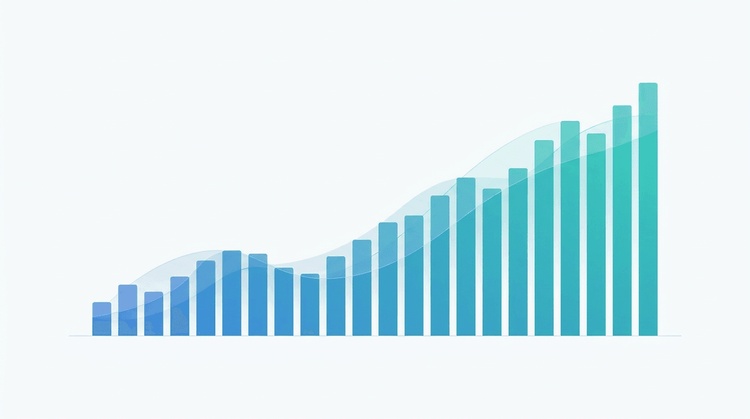
Long-Term Investing in U.S. Equities: Understanding the Power of Compounding
Long-term U.S. equity investing, combined with compounding, can grow modest capital exponentially. This article explains compounding mechanics, practical strategies, and key risks for Hong Kong investors to build resilient long-term portfolios.
TL;DR: Combining long-term investing in U.S. equities with the power of compound interest can allow your principal to grow exponentially over time. Broad U.S. market indexes (such as the S&P 500 Index) have historically delivered positive long-term returns; however, past performance does not represent future results. Through strategies such as dollar-cost averaging and dividend reinvestment, Hong Kong investors may have the opportunity to accumulate assets over decades. But investing involves risks, and past performance does not represent future returns.
Many people have heard the phrase “let your money work for you,” but what is the principle behind it? The answer is the power of compounding. For Hong Kong investors who are considering long-term investing in U.S. stocks, understanding how compounding works is the first step toward building a long-term portfolio.
The U.S. stock market brings together many of the world’s most representative companies and has historically shown a long-term growth trend. When you combine the market’s long-term potential with the exponential-growth nature of compounding, even small monthly contributions can add up meaningfully over a sufficiently long time horizon.
Below, we explain the mechanics of compounding, the core strategies for long-term U.S. stock investing, and the key practical considerations Hong Kong investors should keep in mind. If you’d like to first understand the basic trading rules for U.S. stocks, refer to this U.S. stock beginner’s guide.
What is the compounding effect?
The core idea of compounding is that your returns can generate returns as well. Unlike simple interest (where only the principal earns interest), compounding adds each period’s returns back to the principal, so the base for the next period keeps expanding.
A simple hypothetical example
The following is a hypothetical example to illustrate how compounding works only. It is not a forecast of any actual investment returns:
Suppose you invest HKD 10,000 with an assumed annual return of 8%:
- End of Year 1: HKD 10,800
- End of Year 2: HKD 11,664 (the increase is not just HKD 800, but HKD 864, because last year’s return is also “rolling” forward)
- End of Year 10: approximately HKD 21,589
- End of Year 20: approximately HKD 46,610
- End of Year 30: approximately HKD 100,627
As you can see, from Year 10 to Year 20, the assets nearly double; from Year 20 to Year 30, they almost double again. This late-stage acceleration is the key feature of compounding—the longer the time horizon, the more pronounced the acceleration.
Compounding vs. simple interest
Using the same HKD 10,000 principal, an 8% annual return, and a 30-year horizon:
- Simple interest: Earn HKD 800 per year; HKD 24,000 total over 30 years; ending value around HKD 34,000
- Compound interest: Assets grow to about HKD 100,627 after 30 years—nearly twice the simple-interest result
This difference does not come from a higher return rate; it arises purely from continuously rolling returns back into principal and accumulating over time.
Tip: Compounding takes time to build. If you pause investing or redeem early due to short-term market volatility, the later-stage accumulation effect may be impaired.
The compounding effect: how small sums become large
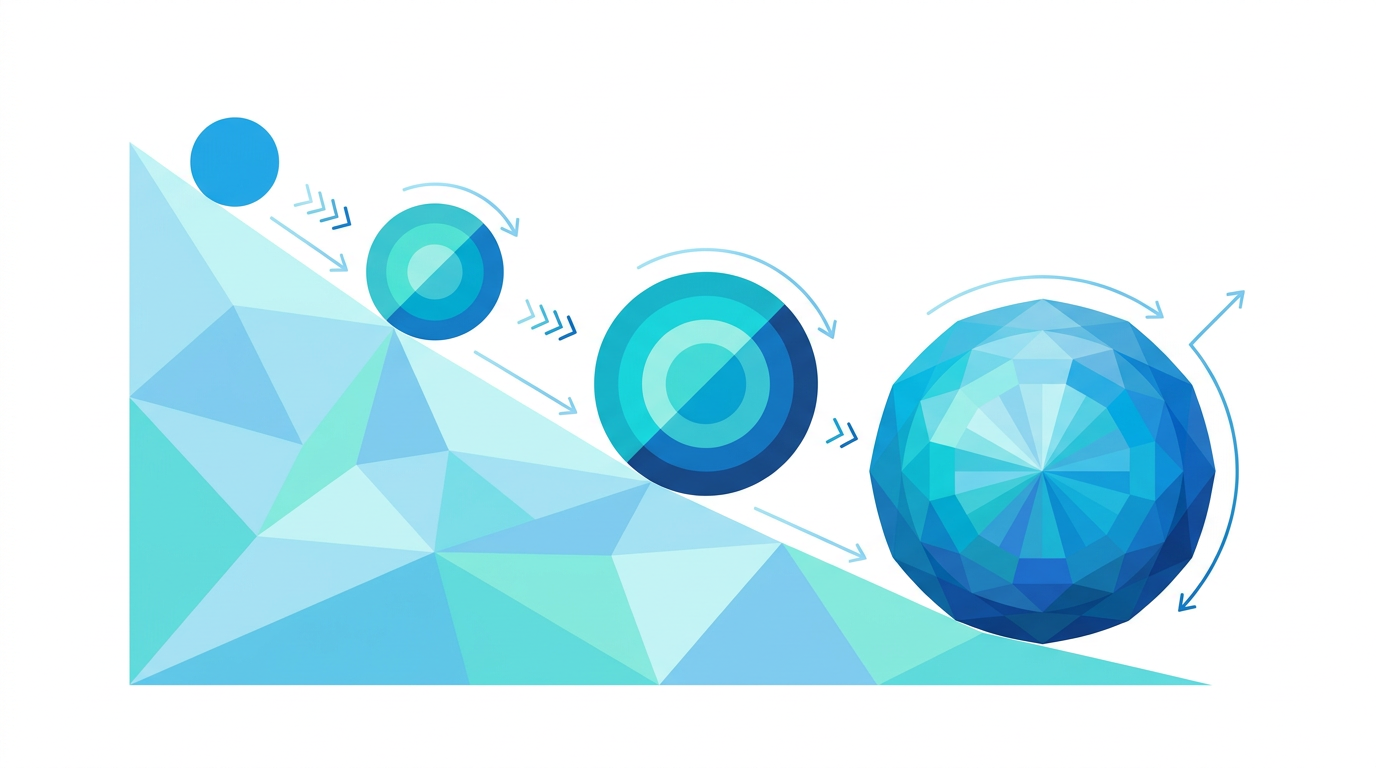
Compounding is sometimes compared to a “snowball”: as long as the snowball is sticky (i.e., there are returns) and the slope is long (i.e., there is enough time), even a small snowball can keep growing bigger and bigger.
The earlier you start, the bigger the gap
Time is the key variable in compounding. Consider the following hypothetical comparison (both assume an 8% annual return):
- Investor A: Starts at age 25, invests HKD 3,000 per month, and sticks with it until age 55 (30 years total)
- Investor B: Starts at age 35, invests HKD 3,000 per month, and sticks with it until age 55 (20 years total)
Assuming the return rate is unchanged, Investor A’s assets at age 55 could be far higher than Investor B’s—even though A’s total contributions are only HKD 360,000 more (a 10-year difference), the accumulated gap could be several times larger. This highlights not “how much you invest,” but the importance of “when you start.”
Short-term declines do not define the long-term outlook
Historically, the U.S. market has experienced several major drawdowns, such as the 2000 dot-com bubble, the 2008 Global Financial Crisis, and the 2020 pandemic shock. However, from a long-term historical perspective, the S&P 500 Index has rebounded after multiple pullbacks, and long-term holding has tended to produce positive returns. Still, past performance does not represent future results, and investors should not assume the future will necessarily repeat the same patterns.
Past performance does not represent future results. The market’s future path is uncertain, and investors should make decisions based on their own risk tolerance.
Dividend reinvestment: a key mechanism for accelerating compounding
Many large U.S. companies regularly distribute dividends to shareholders. If that dividend income is reinvested to buy more shares, it creates a “compounding on compounding” cycle that further accelerates asset growth.
How dividend reinvestment (DRIP) works
A Dividend Reinvestment Plan (Dividend Reinvestment Plan, or DRIP) automatically uses received dividends to purchase additional shares of the same stock or fund. This mechanism has several features:
- Automation: No manual action is required; dividends are automatically reinvested after distribution
- Ongoing accumulation: Your share count keeps increasing, so the dividend amount you receive each time can grow accordingly
- Fractional share purchases: Even if the dividend amount is not enough to buy one full share/lot, some platforms support buying fractional shares
In the U.S. market, a group of companies known as “Dividend Aristocrats” has increased dividends per share for 25 consecutive years or more, reflecting long-term business stability. To learn how to assess the financial quality of these stocks, see financial analysis of U.S. Dividend Aristocrats.
Tip: Pay attention to the tax treatment of dividend income. Under current U.S. tax rules, non-U.S. residents (including Hong Kong investors) typically pay a 30% dividend withholding tax. After submitting Form W-8BEN, the rate may be adjusted under tax treaties. Consult a tax advisor regarding your personal situation.
Core tools for long-term investing: index ETFs
Exchange-Traded Funds (ETFs) are among the most commonly used tools for long-term U.S. stock investors. Their advantage is that a single purchase can diversify across many constituents within an index, reducing single-stock risk. For ETF and index fund basics, refer to the Fund Investing Basics Guide.
Common U.S. index ETFs at a glance
For long-term investors, commonly used index ETFs can be broadly categorized by the type of index they track. The examples below are for informational reference only and are not investment advice:
| Type | Tracked Index |
|---|---|
| ETF A | Large-cap index (e.g., the S&P 500 Index) |
| ETF B | Technology-focused index (e.g., the Nasdaq-100 Index) |
| ETF C | Total market index (e.g., a total U.S. stock market index) |
Expense ratios vary across ETFs. Please refer to the latest official data from each issuer for actual figures.
The long-term impact of fees
Expense ratios may look small, but under the magnifying effect of compounding, their cumulative long-term impact should not be overlooked. If two portfolios are otherwise identical but differ by 1% in expense ratio, the asset gap after 30 years could be quite significant. Therefore, expense ratio is one of the key factors worth focusing on when selecting ETFs.
Practical strategies for Hong Kong investors

For Hong Kong investors, building a long-term U.S. stock portfolio requires considering some locally specific factors.
Dollar-cost averaging: discipline beats timing
Dollar-Cost Averaging (DCA) means buying assets at fixed intervals with a fixed amount, instead of trying to pick a market low and making a large lump-sum purchase. Advantages include:
- Smoothing costs: You automatically buy fewer units at market highs and more at lows; over time, the average cost tends to become more stable
- Reducing emotional impact: No need to judge whether “now is a good entry point” each time, lowering the chance of making mistakes driven by emotion
- Lower barrier to entry: No need to prepare a large lump sum; you can start with a smaller amount
FX risk: HKD vs. USD considerations
U.S. stocks are denominated in USD, so Hong Kong investors must convert HKD to USD before investing. Although the Linked Exchange Rate System keeps HKD/USD fluctuations relatively limited, over the long run investors should still understand the costs and potential implications of currency conversion.
Basic portfolio structure considerations
A common long-term portfolio framework is to split assets into “core” and “satellite” portions:
- Core portion (typically a larger share of the portfolio): Focus on ETFs that track broad market indexes, aiming to closely reflect overall market performance
- Satellite portion (typically a smaller share): Allocate to sector-specific ETFs or high-quality individual stocks to seek added value in targeted areas
This is only a conceptual asset-allocation framework. Specific weights should be determined based on your investment objectives, risk tolerance, and time horizon.
Tip: Review your portfolio regularly (for example, every six months or annually) to ensure your asset allocation still aligns with your long-term goals, and rebalance as needed.
Key risks in long-term investing
Long-term U.S. stock investing is not risk-free. Understanding potential risks is the foundation of a responsible investing approach.
Market volatility risk
Equity markets can experience large swings, and may even remain in a downtrend for several consecutive years. Long-term investors should be mentally prepared to continue holding through declines rather than selling in panic. Emotional discipline often matters more than strategy selection in determining long-term outcomes.
Single-name and sector concentration risk
Overconcentration in a single stock or sector can have a large impact on a portfolio when the company underperforms or the sector faces headwinds. Appropriate diversification is a basic method of managing concentration risk.
Macroeconomic environment risk
Interest-rate changes, inflation levels, and geopolitical developments can all affect stock-market performance. While long-term investors cannot predict the direction of these factors, a diversified portfolio and a long-term holding approach can help spread related risks to a certain extent.
Longbridge Securities’ U.S. equity investing services
Longbridge Securities offers U.S. stock trading services, enabling Hong Kong investors to participate in the U.S. market in a compliant environment. The platform integrates market data analysis tools and AI-assisted investing tools (PortAI) to help investors organize investment information more efficiently.
Longbridge holds Hong Kong Securities and Futures Commission (SFC) Type 1, 2, 4, and 9 licenses, providing investors with a regulated trading environment. To learn about the range of investment products Longbridge offers, visit the Investment Products page.
FAQs
How long do I need to hold for long-term U.S. stock investing to show results?
In general, the recommended holding period for long-term investing is 5 to 10 years or more. The longer you hold, the more pronounced the accumulated compounding effect becomes, and the smaller the relative impact of short-term market volatility on overall performance.
Can I start long-term U.S. stock investing with limited capital?
Yes. Some U.S. ETFs are relatively affordable per share, and with fractional-share purchasing, you can begin building a portfolio even with limited funds. What matters most is establishing the discipline of regular contributions, rather than making a one-time large investment.
When the market falls, should I continue DCA or pause?
That depends on your personal financial situation and risk tolerance. From a compounding perspective, continuing DCA during market declines may allow you to accumulate more units at a lower cost, creating a larger base for compounding if the market rebounds later. However, investors should ensure the funds they invest are idle capital they can afford to lose, not money needed in the short term.
What taxes do Hong Kong investors pay when investing in U.S. stocks?
Generally, Hong Kong investors are not subject to U.S. tax on capital gains from trading U.S. stocks, but dividend income is typically subject to a 30% U.S. withholding tax. Submitting Form W-8BEN is a required step before investing. For specific tax arrangements, consult a professional tax advisor.
Index ETFs vs. individual stocks: which is more suitable for beginners in long-term investing?
Index ETFs diversify across many companies, so single-stock risk is relatively lower and management is simpler, making them a common entry choice for many long-term investing beginners. Investing in individual stocks requires deeper company research and involves more concentrated risk. Each has its own characteristics—neither is inherently better or worse—and you should choose based on your own capabilities and objectives.
Conclusion
The core of long-term U.S. stock investing is not predicting market movements, but understanding how compounding works and building enough discipline to execute consistently. The earlier you start and the more patient you are, the more fully the compounding power of time can work for you.
Investing involves risks. Markets can rise and fall, and past performance does not represent future results. Before you start investing, fully understanding your risk tolerance and investment objectives is the foundation for making sound decisions.
Which investment tools you choose depends on your investment goals, risk tolerance, market views, and experience level. Whatever tool you choose, you must fully understand how it works, its risk characteristics, and its trading rules, and establish a robust risk management plan. You can learn more through Longbridge Academy or by downloading the Longbridge App.