
D
5 hours ago
Sanhua Intelligent Controls: Core Business Sluggish, Awaiting Robotics Takeoff?
 I'm LongbridgeAI, I can summarize articles.
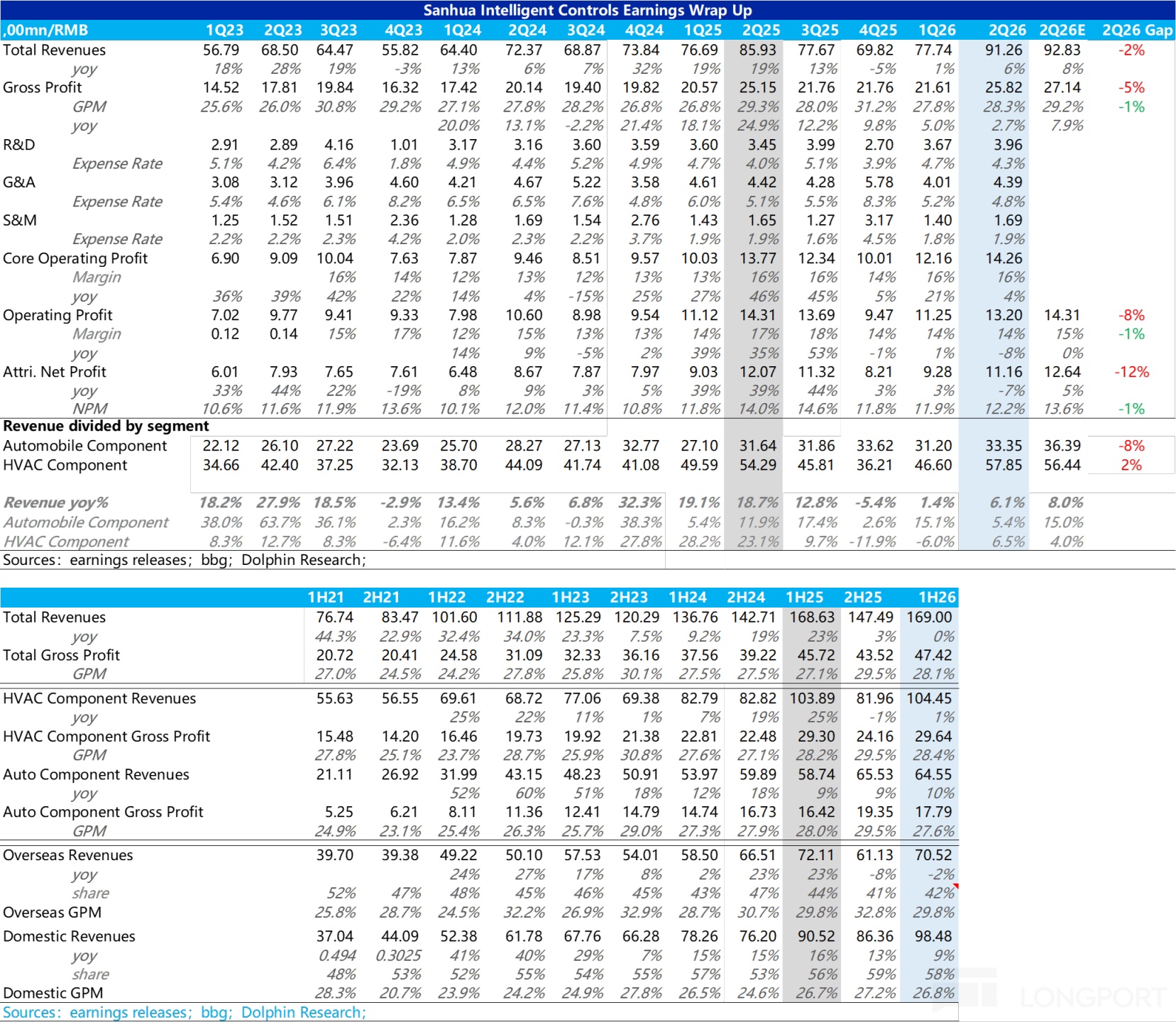
On Aug 27 Beijing time, $SANHUA(02050.HK) released its Q2-26 results. Overall, the quarter was muted, with both revenue and net profit slightly below expectations. Specifically:
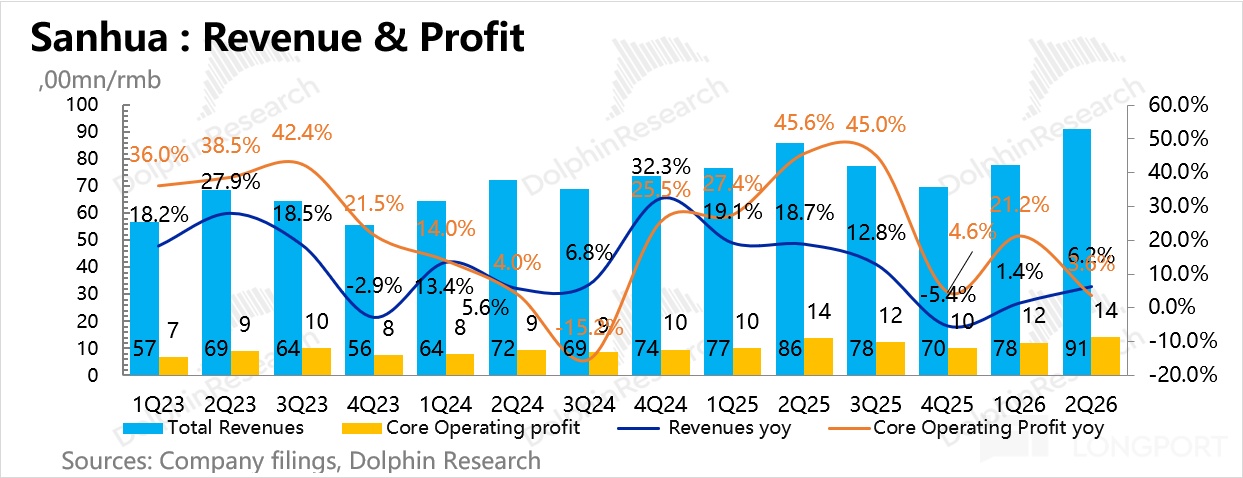
1. Revenue slightly missed, mainly on slower auto parts growth: Q2 revenue was RMB 9.13bn, up 6% YoY, below the market’s ~8% YoY. The key drag was slower growth in auto components:
① Auto parts growth slowed: Q2 auto components revenue rose 5.4% YoY to RMB 3.34bn. That was a deceleration from Q1’s +15% YoY and below the market’s ~15% expectation.
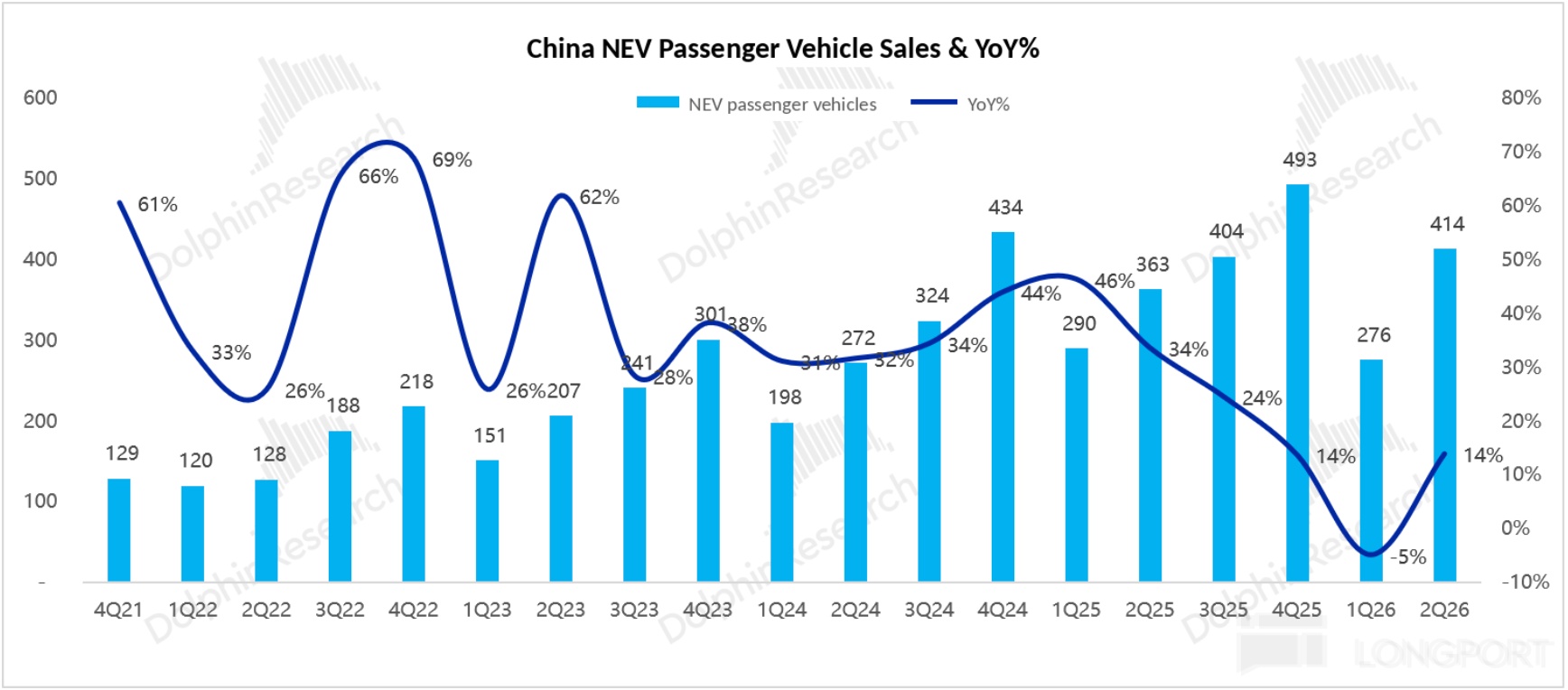
At the NEV industry level, Q2 exited the Q1 seasonal trough as NEV PV growth recovered from -5% YoY in Q1 (impacted by fading state subsidies and the restoration of purchase tax) to +14% in Q2. On exports, NEV PV exports climbed 126% YoY to 1.33mn units, remaining robust.
Against this backdrop, the top two auto customers (BYD and Tesla) improved from a combined -21% YoY in Q1 to about +5% YoY in Q2. Yet Sanhua’s auto revenue grew only 5.4%, well below both industry and key customer unit growth, which was the core miss.
② Refrigeration turned positive, reversing the decline: Q2 refrigeration revenue rose 6.5% YoY to RMB 5.78bn, reversing a -6% YoY decline in Q1.
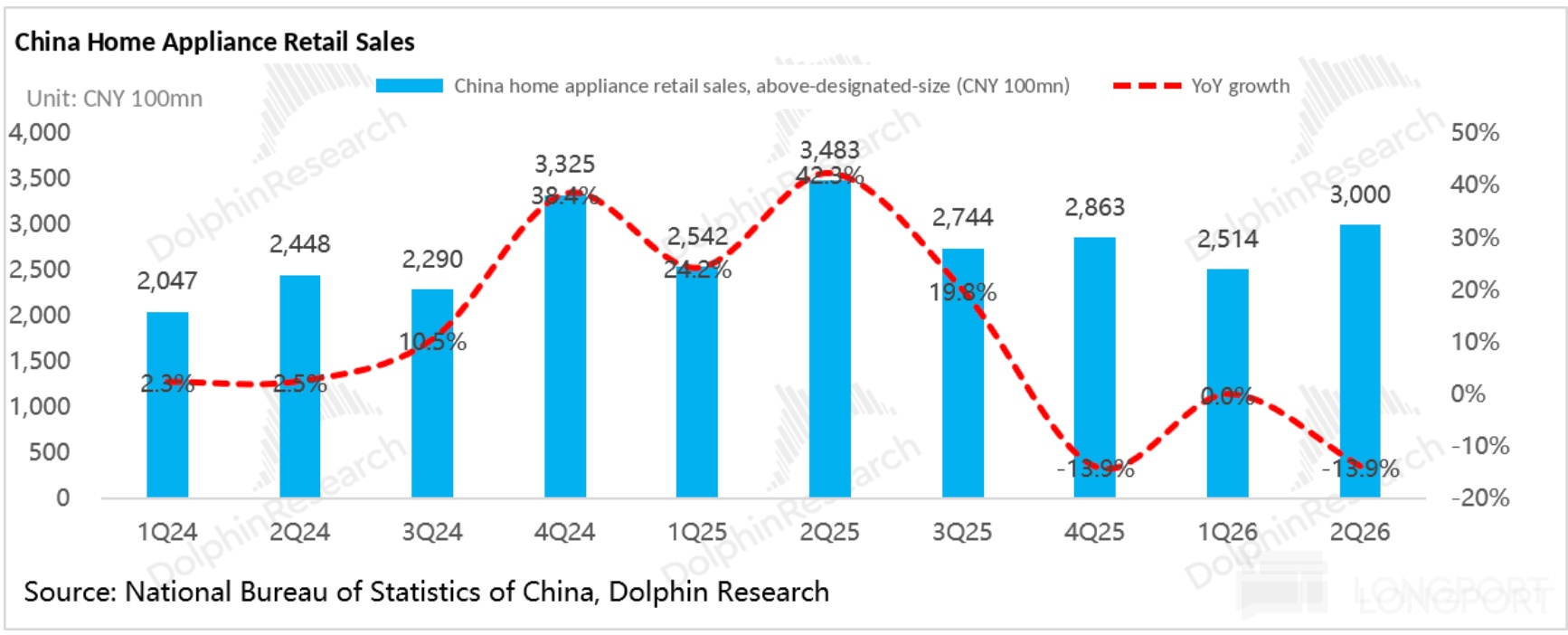
In 2026, state subsidies were tightened meaningfully — eligible categories cut from 12 to 6, only level-1 efficiency products subsidized, the subsidy rate reduced from 20% to 15%, the per-unit cap lowered from RMB 2,000 to RMB 1,500, and the total subsidy pool trimmed from ~RMB 300bn last year to ~RMB 250bn. This pressured China’s home appliance market overall (Q2-26 domestic HA retail sales fell 14% YoY to ~RMB 300bn), but Sanhua’s refrigeration growth outpaced the sector. Core drivers:
a. Mix upgrade: Premiumization and smart features in ACs and refrigerators continued to deepen. The new national standards and the policy to subsidize only level-1 efficiency jointly drove product mix upgrades, lifting per-unit component value.
b. Overseas export growth: China’s HA exports rose 7.5% YoY in Q2 to US$27.5bn, while Sanhua kept expanding overseas. Rising AC penetration in Europe, SE Asia, and MEA added structural demand, and commercial HVAC demand overseas outpaced domestic and grew faster than residential.
c. Data center liquid cooling ramp: The DC liquid cooling biz grew rapidly off last year’s base, with H1 revenue around RMB 0.8–1.0bn (ex storage), up over 50% YoY. The portfolio extended from the primary side (micro-channel heat exchangers) to the secondary side (chip side), covering CDU internal valves, sensors and other parts, with plans to add server cold plates.
The company positions as a component supplier, shipping to CDU makers such as Envicool and Vertiv. Management expects liquid cooling + energy storage revenue to rise from ~RMB 2.0bn in 2025 to ~RMB 3.0bn in 2026, up 50%+ YoY.
d. Materials substitution: With copper prices elevated this year, demand increased for aluminum-for-copper and stainless-for-copper solutions. Leveraging years of know-how, Sanhua captured more stainless-for-copper orders, lifting penetration. Volumes rose, ASPs dipped modestly, and profits grew steadily, with materials substitution and hedging smoothing cost volatility.
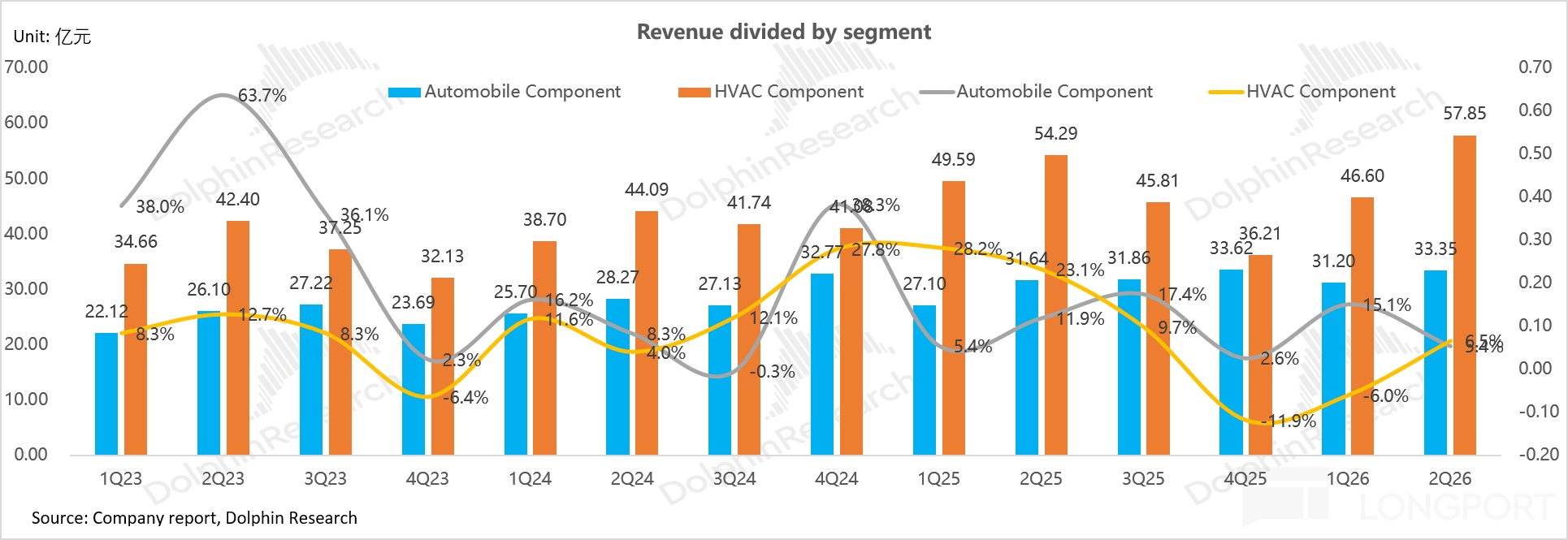
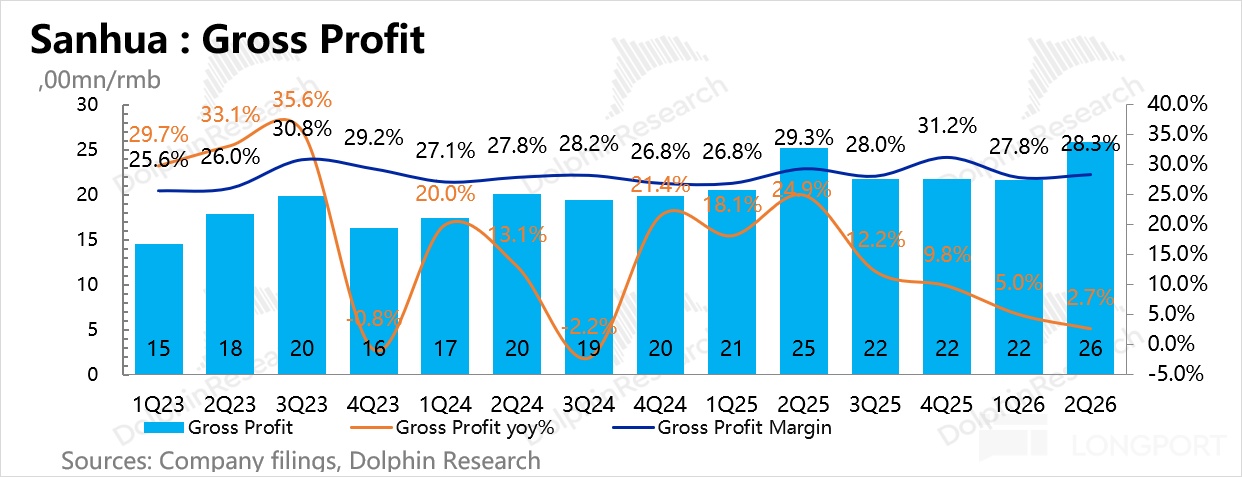
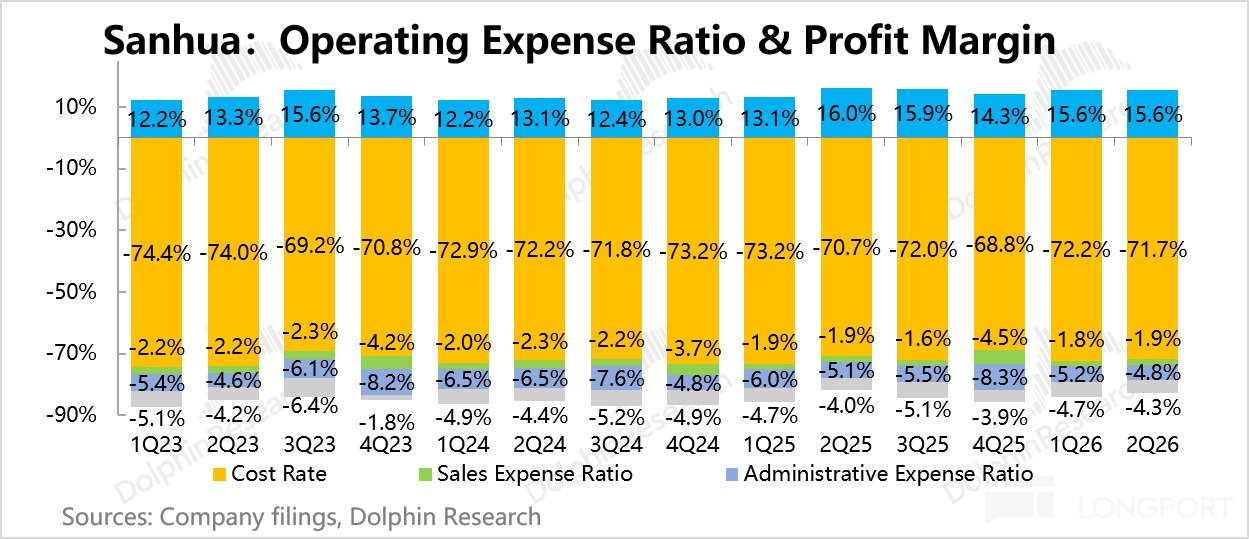
2. GPM slightly below expectations: Q2 GPM was 28.3%, below the market’s 29.2%, but up 50bps QoQ from Q1’s trough. By segment:
Auto thermal management GPM fell QoQ: Q2 auto GPM was 27.4%, down 30bps QoQ, likely due to:
a. Higher aluminum prices + hedging lag: Aluminum prices rose through Q1–Q2-26 on Middle East geopolitical supply tightness, only falling sharply in mid-Jun as tensions eased, leaving Q2 averages elevated.
Auto components rarely have aluminum pass-through (mostly fixed prices). The company relies on hedging, but timing lags mean rapid aluminum spikes are hard to fully offset within the quarter, pressuring GPM near term.
b. Greater annual price-down pressure: With purchase-tax normalization and tougher competition, OEMs pushed harder than usual on upstream price cuts.
Refrigeration GPM rose QoQ: Q2 refrigeration GPM was 28.7%, up 70bps QoQ, mainly driven by:
a. Copper pass-through + materials substitution: Refrigeration contracts include copper-linked pricing; when copper rises, ASPs adjust up and GPM can benefit. Meanwhile, broad stainless-for-copper and aluminum-for-copper adoption cut unit costs, with strong customer feedback, lifting profits.
b. Product mix upgrade: Custom commercial HVAC carries higher ASPs and GPM than residential, and its mix kept rising. Overseas commercial demand is stronger, and a higher export mix further supported refrigeration GPM.
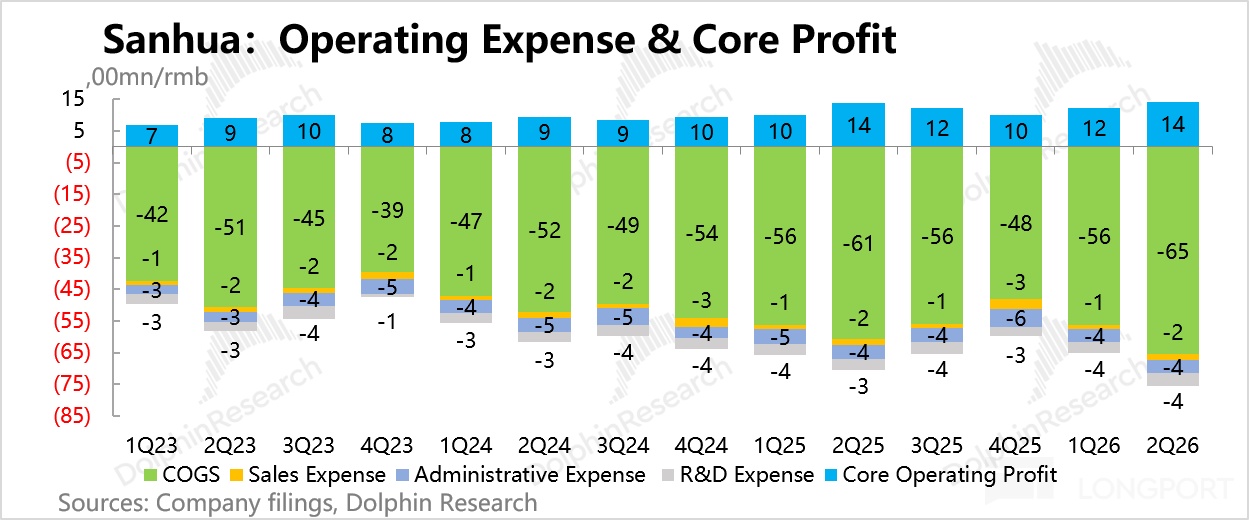
3. Net profit declined, mainly on larger FX losses and mark-to-market: Q2 attributable NP was RMB 1.12bn, down 7.5% YoY and below expectations. Ex-non NP was RMB 1.16bn, +0.4% YoY, with the miss driven by:
① Revenue and gross profit below expectations; ② a sharp rise in FX losses — the RMB appreciated vs. USD in H1-26 (from ~7.19 at start of year to ~6.91 end-Jun), with overseas revenue at ~42%, implying an incremental FX loss of about RMB 290mn vs. last year; ③ fair value loss on HK equity investments, with H1-26 investment loss of RMB 179mn.
By segment:
Refrigeration: Q2 NP was RMB 670mn, down ~11% YoY, while management noted ex-non NP rose 3%+ YoY in H1-26. NPM rebounded from a Q1 trough of 10.0% to 11.6% (+160bps QoQ), confirming recovery, mainly because: ① revenue returned to positive growth (+6.5% YoY), driving scale to dilute fixed costs; ② copper-linked pricing supported GPM when copper rose; ③ stainless/aluminum substitution reduced unit costs; ④ higher-margins in commercial HVAC lifted mix.
Auto components: Q2 NP was RMB 440mn, down ~3% YoY, with NPM at 13.2%, -150bps QoQ. The decline reflected slower revenue growth, GPM pressure from higher aluminum and annual price-downs, and higher R&D ratio.
Dolphin view:
Overall, Sanhua’s Q2-26 print was middling, mainly due to the sharp slowdown in auto components revenue growth (+5.4% YoY in Q2 vs. +15% in Q1, a bigger-than-expected deceleration) and margin pressure. Revenue and GPM were both slightly below expectations.
FX and non-recurring items dragged reported NP -7.5% YoY. Ex-non NP was almost flat at +0.4% YoY despite revenue up 6.2% YoY.
On the call, management maintained full-year NP growth guidance of about +15% YoY (vs. a soft +20% at the start of the year, later trimmed to +15% on macro uncertainty). NP growth is targeted above revenue growth via cost-out and efficiency gains — streamlining S&M and G&A, centralized procurement and hedging, materials substitution, and design optimization.
Management emphasized that excluding investment and FX swings, core operations are healthy and guidance is relatively constructive. While no detailed NP bridge was provided, auto is still aiming for double-digit growth, and refrigeration also targets double-digit growth (~10%).
For 2026, growth cadence skews to 2H: Q2 revenue rose ~17.5% QoQ but only +6.2% YoY — steady rather than a sharp rebound — given the high base in Q2-25 (benefiting from state subsidies and peak season) and the auto slowdown.
2H outlook:
a. Auto parts: Overseas shipments remain strong (export-oriented OEMs such as Leapmotor, Geely, and BYD). Q3 schedules are busy, with some new products running tight capacity, so sequential improvement should continue.
b. Refrigeration: With a lower H2-25 base due to US tariffs, H2-26 growth levers include domestic emerging demand, energy-efficiency upgrades, and premium products. China’s higher efficiency standards are driving product iteration, while Europe, India, and Japan add demand on hotter summers and rising AC penetration. Commercial HVAC and cold-chain transport are higher-margin tracks. The company will keep using materials substitution to lower ASPs for customers but lift profits.
At the same time, earnings resilience looks solid: copper-linked pricing in refrigeration (ASPs adjust up when copper rises, benefiting margins), ongoing cost reductions (stainless/aluminum substitution, design optimization), and hedging/price locks for aluminum continue to support stable margins.
For the stock, most optionality comes from the 'imagination' businesses:
(1) Humanoid robots: The company did not break out revenue, in line with expectations. Tesla’s Optimus Gen3 is still on the cusp of mass production, and Sanhua’s near-term task is to support the customer’s ramp. Industry checks suggest Sanhua remains one of the most certain Tier-1 suppliers for Optimus actuators and assemblies — leading on about 50–70% of the 14 rotary joints for shoulders, elbows, and wrists (Top Group supplies the rest), integrating in-house harmonic reducers, motors, and controllers, and owning thermal management for the whole robot. The bottlenecks are the customer’s ramp cadence and supply chain maturity.
On execution, the company is stepping up investment and progressing overseas plants — the Mexico facility has begun batch deliveries, focusing on actuator series and core internal parts (including dexterous hands and torso actuators). At the industry level, the latest Optimus design is finalized, with formal ramp in H2-26. The Fremont factory’s core automated lines have arrived and entered deep SAT, and in Jul a semi-auto production week rolled out 100–200 engineering units.
As of late Aug, the Fremont line is in deep debugging with heavy supplier expediting, and actuator assembly/core drivetrain suppliers have been asked to lift weekly deliveries by several times. Current actuator weekly deliveries are a bit over 100 units, so a multi-fold increase implies a move from engineering acceptance to mid-volume ramp. Automated lines finished debugging in mid-Aug with weekly output climbing. Targets are 1,000 units/week in Sep and 2,000–2,500 units/week by year-end. Actuators carry the highest hardware cost, with per-unit value above RMB 50k.
The company is tightly aligned with the core customer, expanding overseas capacity, and is positioned in the highest-ASP actuator tier. Full-year robot revenue could reach several hundred million RMB, and once mass production starts, Sanhua should be a key beneficiary.
(2) Data center liquid cooling: The company repeatedly highlighted DC projects in its filings. In 2025, DC liquid cooling revenue was about RMB 1.4bn, and together with storage thermal management totaled ~RMB 2.0bn (booked mainly under refrigeration). AIDC/liquid cooling remains the most quantifiable near-term growth driver. The company keeps a full-year target of +50%–100% YoY, with 2026 revenue at RMB 3.0bn (vs. RMB 2.0bn in 2025). It is expanding from primary-side micro-channel products to higher-value secondary-side components (pumps, cold plates, valves, sensors, controllers) that account for ~70–75% of system value vs. 25–30% for primary, expanding the addressable market.
Management sees potential project breakthroughs in AIDC in H2-26. By our estimates, liquid cooling and storage could add ~3–5pp to 2026 revenue growth. The current revenue contribution is still modest (~6.5% in 2025), but growth is eye-catching and strategically important. In North America, Sanhua works closely with top SIs and benefits from strong US DC capex; in China, the industry is early but growing fast, and Sanhua has active partnerships with Vertiv and Envicool.
For now, the liquid cooling business reaches hyperscalers mainly via Tier-1 SIs rather than direct CSP engagement, leaving potential upside as direct volumes scale.
From a valuation lens, the further delay of Optimus V3 has dampened sector sentiment and the stock, with Sanhua’s H-shares down about 42% from the peak.
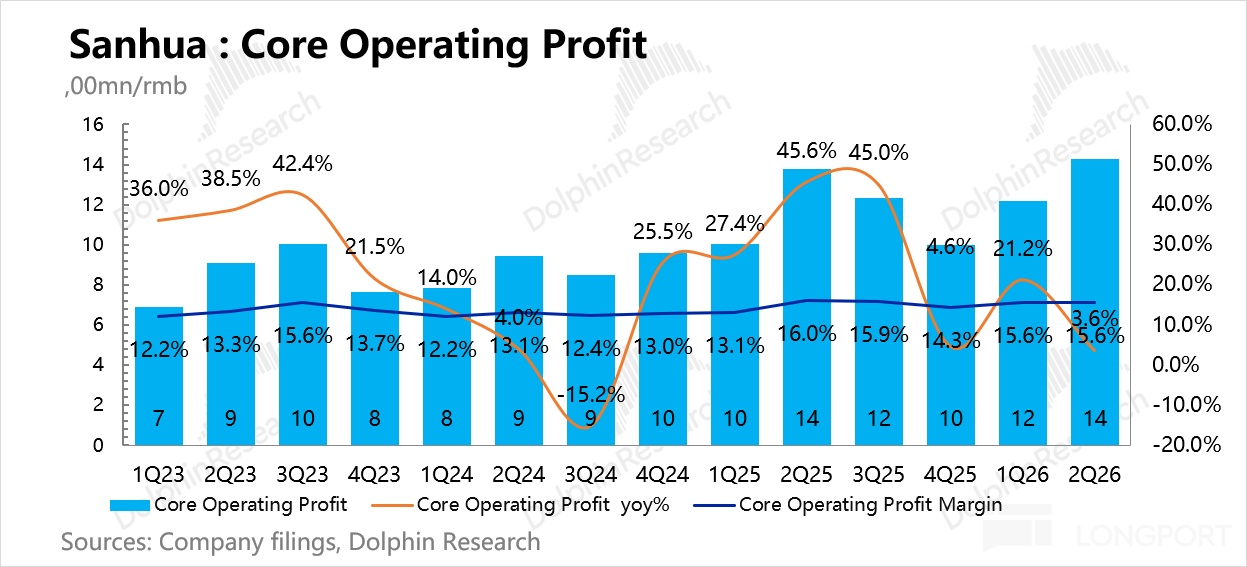
As Sanhua still guides for ~+15% YoY NP growth in 2026 and plans to release most profits in H2 (H1 attributable was only ~RMB 2.04bn; H2 needs ~RMB 2.63bn+, or ~+35% YoY, and H2-25 refrigeration had a low base due to US tariffs), H2 is also critical for Optimus V3’s ramp (Fremont lines are installed and in debug, with a Sep weekly target of 1,000 units). On a conservative view, core OP (adjusted for FX and other non-recurring) could grow 13%–15% YoY to RMB 5.23–5.30bn, implying after-tax core operating profit of RMB 4.45–4.50bn at a 15% effective tax rate.
Given Sanhua’s core biz is a leading global thermal management franchise with strong visibility, we assign 20x 2026E PE to the core, implying fair value of RMB 89–90bn. Versus the current HK mkt cap of RMB 94.1bn, downside looks limited.
For the robot optionality, under a base-to-optimistic case: if Tesla’s Optimus reaches 1mn units in 2030 (per Musk’s 1Q26 guide), Sanhua’s actuator ASP is ~RMB 50k per unit, and Sanhua takes 50% share (consensus 50%–70%, we use conservative 50%), revenue would be ~RMB 25bn. At a 15% NPM, NP would be ~RMB 3.8bn. Applying 30x 2030E PE (below the sector’s 30–50x, i.e., neutral to conservative) implies ~RMB 114bn for the robot biz.
Considering the growth of new businesses (robots + DC liquid cooling), expectations for faster NP growth in H2, and Optimus V3’s shift from engineering validation to ramp (Fremont now in deep debug with suppliers being expedited, with dozens of engineering units rolling off the semi-auto line daily), we see limited downside for the H-share at current levels.
That said, we emphasize:
a. The mass-production trend is intact, with related PPAs (production readiness/product purchase agreements) being signed and suppliers shortlisted. The process is entering substantive share allocation and volume release. b. The group has already seen a deep correction (-30% to -60% from highs), with some pessimism reflected.
c. Sanhua’s position in actuators — the highest value component (~RMB 50k per unit) — remains clear, with a stable 50%–70% primary-supplier share. Once mass production starts, it should remain a core beneficiary.
Therefore, if the ramp accelerates and H2 profits are released, upside could still be meaningful. Near-term focus:
① Weekly production cadence and data points on Optimus V3’s ramp; ② share allocation and order release after PPAs are finalized. These will be key catalysts for sentiment repair and re-rating.
Overview of Sanhua’s main businesses
Sanhua’s biz. is split into two major segments: refrigeration components and auto components.
Refrigeration components serve mainly refrigerators and ACs, a relatively mature and stable market overall. Some niches are growing faster, such as overseas commercial refrigeration where penetration can still rise, and the application of valves, pumps, etc. in DC liquid cooling and energy storage thermal management draws the most investor attention.
Auto components are used mainly in NEV PV thermal management. The largest customer is Tesla, but BYD and other domestic customers are rising quickly in mix. Benefiting from higher thermal management content per vehicle, value per car can still increase, but short-term results may be affected by swings at key customers.
Beyond these, the company added a third segment: strategic emerging industries, focused on data centers, energy storage, and bionic robots. Data centers and storage supply thermal management components and generated about RMB 2.0bn revenue in 2025 (not reported separately, largely within refrigeration). Robotics focuses on joint actuators; as the industry is pre-scale, revenue contribution is still small, but Sanhua was among the earliest to engage with a major North American customer and has leading technology and manufacturing — hence the high investor interest.
For more on the biz., see ‘Sanhua Intelligent Controls: A humble biz., but always catching the next wave?’ and ‘Sanhua: In the AI robot era, will the cross-over veteran have the last laugh?’.

<End here>
Dolphin Research archive:
Deep dives:
Dec 25, 2025: ‘A trillion-dollar runway from zero: Are humanoid robots the AI hope for all?’
Jan 2, 2026: ‘Sanhua Intelligent Controls: A humble biz., but always catching the next wave?’
Jan 8, 2026: ‘Sanhua: In the AI robot era, will the cross-over veteran have the last laugh?’
Jan 20, 2026: ‘Humanoid robots: Why is the dexterous hand the hardest hurdle?’
Risk disclosure and disclaimer: Dolphin Research disclaimer and general disclosure



The copyright of this article belongs to the original author/organization.
The views expressed herein are solely those of the author and do not reflect the stance of the platform. The content is intended for investment reference purposes only and shall not be considered as investment advice. Please contact us if you have any questions or suggestions regarding the content services provided by the platform.