

Nebius: Flashy Numbers Look Padded; Compute Delays Are the Real Overhang
 I'm LongbridgeAI, I can summarize articles.
AI neocloud $Nebius(NBIS.US) reported Q3 results pre-market on Nov 12 (ET). Headline numbers looked strong, with both growth and profitability beating estimates, and GAAP OP turning positive for the first time.
However, after CoreWeave’s strong print, NBIS rallied approx. 15% the next day, front-running a good quarter. A closer look reveals several issues: delays in bringing capacity online drove a notably weaker-than-expected 4Q revenue guide, RPO was essentially flat QoQ, and the 2027 guide was underwhelming.
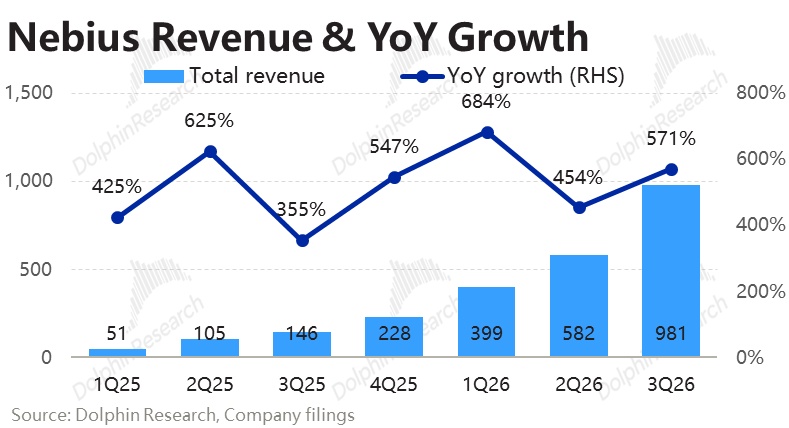
1) Revenue: +68% QoQ, but approx. $330 mn was one-off
Q3'26 revenue was $980 mn, a net sequential add of roughly $400 mn and slightly above the $930 mn consensus. AI cloud revenue was $970 mn, accounting for about 99% of the total.
Roughly $330 mn came from a one-off activation under the asset-light first-phase model, which management expects to become more regular. With construction progress slipping, the revenue beat likely leaned on this one-off and was of lower quality.
ARR at quarter-end was about $6.4 bn, doubling from $3.0 bn at end-Jun and nearly 40% above consensus, but likely distorted by the one-off. The company will no longer use ARR as a KPI, and the prior YE target of $7–9 bn is pushed to >$7 bn by Feb next year.
2) Bookings and pricing: higher unit price and prepay mix, but flat RPO
New Q3 contracts carried annualized revenue per MW above $25 mn, vs. above $20 mn last quarter, and per GPU-hour pricing was over 20% above the 2Q average. Management again highlighted that 3–6 month cluster pricing is more than 2x reserved pricing.
The market has largely digested higher compute rental pricing. This is not an incremental positive.
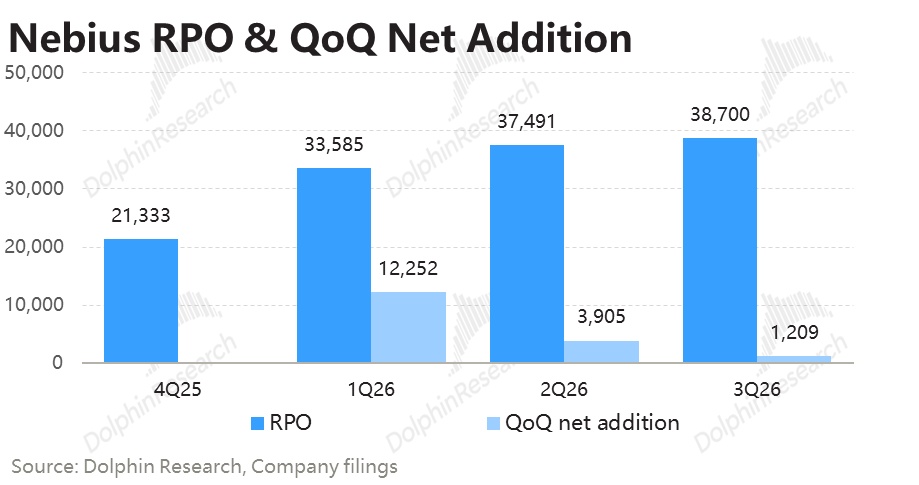
Meanwhile, bookings growth slowed notably: quarter-end RPO was about $38.7 bn, up only +3% QoQ (~$1.2 bn). This suggests either more capacity was reserved for flex-priced short-dated deals, or signings ran into issues in 3Q.
On the positive side, management said new contracts signed since 3Q exceeded $12 bn, including several billion in 5-year deals. Most were signed after quarter-end and will show up in 4Q RPO, pointing to a rebound in bookings.
3) Capacity go-live and Capex: slower ramps, capex still ramping
Multiple third-party colocation sites have shifted deliveries into 1H27. In New Jersey, for the MSFT project, over half of contracted capacity will be delivered by year-end, with the rest pushed to 2Q27, while self-build sites are on or ahead of schedule and the U.S. election does not impact self-build or colo sites.
The company cut its 4Q revenue guide and delayed its timeline to reach $7 bn ARR, driven by construction delays. This is a major problem for a neocloud provider that must rapidly move from financing to production revenue.
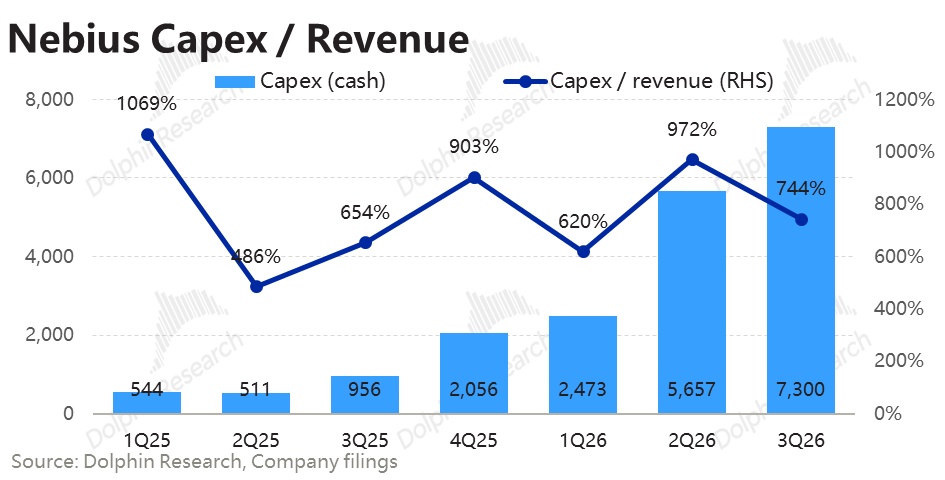
Capex was about $7.3 bn this quarter, nearly +30% QoQ and roughly in line with consensus, at ~7x revenue. On a revenue multiple basis capex intensity appears lower, but excluding the asset-light one-off, it was ~11x cloud rental revenue.
In other words, despite slower capacity ramps, capex outlays did not ease. They in fact moved higher.
4) Cash flow and financing: OCF turned negative; net debt position
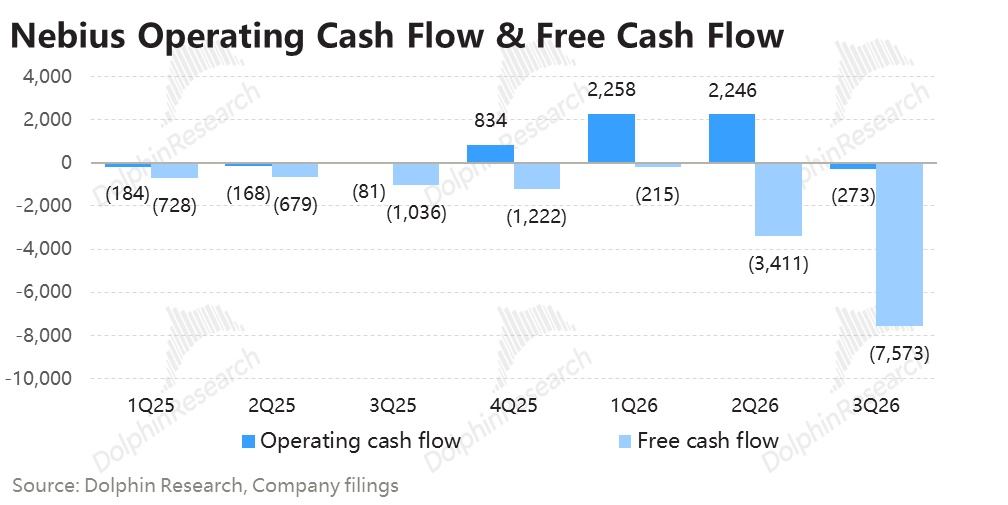
Given heavy capex and operating cash flow of -$270 mn (vs. roughly +$2.25 bn in each of the prior two quarters), free cash outflow was about $7.6 bn, far below expectations. This was a major miss on cash generation.
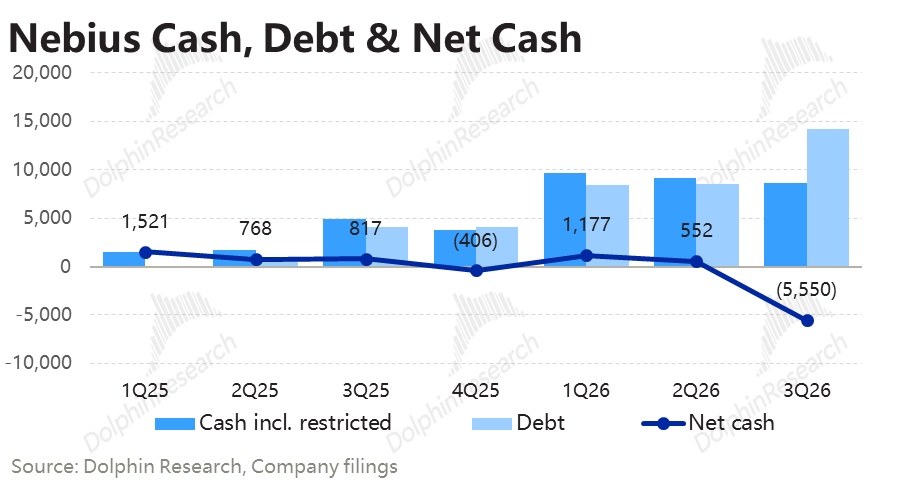
With cash down and about $5.7 bn in new debt, the capital structure swung from net cash to roughly $5.5 bn net debt. While equity funding had been the primary source historically, spending pressure has pushed leverage through an inflection point.
Weak OCF primarily reflected a marked $3.8 bn rise in accounts receivable. This signals delayed customer cash payments.
Encouragingly, similar to CoreWeave, over 90% of contracts longer than one year signed in 3Q included prepayments. Those prepayments can now cover 100% of the related capex (vs. 50–60% last quarter), which should meaningfully ease future cash flow pressure.
The company also signed its first 5-year AI cloud contracts (all expansions by existing clients on new capacity), and added multi-year deals with Databricks, DDOG, SNOW and other non-AI lab customers. The customer base continues to diversify.
5) Margins: well ahead of expectations, but boosted by one-off and lower D&A
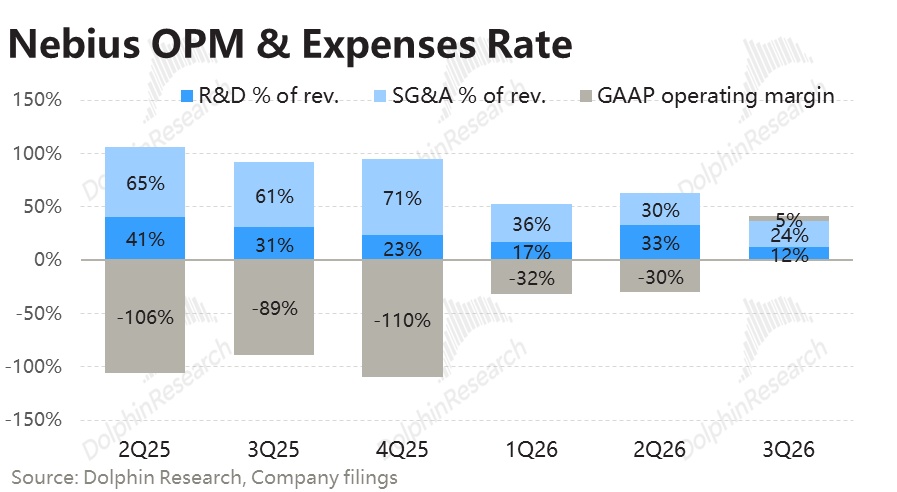
Adj. EBITDA was $470 mn with a 47.5% margin, about +900 bps above consensus and improving for the third straight quarter. The AI cloud segment posted a 53.2% adj. EBITDA margin vs. 49.7% in 2Q, and GAAP OP was $50 mn, turning positive.
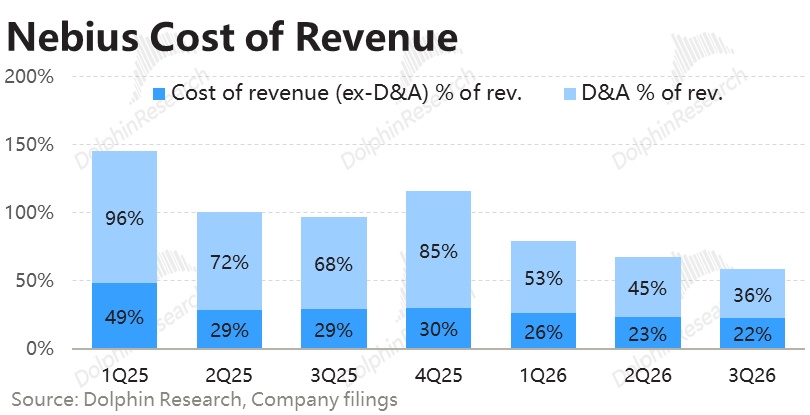
Two factors inflated the beat: first, the ~$330 mn asset-light one-off, which carries high margins and minimal capex; and second, depreciation of $350 mn, roughly 40% below consensus, with D&A as a percent of revenue down from 44.6% to 36.2%. These effects lifted profitability in the quarter.
The likely driver was delayed capacity, leaving a large pool of assets not yet in service and not depreciating. As those delayed assets go live, depreciation should step up materially, and much of the GAAP OP beat should unwind.
The CFO noted that in 4Q the company must bear rent, power and staffing ahead of site go-live, and the full-year ~40% margin guide implies 4Q margins around 35%. This signals a sequential margin dip into year-end.
6) 4Q and full-year guide: revenue cut for this year, 2027 capex far above
With some third-party capacity now pushed into 1H27 (management says the associated contracts remain intact), the FY26 revenue guide was cut from $3.0–3.4 bn to $3.0–3.2 bn. This implies 4Q revenue of ~$1.04–1.24 bn, about 17–31% below consensus.
Based on the full-year EBITDA margin guide, 4Q margin is implied at ~35–36%. That is also below expectations.
Full-year capex was raised to roughly $27 bn, implying 4Q capex of about $11.6 bn and ~27% above consensus. Growth is slowing while investment is accelerating, and the year-end contracted power target of 5 GW is unchanged.
7) 2027 guide:
Revenue of $12–13 bn (~4x this year), with the midpoint about 1% below consensus on conservative build assumptions. Capex of $40–45 bn, with the midpoint ~34% above consensus, again showing no upside on growth but rising investment.
Positively, customer prepayments of $17–20 bn, together with contract-backed financing, are expected to cover 75–85% of capex. Subsequent investment is largely customer-funded.
Management expects pre-tax breakeven in 4Q27 (including interest; GAAP basis not specified). The pace of margin inflection is better than expected.
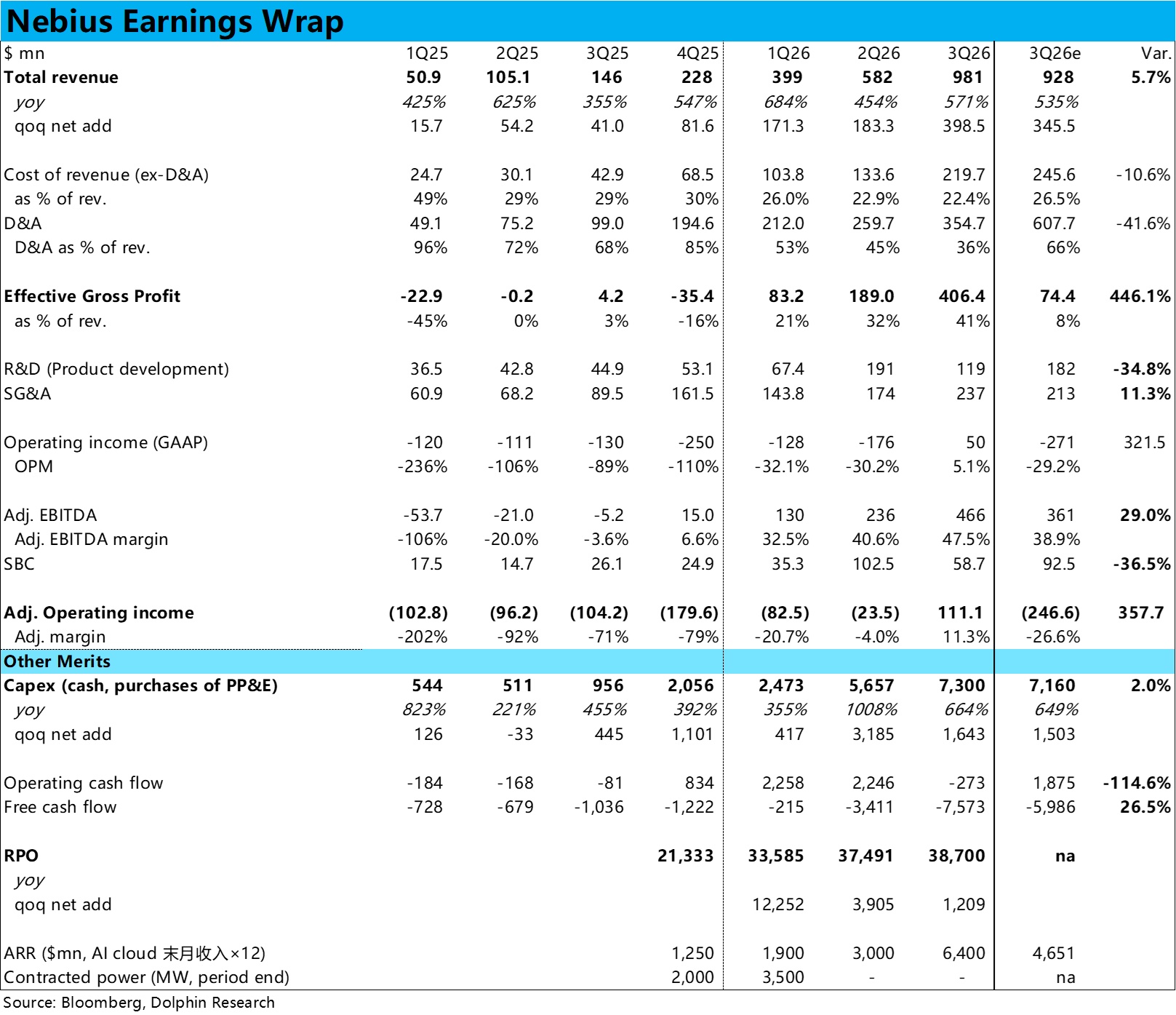
8) Core metrics at a glance; see link for call transcript
Nebius earnings call transcript: 'Nebius (Trans): Prepayments fully cover capex; revenue to quadruple next year'
Dolphin Research view:
1) This quarter’s print in summary
The print looks flashy at first glance, but there are several underlying issues. The revenue and profit beat largely reflect a one-off asset-light contribution and lower depreciation due to delayed capacity; delays in go-live, slower booking intake, and investment accelerating despite no upside to growth drove weaker cash flow and a deteriorating balance sheet.
Meanwhile, price hikes and the positive of funding capex via prepayments and contract-backed loans were already evident in CoreWeave’s results and priced in, and the stock had rallied ahead. This quarter is a mix of realized known positives and negative surprises.
2) Key focus areas
Core issue #1: Price hikes are priced in; volume cadence and ROI matter more
Unit prices and prepayment ratios on new contracts keep rising, and auction/spot pricing exceeds list, confirming a seller’s market and healthy fundamentals for cloud providers. But Nebius’s late-Sep price hikes were well telegraphed and CoreWeave confirmed similar moves, so this round is already in the price and not an incremental positive for NBIS.
Near-term, the setup skews negative for NBIS: few new orders were booked in 3Q with several large deals signed post-quarter, and 4Q revenue and margins will be dragged by delayed go-lives. This weakens the near-term trajectory.
Next year’s revenue should be achievable against the current guide, as assumptions on go-live timing are conservative and asset-light revenue is excluded. Management also indicated 2027 deliveries are being priced higher and customers are already seeking 2028 capacity.
More fundamentally, bookings, prepayments, next year’s revenue target and access to capital all assume sustained supply tightness and large customers remaining willing to sign with neoclouds. Management acknowledged that supply and demand will eventually balance, and once they loosen, bookings, prepayments and financing would all compress together.
Core issue #2: Financing — customers are footing the bill, but at what cost?
Prepayments have become the primary funding source: prepayments on new long-term deals can cover associated capex, and next year prepayments plus contract-backed debt can fund most capex, mirroring CoreWeave’s shift. Management also said they will flex the mix of long vs. short contracts by financing conditions: when financing is tight, sign more long-term with higher prepay; when financing is cheap, hold back for high-priced short-dated and spot.
This suggests it is getting harder for neoclouds to raise capital independently, increasing reliance on long-term customers. That reliance also limits NBIS’s ability to allocate capacity to higher-price-elastic short deals and weakens bargaining power when negotiating with anchor customers.
Core issue #3: Delayed capacity ramps are the biggest problem this quarter; the MSFT contract appears intact
For a neocloud, the race from financing and construction to revenue is all about time; delays mean idle capital. The P&L already shows that last quarter’s large equipment adds did not convert to revenue, and depreciation did not follow.
The proximate cause is power at third-party colo sites such as New Jersey: temporary generation was removed early and replacement fuel cells are ramping slowly. Since late Oct, MSFT flagged delays at some third-party sites, with chatter about NJ slippage and a narrower roster of neocloud partners, while management characterized the delay as a few months with MSFT involved in reprioritization and contracts intact.
From 2027, incremental capacity shifts to self-build, putting construction risk squarely on the company. The cadence of go-lives will be the most important datapoint each quarter.
3) Forecast changes, valuation and investment case
Forecasts: post-earnings we aligned 4Q and 2027 revenue, capex and customer prepayments with guidance, and raised 2027–2030 go-live cadence per management’s plan to add >1 GW annually. This better reflects the updated delivery path.
Financing: for 2027–29 we assume 80% of capex is tied to long-term contracts and covered by customer prepayments and contract-backed borrowings. The remainder is funded first by OCF with any gap filled via equity issuance.
For 2029, revenue is approx. $40.2 bn and adj. EBITDA approx. $31.4 bn. These are about 3% and 26% above consensus, respectively.
Valuation: we use 2029 as the anchor year given D&A headwinds in 2027–28. Adj. EBIT in 2029 is about $10.2 bn, or ~$8.2 bn after a 20% tax rate, and we apply a 17x EV/post-tax OP multiple and subtract roughly $46.4 bn of net debt at end-2029.
After factoring dilution and discounting back to end-2027, our base-case is about $150/sh. In a conservative case we only cut the multiple to 13x, implying roughly $97/sh.
At the Nov 12 intraday price of about $127 (down ~18% post-print), the stock trades ~15% below our base case and ~31% above our conservative case. That implies ~15x 2029 EV/post-tax OP.
Investment view: Supply of cloud compute remains tight and rental prices are still rising, so results remain solid. With more capacity on short-dated terms, NBIS has more flexible pricing and faster pass-through, giving greater earnings beta than CRWV in a price upcycle — why we preferred NBIS among neoclouds during price upswings.
Over the medium term, however, the downside risk is greater than CRWV if supply/demand flips: without long-term floors, short contracts reset to market at expiry, amplifying downside in revenue and today’s valuation premium. This asymmetry is material.
Previously NBIS enjoyed a clear premium to CRWV thanks to a higher short-dated mix (more flexible pricing, higher earnings beta) and lower leverage. As financing capacity weakens, NBIS must rely more on anchor customers’ long-term contracts, prepayments and contract-backed debt, eroding that relative edge and narrowing the valuation gap.
Therefore we remain on the sidelines on NBIS. If one must allocate to neoclouds, CRWV currently screens better than NBIS.
<End of text>
Risk disclosure and statements:Dolphin Research Disclaimer and General Disclosures
Past Dolphin Research on [Nebius]
In-depth research:
2026.11.02 'Nebius: The neocloud juggernaut — gold or bubble?'
The copyright of this article belongs to the original author/organization.
The views expressed herein are solely those of the author and do not reflect the stance of the platform. The content is intended for investment reference purposes only and shall not be considered as investment advice. Please contact us if you have any questions or suggestions regarding the content services provided by the platform.