

To make money, optical module makers must first secure supply. Laser chips and DSPs together account for roughly 50% of …
To make money, optical module makers must first secure supply. Laser chips and DSPs together account for roughly 50% of a module's value and are the most likely delivery choke points, which is a primary source of leaders' higher GPM. Dolphin Research outlines the key bottlenecks in this link.
• DSP: the bottleneck shared by all module makers. They have little in-house design capability and rely mainly on Marvell and Broadcom, which together control over 90% of the high-end DSP market.
3nm parts are likely to face shortages due to yield issues. No one is self-sufficient; what differs is who secures the larger allocation.• Optical chips: constrained by substrate scarcity. InP substrate mass production has high barriers, with supply concentrated in Sumitomo Electric, JX Metals, and AXT in the U.S.
Even the leading laser-chip vendors must procure substrates externally. As a result, these high-value optical chips will be the core bottleneck for module makers.In supply-constrained cycles, vendors with assured delivery gain share and pricing power, which is one source of superior margins.
Those with stronger supply-chain management and higher self-sufficiency in capacity enjoy more secure supply.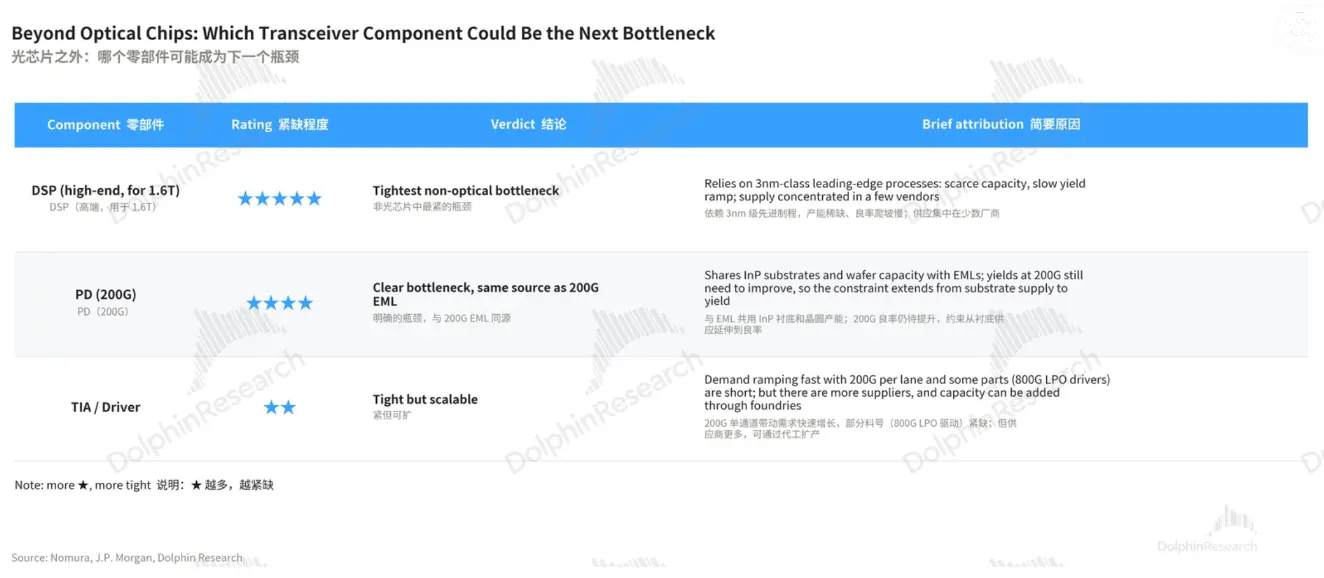
The copyright of this article belongs to the original author/organization.
The views expressed herein are solely those of the author and do not reflect the stance of the platform. The content is intended for investment reference purposes only and shall not be considered as investment advice. Please contact us if you have any questions or suggestions regarding the content services provided by the platform.