

Cerebras (Pt. 2): Lucky break—did the 'paranoid' score a big win?
 I'm LongbridgeAI, I can summarize articles.
In the prior piece, Dolphin Research detailed how $Cerebras(CBRS.US) pursued a first‑principles idea: if chips are cut and stitched back together, why not avoid the cut and build in one piece. The company stuck to this path relentlessly, taking on every obstacle head‑on.
After owning design, test, assembly, and integration end to end, the team finally built the 'radically different' giant below.
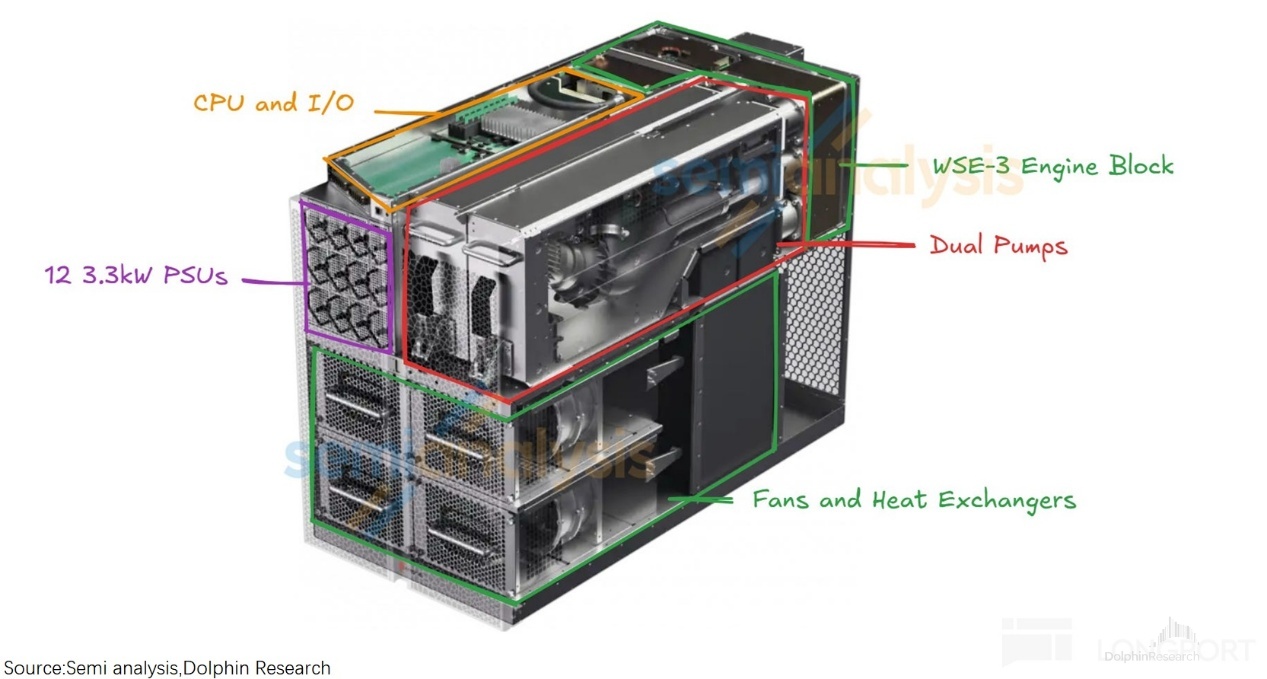
This piece focuses on three questions.
a) How far has Cerebras iterated its products, who is using them, and under what arrangements?
b) How is the biz. performing, especially how revenue is adjusted?
c) What is Cerebras worth?
Details follow.
I. Big, different: how are Cerebras products iterating?
Cerebras was founded in 2015 and only launched its first WSE in 2019. Those three‑plus years were spent tackling yield, power delivery, cooling, reticle‑crossing wiring, and packaging.
Once the core problems were solved, the roadmap progressed from Gen 1 to Gen 3. ① WSE‑1 → WSE‑2: process moved from TSMC 16nm to 7nm, doubling transistors, cores, on‑die SRAM, and bandwidth.
② WSE‑2 → WSE‑3: node moved from 7nm to 5nm, transistors rose ~50%, but cores increased only ~6%. The extra transistor budget strengthened each core instead of adding more cores, via richer tensor ops, more microthreads, and better sparsity handling. Note that from this gen onward, SRAM grows only ~10%, which effectively caps capacity at 44 GB starting with WSE‑3.
③ WSE‑3 → WSE‑3 Turbo: process, transistors, cores, and SRAM are unchanged, essentially the same wafer and not called WSE‑4. The 2x SRAM bandwidth comes purely from doubling frequency, not architecture changes (bandwidth = cores × per‑core per‑cycle bit‑width × clock).
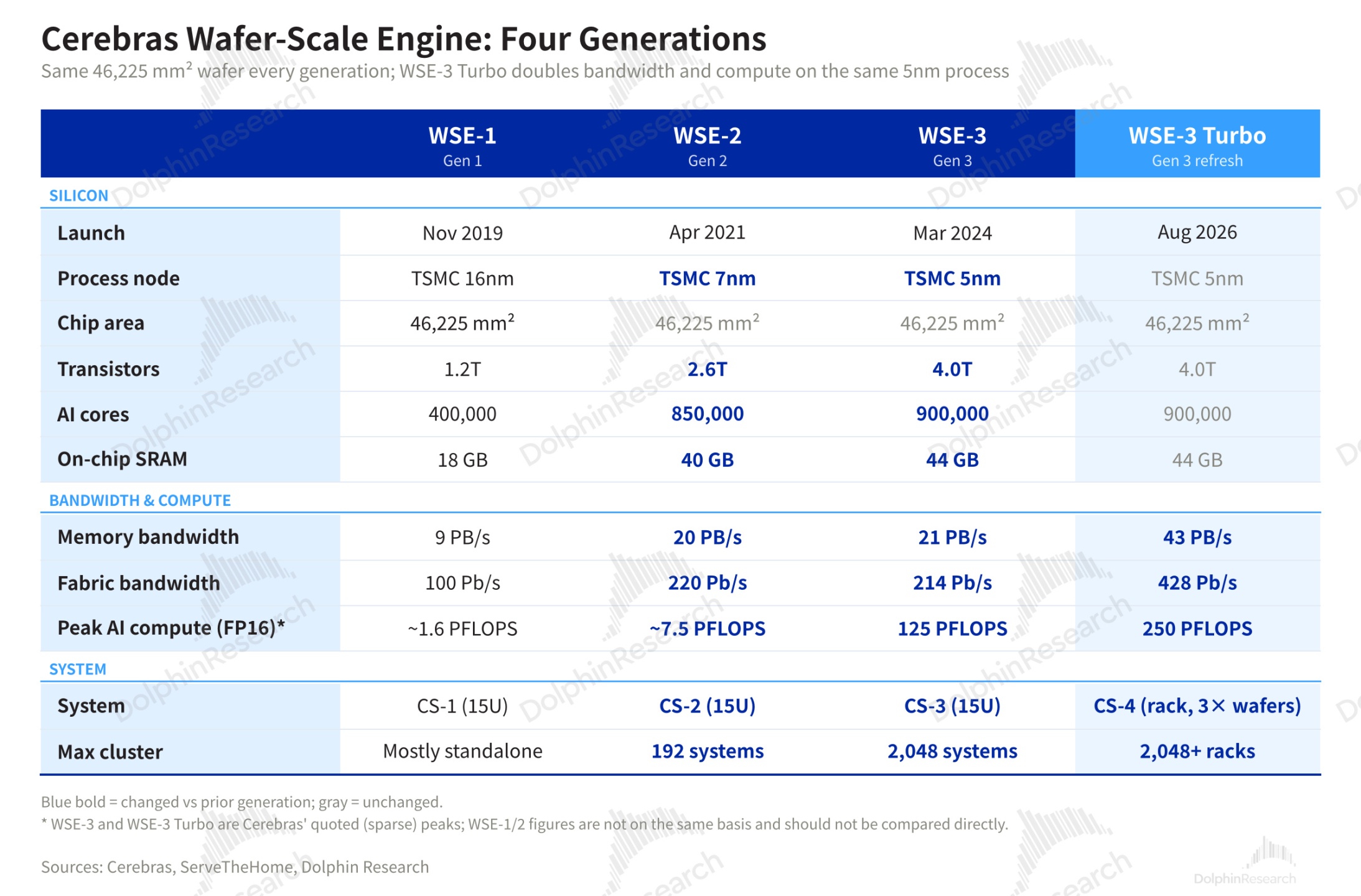
Historically, Cerebras shipped a new gen every ~2–3 years, and it has been over two years since the last launch. If WSE‑4 R&D were smooth, Aug 2026 should have been WSE‑4, not WSE‑3 Turbo. Relying on overclocking plus rack‑scale redesign to keep cadence implies the next wafer ran into challenges.
Under current demand, WSE’s biggest value is on‑die SRAM. But moving from 5nm to 3nm barely shrinks SRAM.
TSMC disclosed at IEDM that N3E’s SRAM bitcell is ~0.021µm², essentially similar to N5.
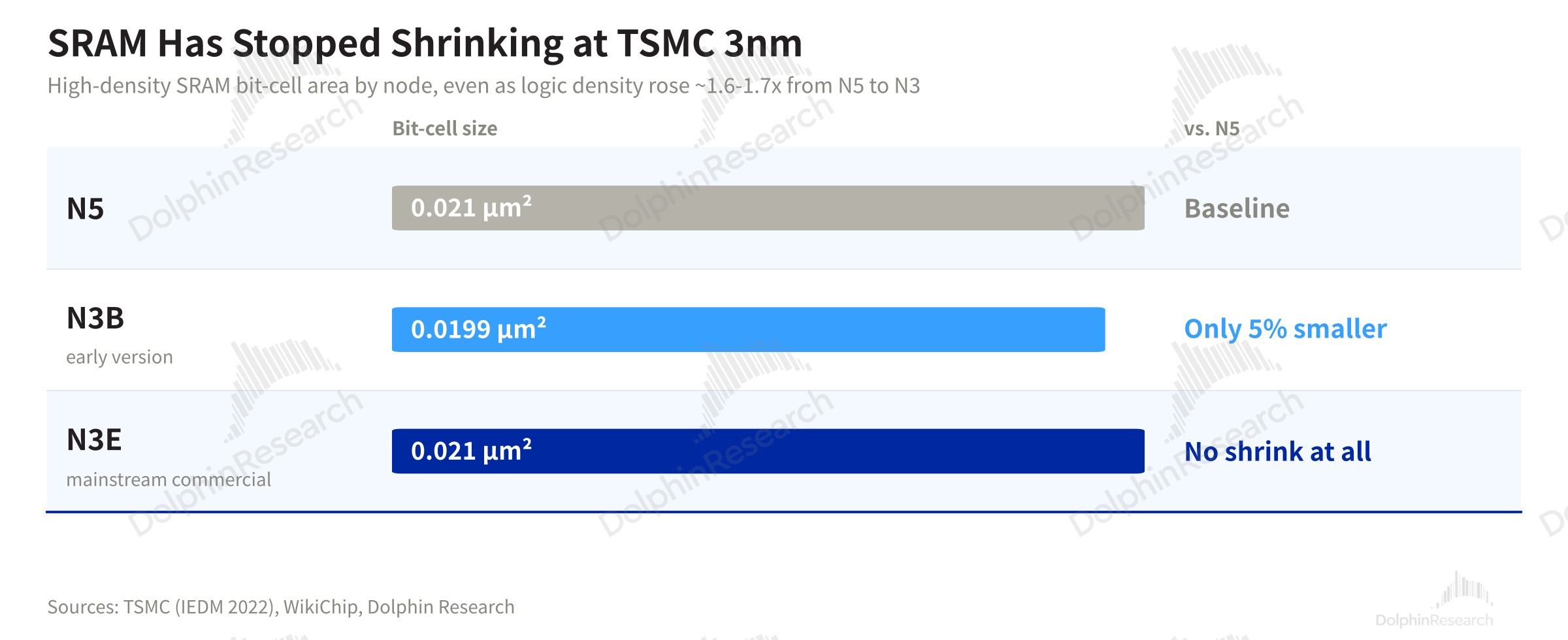
Assume the WSE area splits 50/50 between logic and SRAM. After moving to 3nm, only the logic side shrinks ~40%, leaving total area down only ~20% because SRAM barely shrinks. Since the 1b SRAM cell area is flat, even reallocating logic savings to SRAM only lifts on‑die capacity from 44 GB to ~60 GB, which is insufficient in practice.
In essence, memory does not scale, so large models still spill off‑die or rely on external memory. Continuing to shrink the wafer becomes a bad trade: high cost with little of the desired SRAM uplift. Thus, by Gen 4, Cerebras shifted R&D focus from process scaling to power delivery and rack‑scale architecture. WSE‑3 Turbo/CS‑4 reflects that pivot.
CS‑4 targets four core changes.
1) Chip level: double power headroom, max out clock and bandwidth
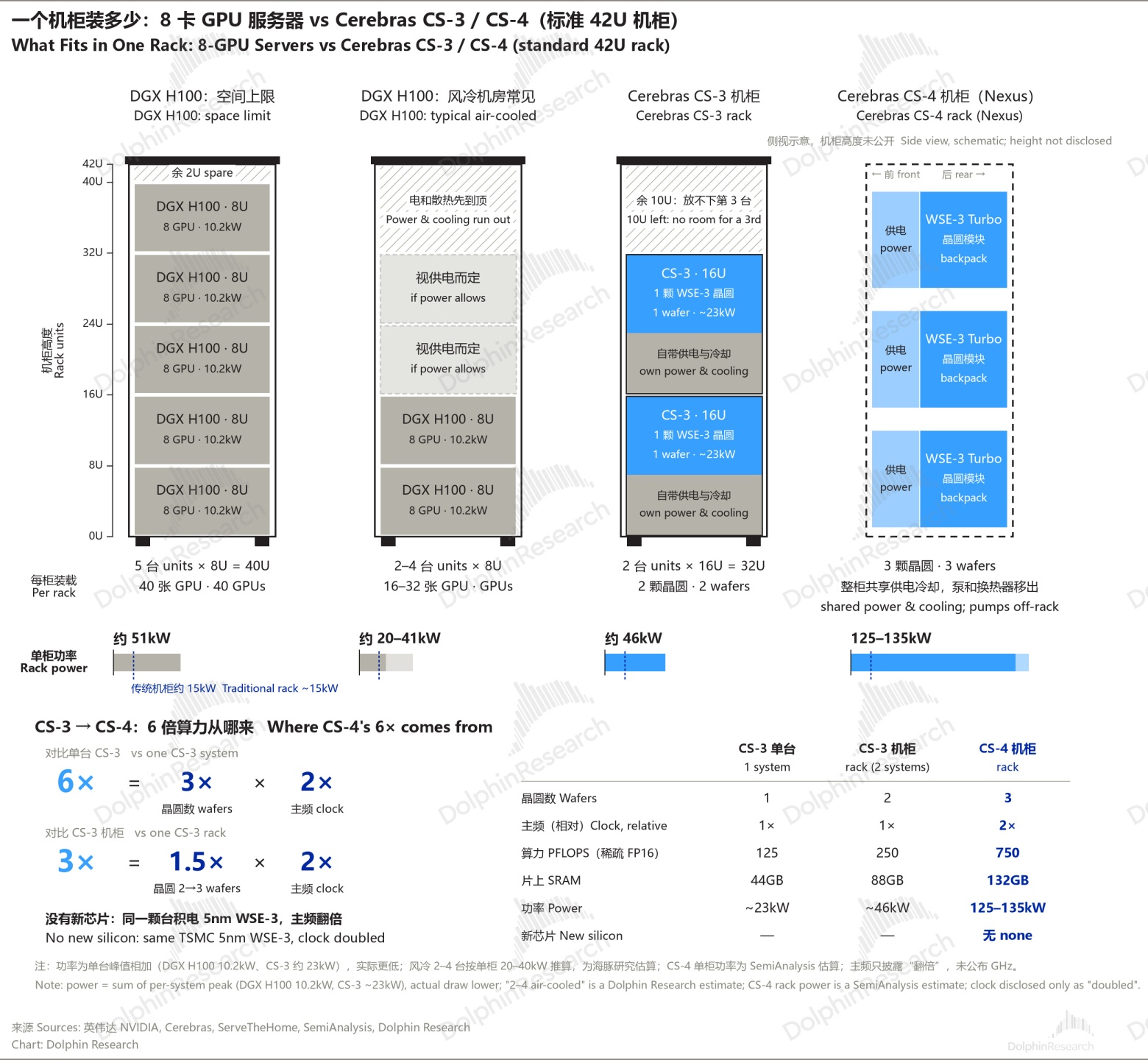
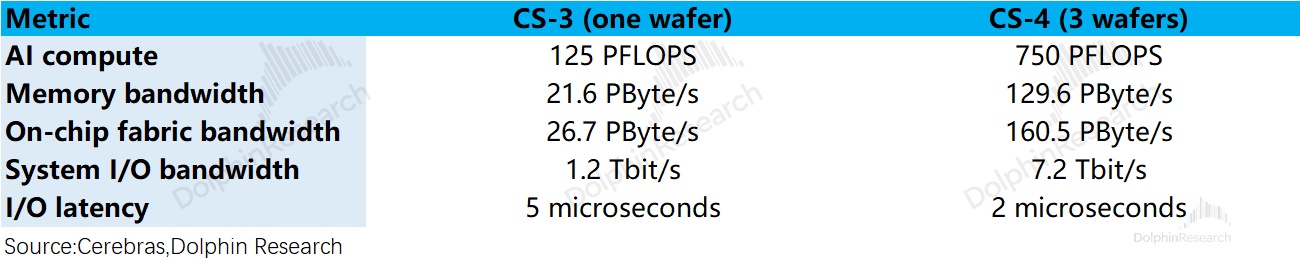
The new Nexus Power Array delivers >2x current, allowing clock to jump from ~1.4 GHz to ~2.8 GHz with the same 5nm wafer and 0.9mn cores.
2) System level: from single‑chassis 'drawer' to high‑density rack‑scale
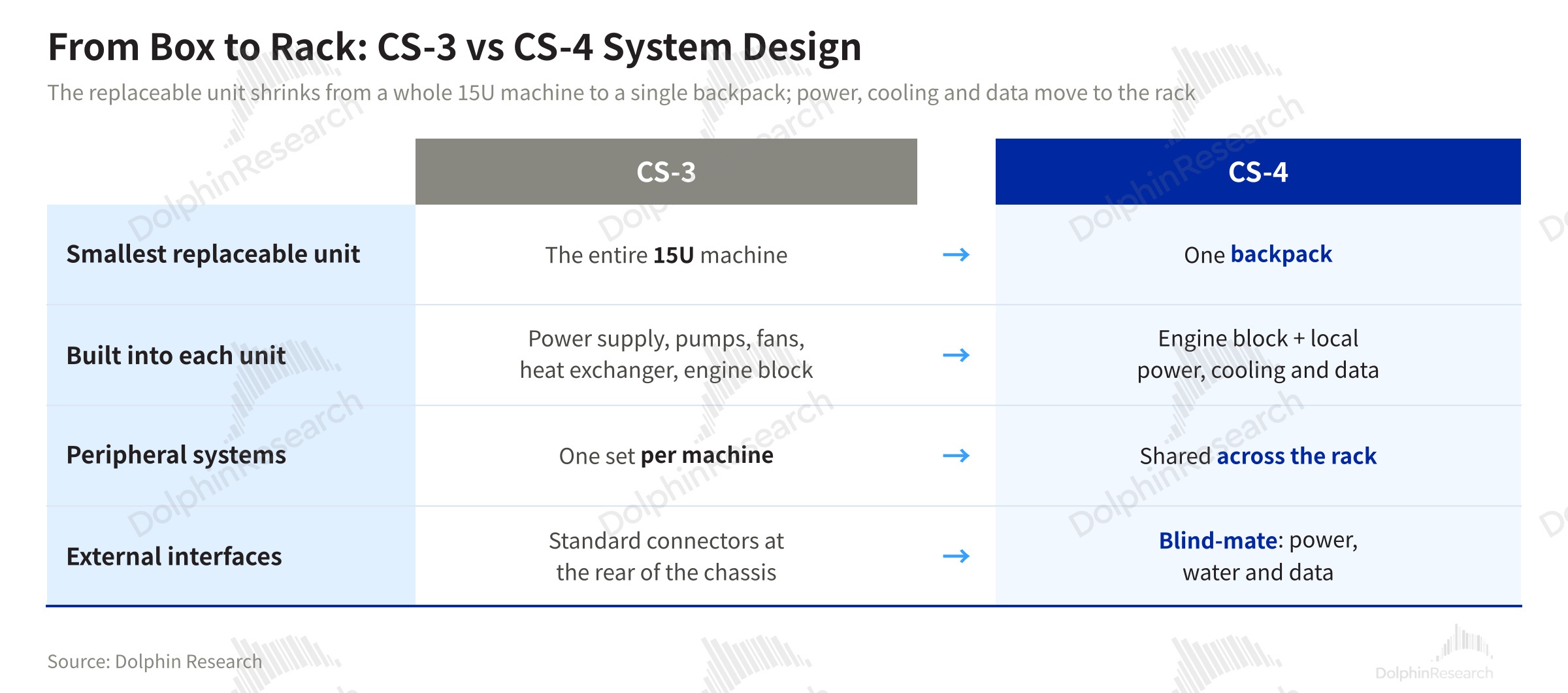
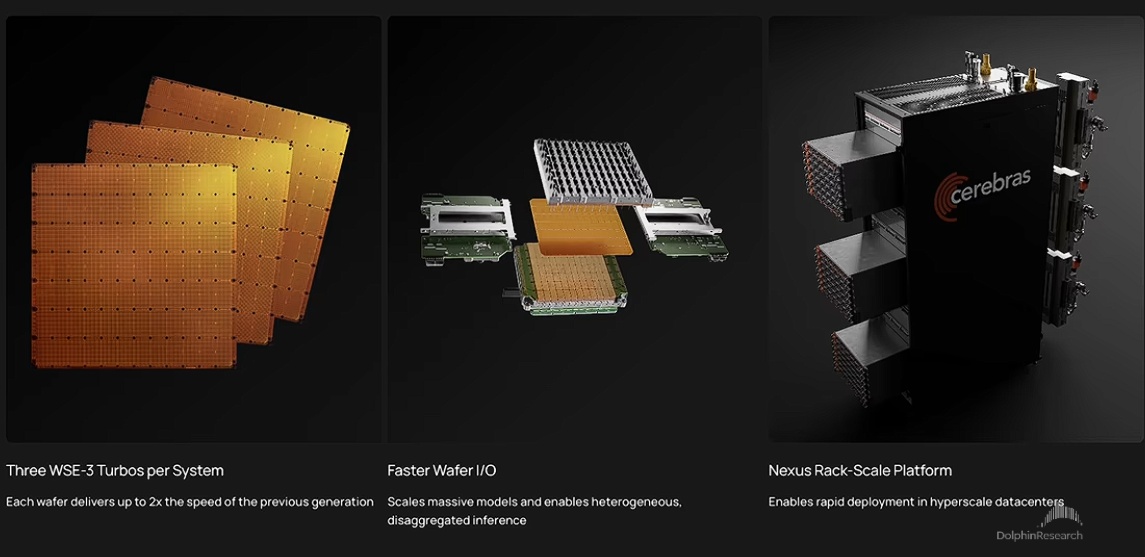
CS‑3 is a 15U chassis with one WSE‑3 wafer (vs. an 8U DGX H100 server). CS‑4 is a rack‑scale Nexus platform, integrating three WSE‑3 Turbo wafers per 42U rack.
3) Packaging & engineering: a backpack‑style plug‑in module
On CS‑3, the wafer, cold plate, PSU, and controller are tightly integrated, making service complex. CS‑4 bundles the wafer, liquid cooling, and micro‑PSU into a self‑contained 'compute backpack' that plugs into the rear power array and liquid manifold, while fans and auxiliaries are shared at the rack level. Servicing becomes like swapping a power‑tool battery: pull the bad backpack and slot in a new one.
4) Interconnect: on‑rack wafer‑to‑wafer links
CS‑3 needed external switches across racks. CS‑4 integrates low‑latency Nexus links in‑rack so the three wafers talk over the backplane, cutting inter‑wafer latency inside a rack from ~5µs to ~2µs.
II. From chip co. to compute co.? Orders are shifting
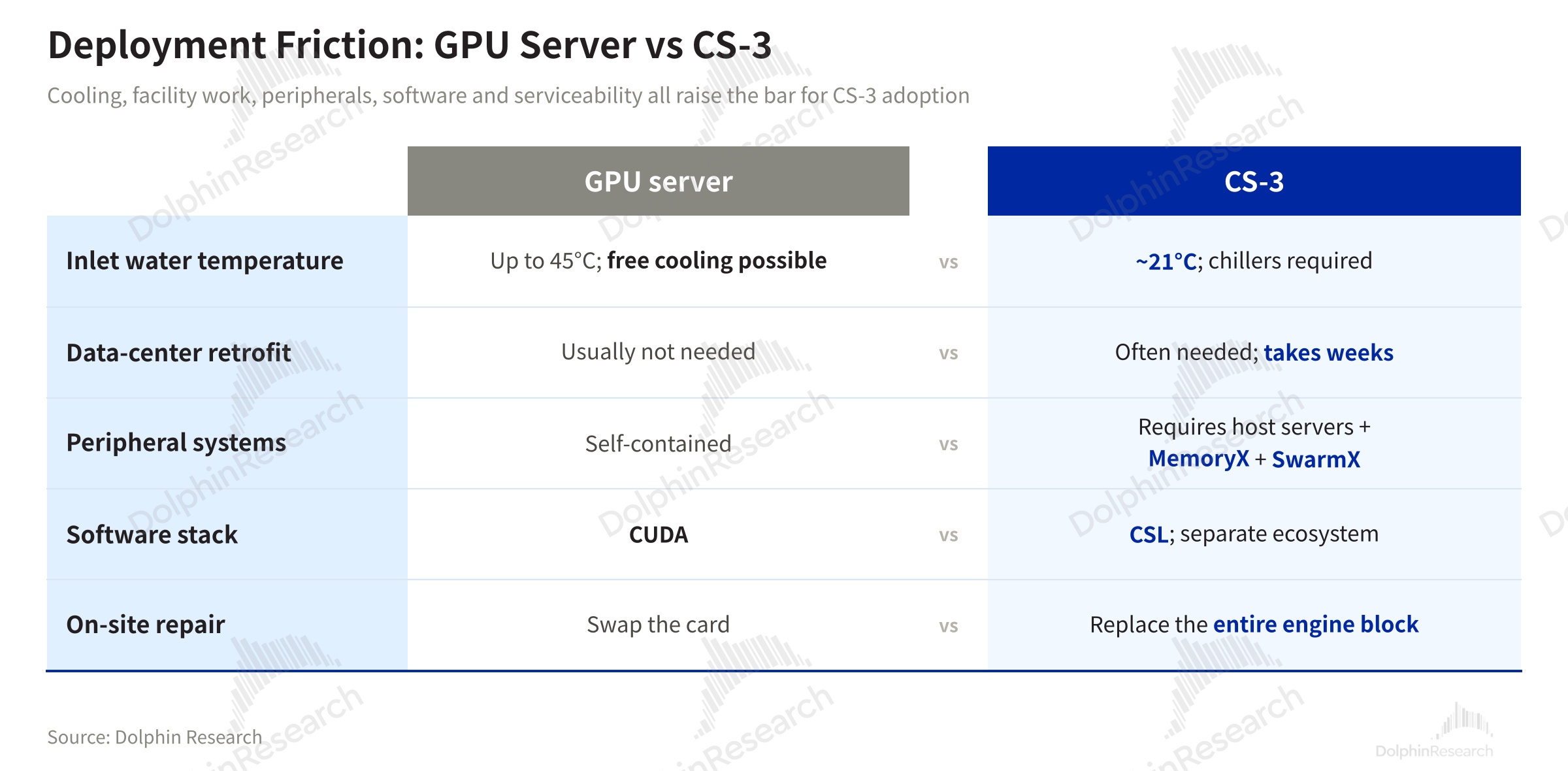
Cerebras is a chip company, but few large customers want to buy its chips for chips’ sake. The stack is too non‑standard, creating heavy deployment friction: data center retrofits, custom 21°C liquid cooling, and bespoke hosts and peripherals.
Historically, only research institutions purchased systems, limiting adoption. Even OpenAI did not want to buy full racks outright. Cerebras therefore hosted machines in its own facilities and bore the costs, evolving into a neocloud with proprietary chips and billing OpenAI for compute at a $/MW rate.
Now, both the revenue mix and profit profile increasingly resemble a new‑cloud compute vendor.
A. In Q2, cloud revenue surpassed hardware revenue.
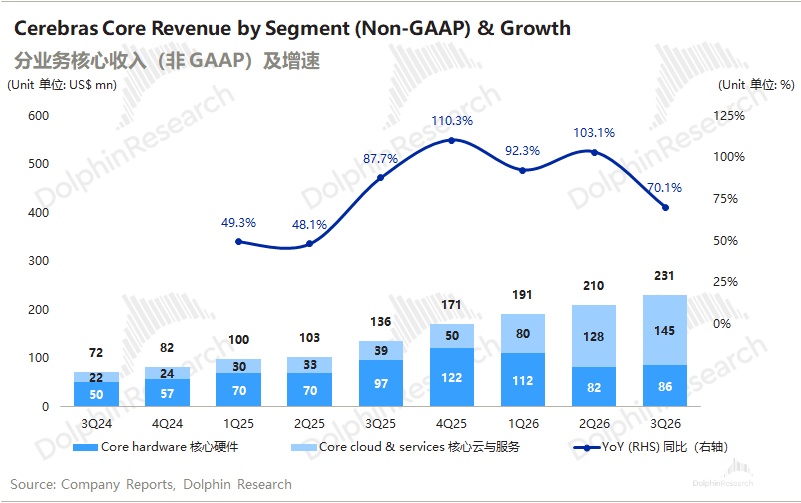
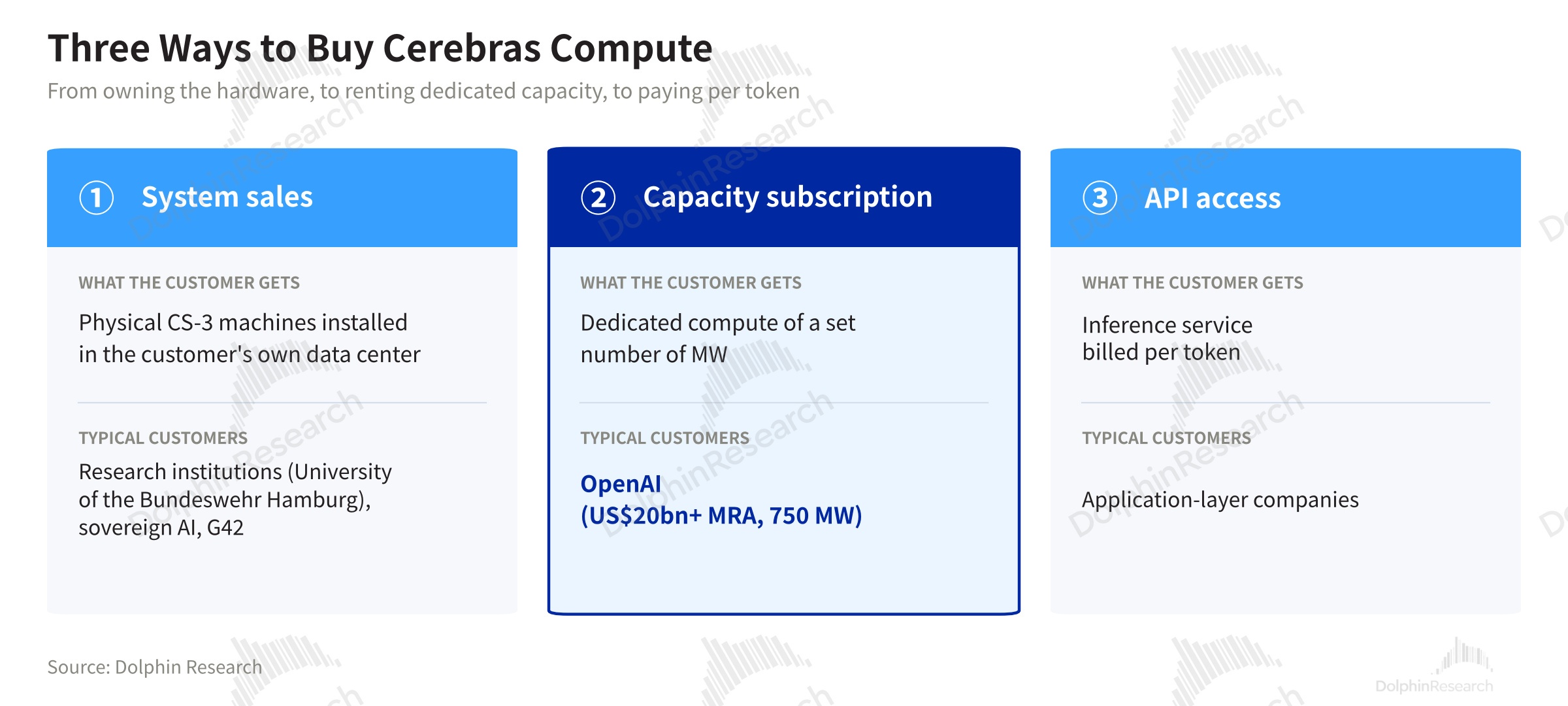
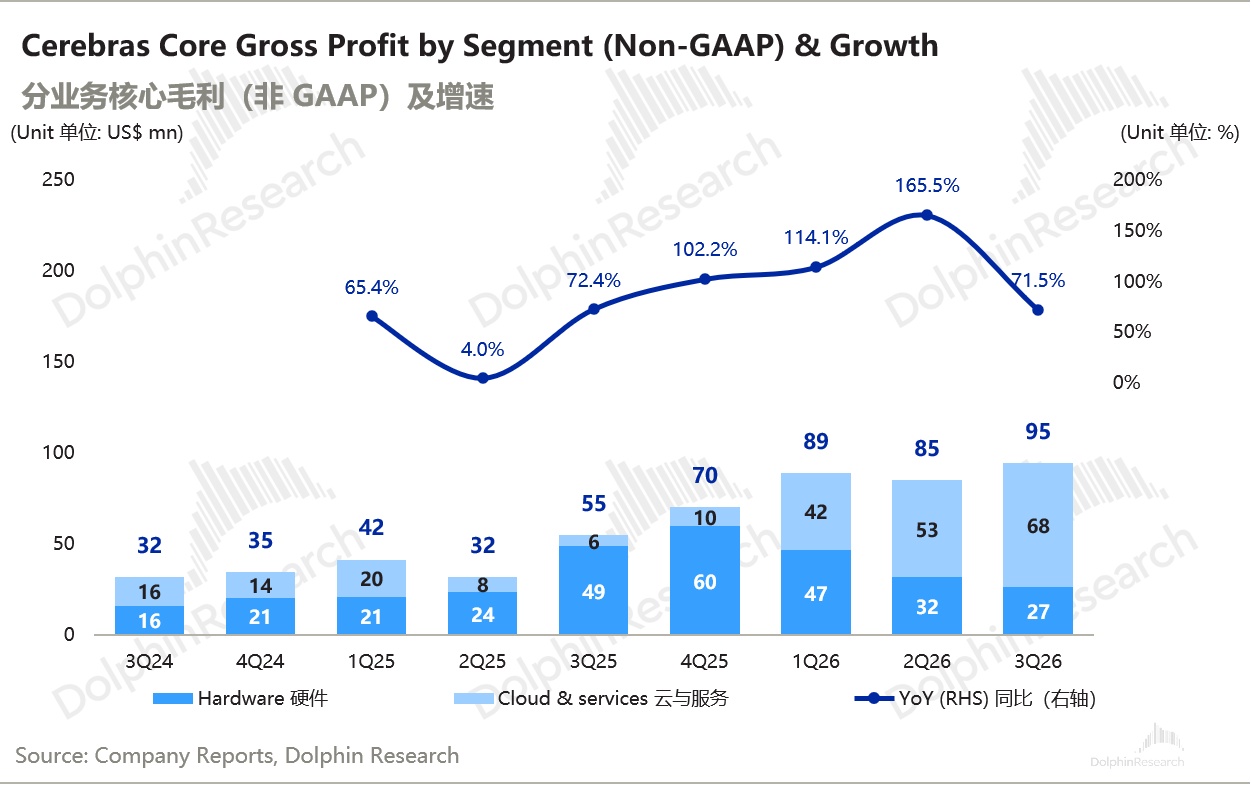
b. On GP contribution, cloud leasing exceeded hardware in Q3. Short term, cloud may stay lumpy due to ramp timing, but over time GP leverage should come mainly from cloud scale and utilization. Hardware GPM is tied to yield, but Cerebras’ yield relies on ~7% design redundancy. As long as defects avoid critical routes, the compiler can map around bad cores, so improvements hinge on mfg. engineering and software, with limited upside.
Cloud is an infra‑ops business where margin depends on pricing and utilization. Scale effects matter more than manufacturing yield.
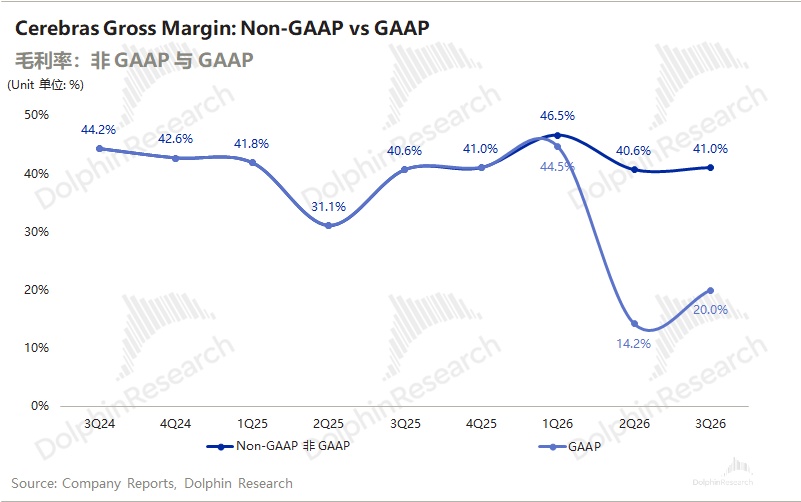
Across key customers, OpenAI buys compute, Middle East shareholders buy full systems, and Amazon uses finance‑lease‑style system purchases. Details follow.
1) OpenAI: buys compute
Like many chip vendors with weak pricing power, Cerebras sells compute and grants equity sweeteners. It issued warrants to OpenAI exercisable at $0.00001 for 33.445 mn Class N shares (non‑voting). Vesting is staged; OpenAI has received 10.03 mn shares (~30%) so far, subject to working‑capital loans, mkt. cap or payment triggers, and staged capacity deliveries.
① Working‑capital loan funded: OpenAI provided a $1.0 bn guaranteed note (6% coupon, due end‑2032) to build related infra. If repaid in compute, interest is waived; once funds arrived in Jan 2026, 4.46 mn shares (~13%) vested to OpenAI.
② Mkt. cap or payment trigger: either Cerebras’ mkt. cap rises above $40 bn or it receives specified fees from OpenAI, which vests 5.57 mn shares. On listing day close (2026/5/14), mkt. cap exceeded $70 bn, satisfying the condition, and 5.57 mn shares (~17%) vested in Jun 2026.
③ Committed and additional capacity deliveries: the remaining ~23.41 mn shares (~70%) vest pro‑rata with delivered compute capacity. At a grant‑date FV of $82/share, the 10.03 mn shares already granted imply $823 mn of warrant consideration. The company offsets revenue over time in step with the related revenue recognition via warrant amortization.
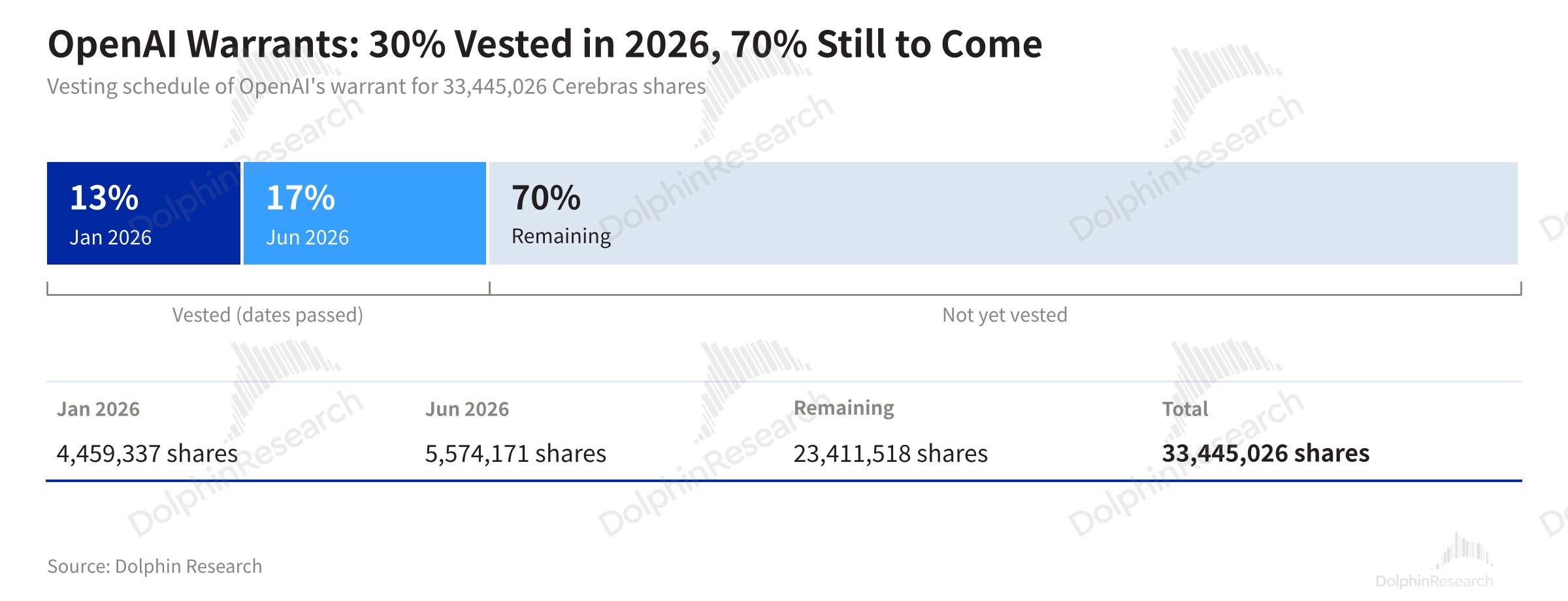
This amortization will fully offset revenue by Oct 2031. In Q1 and Q2, OpenAI‑related net revenue was $16.9 mn and $56.8 mn, with warrant amortization of $0.8 mn and $2.5 mn, implying a ~4–5% offset rate. The parties have signed for 750 MW with options for another 1,250 MW, totaling 2 GW. Only full delivery of 2 GW vests the full 33.44 mn shares; with no voting rights, this is effectively discounted pricing.
In short: Cerebras is first selling compute, then selling it at a discount, and OpenAI holds the leverage. Among chip vendors we track, this is one of the weakest bargaining positions.
2) Other customers:
a) G42: buys systems, gets free warrants
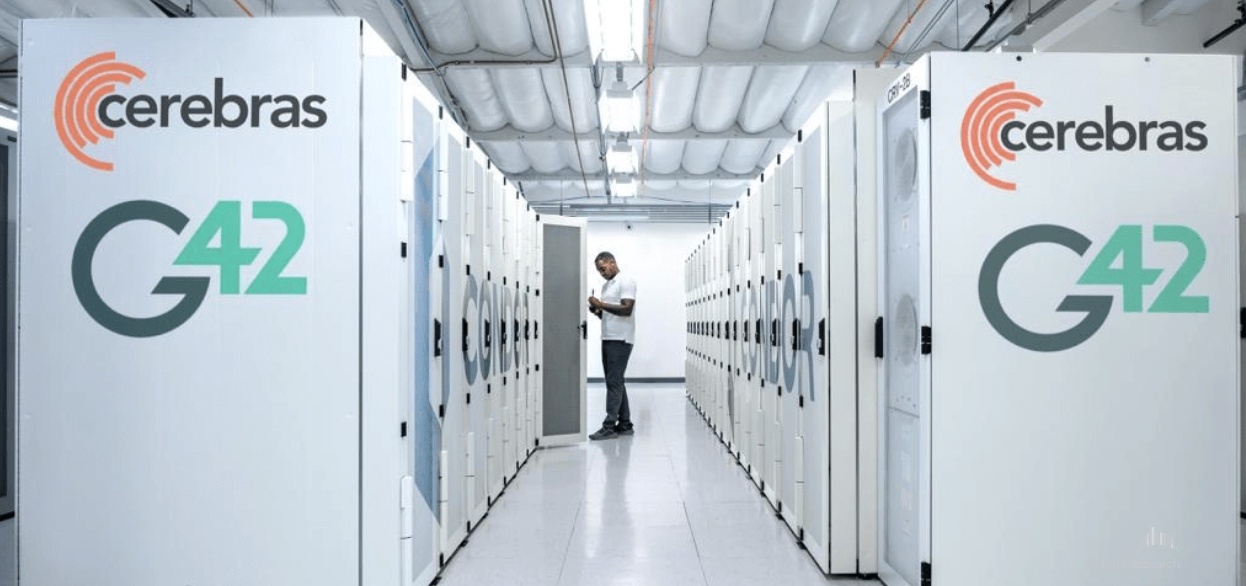
G42, based in Abu Dhabi, is a national AI execution platform and an investor in Cerebras. Together with MBZUAI, it contributed over 80% of revenue in 2024–2025. Cerebras granted G42 two tranches of unconditional warrants: 1.86 mn shares at $82.02 FV and 1.66 mn shares at $90.23, both exercised in Jan and Apr 2026, creating roughly $300 mn of warrant amortization.
b) Amazon: finance‑lease‑style system purchases
At AWS, the split is prefill on Trainium 3 and decode on CS‑3. Like GPUs, Trainium is decode‑bound by HBM bandwidth, which cannot meet Bedrock’s ultra‑low latency alone, and building an SRAM‑based decode ASIC in‑house would take years. So AWS uses Cerebras to shore up decode and deliver a latency tier that the existing portfolio cannot.
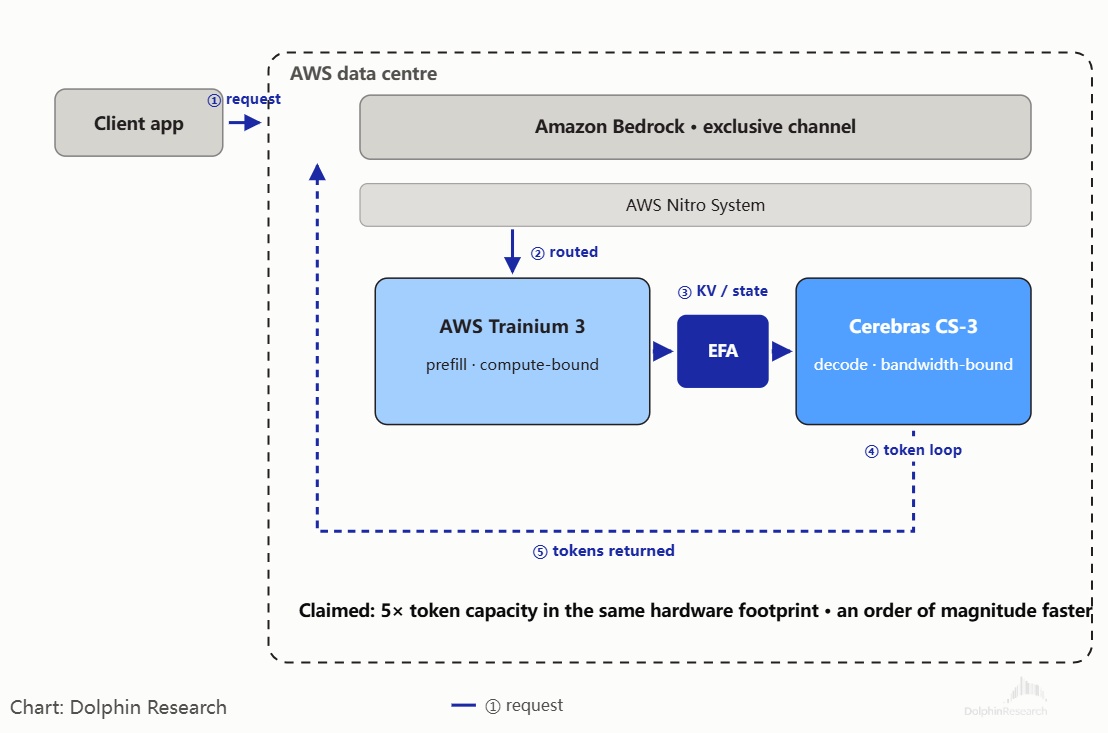
As a cash‑rich buyer, Amazon’s structure is finance‑lease‑style system purchases with a purchase option, price locks, first‑and‑exclusive access via Bedrock, minimum capacity reservations, and other protections favoring AWS. These terms clearly favor Amazon, leaving Cerebras in a bind: if AWS under‑consumes, reserved capacity sits idle; if AWS over‑consumes, customer concentration spikes again.
On equity, Amazon’s warrants are stricter: unlike prior free grants, AWS pays for warrants, gets only 10% upfront, and the remaining 90% vests with payments. The parties signed a binding term sheet in Mar 2026, then an AWS commercial agreement and warrants in Jun (recognizing $50 mn of customer warrant asset), but the definitive agreement is still under negotiation. The framework is set and warrants issued, but the final contract is pending.
Among new customers, Microsoft is a cloud‑services partner and Oracle is a direct hardware buyer. Specifics were not disclosed.
Putting (1)–(2) together, compared with peers that sell chips, Cerebras’ non‑standard product forces whole‑system sales even when selling 'chips'. Beyond small labs or shareholders, systems often go out via finance‑lease structures. Even then, the customer roster is limited, pushing Cerebras to run its own DCs and sell compute instead. Yet even for compute, it still grants warrants to large customers.
In short, Cerebras’ hard work did not translate into pricing power or negotiating leverage. As of Jun 30, 2026, the ~$1.1 bn warrant asset includes roughly $800 mn for OpenAI, $300 mn for G42, and $50 mn for AWS. These are amortized against revenue, but in substance they are discounts that should sit as revenue deductions.
Note: to highlight the impact on reported revenue, the company defines cash‑like 'core revenue' as GAAP revenue + warrant amortization (add back the discount) – pass‑through DC revenue.
① Warrant amortization is a non‑cash equity cost that reduces GAAP revenue and is added back for core revenue.
② Pass‑through revenue: capacity subleased from third parties and resold is booked as GAAP revenue but removed in core revenue.
III. Forecasts and valuation
The key drivers are compute ramp speed and lease pricing. Given DC build‑out delays this quarter, we revise the base case to: OpenAI’s 3‑tranche 750 MW through 2028, with only 600 MW landing on schedule, plus the 1,250 MW option delivered later per contract; total capacity across customers rises from 88 MW in 2026 to 875 MW in 2028.
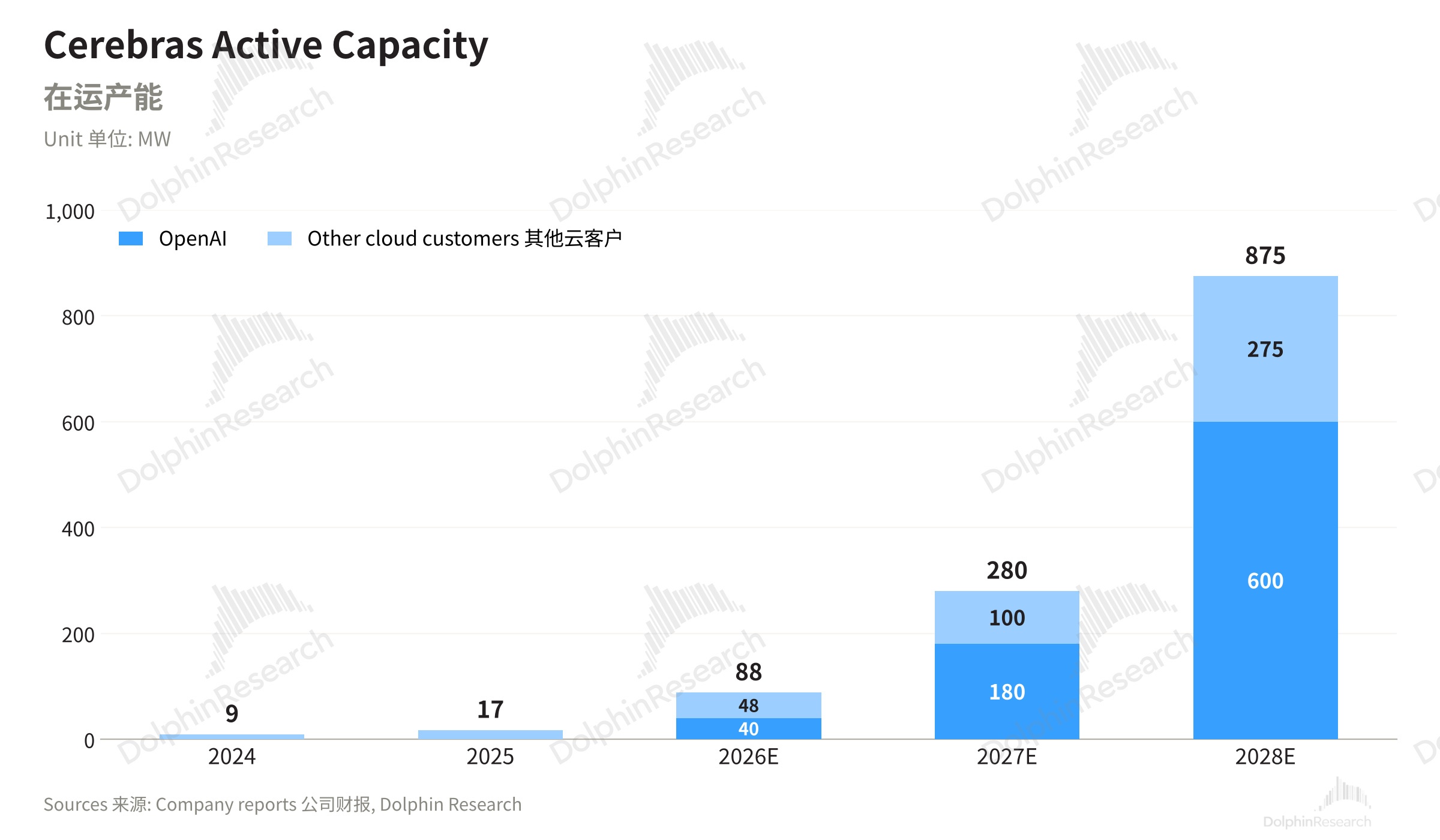
② Pricing: OpenAI at $7.5 mn/MW/year; other customers at $4.5 mn (lower‑priced managed parks). Overall pricing is low due to long‑term anchor deals with limited float. Hardware is modeled at $1.5 mn per system, with flat hardware revenue in 2027.
③ Capex per GW: with limited disclosure, we estimate roughly $16 bn per GW, excluding buildings and systems. Chip and systems are in‑house; spend is mainly on network gear, racks, and cabling, with sites leased from third parties.
In aggregate, from ~$950 mn in 2026 to ~$2.85 bn in 2027 (per guidance), we estimate core revenue of ~$7.8 bn by 2028. Core OP begins to scale in 2027 as cloud GPM rises, reaching roughly $2.9 bn in 2028.
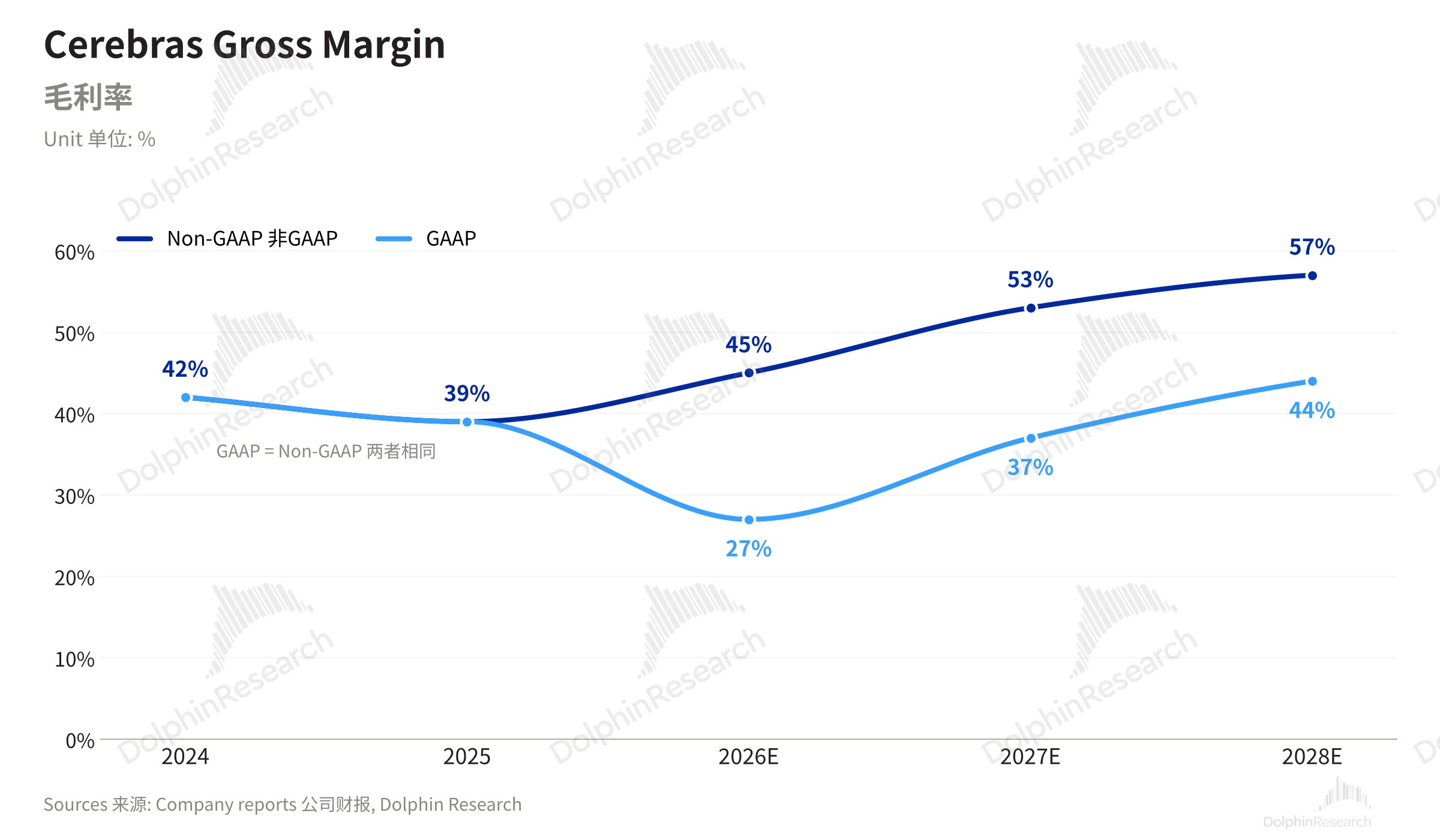
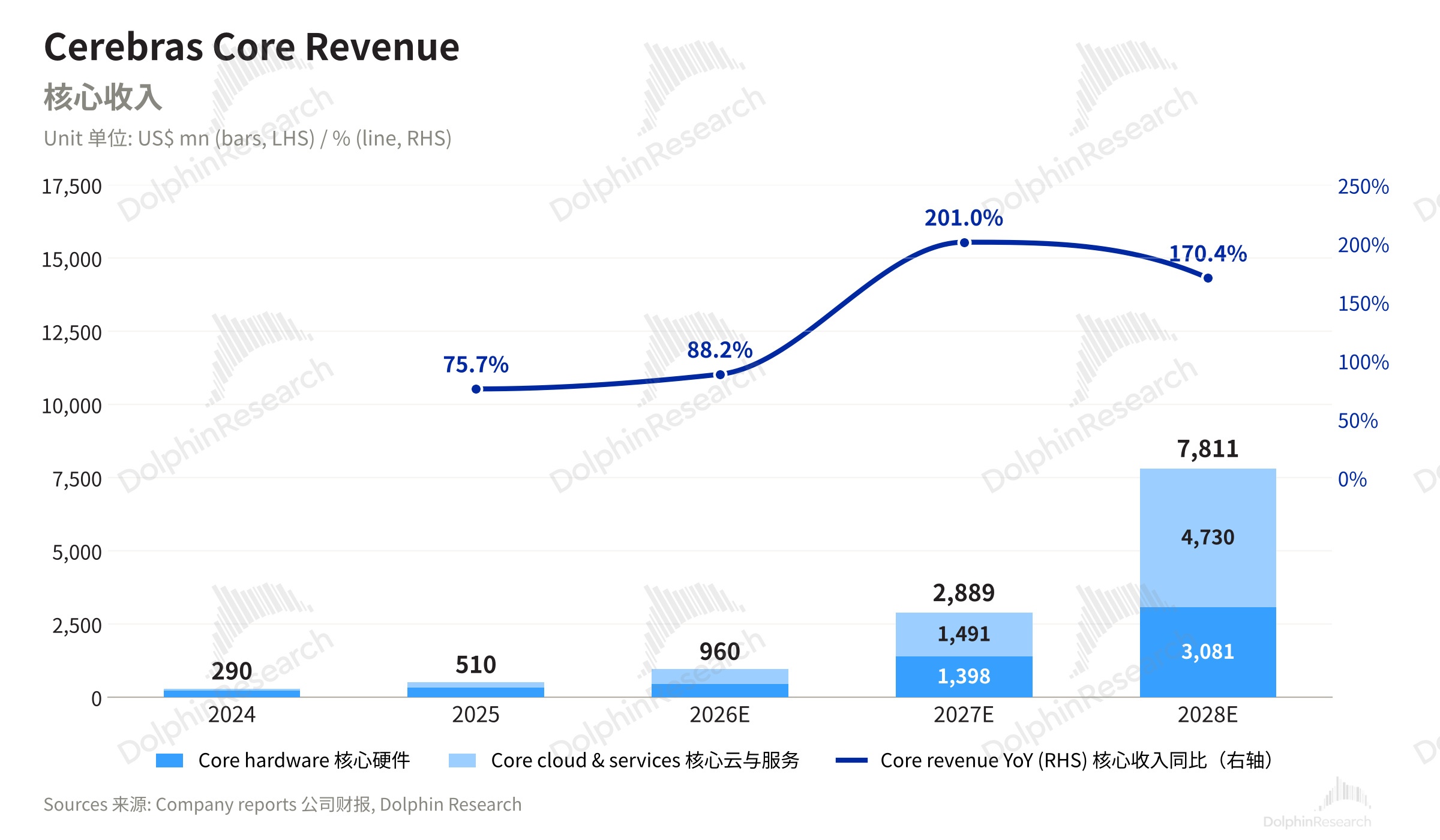
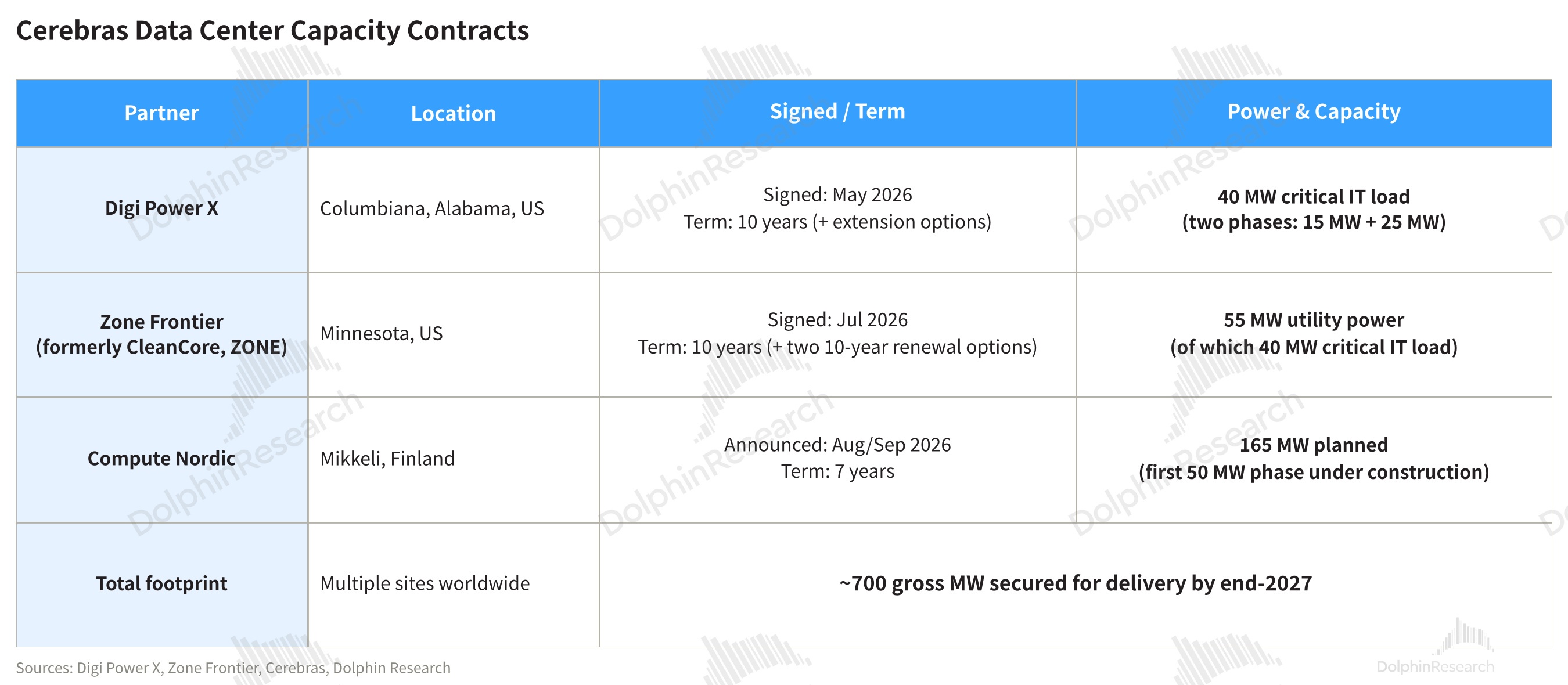
On valuation, the company has effectively become a new‑cloud player powered by proprietary chips. A portion of its advantage has shifted to early, long‑dated leases for DC space and power, notably ~700 MW contracted and fully delivered by end‑2027 under the OpenAI deal.
Using 2028 as the anchor: apply 25x PE to hardware and 20x PE to cloud, subtract an additional $3.0 bn of debt needed through end‑2028, and discount back at 15%. The base‑case equity value is roughly $24 bn.
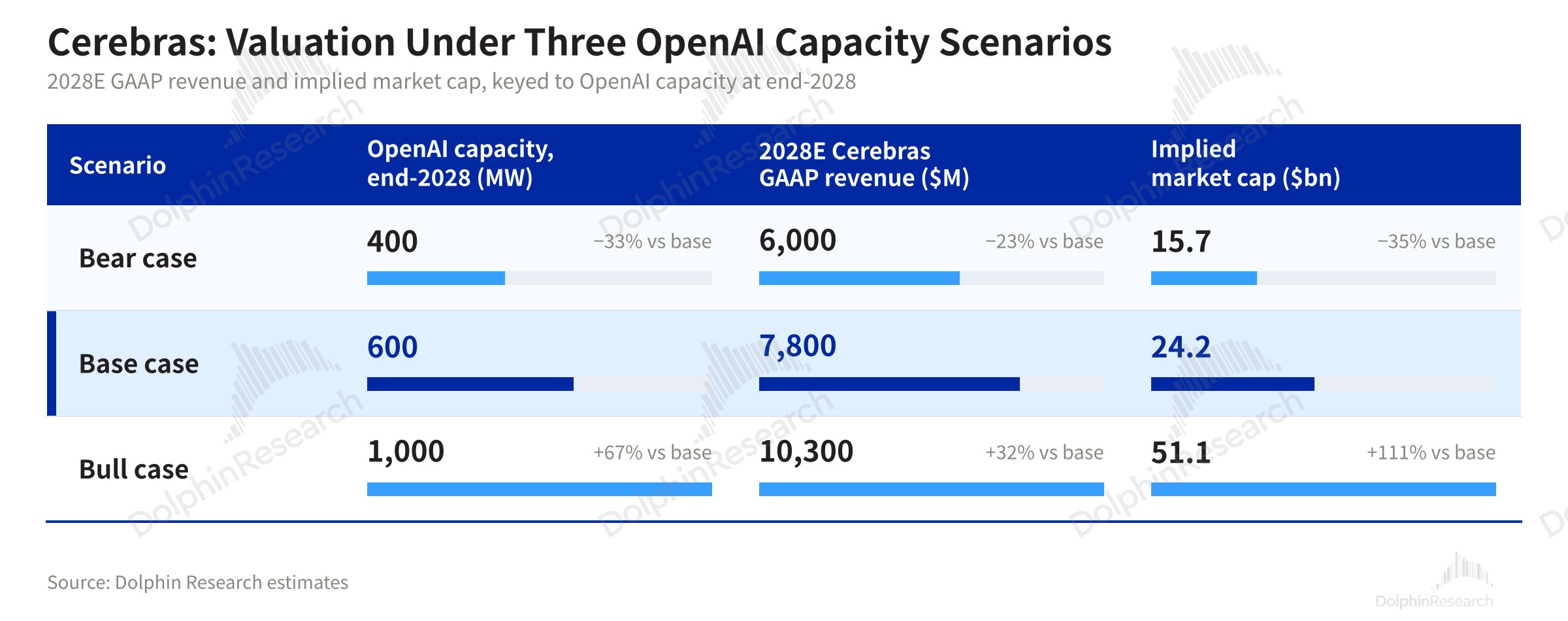
Overall, the outlook hinges on the OpenAI megadeal’s delivery. Given capacity‑ramp and delivery uncertainty, we see a wide valuation band of ~$15.7–51.1 bn (smaller caps are more volatile).
IV. Takeaways: thin valuation support; margin of safety first
Driven by the vision of a monolithic, no‑stitch wafer, the company took the non‑standard route to the extreme. Customers resisted bespoke procurement, forcing a pivot from chip vendor to new‑cloud provider powered by in‑house silicon. As a new‑cloud player, its leverage with customers remains limited.
Fortuitously, it rode the inference tailwind of compute‑in‑memory‑like low‑latency decoding and won some cloud logos. In a world of power and DC scarcity, the ~700 MW of pre‑secured capacity is its most valuable asset. But with weaker bargaining power, it faces greater downside beta when the sector de‑rates.
In this context, we think investors should demand a wide margin of safety. For example, consider entry only if mkt. cap retraces below ~$20 bn, roughly in line with the FV of OpenAI’s warrants.
<End>
Nov 13, 2026 call notes: Cerebras (Trans): 700 MW DC secured; Microsoft to contribute from 1H27
Nov 13, 2026 ER take: Cerebras: demand/supply both sound; facilities are the bottleneck
Oct 9, 2026 deep‑dive Part I: Cerebras: the no‑reticle‑split chip 'beast'—can it challenge NVIDIA?
Risk disclosure and statement: Dolphin Research disclaimer and general disclosure
The copyright of this article belongs to the original author/organization.
The views expressed herein are solely those of the author and do not reflect the stance of the platform. The content is intended for investment reference purposes only and shall not be considered as investment advice. Please contact us if you have any questions or suggestions regarding the content services provided by the platform.