
 I'm LongbridgeAI, I can summarize articles.
Recently, the investment value data analysis platform Ruishou Analysis, under Chuangyebang, released the "2024 China Biomanufacturing Industry Development Report." The core viewpoints of the report are as follows:
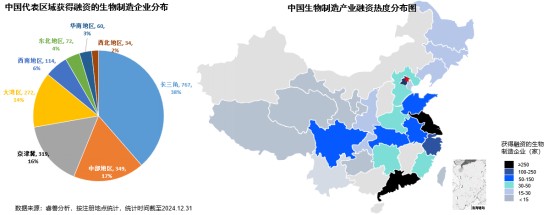
The Yangtze River Delta, Beijing-Tianjin-Hebei, and the Greater Bay Area account for nearly 70% of national financing share. China has initially formed a biomanufacturing industry pattern dominated by three major urban agglomerations, with the central and northern regions as supplements. The Yangtze River Delta, Beijing-Tianjin-Hebei, and the Greater Bay Area, rich in innovative resources, have collaboratively built a new economic development model of "R&D - transformation - industry" in biomanufacturing, with financed enterprises accounting for 68% of the national total. The central region, relying on advantages in raw materials, labor, and market, focuses on industrialization projects in pharmaceuticals, food, and other specialty industries, with financed enterprises accounting for 17% of the national total. The northeastern and northwestern regions, leveraging advantages in climate, energy, raw materials, and the fermentation industry foundation, focus on large-scale industrialization projects.
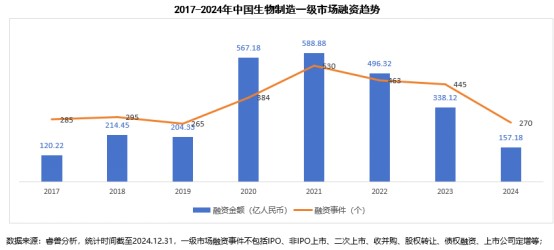
The decline in investment and financing events in 2024 is expected to reach 40%-50%. Since 2022, primary market financing in the biomanufacturing sector has shown a year-on-year downward trend. In the "capital winter," investments have become more rational, with 270 financing events completed in 2024 (a year-on-year decrease of 39.3%), disclosing a financing amount of 15.718 billion RMB (a year-on-year decrease of 53.5%).
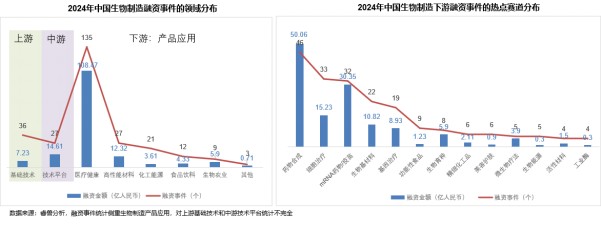
Financing events in the healthcare sector account for 50%. In 2024, 135 financing events were completed in the healthcare sector, the most among all sectors. In the sub-sectors, drug synthesis, mRNA drugs/vaccines, cell therapy, and bio-based materials have seen high financing activity, with each completing over 20 financing events and a total financing amount exceeding 1 billion RMB.
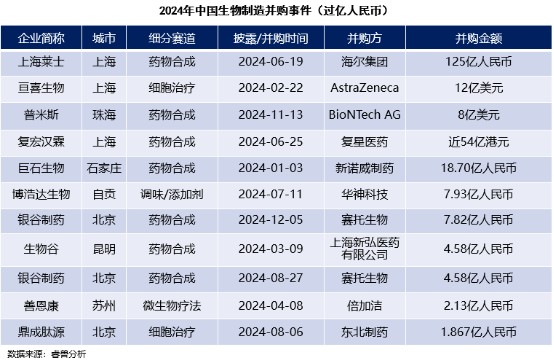
The merger and acquisition market is relatively active, with many large transactions. Since 2021, the M&A market has been relatively active, with 25 M&A events in 2024, disclosing a total amount of 36.04 billion RMB (a year-on-year increase of 4 times), including 4 M&A events exceeding 5 billion RMB. International giants, listed companies, and industrial groups are seeking new growth curves in biomanufacturing, with state-owned capital investment leading the way, accelerating industrial investment, mergers, and integration.
1. Industry Development and Market Pattern
Biomanufacturing, aiding industrial upgrading, is expected to change the world industrial pattern
Biomanufacturing is an advanced industrial model that promotes economic growth and improves public health, agricultural efficiency, and safety benefits by changing production raw materials and innovating manufacturing processes. It is expected to become the fourth industrial wave after the agricultural economy, industrial economy, and digital economy, changing the world industrial pattern.
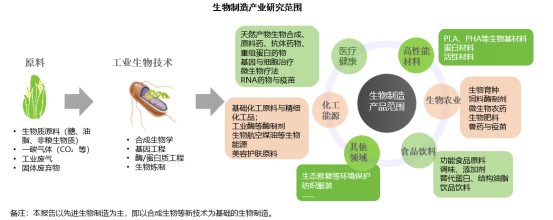
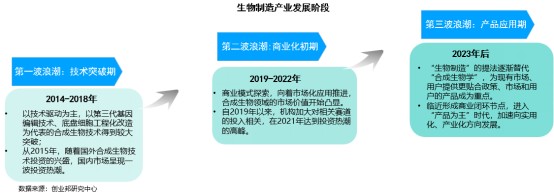
Biomanufacturing enterprises have entered the product application phase, and large-scale production has become the core competitive strength With the increasing support from national and local governments, and significant investments from the capital market in synthetic biology companies, China's biomanufacturing enterprises are approaching a critical point in forming a commercial closed loop, transitioning from technological breakthroughs to practical applications.
China has initially formed an industrial layout dominated by the Yangtze River Delta, Beijing-Tianjin-Hebei, and the Greater Bay Area
The development of the biomanufacturing industry relies on talent and raw material resources, boosted by the overall scientific research strength of cities. Currently, a pattern has formed dominated by the Yangtze River Delta, Beijing-Tianjin-Hebei, and the Greater Bay Area, with the central region represented by Shandong, Shanxi, Anhui, and Henan as the backbone, followed by the southwestern region represented by Sichuan and Chongqing, the northeastern provinces represented by Heilongjiang, and the northwestern region represented by Xinjiang and Inner Mongolia.
Investment hotspots include Jiangsu, Beijing, Guangdong, and Shanghai, followed by Zhejiang, Shandong, Hubei, Sichuan, and Anhui. The biomanufacturing industry in the Yangtze River Delta urban agglomeration shows a significant clustering effect, with high investment and financing enthusiasm, accounting for 38% of the total number of financed enterprises nationwide.
Enterprises are concentrated in the fields of healthcare, chemical energy and bio-based materials, and bio-agriculture
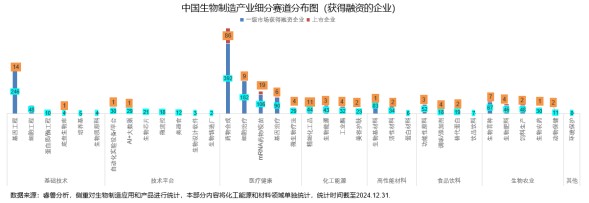
According to incomplete statistics from RuiShou Analysis, as of the end of December 2024, there are 1,994 registered biomanufacturing enterprises that have obtained public financing (focusing on application-level statistics), among which 1,805 enterprises have received financing in the primary market, and 189 are listed companies.
Enterprises that have received financing in the primary market are concentrated in drug synthesis (392), genetic engineering (246), cell therapy (182), mRNA drugs/vaccines (106), gene therapy (90), bio-based materials (83), and biological breeding (67) sectors.
Listed companies are mainly distributed in drug synthesis (86), mRNA drugs/vaccines (19), genetic engineering (14), fine chemicals (11), and cell therapy (9) sectors.
2. Venture Capital Market
Secondary Market: IPO process hindered, number of listed companies significantly reduced
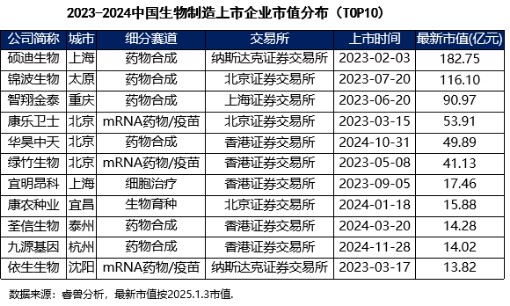
Since 2021, the global and A-share IPO markets have overall slowed down, and the number of biomanufacturing IPOs has also decreased year by year. In 2023, 9 companies went public (a year-on-year decrease of 59%), and in 2024, 5 companies are expected to IPO (a year-on-year decrease of 44%), with only ShuoDi Bio and JinBo Bio having a market value of over 10 billion
The M&A market is relatively active, with many large transactions
Since 2021, the M&A market has been relatively active, with 36 biomanufacturing M&A events in 2023, disclosing a total amount of RMB 7.244 billion. In 2024, there were 25 M&A events, disclosing a total amount of RMB 36.04 billion, among which Shanghai Lai Shi, Genexine, Promis, and Fuhong Hanlin all had M&A transactions exceeding RMB 5 billion. The focus of the M&A companies is concentrated in drug synthesis (10 events) and genetic engineering (3 events).
Primary Market: Financing events have been declining year by year, mainly in early-stage financing
According to data from Ruishou Analysis, from 2017 to 2021, biomanufacturing financing events steadily increased, with the highest financing heat in 2021 (530 events, RMB 58.888 billion). From 2022 to 2024, there has been a year-on-year decline trend, with investment becoming more rational during the "capital winter." In 2023, the disclosed financing amount was RMB 33.812 billion (a year-on-year decrease of 31.9%), and in 2024, there were 270 completed financing events (a year-on-year decrease of 39.3%), with a disclosed financing amount of RMB 15.718 billion (a year-on-year decrease of 53.5%).
Since 2024, financing events have been mainly in the early stages, with 187 early-stage (A round and before) financing events (accounting for 69%), among which there were 136 A round financing events, making it the most frequent round of investment and financing. There were 72 financing events in the growth stage (B-C rounds) and 11 financing events in the later stage (D-Pre-IPO rounds).
Hot Cities: Shanghai, Beijing, Suzhou, and Hangzhou have high investment and financing activity
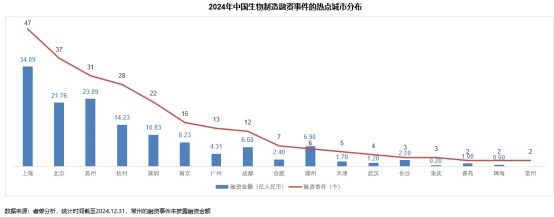
In 2024, Shanghai led with 47 financing events and a total financing amount of RMB 3.409 billion, surpassing other cities. Both Beijing and Suzhou had over 30 financing events, with total financing amounts exceeding RMB 2 billion; Hangzhou and Shenzhen each had over 20 financing events, with total financing amounts exceeding RMB 1 billion.
Hot Tracks: Concentrated in drug synthesis, mRNA drugs/vaccines, cell therapy, and bio-based materials In the 2024 financing events, there are many financing events in the fields of medical health, high-performance materials, and chemical energy at the product application level; in the segmented tracks, drug synthesis, cell therapy, mRNA drugs/vaccines, and bio-based materials have high financing heat, each completing more than 20 financing events, with financing amounts exceeding 1 billion yuan.
Investment Institutions: Shunxi Fund and Qiming Venture Partners are the most active
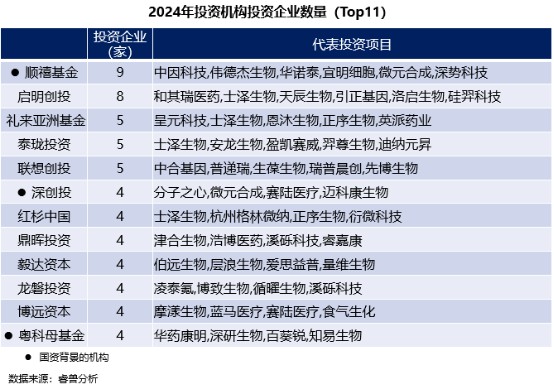
In the 2024 biomanufacturing financing events, 410 investment institutions participated, among which 374 are VC/PE (including state-owned background) accounting for 91%, and 36 are CVC accounting for 9%. Among them, Shunxi Fund and Qiming Venture Partners rank in the top 2, investing in more than 8 companies. Among the top 11 active institutions, those with state-owned backgrounds account for 33%, with Shunxi Fund, Shenzhen Capital Group, and Guangdong Science and Technology Fund being relatively active. Among the active CVC institutions, Lenovo Capital is particularly active.
Currently, there are 10 unicorns concentrated in the biopharmaceutical field
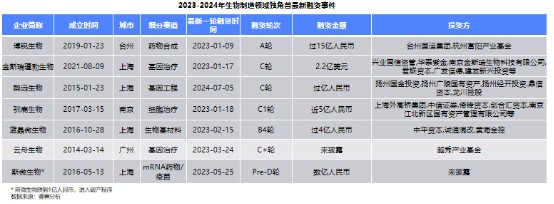
In 2023, 3 new unicorns (established within 10 years and valued at over 1 billion USD) emerged: Borui Biotech, Blue Crystal Microbiology, and Yunzhou Biotech, with 3 existing unicorns receiving the latest financing. In 2024, there are no new unicorns, with only Kunyu Biotech receiving the latest financing.
Currently, there are 10 unicorns in the biomanufacturing field (Si Microbiology has entered bankruptcy proceedings and is not counted), concentrated in the mRNA drugs/vaccines (2), drug synthesis (2), gene therapy (2), and genetic engineering (2) tracks.
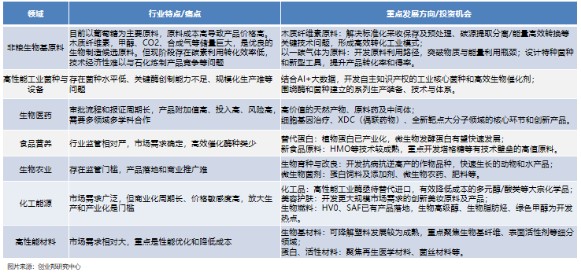
Based on the above analysis, the industry development trends and investment opportunities are as follows:
The biomanufacturing industry is currently developing towards diversification of raw material utilization, efficiency of bioconversion systems, and full-link and diversified products. With continuous innovation in business models and accelerated applications in segmented fields, the ecosystem of the biomanufacturing industry will become more complete.
The above content is excerpted from the "2024 China Biomanufacturing Industry Development Report" by Chuangyebang. For more detailed content and data analysis, please log in to Ruishou Analysis to obtain the complete report