I'm LongbridgeAI, I can summarize articles.
Physical bookstores have not performed particularly well in offline commerce in recent years, or one might say they have been somewhat wavering.
Even one of the most popular bookstores, "Tsutaya Bookstore," has now closed multiple locations.
Tsutaya Bookstore has closed again
On April 8, Tsutaya Bookstore officially announced the closure of the "TSUTAYA BOOKSTORE Shanghai MOHO" location, stating, "Due to reasons from the operating party, we have to decide to terminate the operation of this store."
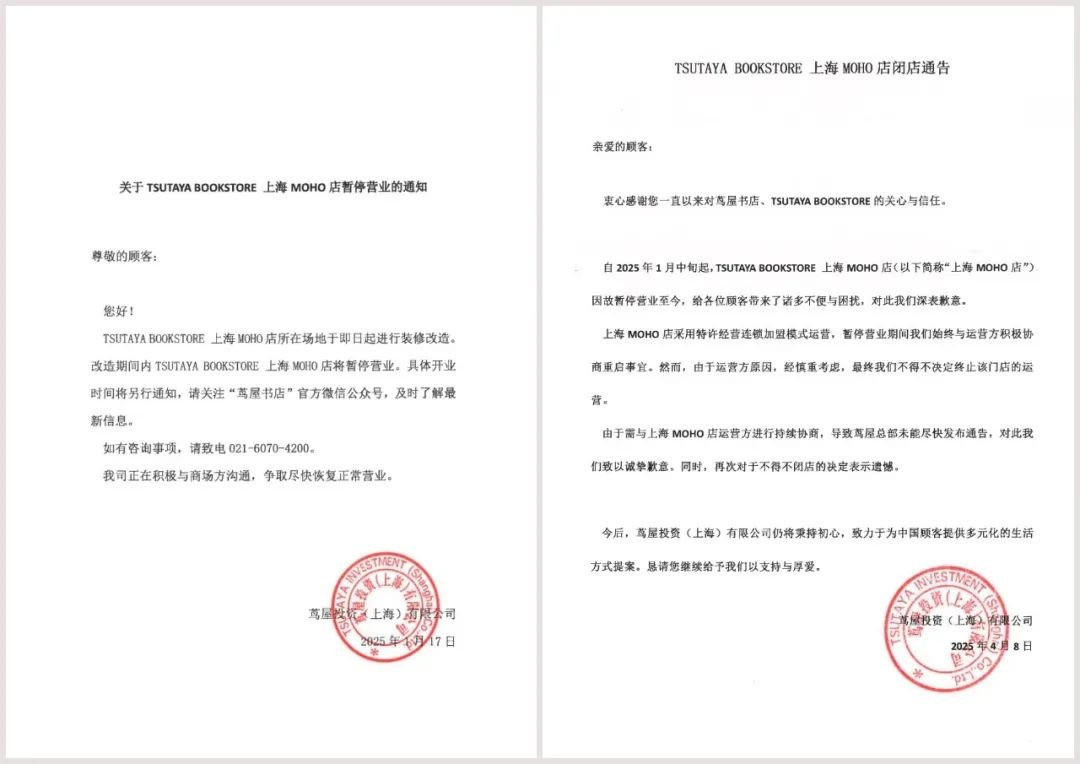 Image source: Tsutaya Bookstore official
As early as January this year, the Tsutaya Shanghai MOHO store had suspended operations for venue renovations, with "specific reopening time to be announced later." According to shares from netizens on social media, the bookstore was subsequently occupied by a large number of fitness equipment, with the popular gym Change Pro becoming the new owner of the space. During this time, there were also reports that the bookstore would move to the first floor and reopen on a later date.
With the announcement of the closure, this nearly three-month tug-of-war has finally come to an end.
The Tsutaya Shanghai MOHO store was located on the third floor of the mall and opened simultaneously with the mall, operating for only two years. The closure notice mentioned, "The Shanghai MOHO store operates under a franchise chain model, and during the suspension period, we have been actively negotiating with the operating party regarding the restart. However, due to reasons from the operating party, after careful consideration, we ultimately had to decide to terminate the operation of this store."
In short, the operating party no longer wishes to manage this store.
Not only the Shanghai MOHO store, but looking back in time, we also noticed that the Tsutaya Tianjin Renheng Isetan store and the Xi'an Maike Center store are facing the same situation.
The Tianjin Renheng Isetan store officially ended operations at the end of March this year. This store opened in September 2021 and was Tsutaya's first store in North China, attracting many consumers with its "forest bookstore" design covering 2,000 square meters. According to the announcement from Renheng Isetan, the reason for the closure of the Tsutaya Tianjin store is "operational adjustment."
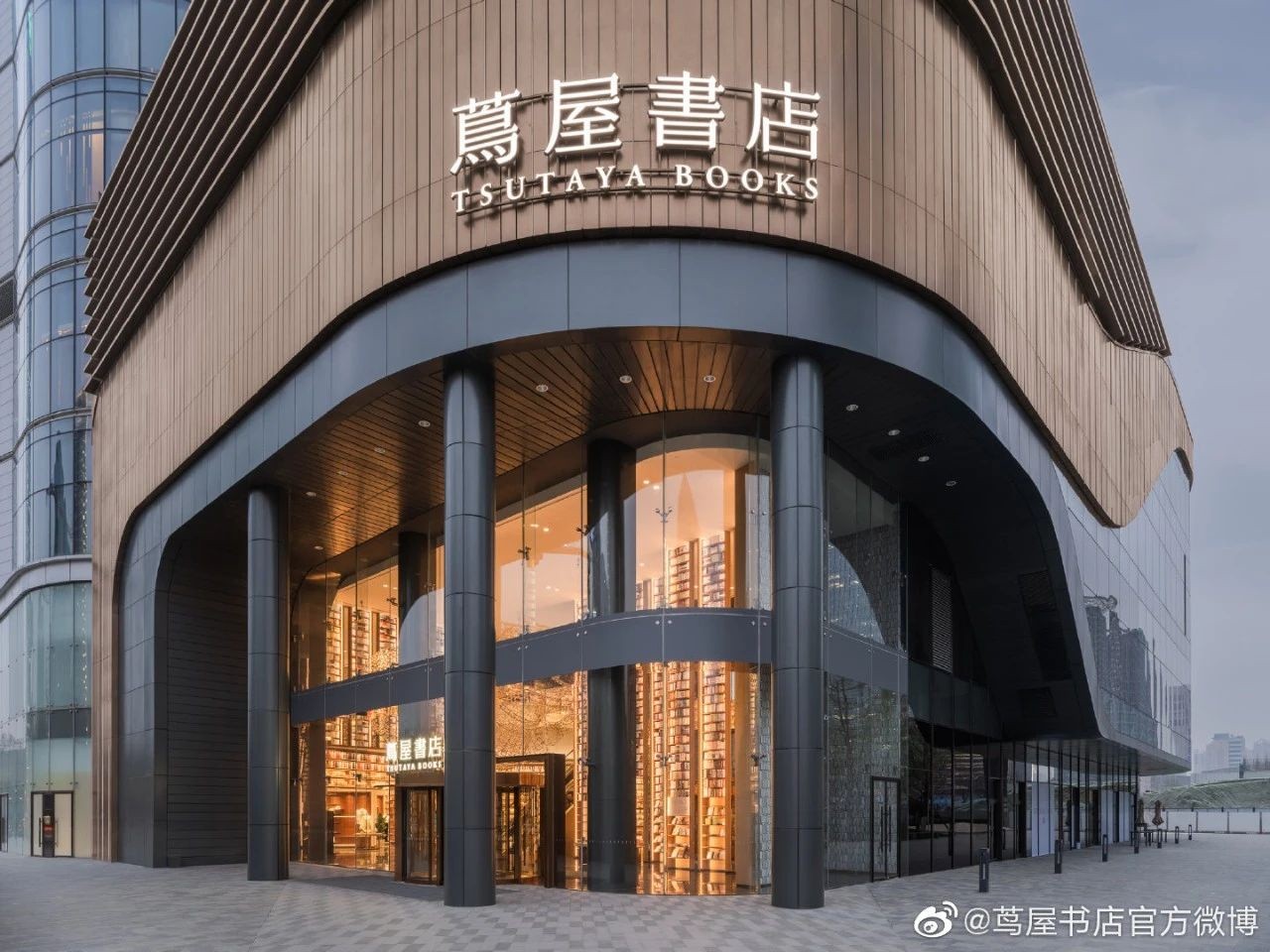 Image source: Tsutaya Bookstore official Weibo
The Xi'an Maike Center Tsutaya Bookstore also terminated operations in October last year due to "strategic operational adjustments." This store was Tsutaya's third store in mainland China and the first in Northwest China, opening its doors in March 2021.
Since opening its first store in mainland China in October 2020, the number of Tsutaya bookstores peaked at 15 in 2024.
However, in less than a year, three stores have closed consecutively, and currently, Tsutaya has only 12 stores in the country From the perspective of Tsutaya's domestic operating model, it adopts a franchise model, where Tsutaya Japan, as the brand owner, authorizes, operates, and provides guidance, while local real estate developers or third parties operate independently.
This also means that the profit pressure is more transferred to the operators. Further, under the influence of high operating costs, weak traffic attraction, and other factors, it seems reasonable that Tsutaya has been abandoned during the mall adjustment process.
Is "Bookstore + Cultural Creativity + Coffee" Unworkable?
When Tsutaya bookstores first entered the mainland market, they boldly stated their plan to open 1,100 stores within ten years. Now, it seems that this plan is no longer feasible.
From the perspective of Tsutaya China's store formats, we notice that it mainly expands through two types of stores: TSUTAYA BOOKS and TSUTAYA BOOKSTORE. The former is a "lifestyle bookstore," while the latter is a "location-adapted lifestyle bookstore." But essentially, both are composite bookstores of "bookstore + cultural creativity + coffee."
So does Tsutaya China's fatigue mean that this type of bookstore model has failed? Not necessarily.
Tsutaya has achieved great success in Japan with its unique "lifestyle proposal" bookstore model, transforming bookstores into multicultural spaces that integrate books, cultural creativity, coffee, and lifestyle goods, precisely meeting Japanese consumers' pursuit of refined living and cultural experiences. However, after transitioning to China, it has shown signs of fatigue, which is not a problem with the model itself, but rather due to various factors not being suitable.
From the consumer's perspective, product pricing is one of the key factors that deter most people from Tsutaya. In terms of books, although Tsutaya's taste is good, the books sold without discounts struggle to compete with online e-commerce platforms; in terms of cultural creative stationery, the product pricing is almost calculated by dividing the yen price by ten, while under normal exchange rates, the RMB to yen ratio is about 1:20. Therefore, many netizens jokingly refer to "Tsutaya bookstores having their own exchange rate."
Under such a high-end positioning, Tsutaya in China seems not to have truly integrated Japan's "lifestyle proposal" bookstore model with local Chinese demands, leading it to become a cultural luxury that can only be admired from a distance, contrary to local consumption logic, making it difficult to cultivate a loyal user base that can support store operations.
Therefore, under the franchise model, the "most beautiful bookstore" gimmick has made Tsutaya a tool for attracting traffic to shopping malls, drawing in consumers while also attracting other brands. Once the hype fades and business performance declines, Tsutaya becomes a target for adjustment and optimization.
On the other hand, we also see that under the "bookstore + cultural creativity + coffee" composite model, there are still brands developing steadily.
Image source: Xixifu Bookstore
For example, Xixifu Bookstore, the largest private bookstore in the country, currently has nearly 400 stores and over 5 million active members. From the perspective of store location, over 90% of its stores are located in commercial complexes, and it adapts to different locations with three types of stores: black label, green label, and red label At the same time, in terms of revenue composition, Xixifu derives important sources of revenue and profit not only from books but also from a coffee area that accounts for a fixed proportion of 15% and cultural and creative products that account for 5%.
Founded in Shenzhen, Mi Bookstore has innovated its business model with "Books +" by integrating cultural and creative products, coffee, education, and cultural activities. Currently, it has opened over 40 chain stores in 16 cities across 7 provinces in the country. In 2024, more than 70% of Mi Bookstore's locations are expected to achieve profitability on a per-store basis.
Commercial Complexes Still Need Bookstores
In fact, over the years, under the dominance of the experience economy, physical bookstores have long surpassed the boundaries of traditional retail, evolving into urban cultural spaces with composite value and a certain degree of "irreplaceability."
Especially after online channels have addressed efficiency needs, consumers are still willing to return to offline commercial spaces, particularly those that project strong emotional connections with aesthetic value and content depth. For commercial complexes, introducing high-quality bookstores is not merely a matter of filling a business gap but a strategic choice to build spiritual landmarks.
To better overcome operational difficulties, physical bookstores are continuously exploring and adjusting their diversification strategies. Nowadays, in addition to aesthetically pleasing composite bookstores, there are also specialty bookstores focused on specific themes and traditional bookstores that have undergone rebirth, fully meeting the diverse needs of different consumers.
Kubrick Bookstore, located in Shanghai's Taikoo Li, is adjacent to the "movie movie" cinema opened by Broadway Cinemas in Hong Kong, maintaining the brand's original intention of integrating reading and viewing in Hong Kong. The bookstore mainly sells film and literature-related books and relies on the niche film list and rich viewing activities of MOViE MOViE cinema to form a precise and stable consumer base.
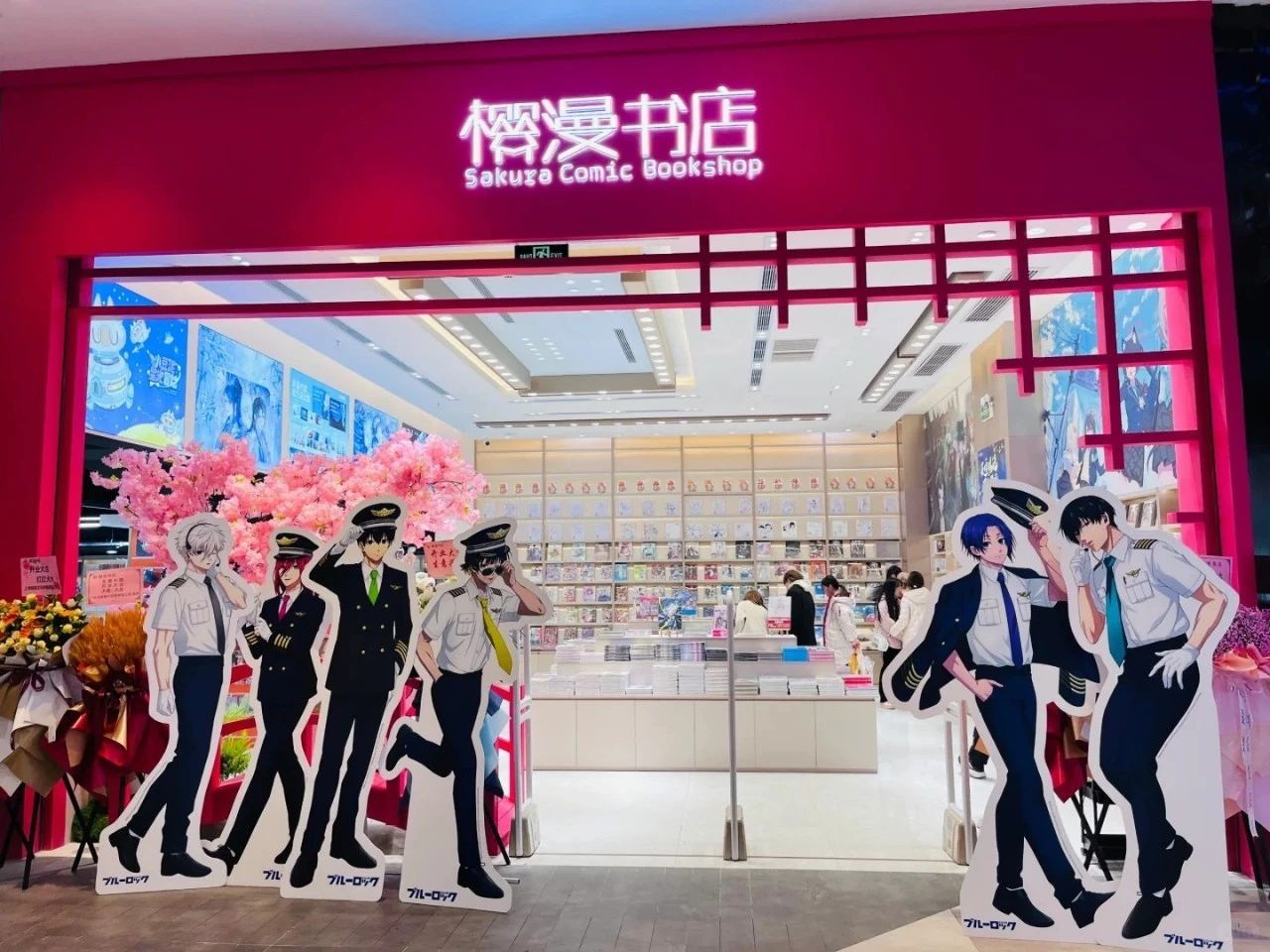
Image source: Yingman Bookstore
In the currently popular ACG (Anime, Comic, and Games) sector, Yingman Bookstore is also gradually making strides, with 6 stores already in operation. While ensuring the richness of imported and domestically produced comic book products, it has also added more diverse services and products such as anime clothing and trendy toys, and maintains contact with customers through events like new book release signings.
Founded in 2020, naive Ideal Country is a multifunctional space that integrates books, coffee, cocktails, and accommodation. It also serves as the physical space for the publishing brand Ideal Country and the offline experience store for Kan Lixiang. It has currently opened locations in Beijing, Anaya Beidaihe, Shanghai, and Anaya Chongli. Overall, naive Ideal Country is more about selling a uniquely private reading and writing space, providing literary youth with a more intimate and secure spiritual world connected to books.
Clearly, finding a balance between sentiment and commercialization, while not forgetting the essence of bookstores, is the ultimate key to attracting consumers into the store. Physical bookstores should not abandon their purity as temples of knowledge in the excessive pursuit of commercial interests; they need to retain a tranquil reading space and select quality books to meet consumers' spiritual needs. At the same time, moderate commercialization, such as launching specialty cultural and creative products and hosting cultural events, can also inject vitality into bookstore operations and achieve sustainable development Regarding the coordinated development of physical bookstores and commercial complexes, it is essentially a deep integration of cultural value and commercial efficiency. In the current era dominated by consumption upgrades and the experience economy, both need to break through traditional business boundaries, co-create scenarios, mutually benefit from traffic, and resonate in value to build a "cultural consumption community."
This article is reproduced from CEO Brand Observation (ID: new_shop_) with authorization, and the copyright belongs to CEO Brand Observation. Unauthorized translation or reproduction is prohibited.
The "2024 China New Consumer Brand Growth White Paper" is based on in-depth analysis from over 8,000 consumer surveys, 100+ expert think tanks, and 3,000+ enterprises, decoding the essence of the market from eight dimensions and anchoring future trends from six perspectives. This 200,000-word professional report will serve as a "barometer" for the iteration of the consumer industry and will also be a strategic guide for enterprises to break through the constraints of existing stock and reshape growth momentum.
Click here or the image below to purchase, with free shipping to your home!