
 I'm LongbridgeAI, I can summarize articles.
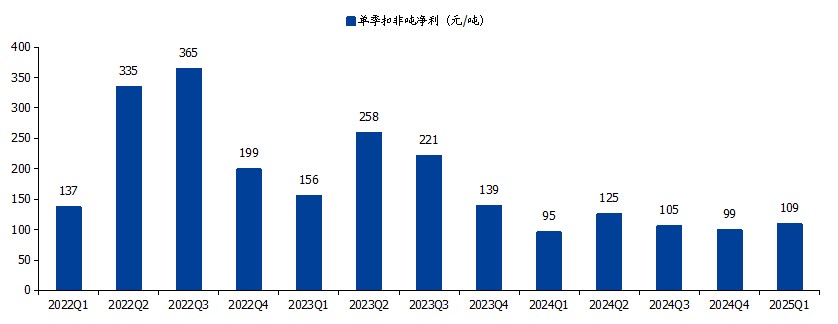
According to the Zhitong Finance APP, Guosheng Securities released a research report stating that based on the latest steel price trends and macro demand conditions, the forecast for Honglu Steel Structure (002541.SZ) has been adjusted to a net profit attributable to the parent company of 870 million, 1.04 billion, and 1.25 billion yuan for 2025-2027, representing year-on-year increases of 13%, 20%, and 20%, respectively. The current stock price corresponds to PE ratios of 15, 12, and 10 times. The company is a leader in steel structure manufacturing, with a solid competitive advantage and a continuously optimized management system; in Q1 2025, orders, production, revenue, and net profit per ton excluding non-recurring items have all shown upward turning points, and it is expected to continue benefiting from demand recovery; the welding robots have reached a certain scale, and this year is expected to be the year of benefit realization, with subsequent cost reduction and increased production from robots likely to contribute significant performance elasticity to the company (calculating that the net profit per ton excluding non-recurring items has a 343% expansion space compared to 2024). Overall, the company's performance recovery trend this year is clear, with significant medium- to long-term profit expansion space, and the valuation remains low, continuing to be a key focus.
Chart 6: Honglu Steel Structure Quarterly Net Profit Excluding Non-Recurring Items (Yuan/Ton)
Source: Wind, Guosheng Securities Research Institute
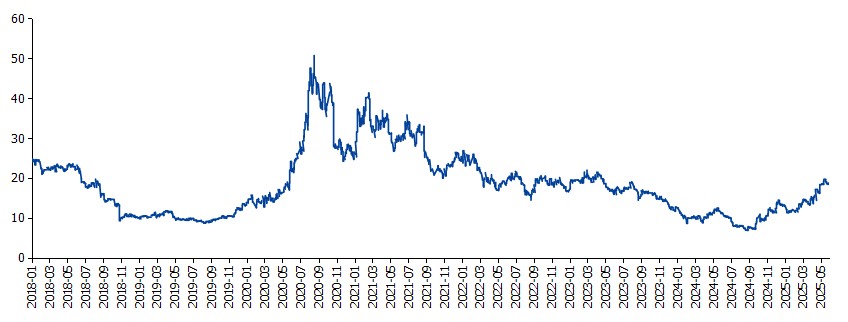
Chart 7: Honglu Steel Structure PE (ttm) Trend Since 2018
Source: Wind, Guosheng Securities Research Institute
What is the Benefit of Honglu Steel Structure's Welding Robots?
The demand for industry transformation and upgrading is increasingly urgent, and intelligent transformation directly addresses industry pain points. Steel structure processing has characteristics of non-standardization, multiple processes, and reliance on manual labor, leading to management difficulties and production instability. Taking welding, a key process in steel structure processing, as an example: the welding process largely relies on welders using handheld welding machines. Due to the high technical requirements for manual welding, long training periods for skilled workers, and harsh working environments, labor costs are high, resources are scarce, and the skill levels of different welders vary, making product quality difficult to control. China's "14th Five-Year Plan and 2035 Vision Goals" clearly states the need to "develop intelligent construction"; at the same time, according to the public account of Baichu Electronics, it is predicted that by 2035, the application of steel structure buildings in China will reach the level of moderately developed countries, and the numerical control rate of key processes in steel structure manufacturing in China should exceed 50%, with the average labor productivity per capita in the entire industry exceeding 100 tons/year. Under the demands of industry development and policy promotion, there is ample demand and wide space for automation and intelligent upgrades in the steel structure industry.
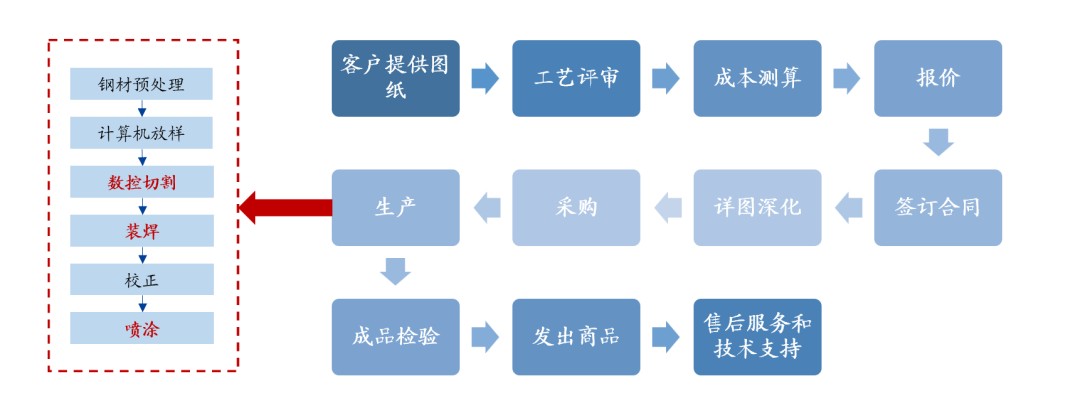
Chart 1: Steel Structure Manufacturing Business Process
 Source: Company Announcement, Guosheng Securities Research Institute
The company has been continuously researching and deploying welding robots in recent years, and has now reached a certain scale.
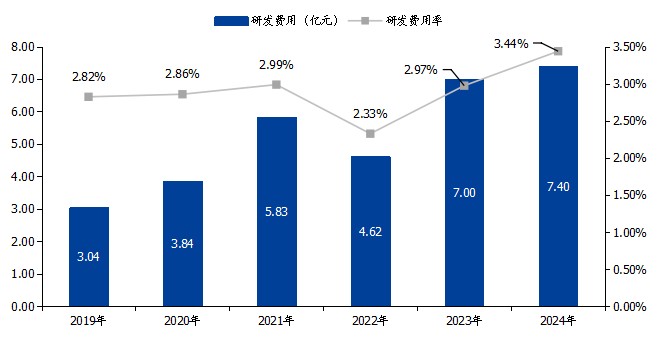
Since 2023, the company has significantly increased its research and deployment of welding robots, with R&D expense ratios of 2.97% and 3.44% for 2023 and 2024 respectively, an increase of 0.65 and 0.46 percentage points year-on-year. The welding of small batches and non-standard parts requires robots equipped with welding systems capable of recognizing and autonomously planning welding paths, with the key challenges being welding models and 3D vision. Welding models rely on industrial software such as CAD, CAM, and NC, with algorithms at their core and requiring a large accumulation of data, resulting in high technical barriers. 3D vision focuses on recognition algorithms, but the domestic 3D industrial vision market is still in its early development stage, with an immature industrial chain and the need for substantial data feedback for algorithm iteration.
Compared to software development companies, HONGLU has accumulated rich production data over many years of production, and during the R&D process, it can continuously test and optimize through extensive practical applications. Since 2023, the company has independently developed the "Arc Welding Robot Control System," which has been applied to the company's integrated lightweight welding robots and rail-type robot welding stations, with further breakthroughs expected in the software development of more complex welding processes.
As of the end of 2024, the company's ten major production bases have scaled up to nearly 2,000 lightweight welding robots and rail-type robot welding stations, and external sales have begun. This year, under the national equipment renewal and transformation subsidy policy, the company is expected to continue large-scale deployment of welding robots.
Chart 2: HONGLU's R&D Expenses and R&D Expense Ratios Over the Years
Source: Wind, Guosheng Securities Research Institute
Welding robots need to overcome four thresholds in succession, and the company has currently surpassed the second threshold.
The main types of welding in the steel structure welding process, ranked from simple to difficult, include:
-
Single weld (fillet weld): Suitable for welding between thin plates (steel plates below 4mm), fillet welds generally do not have a groove and are usually welded using gas shielded welding.
-
Multi-layer multi-pass welding (groove welding): Refers to welding thicker seams by dividing the weld into multiple layers, with each layer further divided into multiple passes, welded in a specific order layer by layer to complete the entire weld, typically using submerged arc welding.
-
Groove weld with full penetration and flaw detection for level one welds: A higher quality requirement for groove welding, which must be fully penetrated and pass flaw detection to meet level one weld requirements.
-
Multi-position welding: Includes horizontal welding, vertical welding, etc. The company applied for a patent for "A Submerged Arc Welding Robot for Steel Structures and Its Usage Method" in March 2025. According to the HONGLU Intelligent Manufacturing WeChat video account, the HONGLU submerged arc welding robot has been widely used in the ten major bases as of April 2025. Considering that submerged arc welding technology is mainly used for multi-layer multi-pass welding, it can be concluded that the company's welding robot technology and applications have basically surpassed the second threshold Chart 3: Illustration of Some Welding Methods
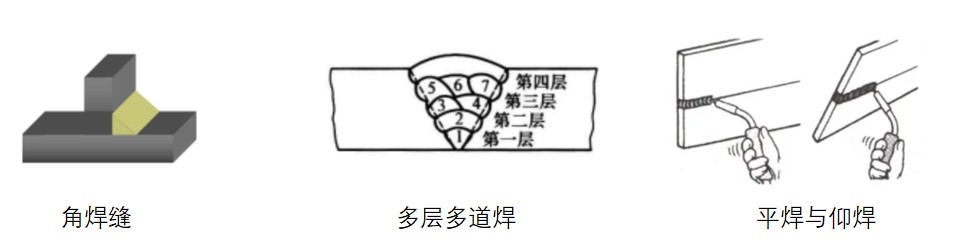
Source: YuanChuangLi Non-destructive Testing Network, Refrigeration Network, Megmeet Official Website, Guosheng Securities Research Institute
The benefits of welding robots for HONGLU include four aspects: 1) Quality Improvement: The skill levels of welders vary, and it is difficult for them to work at high intensity for long periods. In contrast, welding robots provide stable welding quality, which can enhance product quality; 2) Cost Reduction: One operator can manage three welding robots, completing the daily workload of three skilled welders, significantly reducing labor costs and addressing the current shortage of quality welders; 3) Increased Production: The welding environment is relatively harsh, and welders typically work 8 hours a day, while robots can operate continuously, breaking through the designed production capacity of the production line; 4) External Sales: The company's robotic products have been sold externally, with key products like the teach-free intelligent welding workstation priced at 198,000 yuan/unit, and other agile robots priced at 120,000 to 140,000 yuan/unit, expected to create new growth points. This article mainly focuses on the quantitative assessment of cost reduction and increased production benefits.
1. Cost Reduction Benefit: Ton Cost Expected to Decrease by 88 Yuan/Ton
We make the following assumptions: 1) Based on the company's production personnel of 22,509 by the end of 2024, assuming about 8,000 of them are welders, with 80% of the welding workload replaceable by welding robots, corresponding to 6,400 welders; 2) Assuming welding robots have slightly higher welding efficiency than welders, 6,000 robots can complete the workload of 6,400 welders; and assuming the average price of each welding robot is 200,000 yuan, with a depreciation period of 5 years and a salvage value of 5%; 3) Assuming one operator can manage three welding robots, thus 6,000 robots require 2,000 operators; 4) Assuming the average monthly salary of a welder is 10,000 yuan and the monthly salary of an operator is 6,000 yuan. Based on the above assumptions, the cost of 6,400 replaced welders is 768 million yuan/year, robot depreciation is 228 million yuan/year, and operator costs are 144 million yuan/year, so the cost reduction benefit = 768 - 228 - 144 = 400 million yuan/year. If calculated based on a production volume of 4.51 million tons/year in 2024, the corresponding cost reduction per ton is 88 yuan.
Chart 4: Cost Reduction Benefit Calculation of Welding Robots for HONGLU's Steel Structure Production
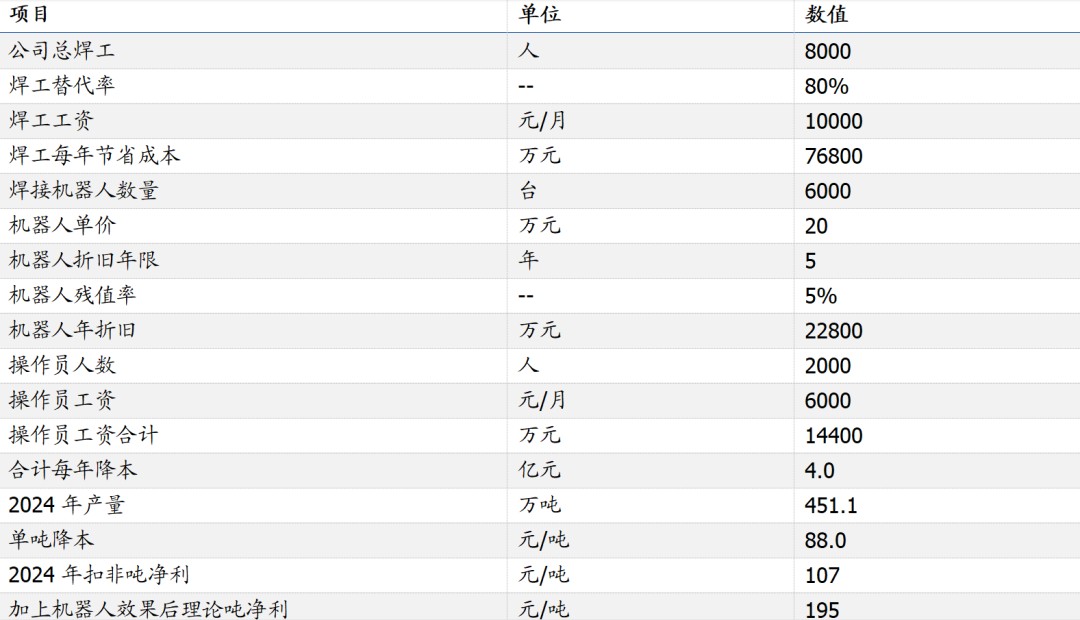
Source: HONGLU Announcement, Baichu Electronics Announcement, Guoyang Employment WeChat Official Account, Guosheng Securities Research Institute
2. Increased Production Benefit: Improved Capacity Utilization Rate, Leading to Significant Incremental Profit
Assuming welding robots achieve a capacity utilization rate of 180% through two shifts, the company's actual production could reach 9.36 million tons, more than double the actual production in 2024, equivalent to recreating another HONGLU. The expansion only needs to consider proportionate allocation of existing production costs, without the need to increase building depreciation + land use rights amortization (the company's building depreciation + land amortization per ton in 2024 is 63 yuan) Therefore, the net profit excluding non-recurring items from the incremental production can increase by an additional 63 yuan/ton based on the cost reduction benefits mentioned earlier. Thus, we can estimate that the increase in production capacity utilization rate to 180% will correspond to a net profit excluding non-recurring items of 1.25 billion yuan from the incremental production of 4.85 million tons. Furthermore, it can be calculated that after the company's capacity utilization rate rises to 180%, the total benefits from cost reduction and increased production will amount to 1.65 billion yuan. Adding the net profit excluding non-recurring items attributable to the parent company of 480 million yuan in 2024, the theoretical net profit excluding non-recurring items attributable to the parent company will be 2.13 billion yuan, an increase of 343% compared to 2024.
Chart 5: Calculation of the Benefits of Welding Robots on HONGLU's Capacity Utilization Rate Improvement
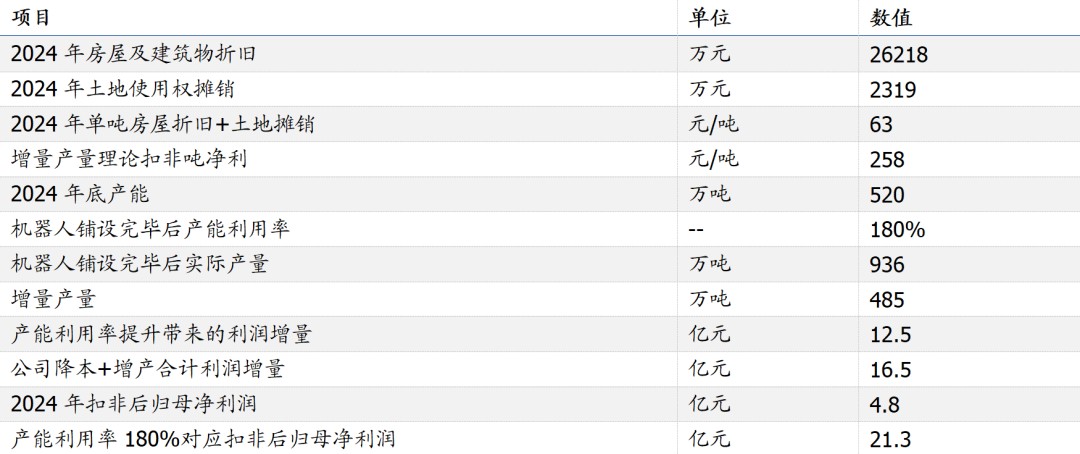
Source: Company announcement, Wind, Guosheng Securities Research Institute