I'm LongbridgeAI, I can summarize articles.
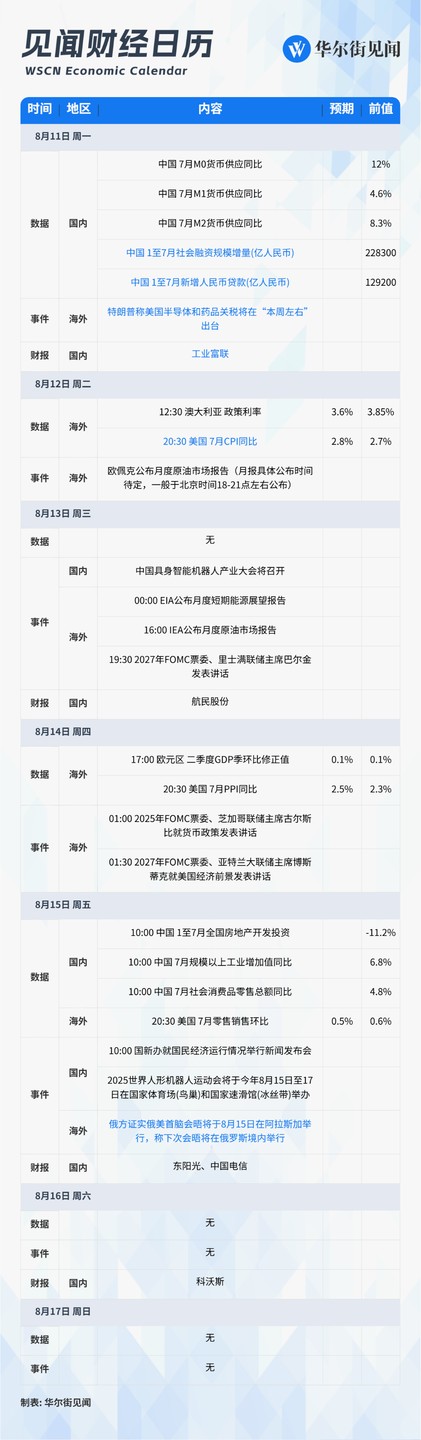
August 11 - August 17 Weekly Major Financial Events Overview, all times in Beijing:
Key Focus: U.S. July CPI, PPI, retail sales, multiple Federal Reserve officials speaking intensively; China's July social financing, retail sales of consumer goods, industrial added value above designated size data; Eurozone Q2 GDP quarter-on-quarter revision, Reserve Bank of Australia interest rate decision announcement.
In addition, the Russian side confirmed that the U.S.-Russia summit will be held on August 15 in Alaska, stating that the next meeting will be held in Russia. Trump stated that U.S. semiconductor and pharmaceutical tariffs will be announced "around this week." The China Embodied Intelligent Robot Industry Conference and the 2025 World Humanoid Robot Games will be held. FII will announce its financial report.
Economic Indicators
- U.S. July CPI
Last month's data showed that U.S. June inflation data performed moderately overall, with core CPI rising 2.9% year-on-year. The market generally believes that the Federal Reserve's interest rate cut in September is almost a certainty, with the suspense shifting to a 50 basis point cut.
San Francisco Fed President Mary Daly stated on the 4th that if inflation rebounds and spreads, or if the job market rebounds, the number of necessary rate cuts may be less than two. However, she also warned that if the Federal Reserve waits to "confirm that inflation will not have a transmission effect—this process may take 6 months or even a year, then it will definitely be too late."
Chris Beauchamp, Chief Market Analyst at trading platform IG, stated in a report that recent U.S. ISM services PMI data showed a significant rise in the prices paid sub-index, reminding the market that "inflation remains a force that cannot be ignored."
Citigroup economists stated that after the previous June data showed "early signs of significant price increases for goods," investors will focus on the extent of the impact of tariffs on prices. They expect this pass-through to moderately expand in July, leading to a strong rise in core goods prices. However, this impact may become more apparent in the fall and should not prevent the Federal Reserve from cutting rates next month, especially considering the weakness in the labor market.
- U.S. July PPI
Last month's data showed that U.S. June PPI was 2.3% year-on-year, significantly below the expected 2.5%, marking the lowest year-on-year increase since September 2024, with the previous value revised from 2.6% to 2.7%, and month-on-month at 0%, below the expected 0.2%, with the previous value revised from 0.1% to 0.3%.
Service prices unexpectedly declined, and moderate increases in goods showed that the current "inflation pipeline" is not heating up. However, the revision of previous data and the recovery of intermediate demand goods may still indicate potential risks in the future. Tariff inflation may not have disappeared but has only been temporarily "delayed."
Analysis suggests that the trading implication lies in the re-evaluation of the chain "CPI/PPI → nominal and real interest rates → U.S. dollar." If July CPI accelerates and is confirmed by PPI, cost-push and tariff transmission will raise nominal interest rates and breakeven inflation, suppressing U.S. Treasury duration and providing phase-specific support for the dollar;If inflation weakens, employment cracks will dominate the narrative, with deflation expectations rising and the dollar under pressure.
- U.S. July Retail Sales
Last month's data showed that U.S. retail sales increased by 0.6% month-on-month in June, reversing a decline that had lasted for two consecutive months. This strong rebound exceeded the expectations of most economists and is expected to alleviate market concerns about a tightening of consumer spending. Auto sales rebounded after two months of decline, becoming a significant factor driving overall growth.
Analysts believe that Friday's retail and industrial output data will test demand resilience: if retail accelerates, it could offset growth concerns and provide late-session support for the dollar; if it softens, the repricing of "weak growth + mild inflation" will strengthen, putting downward pressure on the dollar.
- China's Irregular Announcement of July Social Financing Data
China's monetary policy has shown significant support for the real economy in the first half of the year. Last month's data showed that new social financing in June was 4.2 trillion yuan, with new RMB loans of 2.24 trillion yuan, and the M2-M1 spread was 3.7 percentage points, narrowing by 1.9 percentage points from May's 5.6 percentage points.
Zou Lan, Deputy Governor of the People's Bank of China, stated that in international comparison, the People's Bank has continuously lowered the reserve requirement ratio and interest rates multiple times in recent years, and the monetary policy stance is supportive, with policy effects accumulating continuously.
- China's National Real Estate Development Investment from January to July
Last month's data showed that real estate development investment in China from January to June decreased by 11.2% year-on-year, and the sales area of new commercial housing decreased by 3.5% year-on-year. From January to June, the year-on-year decline in the sales area of new commercial housing expanded by 0.6 percentage points compared to January to May; among them, the sales area of residential properties decreased by 3.7%. The sales amount of new commercial housing was 44,241 billion yuan, a decrease of 5.5%; among them, the sales amount of residential properties decreased by 5.2%.
- China's July Industrial Added Value Above Designated Size
Last month's data showed that China's industrial added value above designated size increased by 6.8% year-on-year in June, with rapid growth in the production of new energy vehicles and industrial robots. In June, 36 out of 41 major industries maintained year-on-year growth in added value. The electrical machinery and equipment manufacturing industry and the computer, communication, and other electronic equipment manufacturing industry showed rapid growth in output. The production of 3D printing equipment, new energy vehicles, and industrial robots increased by 43.1%, 36.2%, and 35.6% year-on-year, respectively.
- China's July Total Retail Sales of Consumer Goods
Last month's data showed that the year-on-year growth rate of China's retail sales of consumer goods slowed to 4.8% in June, with a slowdown in catering revenue. Retail sales of household appliances and audio-visual equipment, cultural and office supplies, and communication equipment above designated size increased by 32.4%, 24.4%, and 13.9%, respectively, slowing compared to the previous month. In June, catering revenue was 470.8 billion yuan, an increase of 0.9%, down from 5.9% previously.
- Eurozone Q2 GDP Quarter-on-Quarter Revision
The Eurozone's economic growth significantly slowed in the second quarter but was better than the market's previous expectation of zero growth, with the quarter-on-quarter growth rate dropping from 0.6% in the first quarter to 0.1%. Year-on-year growth reached 1.4%, also higher than the expected 1.2%. However, there is a clear severe divergence within the region, with Germany, the Eurozone's largest economy, and Italy, the third-largest economy, both falling into contractionPreviously, to stimulate the economy, the European Central Bank has lowered its key interest rate to 2% over the past 13 months. However, the latest data shows that the economic fundamentals are better than feared, and financial markets believe that the necessity for the European Central Bank to continue easing policy is decreasing. Currently, the market estimates the likelihood of another rate cut by the European Central Bank before December is only 50%.
- Reserve Bank of Australia announces interest rate decision
The Reserve Bank of Australia will conduct its third rate cut in this cycle and update its economic forecasts.
In this round of easing, the Reserve Bank of Australia has only cut rates twice by 25 basis points from the peak. It is expected that RBA Governor Michele Bullock will maintain a cautious tone, emphasizing the need for global risks and gradual actions. The market will closely monitor any changes in the RBA's unemployment rate forecast, especially after the unexpected rise in the unemployment rate last month.
Financial Events
- Russia confirms that the meeting between the Russian and American presidents will be held on August 15 in Alaska, stating that the next meeting will be held in Russia
According to CCTV News, on August 9 local time, Russian presidential assistant Ushakov stated that Russian President Putin and American President Trump will meet on August 15 local time in Alaska.
Ushakov stated that the focus of the talks between Putin and Trump will be on achieving a long-term peace plan for Ukraine.
Ushakov mentioned that the preparation process for the meeting between the Russian and American leaders will not be smooth, but both sides will make efforts for it.
Ushakov indicated that after the meeting in Alaska, the next meeting between Putin and Trump will be held in Russia. The Russian side has already sent the corresponding invitation to the American side.
On August 8 local time, American President Trump posted on his social platform "Truth Social" that he will meet with Russian President Putin on August 15 in Alaska, with more details to be announced later. Earlier that day, Trump stated that the U.S. and Russia are "very close" to reaching an agreement on the Ukraine issue. Both sides are arranging the meeting location.
- Trump states that U.S. tariffs on semiconductors and pharmaceuticals will be introduced "around this week"
According to CCTV NewsOn August 5th, local time, U.S. President Trump stated in an interview with CNBC that, given India's continued purchase of Russian oil, he would "significantly" increase tariffs on goods imported from India within the next 24 hours. According to CCTV News, on August 6th, Wednesday, Trump signed an executive order imposing an additional 25% tariff on goods from India in response to India's continued "direct or indirect imports of Russian oil."
Regarding the tariff policy, Trump unexpectedly announced a significant increase in drug tariffs (up to 250%) and stated that he would announce tariffs on drugs and chips within the next week.
- Multiple Federal Reserve officials speak out intensively
After the employment report was released, the Federal Reserve ended its quiet period, and officials spoke out intensively. On the 13th, 2027 FOMC voting member and Richmond Fed President Barkin delivered a speech; on the 14th, 2027 FOMC voting member and Atlanta Fed President Bostic spoke about the U.S. economic outlook; on the 14th, 2025 FOMC voting member and Chicago Fed President Goolsbee discussed monetary policy.
According to Bank of America’s research report, the Federal Reserve has formed two distinct camps. The dovish camp, represented by New York Fed President Williams and Richmond Fed President Hammack, believes that the labor market remains resilient and is more concerned about inflation issues.
On the other side, the hawkish camp, including Minneapolis Fed President Kashkari, San Francisco Fed President Daly, and governors Waller and Bowman, is more focused on the downside risks to economic activity and signs of a slowdown in the labor market, believing there is reason to cut interest rates in the short term. The core of the disagreement lies in the different assessments of the current economic situationBank of America analysts stated that despite significant internal divisions within the Federal Reserve, the market should keep its focus firmly on Chairman Powell. Powell's policy signals carry far more weight than those of his colleagues, and the Jackson Hole central bank annual meeting has historically been his preferred platform for releasing significant policy shift signals. If the Fed's policy focus has indeed shifted from inflation to a greater emphasis on employment, this meeting will be the most likely opportunity for it to announce this change to the market.
Public information shows that this year's Jackson Hole central bank annual meeting will be held from August 21 to 23.
- The China Embodied Intelligent Robotics Industry Conference will be held
This conference covers the ecosystem of the embodied intelligent robotics industry, from suppliers of robot raw materials and components, system integrators, simulation and testing to complete machine manufacturing, focusing on cutting-edge fields such as embodied intelligence and automotive technology, covering core components to end applications.
- The 2025 World Humanoid Robot Games will be held from August 15 to 17 this year at the National Stadium (Bird's Nest) and the National Speed Skating Hall (Ice Ribbon)
This event has attracted enthusiastic registrations from teams around the world. Currently, teams from Portugal, Japan, and the UAE have successively settled in the humanoid robot football training base to begin pre-competition preparations.
Corporate Financial Reports
- FII
North American cloud manufacturers have seen explosive growth in performance, with recent financial report data from major companies such as Microsoft and Meta far exceeding market expectations, and all have unanimously raised their capital expenditures in infrastructure areas such as computing power.
Minsheng Securities recently released a research report stating that FII, as a core global AI server OEM manufacturer, has achieved a market share of about 40% in the AI server market, with major clients including Microsoft, Amazon, Google, and other core CSP manufacturers, and is expected to fully benefit from the ramp-up of AI servers. The report also mentioned that earlier market concerns about the delayed shipment of the GB200 have now been resolved, and the cabinet servers have entered a large-scale shipment phase. As one of the most important suppliers of NVIDIA's GB200 cabinets, FII has already completed mass production delivery of the GB200 cabinets in the fourth quarter of 2024, and it is expected that the GB200 will bring significant performance growth to the company this year.
FII's performance forecast for the first half of this year far exceeded market expectations. Especially in the second quarter, the company's AI and cloud computing businesses achieved rapid growth, with cloud computing business revenue increasing by over 50% compared to the same period last year, AI server revenue increasing by over 60% year-on-year, and server revenue from cloud service providers increasing by over 150% year-on-year. Many institutions have stated that as computing power demand continues to rise and the company's global industrial chain advantages become more pronounced, FII's profitability will surely reach new heights, further consolidating its leading position.
Subscribe to Weekly Major Events:
Domestic Events:
 Overseas Events: