
 I'm LongbridgeAI, I can summarize articles.
The external fund manager backed by Berkshire Hathaway's Charlie Munger, Li Lu, makes no bones about it when he says 'The biggest investment risk is not the volatility of prices, but whether you will suffer a permanent loss of capital.' So it seems the smart money knows that debt - which is usually involved in bankruptcies - is a very important factor, when you assess how risky a company is. As with many other companies Tern Properties Company Limited (HKG:277) makes use of debt. But is this debt a concern to shareholders?
We've found 21 US stocks that are forecast to pay a dividend yield of over 6% next year. See the full list for free.
When Is Debt Dangerous?
Debt is a tool to help businesses grow, but if a business is incapable of paying off its lenders, then it exists at their mercy. Part and parcel of capitalism is the process of 'creative destruction' where failed businesses are mercilessly liquidated by their bankers. However, a more frequent (but still costly) occurrence is where a company must issue shares at bargain-basement prices, permanently diluting shareholders, just to shore up its balance sheet. Of course, plenty of companies use debt to fund growth, without any negative consequences. When we examine debt levels, we first consider both cash and debt levels, together.
What Is Tern Properties's Net Debt?
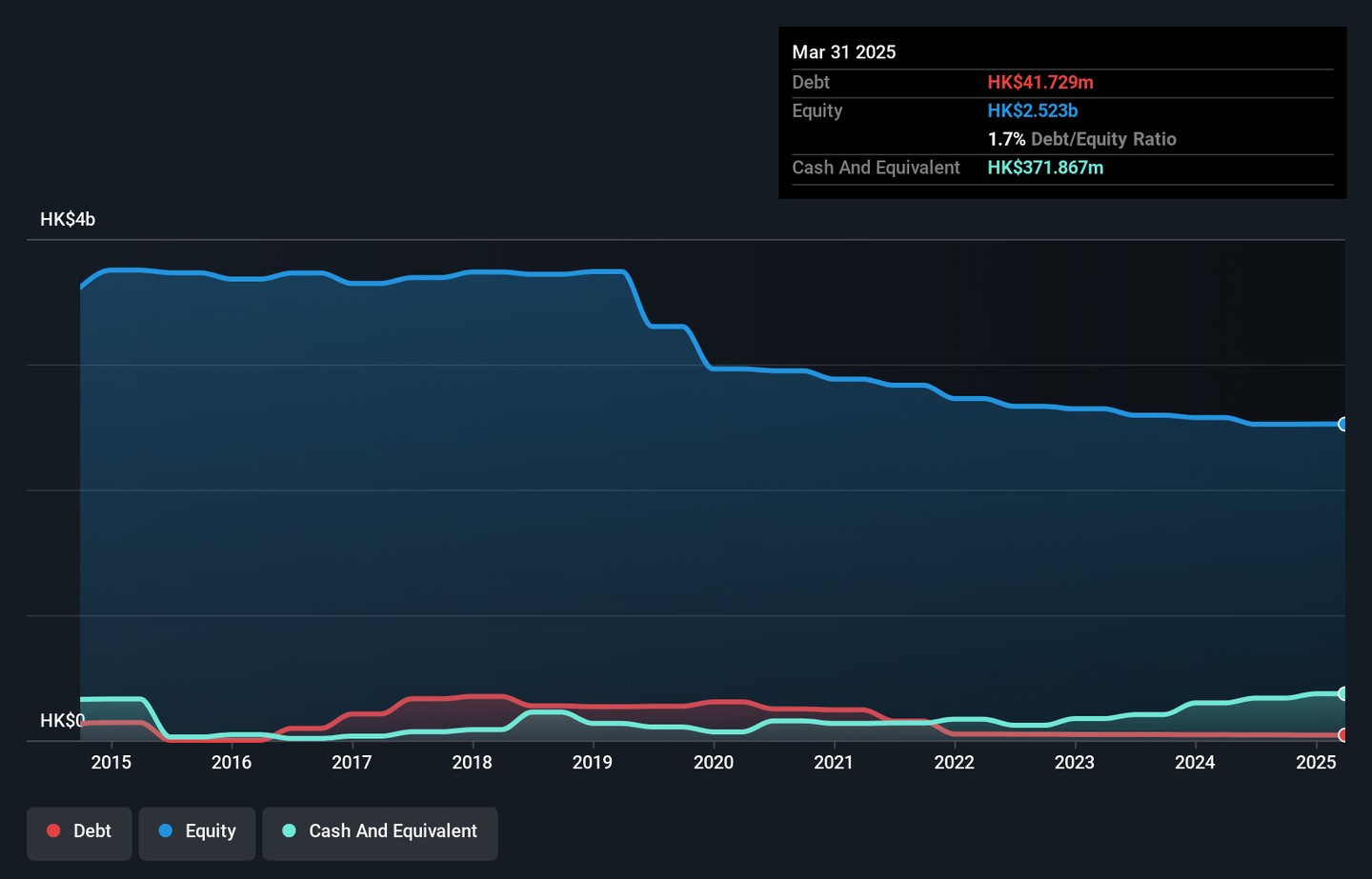
As you can see below, Tern Properties had HK$41.7m of debt at March 2025, down from HK$44.6m a year prior. However, it does have HK$371.9m in cash offsetting this, leading to net cash of HK$330.1m.
A Look At Tern Properties' Liabilities
The latest balance sheet data shows that Tern Properties had liabilities of HK$23.0m due within a year, and liabilities of HK$82.0m falling due after that. On the other hand, it had cash of HK$371.9m and HK$10.0m worth of receivables due within a year. So it actually has HK$276.9m more liquid assets than total liabilities.
This surplus liquidity suggests that Tern Properties' balance sheet could take a hit just as well as Homer Simpson's head can take a punch. With this in mind one could posit that its balance sheet means the company is able to handle some adversity. Simply put, the fact that Tern Properties has more cash than debt is arguably a good indication that it can manage its debt safely.
View our latest analysis for Tern Properties
It is just as well that Tern Properties's load is not too heavy, because its EBIT was down 49% over the last year. Falling earnings (if the trend continues) could eventually make even modest debt quite risky. There's no doubt that we learn most about debt from the balance sheet. But it is Tern Properties's earnings that will influence how the balance sheet holds up in the future. So if you're keen to discover more about its earnings, it might be worth checking out this graph of its long term earnings trend.
Finally, while the tax-man may adore accounting profits, lenders only accept cold hard cash. While Tern Properties has net cash on its balance sheet, it's still worth taking a look at its ability to convert earnings before interest and tax (EBIT) to free cash flow, to help us understand how quickly it is building (or eroding) that cash balance. Happily for any shareholders, Tern Properties actually produced more free cash flow than EBIT over the last three years. That sort of strong cash conversion gets us as excited as the crowd when the beat drops at a Daft Punk concert.
Summing Up
While we empathize with investors who find debt concerning, you should keep in mind that Tern Properties has net cash of HK$330.1m, as well as more liquid assets than liabilities. And it impressed us with free cash flow of HK$7.2m, being 108% of its EBIT. So is Tern Properties's debt a risk? It doesn't seem so to us. There's no doubt that we learn most about debt from the balance sheet. But ultimately, every company can contain risks that exist outside of the balance sheet. For example, we've discovered 1 warning sign for Tern Properties that you should be aware of before investing here.
At the end of the day, it's often better to focus on companies that are free from net debt. You can access our special list of such companies (all with a track record of profit growth). It's free.