
 I'm LongbridgeAI, I can summarize articles.
To address the significant power gap brought about by the development of artificial intelligence, the Trump administration is planning to utilize "hundreds of billions of dollars" in national funds to finance the construction of new nuclear power plants, aiming to ensure the energy infrastructure required for the AI revolution and position the government as the ultimate capital backer supporting the development of this critical industry.
According to Reuters, U.S. Secretary of Energy Chris Wright clearly stated at a conference hosted by the American Nuclear Society that the Loan Programs Office (LPO) under the Department of Energy will allocate the vast majority of its funds to support the construction of nuclear power plants. The LPO has the authority to provide hundreds of billions of dollars in financing assistance, including loan guarantees for projects that have difficulty obtaining bank loans.
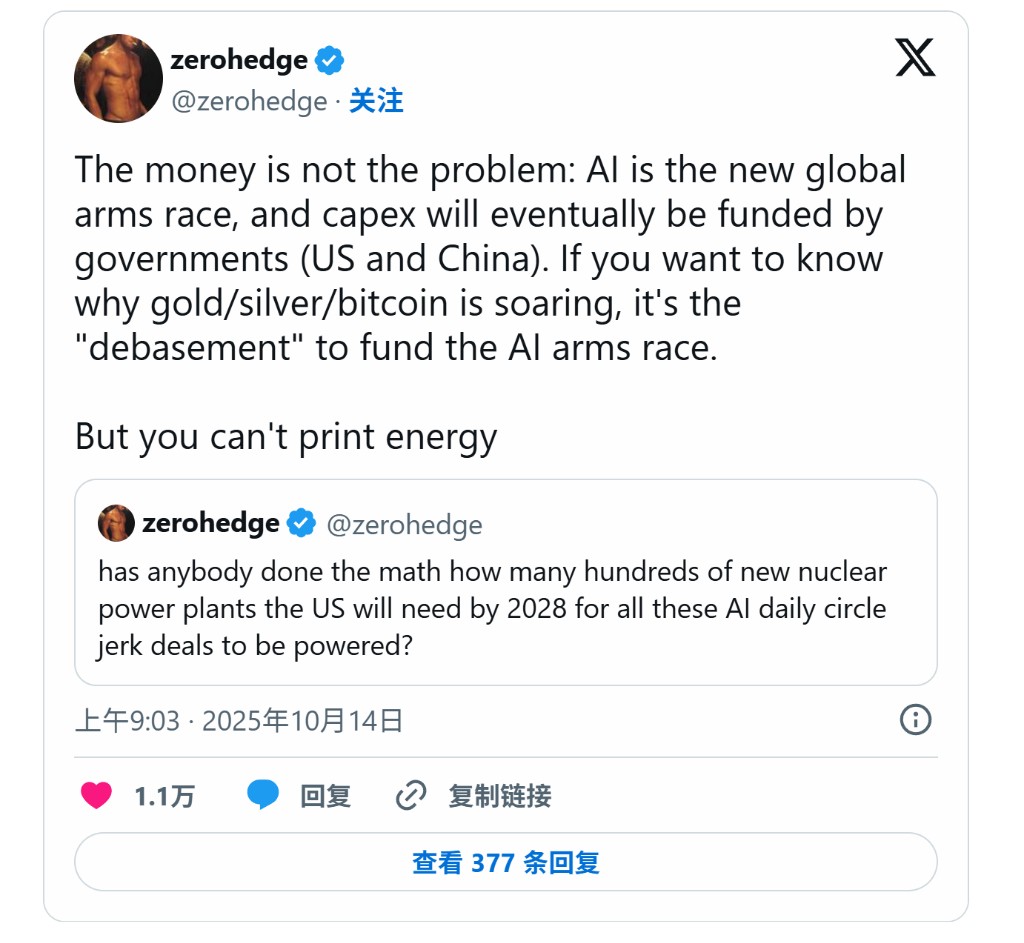
This policy statement directly addresses the core concerns of the market: where the massive investment in energy infrastructure needed to meet the enormous power demands of AI data centers will come from. Without strong government intervention, the current AI boom may struggle to continue due to energy bottlenecks. Chris Wright set a clear goal, hoping to see "dozens of nuclear power plants under construction" by the time "we leave office in three years and three months."
This move also marks the continuation of a series of supportive policies for nuclear power. Previously, President Trump signed an executive order in May of this year, calling for the construction of ten large nuclear reactors by 2030. This clarifies the government's strategic direction in addressing AI power demands through nuclear energy, with a series of debt financing agreements expected to materialize in the coming weeks to months.
Government Steps In to Fill the AI Energy Funding Gap
The exponential development of AI is placing unprecedented pressure on the U.S. power grid, driven by a massive funding gap.
According to previous estimates by Morgan Stanley, by 2028, the U.S. will need at least 36 gigawatts (GW) of new power to support the operation of data centers, and this number is likely even higher today. With an estimated cost of $50 billion to $60 billion per gigawatt of power, the investment demand for energy infrastructure in the coming years could reach trillions of dollars, and this funding is currently not in place.
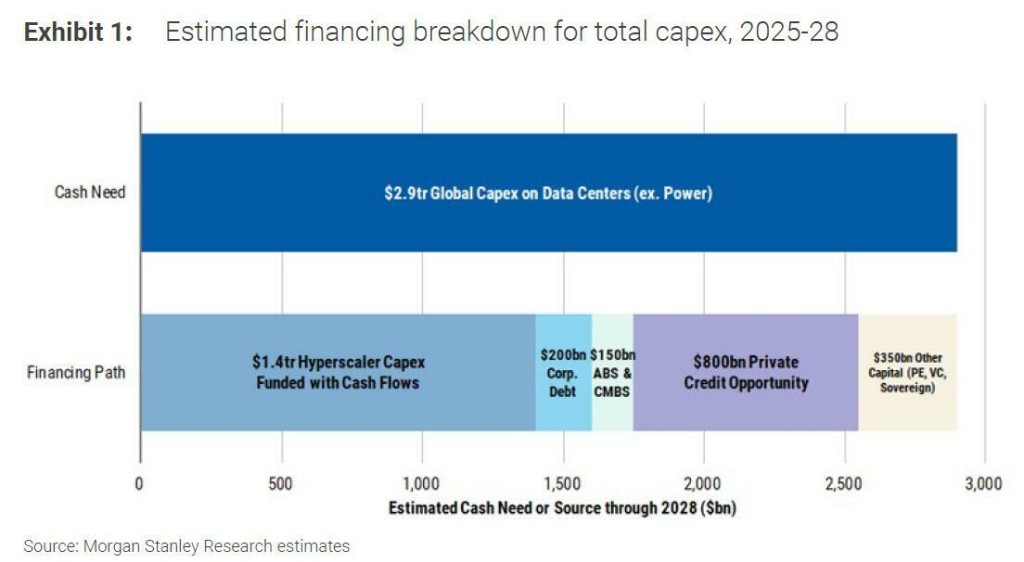
Chris Wright's statement indicates that the U.S. government will take an active role in filling this gap. He stated that the power demand from the AI sector will attract "reputable suppliers" to invest billions of dollars in equity capital for the construction of new nuclear capacity. The Department of Energy's loan office can provide low-cost debt financing for these private capital investments, with a matching ratio of up to four to one. This public-private partnership model aims to leverage and accelerate the implementation of nuclear power projects.
The U.S. government's determination to promote nuclear power construction also stems from its relatively stagnant status in this field. Currently, there are no commercial nuclear reactors under construction in the U.S. During Trump's first term, the LPO's only use of its authority was to provide financing for the Vogtle nuclear power plant project in Georgia Now, the government's ambitions go far beyond this.
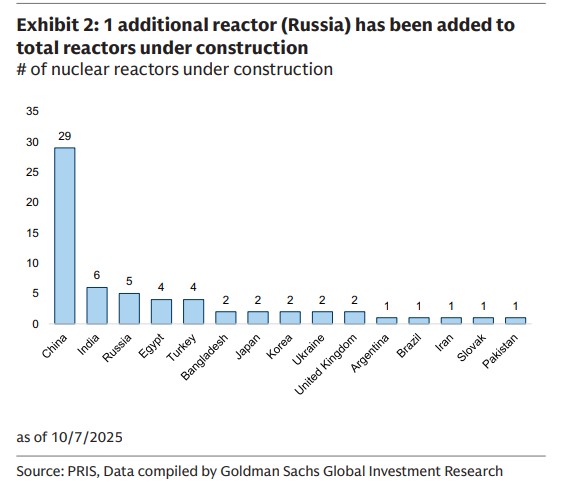
Chris Wright hopes to see dozens of projects start simultaneously before the end of his term, which is not only the government's goal but also the expectation of all major cloud service providers. As OpenAI CEO Sam Altman stated, the market generally expects the U.S. government to play the role of "the last guarantor." If these nuclear power plants cannot be built, the viewpoint cited in the article suggests that the AI bubble may burst in a shocking manner.
Tech Giants and Westinghouse Electric's Layout
Under the guidance of government signals, the private sector has begun to actively position itself. Tech giants including Alphabet, Amazon, Meta Platforms, and Microsoft are investing billions of dollars to restart old nuclear power plants, upgrade existing facilities, and deploy new reactor technologies.
Among them, nuclear technology giant Westinghouse Electric has become a key player. Last month, the Trump administration reached an agreement with Westinghouse Electric's parent company—uranium miner Cameco and Brookfield Asset Management—to invest $80 billion in building nuclear power plants across the United States. Westinghouse Electric CEO Dan Sumner stated in July that they would use their modernized AP1000 reactor design in response to the government's call, which can power over 750,000 households.
Cameco COO Grant Isaac also confirmed to investors that the government has various tools to facilitate financing for Westinghouse Electric's reactors and indicated that there is "strong interest" in this minimum $80 billion investment from the market.
Cost Overrun History Creates New Opportunities for SMR
Despite the promising outlook, the construction of large nuclear power projects is fraught with challenges, especially in cost control. Westinghouse Electric has faced difficulties in delivering the AP1000 reactors on time and within budget. A severe example is that the company filed for bankruptcy in 2017 due to cost overruns in significant projects in Georgia and South Carolina, highlighting the high-risk, capital-intensive nature of nuclear power construction.
This history has also opened the door for more cost-effective alternatives, such as small modular reactors (SMR) developed by companies like Oklo and Nano Nuclear. These smaller, lower-cost projects may serve as effective supplements to address the shortcomings of large reactor construction, which has long cycles and massive investments.
At the same time, according to the terms of the agreement in October, Westinghouse Electric may potentially spin off into an independent publicly traded company in the future, at which point the U.S. government may become one of its shareholders to more deeply bind government credit with the success or failure of the projects