
 I'm LongbridgeAI, I can summarize articles.
JP Morgan stated that just seven days after the outbreak of the geopolitical conflict in the Middle East, supply disruptions in the Gulf oil-producing countries have exceeded expectations and are accelerating.
On March 9, according to news from the Wind Trading Desk, JP Morgan's commodity research team provided a market alert in their latest emergency report, based on detailed tank capacity and tanker data:
The current actual production cut is approximately 2 million barrels per day, but driven by the dual pressures of tank saturation and severe tanker shortages, the regional production cut scale will exceed 4 million barrels per day before Friday (March 13).
The research report pointed out that this figure means that global oil supply will lose more than twice the total export volume of Iraq in just two weeks.
As the conflict continues, shipping through the Strait of Hormuz is obstructed, coupled with production cuts from Middle Eastern oil-producing countries, oil prices continue to soar and have already transmitted to the consumer end. Specifically:
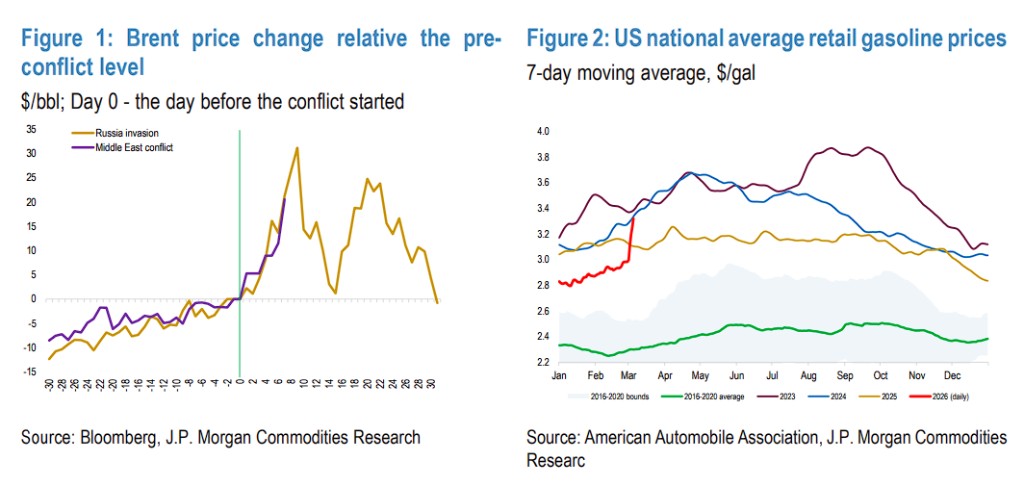
On the seventh day after the conflict broke out, Brent crude oil quickly surpassed $94 per barrel from about $83 per barrel before the conflict, with a weekly increase of over 13%. The average retail gasoline price in the U.S. jumped to $3.30 per gallon from March 4 to 5, reaching a two-year high, and the transmission effect on the consumer end has already become apparent.
Production Cut Progress: Faster than Expected, Trajectory Still Accelerating
JP Morgan's framework model shows that the estimated production cut on the seventh day of the conflict is about 2.5 million barrels per day, while data agencies like Kpler have tracked reported disruptions of about 2 million barrels per day—the slight gap between the two indicates that actual production cuts are rapidly approaching the trajectory predicted by the model.
The report clearly states that supply disruptions are no longer limited to isolated oil fields but are beginning to spread across the entire region. The core mechanism driving this process is tank saturation forcing upstream production cuts: when export channels are blocked and floating storage space is exhausted, oil-producing countries have no choice but to gradually shut down upstream production.
JP Morgan pointed out that Iraq's production cuts have moved from the warning stage to the substantive stage.
Several major oil fields in the south have initiated production cuts, initially concentrated in core hubs like Rumaila, but as tank space continues to tighten, larger-scale production cuts in the southern oil field cluster seem inevitable.
Meanwhile, exports from the Kurdistan region have effectively come to a standstill, with HKN Energy announcing a suspension of operations at the Sarsang oil field after a drone attack, further exacerbating the supply gap in northern Iraq.
Additionally, as mentioned in a previous article by Wall Street Watch, Abu Dhabi National Oil Company (Adnoc) and Kuwait Petroleum Company (Kuwait Petroleum) have both announced production cuts.
Among them, the UAE stated that it is "adjusting offshore production levels to meet storage demands," while Kuwait explicitly attributed this production cut to "Iran's threats to the safe passage of vessels through the Strait of Hormuz."
Tanker Crisis: Available Capacity in the Persian Gulf Plummets by 78%
JP Morgan's inventory matrix reveals significant disparities in the resilience of various oil-producing countries:
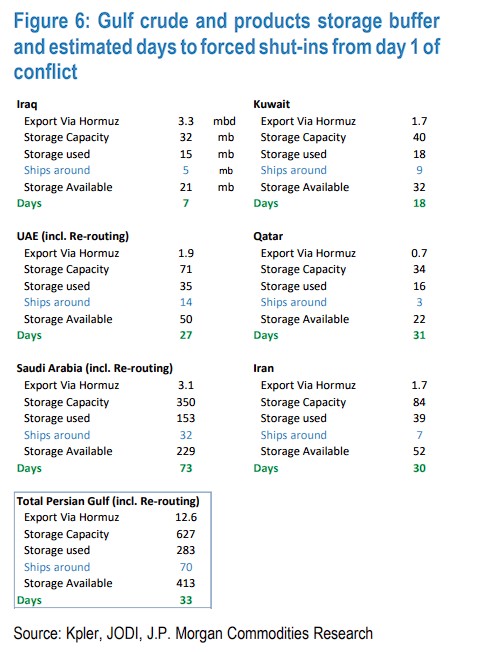
The data clearly indicates that Iraq is the most vulnerable link, with its inventory buffer only able to support for about a week; Kuwait follows closely behind. Saudi Arabia, with its large tank capacity (available reserves up to 229 million barrels) and some alternative export channels, has relatively strong short-term resilience, but it too cannot remain unaffected.
JP Morgan also emphasized in its research report that the speed of the collapse in the tanker market during this crisis is shocking.
According to Kpler data, there are currently only 14 Very Large Crude Carriers (VLCCs) operating in the Persian Gulf (of which 3 are related to Iran), down from 64 before the outbreak of conflict, a decrease of 78%.
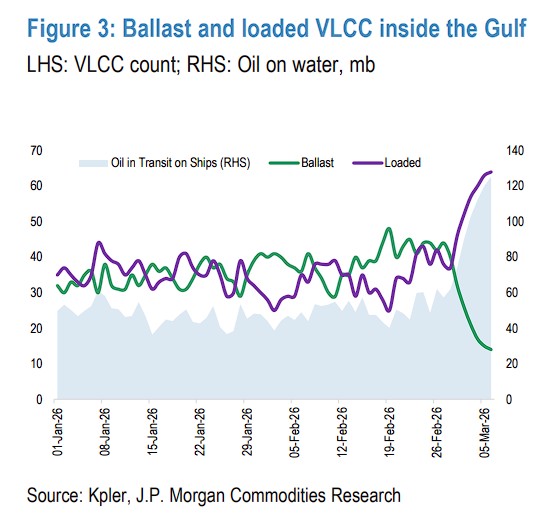
JP Morgan warns: Starting this week, oil-producing countries will be forced to transfer crude oil to onshore storage tanks, which will significantly accelerate the filling rate of these tanks, thereby pushing the entire region into a mandatory production halt phase more quickly.
The above exciting content comes from the Wind Chaser Trading Platform.
For more detailed interpretations, including real-time analysis and frontline research, please join the【 **Wind Chaser Trading Platform ▪ Annual Membership**】

Risk Warning and Disclaimer
The market has risks, and investment requires caution. This article does not constitute personal investment advice and does not take into account the specific investment goals, financial conditions, or needs of individual users. Users should consider whether any opinions, views, or conclusions in this article are suitable for their specific circumstances. Investment based on this is at one's own risk