
 I'm LongbridgeAI, I can summarize articles.
On the evening of June 10, 2026, an announcement from Chengdu Shuangliu pushed the wave of "collective overseas expansion" in China's optical module industry forward again — Eoptolink (300502.SZ) board officially approved the proposal to issue H shares and list on the main board of the Hong Kong Stock Exchange.
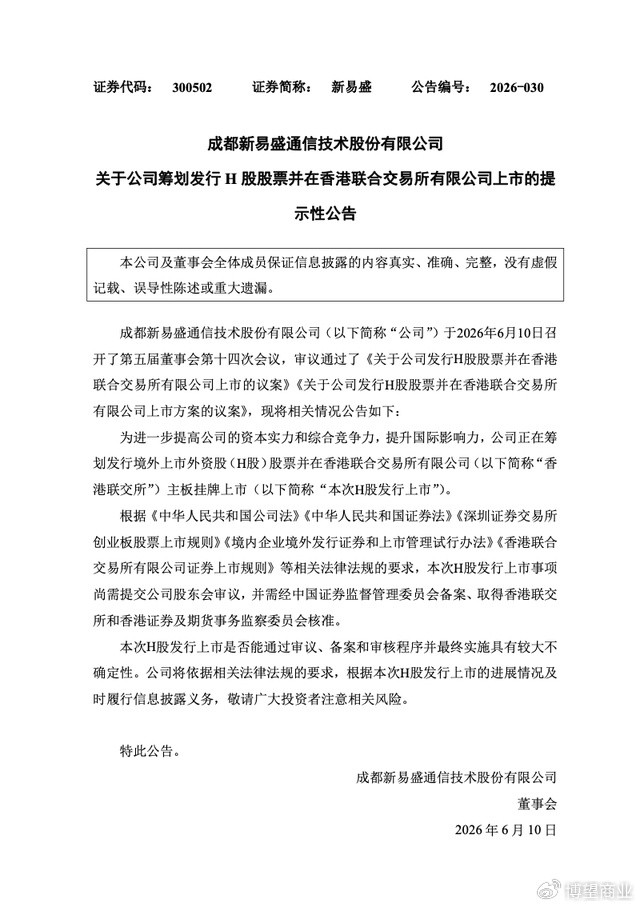
This optical module leader, with over 90% of its revenue coming from overseas, has officially joined the IPO sequence in Hong Kong. Prior to this, in November 2025, Zhongji Xuchuang had initiated preparations for H share listing; in April 2026, Tianfu Communication officially submitted its listing application to the Hong Kong Stock Exchange. Thus, the three major optical module giants in the A-share market, referred to by investors as "Yi Zhongtian," have all embarked on the path of listing in Hong Kong.
Compared to Eoptolink's market capitalization of 700 billion to 800 billion in A-shares, the fundraising scale in Hong Kong is relatively small — this H share issuance will not exceed 8% of the total share capital after issuance, and even with a 15% over-allotment option, it amounts to only several billion Hong Kong dollars. With 7.7 billion in operating cash flow and nearly 10 billion in annual profits, why is Eoptolink in such a hurry to go to the Hong Kong market — what are their plans?
The answer lies in three keywords behind the glamorous financial report of this "grassroots counterattack" star company: capacity, research and development, and exchange rates.
01
A vocational school graduate starts a business, creating an 800 billion empire
The story of Eoptolink is one of the simplest and most inspiring entrepreneurial scripts in China's manufacturing industry.
Founder Gao Guangrong was born in 1969 in Leshan, Sichuan. After graduating from a vocational school, he was assigned to the optical communication branch of Leshan Radio Factory, where he worked as a technician for nine years. In 1998, he ventured into entrepreneurship, establishing a company in Chengdu to act as an agent for optical communication products. Realizing that reselling others' products yielded thin profits, he quickly understood: "Selling someone else's products can earn 10 yuan per item; but if I develop my own, the profit can multiply several times."
In 2008, Gao Guangrong merged the "Guangsheng Communication" he co-founded with another company "Yijielong," thus Eoptolink was born. Over the next decade, Eoptolink underwent two critical decisions: the first was a strategic shift from the telecommunications market to the data communication market — around 2018, he resolutely shifted the R&D focus to high-speed optical modules for data centers, precisely hitting the rising capital expenditure cycle of global cloud vendors; the second was a diversified bet on technology routes, especially the launch of the 800G LPO (Linear Drive) optical module in 2023, which eliminated high-power DSP chips, reducing power consumption by more than 50% It is this product that has allowed Eoptolink to secure over 60% of the 800G LPO orders from Meta and Amazon, while also entering the supply chain of NVIDIA's GB200 platform. According to industry estimates, Eoptolink accounts for more than 30% of NVIDIA's optical module orders. In 2025, the company plans to invest CNY 702 million in R&D, building a complete technology matrix covering pluggable modules, LPO/LRO, XPO, NPO, and CPO.
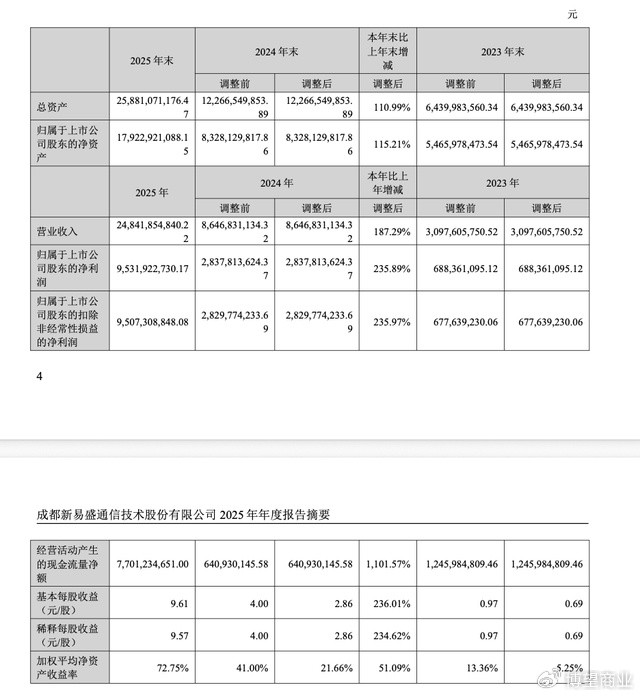
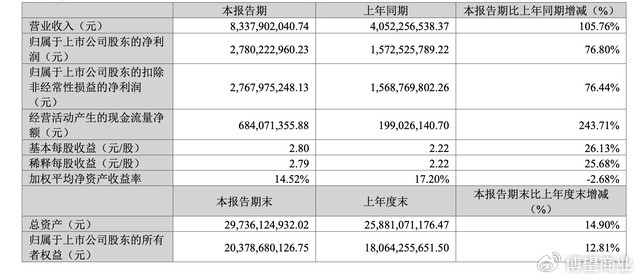
The performance has thus exploded exponentially. In 2025, Eoptolink's revenue is expected to reach CNY 24.842 billion, a year-on-year increase of 187.29%; net profit attributable to the parent company is expected to be CNY 9.532 billion, a year-on-year increase of 235.89%. In the first quarter of 2026, revenue is expected to be CNY 8.338 billion, a year-on-year increase of 105.76%; net profit is expected to be CNY 2.780 billion, a year-on-year increase of 76.80%.
The capital market has provided astonishing returns. Eoptolink's stock price has surged from a low of CNY 40 in April 2025, accumulating more than 13 times in just over a year. On June 5, it reached a historical high of CNY 818.38 during trading, with a market value briefly exceeding CNY 810 billion. Based on the 6.24% shareholding ratio of its founder, his personal wealth has soared to CNY 46.8 billion.
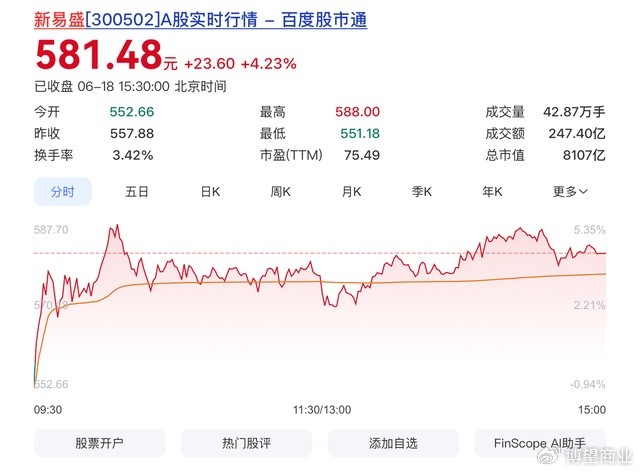
However, standing at the peak of an 800 billion market value, the true motivation behind Eoptolink's listing in Hong Kong is far more complex than just the phrase "global layout."
02
Capacity Crisis, R&D Burnout, Pain from Exchange Rates
The first pressure faced by Eoptolink comes from capacity.
The 2025 annual report shows that the company's capacity utilization rate has exceeded 93%, operating at full production capacity. Orders continue to flood in—management revealed that orders for 1.6T optical modules have significantly increased compared to last year and are expected to grow rapidly quarter by quarter. However, the ceiling on capacity is already visible.
The only solution lies in Thailand. Eoptolink's factories in Thailand, both Phase I and Phase II, have officially commenced production. Since the completion of Phase II at the beginning of 2025, capacity expansion has been ongoing, with a noticeable acceleration in 2026. Even so, capacity remains tight, and the company has clearly stated that "the Thailand factory will continue to expand its scale and continue to build new plants to meet the capacity demands for order delivery." The third phase has not yet been put into production, and distant water cannot quench immediate thirst.
Expansion requires money. The procurement of equipment for the Thai production line, construction of factories, and recruitment of personnel all require substantial financial investment. The optical module industry is currently in a critical stage of capacity competition—whoever expands capacity first will seize the next round of orders. In this window period, being a step slower may result in being left behind by competitors.
The prepayment data is the most direct proof of the company's stocking efforts. In the first quarter of 2026, the company's prepayments reached 682 million yuan, a staggering increase of 3920.83% compared to the previous quarter. This indicates that the company is frantically locking in upstream materials—core components such as optical chips and electrical chips are in tight supply, and without advance payments, goods cannot be secured. This rush to stock also requires massive financial support.
Additionally, the technological iteration in the optical module industry is accelerating at a visibly rapid pace.
From 400G to 800G, and from 800G to 1.6T, the cycle of generational replacement is becoming shorter. Each technological upgrade means significant R&D investment. In 2024 and 2025, Eoptolink's R&D expenses are expected to increase by 201.38% and 74.16%, respectively. Management anticipates that related expenditures will continue to rise.
This is far from the end. The R&D of next-generation products such as 3.2T and 6.4T is already underway. Meanwhile, new technological routes such as silicon photonics and CPO coexist, and the industry's technological paths have yet to converge. For a company that wants to maintain its position at the table, it is not just a matter of choosing one path to follow, but rather a question of betting on every path—because once the wrong choice is made, it may be completely left behind by competitors.
The 700 million yuan R&D investment accounts for only 2.83% of the 24.8 billion yuan revenue, which is a considerable absolute value, but still insufficient relative to the investment demands of the technological race. One important use of funds raised in the Hong Kong stock market is for core technology R&D. Although this amount is not a decisive large sum, during the critical window for tackling key technologies, every penny may determine success or failure.
One of the most easily overlooked yet fatal pressures on Eoptolink comes from exchange rates.
The company's overseas revenue accounts for as much as 96.16%. This is a double-edged sword—while overseas markets bring high gross margins and high growth, they also expose the company's profit and loss statement to the risks of exchange rate fluctuations.
In the first quarter of 2026, Eoptolink's financial expenses changed dramatically from -33.09 million yuan in the same period last year to 522 million yuan. Exchange losses are a core driver of this change. An annual profit of 9.5 billion yuan was eroded by over 500 million yuan in just one quarter due to exchange rates—this fragility in profitability is an unbearable burden for any listed company.
One of the core values of being listed on the Hong Kong stock market lies precisely in hedging against exchange rate risks. By raising funds in Hong Kong dollars on the Hong Kong Stock Exchange, Eoptolink can directly use Hong Kong dollars for overseas procurement and operational payments, reducing its exposure to exchange rate fluctuations between the US dollar and the Chinese yuan.
At the same time, the Hong Kong stock platform allows the company to allocate global resources more flexibly—this is not just a luxury for a company that derives 96% of its revenue from overseas, but a necessity.
From another perspective, Eoptolink's A-share price-to-earnings ratio (TTM) is about 75 times, which is relatively high in the A-share optical module sector. If the valuation for the Hong Kong stock issuance is relatively low, it may exert certain pressure on the A-share valuation—this is also one of the reasons for the sharp fluctuations in stock prices following the announcement 03
"Yizhongtian" gathers in Hong Kong stocks, a collective defensive battle
Eoptolink is not an isolated case.
Zhongji Xuchuang will start preparing for H shares in November 2025, and Tianfu Communication submitted its H share listing application in April 2026. Huagong Technology also submitted an application to the Hong Kong Stock Exchange in April this year. The "Yizhongtian" combination of optical modules gathering in Hong Kong stocks has become a foregone conclusion.
This is not a coincidence, but an industry consensus.
The optical module industry is in a new stage of "capacity rush, supply constraints, technological iteration, and pattern reconstruction." The challenges faced by leading enterprises are highly consistent: capacity expansion requires money, technological research and development requires money, exchange rate risks need to be hedged, and internationalization requires capital platforms. The Hong Kong stock market provides a second financing channel outside of the A-share market and offers flexibility for offshore capital operations.
A deeper reason is that the customers of these enterprises—Meta, Amazon, Nvidia, Microsoft—are all global technology giants.
While listing on the A-share market can certainly achieve high valuations, in the eyes of international customers, a Chinese supplier with a Hong Kong stock listing platform means higher corporate governance transparency and more convenient capital communication channels. Listing in Hong Kong is essentially a passport for globalization.
Eoptolink's listing in Hong Kong is a good move, but also a risky one.
The advantage lies in its ability to simultaneously open up space in three dimensions: capacity, research and development, and exchange rates. Although the fundraising scale in the Hong Kong stock market is not large, it addresses urgent needs—expansion of the Thailand factory, research and development of 3.2T optical modules, and hedging against exchange rate risks, each of which requires funding and capital platform support.
The risk lies in the market's scrutiny of high-valuation companies, which is never lenient. If Broadcom's financial report guidance falls short of expectations, it can trigger a comprehensive correction in the optical module sector. If the Hong Kong IPO price is lower than market expectations or performs poorly after listing, the drag effect on A-share valuations should not be underestimated.
The deeper issue is: as the 800G dividend gradually peaks, competition for 1.6T fully unfolds, and the R&D race for 3.2T has already begun, can Eoptolink continue to maintain its technological leadership? As the capacity of the Thailand factory is gradually released, can it be timely converted into orders and profits? As exchange rate fluctuations become the norm, can the company establish an effective hedging mechanism?
These three questions are the key to determining whether Eoptolink can move from 800 billion to a higher level. The Hong Kong IPO is just the beginning—the real test comes after the listing