
 I'm LongbridgeAI, I can summarize articles.
METIS TECHBIO-P released its 2026 interim report, reporting H1 revenue of RMB 154.3 million, a significant year-on-year increase. The company has achieved monetization through three AI4S-driven models: first, global licensing of its self-developed asset MTS-128 to Boulevard Bio, securing a $20 million upfront payment and potential proceeds of up to $1.6 billion; second, collaborations with multiple enterprises on its delivery technology OpenCGT project, with potential total transaction value exceeding RMB 6 billion; and third, localized deployment of its AI platform
On August 25, METIS TECHBIO-P released its 2026 interim results. The following morning, the company held its first post-listing performance briefing, attended by Chairman and CEO Lai Caida.
METIS TECHBIO-P focuses on AI-driven drug delivery and drug design. In the interim report, the company summarized its long-term technological roadmap into three layers: adopting AI4S (AI for Science) as the overall industrial direction, leveraging Biological AI as the core technical capability, and utilizing Scaling Laws in the life sciences to drive the continuous evolution of data, models, and experimental systems, ultimately aiming for cell reprogramming.
In the first half of the year, this capability generated RMB 154.3 million in revenue, with RMB 153.6 million coming from cooperation agreements, primarily from the external licensing of MTS-128. In the same period last year, the company's revenue was RMB 1.14 million. This figure exceeds 47% of the company's total revenue for the entire previous year.
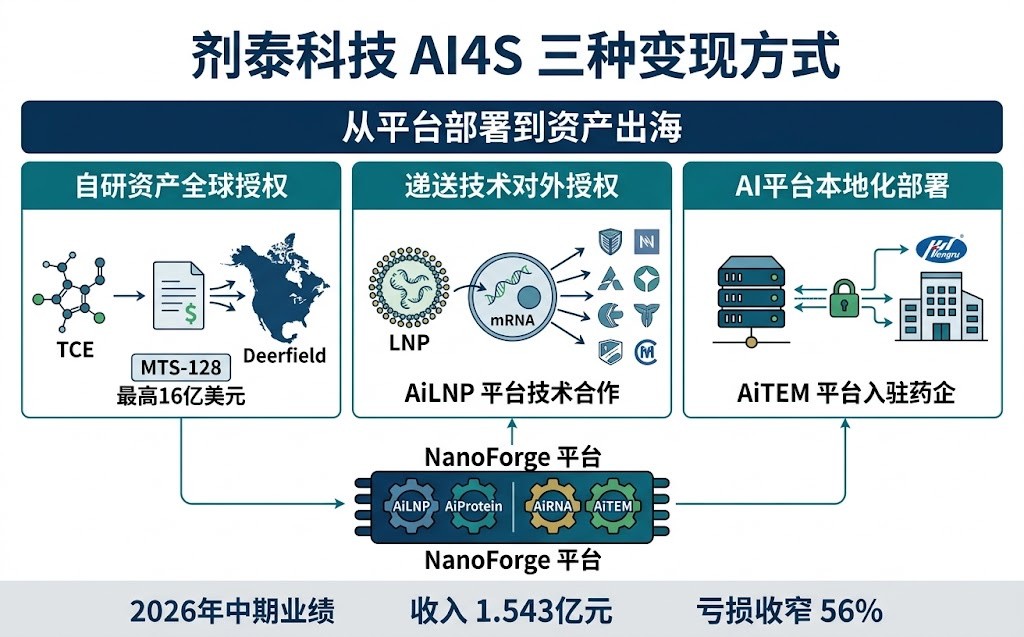
During and after the reporting period, the company's external AI4S collaborations were reflected in three areas: global licensing of self-developed assets, external licensing of delivery technologies, and localized deployment of the AI platform at pharmaceutical companies. These three deals represent three forms of the same underlying platform.
Three Key Deals
The largest deal involves MTS-128, a trispecific TCE independently developed by METIS TECHBIO-P based on the NanoForge platform, with AI driving the process from molecular design to optimization. The company exclusively licensed the global development, manufacturing, and commercialization rights to Boulevard Bio, a biotechnology company supported by the US pharmaceutical investment firm Deerfield. The company has received a $20 million upfront payment and is eligible for up to $1.6 billion in development, regulatory, and commercialization milestone payments, as well as tiered sales royalties. According to public disclosures, this sets a new record for the single largest overseas licensing amount for a preclinical TCE project by a Chinese pharmaceutical company.
The second deal involves licensing delivery technology. The OpenCGT project, launched in 2025, opens the capabilities of the AiLNP platform to external companies. It has currently reached technical cooperation agreements with companies such as RayzeGen, Jingtong Life, Joy City Holdings' Industrial Platform, BioThunder AG, and Aicogen Therapeutics, covering cell therapy, gene therapy, fibrotic cell programming, and in vivo immunotherapy. The potential total transaction value exceeds RMB 6 billion. Among these, BioThunder AG has exercised its option and signed a license agreement covering up to 10 candidate products, and METIS TECHBIO-P has received an exclusive licensing fee of RMB 15 million.
The third deal involves platform deployment. On August 3, the AiTEM AI formulation innovation platform completed localized deployment at Hengrui Medicine for the development of formulations for poorly soluble drugs. After the reporting period, the company also signed a strategic cooperation agreement with Pu Luo Pharmaceutical.
R&D Spending Up 48%, Loss Narrowed by 56%
R&D expenses in the first half amounted to RMB 172.4 million, a year-on-year increase of 48.1%, mainly driven by share-based payments and increased professional service fees related to key pipelines. The adjusted net loss was RMB 51.1 million, narrowing by 56.4% year-on-year. The loss attributable to owners of the company was RMB 153.2 million, a narrowing of 20.0%.
At the end of the period, cash and cash equivalents, time deposits, and financial assets at fair value through profit or loss totaled RMB 3.0253 billion. The debt-to-asset ratio decreased from 19% at the end of 2025 to 9%. The company has 150 employees, an increase of 21 from the same period last year, with R&D personnel accounting for 70%.
Some brokerages expect the company's adjusted net profit to turn positive in 2027. Lai Caida did not confirm this timeline, stating that revenue growth is currently outpacing R&D growth. With both sides growing rapidly, a balance can be achieved. "We will not improve our operating leverage profits by reducing R&D," he said.
What Is Being Sold
The platform being sold is called NanoForge.
In May, METIS TECHBIO-P launched the AiProtein platform and the antibody design agent AARON, covering de novo antibody generation, structure and function prediction, affinity maturation, and druggability assessment. The Spearman correlation coefficients for major property prediction metrics all exceeded 0.8. Combined with the previously launched AiLNP, AiRNA, and AiTEM, NanoForge's four platforms correspond to delivery systems, nucleic acid sequences, protein antibodies, and formulation development, respectively.
In the delivery sector, there were four advancements during the reporting period.
Cardiomyocyte-targeting LNPs achieved a transfection rate of over 95% for reporter gene mRNA into cardiomyocytes in mouse models. When delivering CRISPR mRNA/gRNA, effective editing was achieved in over 50% of cardiomyocytes, with extremely low non-specific editing rates in non-target organs. This result was selected for an oral presentation on the latest technological breakthroughs at the 2026 CRS Annual Meeting.
In vivo CAR-T actively targeting LNPs achieved delivery efficiency more than three times that of industry classic controls in mouse and non-human primate models. The non-human primate high-throughput DNA barcoding screening platform can simultaneously complete quantitative assessment of multi-tissue distribution for dozens of candidate LNPs in a single cynomolgus monkey. The targeted LNP site-specific conjugation platform addresses the issue of antibody shedding during production processes and in vivo circulation.
The AiRNA platform used over 20,000 experimentally validated IRES sequences to train a deep generative neural network, completing the first round of validation. The translation regulation activity of some generated sequences exceeded that of the classic CVB3 IRES.
At the briefing, Lai Caida stated that pharmaceutical companies ultimately pay for results, not just for AI companies. The hard metrics are the success rate and speed from target identification to preclinical candidate compounds (PCC). METIS TECHBIO-P's fastest project completed PCC in 11 months.
He also mentioned that the bottlenecks in AI drug discovery have shifted.
Whether AI can generate molecules has been verified in recent years, and the efficiency of drug discovery is accelerating. The current question is whether these designed molecules can hold up in real biological systems—from animals to humans, and from efficacy to safety—forming a closed data loop.
Pipeline
As of June 30, METIS TECHBIO-P had over 10 pipelines under development, including 1 Pre-NDA product, 5 products in clinical application and clinical stages, and 5 products in PCC development stage, along with 2 animal health products.
The most advanced is MTS-004, an orally disintegrating tablet for treating pseudobulbar affect, incubated by the AiTEM platform. It was licensed to Zhejiang Yin'an in September 2025, with a RMB 100 million upfront payment received in December of that year. The licensee has completed Pre-NDA communications and is undergoing validation production. Lai Caida stated that Yin'an is responsible for registration, commercialization, and expansion into new indications, while METIS TECHBIO-P is mainly responsible for production. The timing of NDA approval "will still depend on the actual progress of registration work and the regulatory approval process."
There are three other products in the clinical stage. MTS-201 is an oral TGR5 agonist exploring therapeutic potential for weight loss and metabolic diseases. Phase I clinical trial Parts A and B have been completed, and Part C has started. MTS-105 targets GPC3 on the surface of liver cancer cells. The investigator-initiated clinical study at Peking University Cancer Hospital has entered dose escalation, with preclinical results published in Nature Communications. MTS-109 is an mRNA-encoded CD3×CD19×BCMA trispecific TCE. Positive early clinical data has been observed in the investigator-initiated clinical study at Shanghai Changzheng Hospital, with simultaneous IND applications in China and the US, targeting autoimmune diseases such as systemic lupus erythematosus.
MTS-107, in the PCC stage, is an mRNA therapeutic vaccine for HPV16/18-positive cervical cancer and head and neck cancer. In mouse models, it achieved 100% complete remission when combined with PD-1 inhibitors. When asked how soon domestic mRNA therapeutic tumor vaccines could reach the market, Lai Caida said it depends on the regulatory process, and conditions for personalized vaccines in production and CMC need to be resolved jointly by the industry and regulators.
When asked about the core goals for the full year, Lai Caida cited two things: generating more sustainable, scaled collaborations with core large pharmaceutical companies, and achieving preliminary clinical validation for core pipelines.
Regarding AI4S, the company stated that the longer journey ahead involves moving from AI-designed molecules, to AI-understood cells, and finally to AI-reprogrammed cells.
Risk Warning and Disclaimer
The market carries risks; investment requires caution. This article does not constitute personal investment advice, nor does it consider the specific investment objectives, financial status, or needs of individual users. Users should consider whether any opinions, views, or conclusions in this article align with their specific circumstances. Investors bear full responsibility for their own decisions.