
 I'm LongbridgeAI, I can summarize articles.
Investing 700 million in a private placement for a materials company
Big shots make their move, determined to succeed.
On the evening of October 8, SINOMATECH, a leader in new materials, announced a private placement: issuing 87.1819 million shares to 15 investors at 51.40 yuan per share, raising a total of 4.481 billion yuan.
When the news broke, the most eye-catching name was not E Fund, not China Life Pension, but—Ge Weidong.
This private equity titan entered the fray with the highest bid, ultimately securing an allocation of 13.6187 million shares. He spent approximately 700 million yuan, instantly becoming the company's fifth-largest shareholder.
He had previously reaped floating profits of over 10 billion yuan each on tech stocks like Muxi Shares and GigaDevice, yet he chose to deploy his latest "heavy punch" into a materials stock.
This was truly unexpected.
Highest Bid, Determined to Succeed
There were indeed many institutions and investors vying for SINOMATECH's private placement.
During the subscription and bidding phase in late September, a total of 25 investors submitted valid bids, covering top-tier public funds, insurance capital, securities asset management firms, foreign investors, and renowned individual investors. The lineup was nothing short of luxurious.
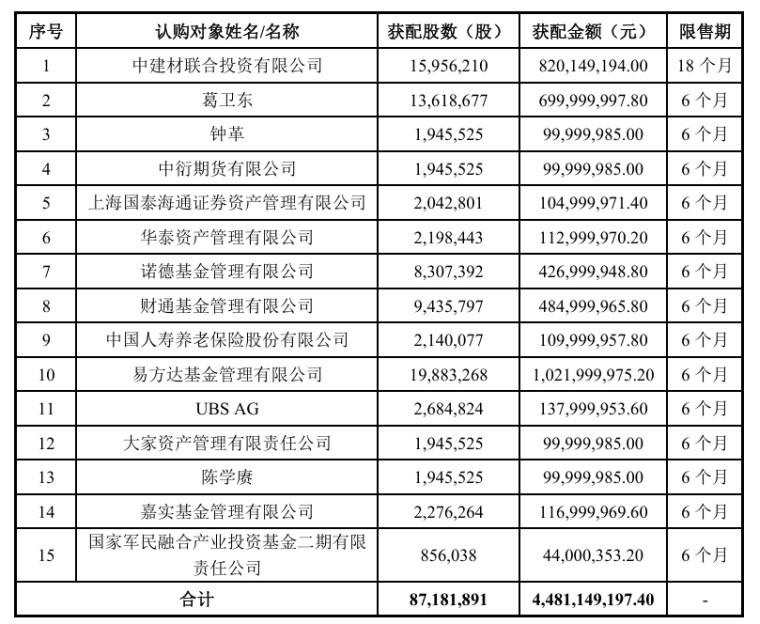
Ultimately, SINOMATECH completed the issuance at 51.40 yuan per share, with 15 investors selected, contributing a total of 4.481 billion yuan.
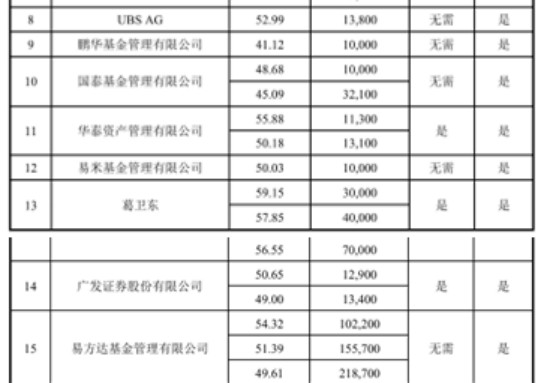
Ge Weidong's bidding strategy was quite aggressive—he placed bids in three tiers: 59.15 yuan, 57.85 yuan, and 56.55 yuan, corresponding to subscription amounts of 300 million, 400 million, and 700 million yuan, respectively.
Among these, 59.15 yuan was the highest price offered by any of the 25 applicants.
This stance spoke volumes.
In the end, he received the full allocation for his top-tier bid of 700 million yuan, securing 13.6187 million shares with a six-month lock-up period.
A Star-Studded Allocation List
Besides Ge Weidong, the allocation list for this private placement was equally star-studded.
E Fund became the largest subscriber with 1.022 billion yuan; Caitong Fund, which has shown impressive performance in the past two years, secured a 485 million yuan share; Nuode Fund was allocated 427 million yuan.
On the insurance capital front, China Life Pension and Dajia Asset both appeared; in securities asset management, Huatai Asset and Shanghai Guotai Haitong Asset Management each made gains; foreign investor UBS AG was allocated 138 million yuan; and the Second Phase of the National Civil-Military Integration Industry Investment Fund also participated in the subscription.
Renowned individual investors Zhong Ge and Cheng Xuegeng were each allocated approximately 100 million yuan.
CNBM United Investment Co., Ltd., under SINOMATECH's controlling shareholder China National Building Material Group, subscribed to 820 million yuan, with a lock-up period of up to 18 months.
This list itself is a signal.
Why SINOMATECH?
Capital is focusing here for two main reasons: company quality and price.
In terms of quality, SINOMATECH is the core new materials platform under China National Building Material Group, focusing on three major tracks: special fibers, composite materials, and new energy materials. Its subsidiary, Taishan Fiberglass, is a domestic leader in the fiberglass industry.
In terms of performance, the company is accelerating. In the first half of 2026, revenue reached 16.257 billion yuan, a year-on-year increase of 21.95%; net profit attributable to shareholders was 1.208 billion yuan, up 20.93% year-on-year; and net profit deducting non-recurring items was 1.095 billion yuan, up 35.54% year-on-year.
Additionally, SINOMATECH has tapped into the currently hot AI narrative.
Taishan Fiberglass, a subsidiary primarily engaged in fiberglass and related products, saw sales of special fiber cloth associated with AI reach 13.45 million meters in the first half of 2026, generating revenue of 530 million yuan, representing year-on-year growth of 50% and 114%, respectively.
The company revealed the reasons for this growth in its semi-annual report:
AI computing power demand combined with supply shortages has led to supply falling short of demand for special fiber cloth.

Furthermore, out of the 4.481 billion yuan raised, 1.662 billion yuan will be invested in a project with an annual capacity of 35 million meters of low-dielectric fiber cloth, and 1.475 billion yuan will go towards a project with an annual capacity of 24 million meters of ultra-low loss low-dielectric fiber cloth.
Both projects fall under the category of special fiber cloth, meaning that SINOMATECH's future demand will be more closely linked to the industry of AI-related components.
Cost Advantage Is Not Significant
However, Ge Weidong's cost advantage in participating in this private placement is not significant.
The price Ge Weidong paid for the allocation was 51.40 yuan per share. On October 8, SINOMATECH's closing price was 52.01 yuan. Based on this, Ge Weidong's paper floating profit margin was only about 1.2%.
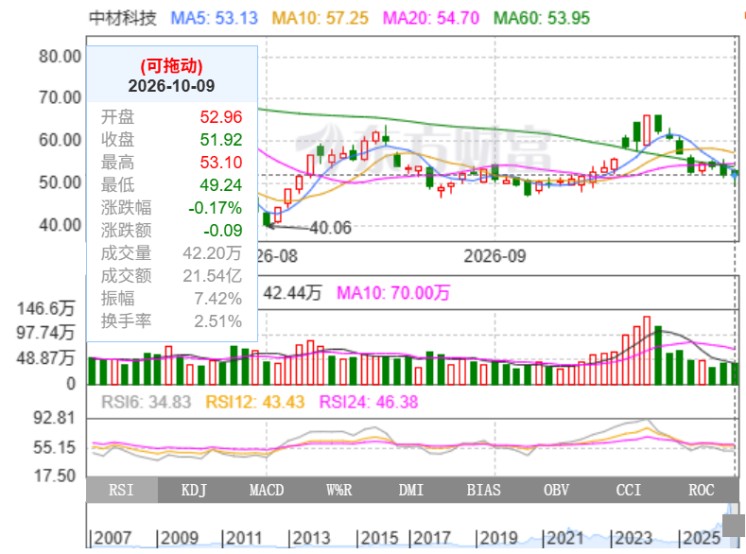
On October 9, the first trading day after the private placement announcement, SINOMATECH opened at 52.96 yuan, dipped to a low of 49.24 yuan during the session, and finally closed at 51.92 yuan.
Calculated based on the closing price, Ge Weidong's paper floating profit further shrunk to about 1%. This does not even account for the fact that SINOMATECH's stock price briefly fell below his cost line during the session .
However, experiencing short-term floating losses or even meager profits from participating in private placements is not rare in Ge Weidong's history.
GigaDevice and Tibet Rhodiola Pharmaceutical, which made him substantial profits, both endured long periods of floating losses initially, eventually exploding in value through long-term holding.
This time, he is likely unconcerned with short-term fluctuations in paper gains or losses.
The Path to "Deification" via Private Placements
In the history of A-share investment, Ge Weidong is perhaps one of the individual investors who has made the most money from secondary market private placements.
His track record is legendary enough to stand alone.
GigaDevice is his representative work for achieving "deification" through private placements.
Ge Weidong began building positions in the secondary market in 2018 (estimated cost around 70 yuan per share) and subsequently heavily participated in private placements twice:
August 2019: Subscribed to 5.0351 million shares at 75.47 yuan per share, spending approximately 380 million yuan;
June 2020: Splashed out 1.5 billion yuan to subscribe to approximately 7.36 million shares at 203.78 yuan per share.
Since then, his holdings have experienced a long "roller coaster": the stock price peaked above 230 yuan in mid-2021, then fell to a low of 55 yuan in early 2024—but Ge Weidong's core position remained virtually unchanged.
The turning point came in 2025–2026.
The AI computing power wave drove a reversal in the memory cycle, leading to an explosion in GigaDevice's performance. In the first half of 2026, the projected net profit attributable to shareholders was approximately 6.9 billion yuan, a year-on-year increase of about 1099%.
On June 29, 2026, GigaDevice's stock price hit an all-time high of 846.66 yuan.
According to market estimates, the Ge Weidong family (including his wife Wang Ping) holds approximately 24 million shares, with a cumulative investment of about 3.68 billion yuan. At the peak, their floating profits exceeded 13 billion yuan.
Tibet Rhodiola Pharmaceutical was another battle that made him "famous."
In May 2017, Ge Weidong participated in a private placement at 36.48 yuan per share, spending approximately 106 million yuan. He subsequently added to his position against the trend and held for three years.
In July 2020, Tibet Rhodiola Pharmaceutical climbed to a peak of 88.40 yuan, yielding considerable floating profits on the private placement portion.
The external evaluation of this was: "Three years of floating losses, followed by a billion-yuan windfall."
In recent years, regarding Jingjia Micro, Ge Weidong participated in a private placement in 2023, achieving interim floating profits of over 50%.
But none of these compare to the astonishing return from his primary market (Pre-IPO) investment.
Muxi Shares: Through his personal account and Hunshun Investment, Ge Weidong repeatedly increased capital or acquired shares starting in 2022, with a cumulative investment exceeding 1 billion yuan.
On December 17, 2025, Muxi Shares listed on the STAR Market, surging 692.95% on its first day, touching 895 yuan at one point during the session.
Calculated at the highest price, the value of shares held by Ge Weidong and Hunshun Investment once exceeded 24 billion yuan, with floating profits exceeding 20 billion yuan.
Of course, Ge Weidong's private placement investments have also encountered pitfalls. These include JAC Motors, 3peak, and BLT.
Therefore, masters are not those who never lose, but those who earn enough when they win.
Which Outcome Will Be Replicated?
This time, Ge Weidong put 700 million yuan on the table for SINOMATECH.
The cost advantage is still not obvious, and short-term floating profits are meager, but this time, he is joined in the private placement list by a large number of well-known institutions in the market.
What they are targeting, their respective investment logics, remain unknown to the outside world, nor can outsiders predict their success or failure.
Time will provide the answer.