
 I'm LongbridgeAI, I can summarize articles.
Morgan Stanley reveals that under the base case scenario, Muse's monthly service cost per user reaches $37, with an annual cost of $445, exceeding Meta's global average annual Revenue Per User of $70. More critically, true monetization is not expected until 2027–2028. Meanwhile, Amazon, Costco, and Netflix have successively blocked access to Muse, leaving its current daily active users at only about 2.7 million, far short of the "1 billion users" valuation expectation. The Q3 earnings report on November 4 will be the first major test
Meta officially launched its AI agent, Muse, on September 8, immediately igniting market enthusiasm—Meta's stock price surged 27% within 12 trading days, peaking at $777.59, while its forward P/E ratio jumped from 14x in late August to 21x. However, just one month later, cracks in growth have already appeared.
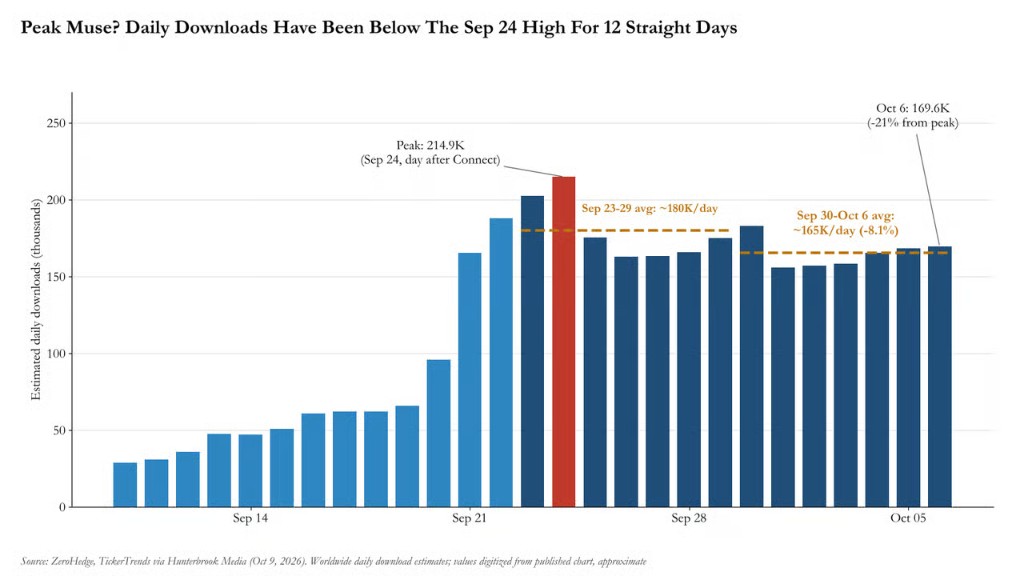
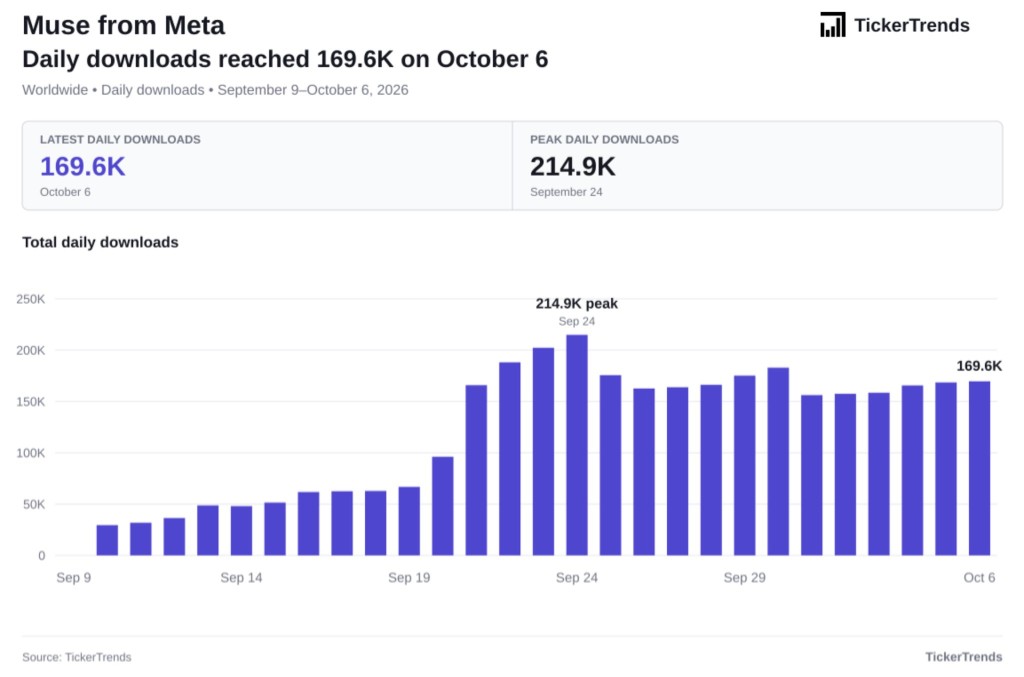
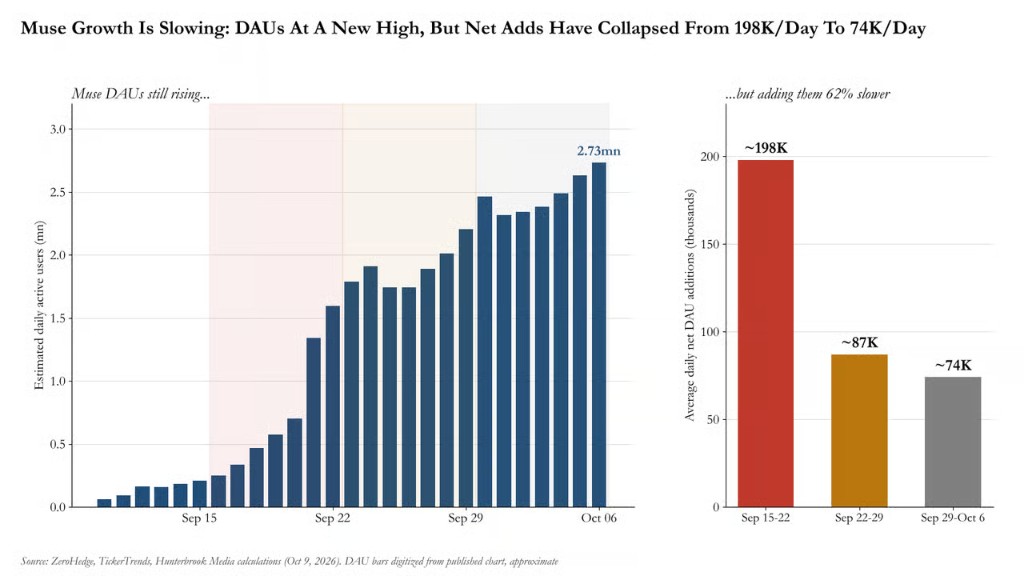
Data from alternative data firm TickerTrends shows that Muse's average daily net new users have plummeted from a peak of approximately 198,000 in September to about 74,000, a drop of 62.4%, with downloads also falling more than 21% from their peak.
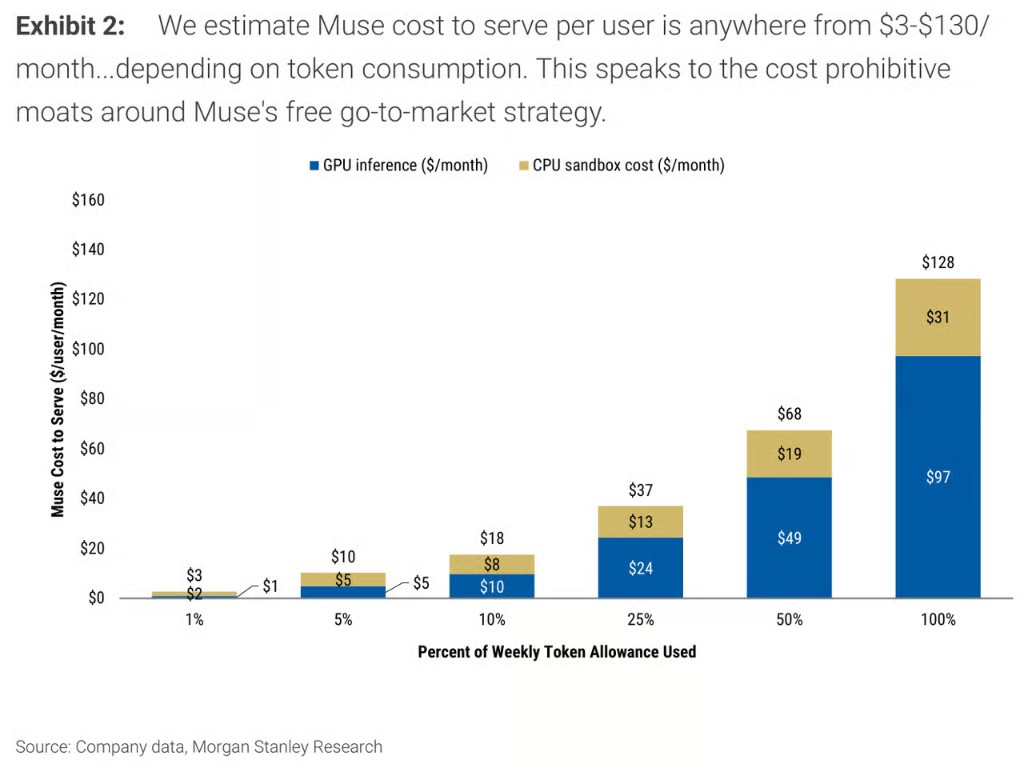
Meanwhile, Morgan Stanley released its most detailed cost model for Muse to date, revealing an alarming figure: Muse's monthly service cost per user ranges from $3 to $130, with a base case of $37, equivalent to an annual cost of $445—exceeding Meta's global average annual Revenue Per User of approximately $70. More importantly, Morgan Stanley explicitly stated that true commercial monetization for Muse will not occur until late 2027 to 2028.
The Morgan Stanley report also pointed out that Meta's current valuation expansion is entirely built on the perfect growth story of "1 billion users," but in reality, its Daily Active Users (DAU) are currently less than 3 million. Furthermore, Muse is facing ecosystem blockades from platforms like Amazon, and the traditional subscription business model, which relies on "consumer inertia," faces collateral short-selling risks from disruption by AI agents. In contrast, Chinese tech giants with closed ecosystems and payment infrastructure (such as Tencent) may possess a more robust moat in the AI agent race than Meta Platforms.
The First Crack in the Growth Myth: User Growth Plummets 62%
Muse's user data was tracked by alternative data firm TickerTrends and disclosed after analysis by Hunterbrook Media. The core data is as follows:
- Downloads: Approximately 169,600 on October 6, a 21.1% decline from the peak of 214,900 on the day after the September 24 Connect launch event, and remaining below the peak for 12 consecutive days. The daily average was about 180,000 in the previous week, dropping to about 165,000 in the latest week, a week-over-week decrease of 8.1%.
- User Scale: DAU (Daily Active Users) reached a new high of 2.7309 million on October 6. While the total user base is still growing, the growth rate has slowed significantly. From September 15 to 22, the average daily net new users were about 198,000; this dropped to about 87,000 the following week; and further decreased to about 74,000 for the week ending October 6, a 62.4% drop from the initial explosion period and a 14.5% drop from the previous week.
- Engagement Proxy Metrics: In the week ending October 7, the weekly volume of app reviews fell 11.6% week-over-week to 4,716, with iOS reviews down 22.5%; the single-day review count on October 7 was 664, a 17.2% decrease from the peak of 802 on October 1.
Notably, there are significant discrepancies in user scale estimates for Muse across different data sources: TickerTrends reports 2.73 million DAU, Similarweb reports 2.18 million, and Sensor Tower shows cumulative downloads of 6.6 million with DAU around 1.8 million. The difference between the highest and lowest DAU estimates among the three firms is about 50%, but none exceed 3 million.
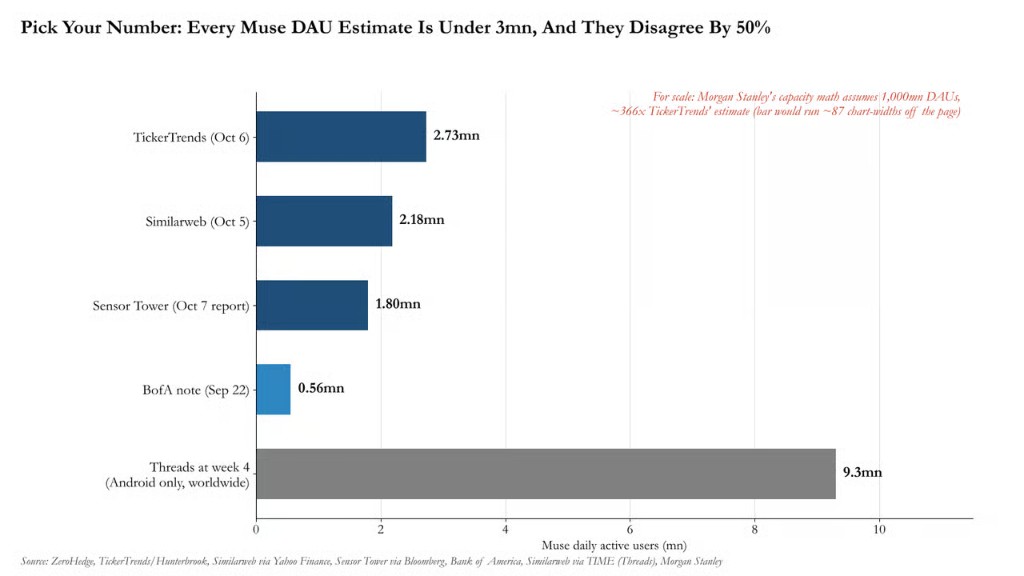
In contrast, Morgan Stanley's capacity analysis is based on 1 billion daily active users—meaning that according to TickerTrends' data, the CPU capacity Meta has purchased is approximately 366 times the current actual number of users.
Muse's Background and Real-World Resistance
Product Architecture: Muse runs on the Muse Spark model, providing each user with a dedicated "Muse Secure Virtual Machine," supporting standalone apps, web interfaces, WhatsApp integration, and native Mac clients. Pricing is divided into three tiers: Free tier (100 million tokens per week), Power tier at $20 per month (500 million tokens per week), and Maximum tier at $100 per month (3 billion tokens per week).
Milestone Data: On iOS, Muse achieved 1.43 million cumulative downloads in its first 12 days, surpassing ChatGPT's 1.37 million during the same period (JPMorgan data), and topped both the App Store and Google Play charts.
Successive Obstacles:
-
On the evening of September 20, Amazon blocked Muse's access to its platform, citing that Muse did not clearly identify itself as an AI agent and stored user credentials without proper disclosure;
-
TickerTrends tracked similar user reports of restrictions from Costco and Netflix;
-
Telecom operators began routing AI customer service calls initiated by Muse away from human agents, weakening the "make calls on behalf of users" feature;
-
A zero-day vulnerability that could allow local apps to hijack user Muse accounts was urgently patched;
-
Hunterbrook previously reported that Muse could be induced to profile vulnerable individuals;
-
Meta admitted that Muse's workspace file structure followed OpenClaw's design blueprint but claimed the code was written from scratch.
When Will Muse Monetize? Answer: Not in the Short Term
Morgan Stanley analyst Brian Nowak stated bluntly in the report: “We expect Muse subscription revenue to remain very limited for a considerable period, as Meta is currently focused on expanding its user base, enhancing engagement, and driving commercial behavior, rather than monetization. The initial 'take rate' on connection protocols is negligible.”
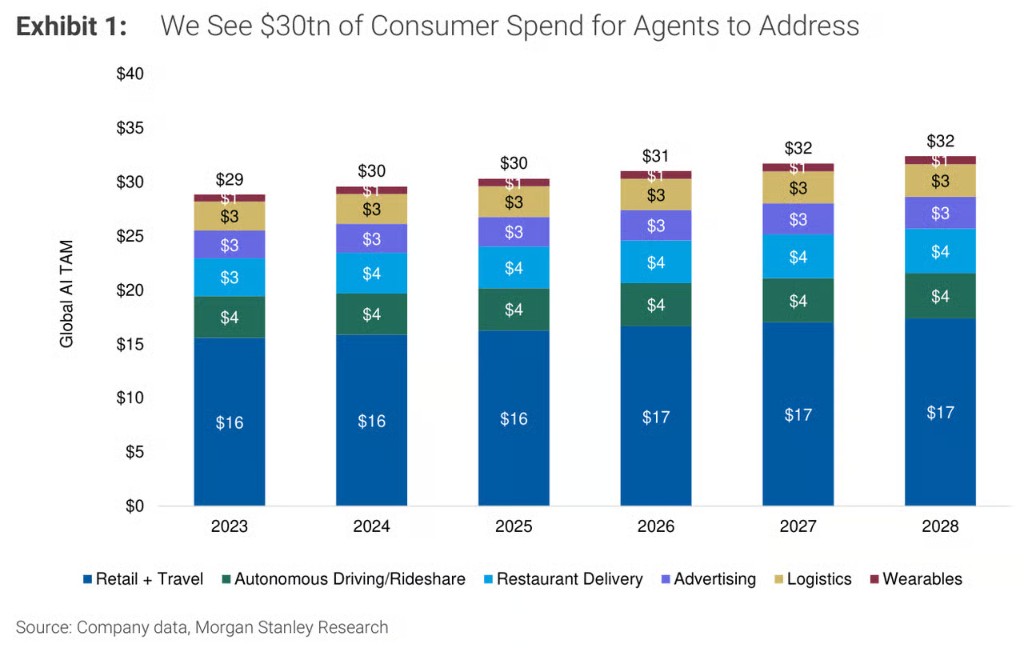
In the long term, Nowak believes Meta will build a real-time bidding auction market similar to ad auctions—where enterprises pay for transactions completed by agents. The consumer spending pool targeted by this model is approximately $30 trillion, with retail and travel accounting for about $17 trillion. But the timeline is clear: no earlier than late 2027 to 2028.
Bank of America Merrill Lynch believes substantial revenue from ads, subscriptions, or commissions is unlikely to appear before 2028; Goldman Sachs lists "whether monetization can follow quickly" as a key question and identifies privacy and security risks as the largest single risk.
Impact of Slowing Growth: A bidding auction market requires a massive and active user base to attract enterprises to bid with real money. Maintaining weekly net new users at 74,000 instead of 198,000 will push the "late 2027 to 2028" timeline even further back.
How High Are Muse's Service Costs? $3 to $130 Per User Per Month
This is the most valuable part of the Morgan Stanley report. Muse's computing costs are divided into two parts:
-
GPU Inference Cost: Scales linearly with token consumption (computing power for the model to process user requests);
-
CPU Sandbox Cost: Scales with the frequency of Muse activation by users and the duration of virtual machine runtime (browser, tools, and code execution environment).
Key Assumptions: On the GPU side, Morgan Stanley uses the GB300 framework, with 410,256 GPUs per gigawatt. At 75% utilization, each GPU processes 3,500 tokens per second, equivalent to processing 33,962 trillion tokens per year per gigawatt. With annual infrastructure costs of $7.63 billion, the inference cost is approximately $0.225 per million tokens.
On the CPU side, assuming a sandbox runtime of about 10 minutes per activation, using a virtual machine with 2-core vCPU/8GB memory, priced at AWS AMD instance on-demand rates ($0.1217/hour), plus 7.5GB storage ($0.60/month).
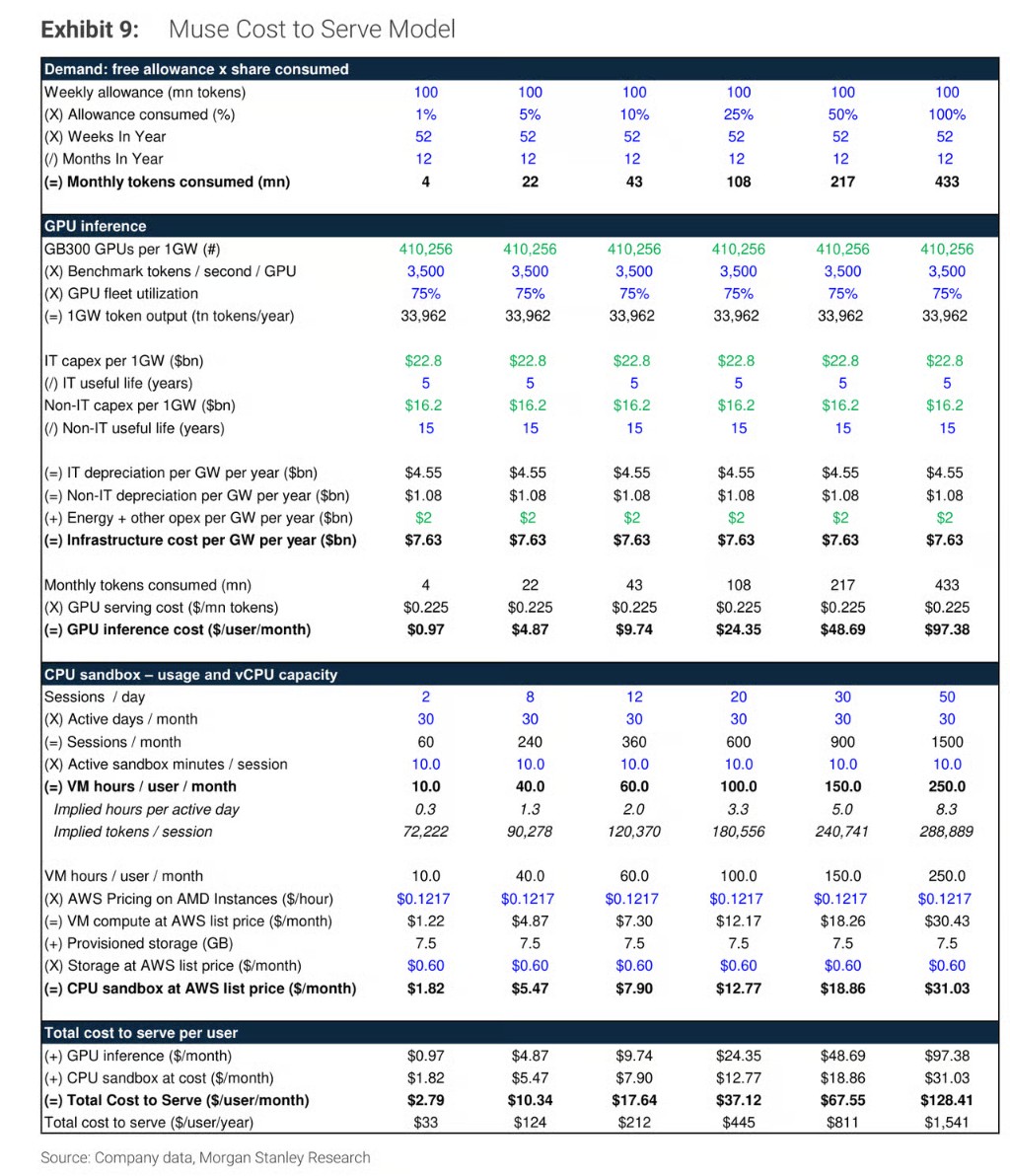
Base Case Scenario (25% quota usage): Users consume about 108 million tokens per month (20 sessions per day), resulting in a monthly service cost of $37.12 and an annual cost of $445. Nowak views this as "closer to the upper bound," as the model assumes Meta rents all CPU sandboxes at AWS list prices, which would not be the case in reality.
Comparison with ARPU: Morgan Stanley estimates Meta's global average Annual Revenue Per User (ARPU) is approximately $70. Even if users only utilize 5% of the free quota, the annual service cost is about $124, which already exceeds the annual revenue generated by Meta's average user.
Extreme Scenario Calculation (Author's projection based on Morgan Stanley's GPU costs, including only GPU inference, excluding CPU sandbox):
-
Power tier ($20/month) at full usage: Monthly inference cost is approximately $488;
-
Maximum tier ($100/month) at full usage: Monthly inference cost is approximately $2,925.
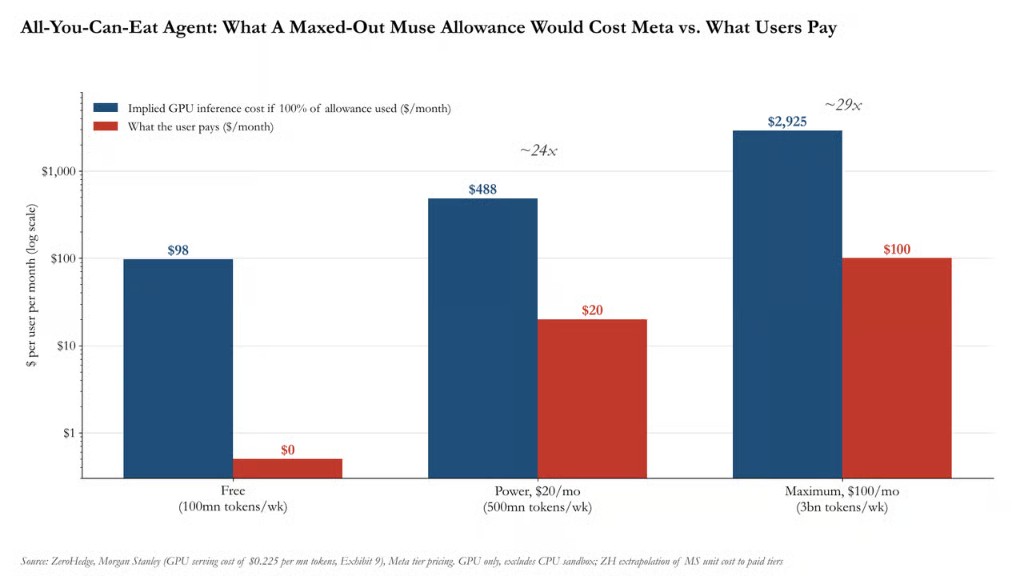
Two Sides of Scale Effects: If calculated based on 1 billion DAU and 25% usage, the annual service cost would be approximately $445 billion, whereas Morgan Stanley's forecast for Meta's full-year 2026 revenue is only $256 billion. However, calculated based on the current 2.73 million DAU, the same cost model translates to an annual cost of about $1.2 billion, which is merely a fraction of the $209 billion operating expense forecast for 2027 in Morgan Stanley's model.
Morgan Stanley's conclusion is: High costs themselves constitute a moat—“This analysis indicates that for smaller competitors, scaling to products competitive with Meta presents insurmountable cost barriers,” while Meta's core advertising business, growing 27% annually and reaching $250 billion in scale, provides unique financial support.
Will Meta Face Computing Bottlenecks? CPU Side: No
Morgan Stanley's answer is clear: “No. We estimate that the CPU capacity Meta purchases in 2026 alone will be sufficient to serve 1 billion daily active users (calculated at 25% quota usage).”

Supply Chain Calculation: Morgan Stanley estimates Meta will purchase 20% of AMD's 2026 server CPU shipments, i.e., about 2.18 million chips (126 cores, 2 threads each), totaling 549 million vCPUs; plus about 360,000 NVIDIA Vera CPUs (88 cores, 2 threads each), totaling 63 million vCPUs; plus 30 million cores from the AWS Graviton5 agreement. Totaling 643 million vCPUs, i.e., 321 million Muse instances (2 vCPUs per instance).
Demand Side Calculation: 1 billion DAU × 12.5% concurrent online rate (3 hours active out of 24) × 2x peak factor × 1.2x redundancy = 300 million concurrent running instances, accounting for about 93% of the 2026 procurement volume.
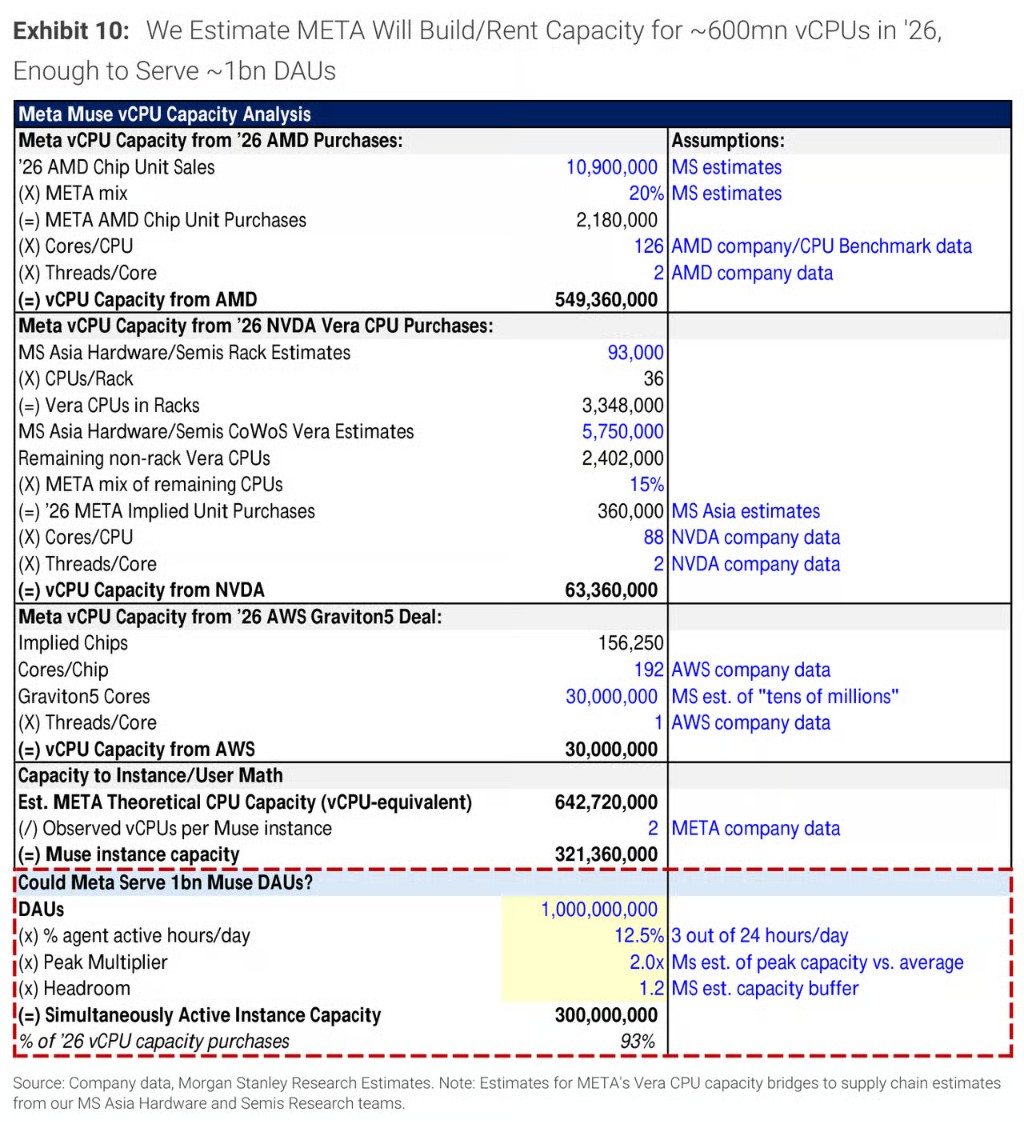
Reality Check: Based on the current 2.73 million DAU, Muse requires only about 800,000 concurrent running instances, accounting for about 0.25% of Morgan Stanley's estimated Meta procurement. At a net daily user growth rate of 74,000, reaching 1 billion DAU would take approximately 37 years.
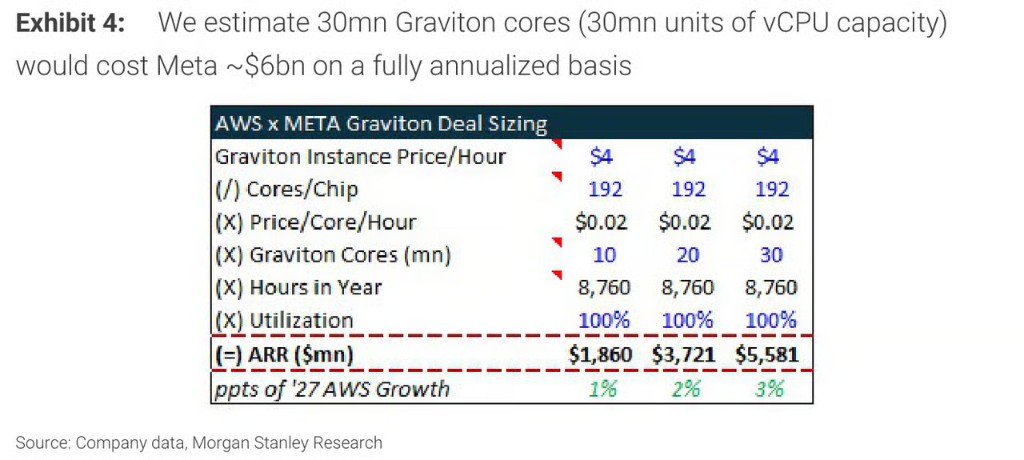
Regarding the Graviton agreement: Meta and AWS announced a "multi-billion dollar" Graviton5 agreement on April 24, involving "tens of millions" of cores. Morgan Stanley estimates this at 30 million cores, calculated at approximately $0.02/core/hour, translating to about $5.6 billion in annualized AWS revenue, contributing about 3 percentage points to AWS's 2027 growth. Meta is a multi-billion dollar key customer of AWS, while Amazon simultaneously blocks Meta's agent—both statements are true.
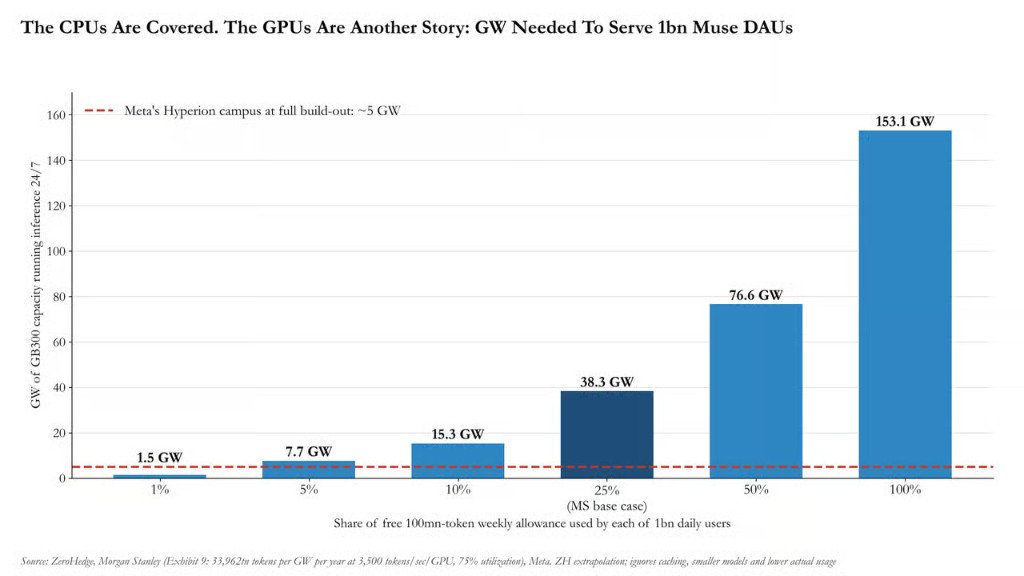
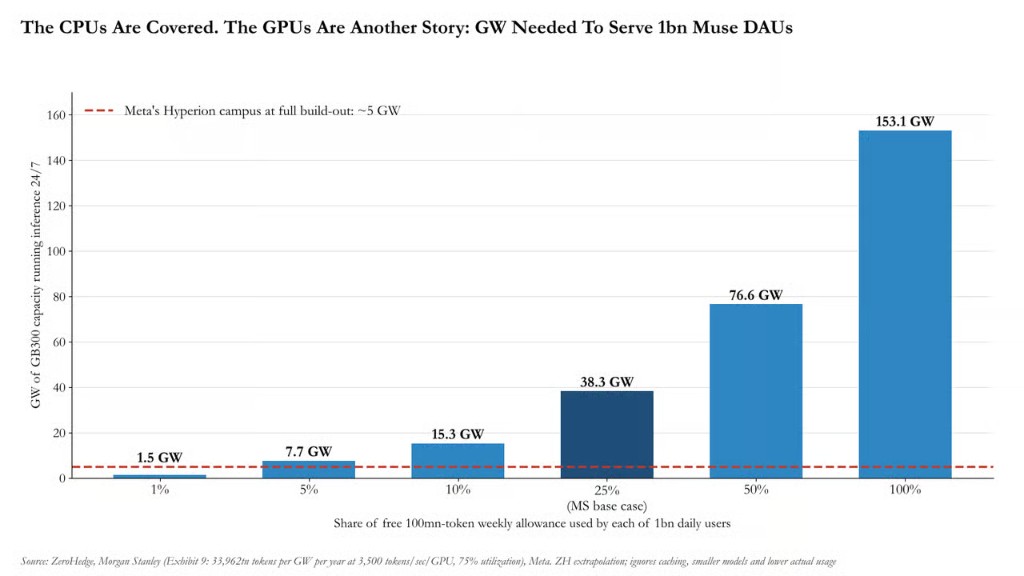
Concerns on the GPU Side (not directly calculated by Morgan Stanley): Based on Morgan Stanley's own GPU assumptions, serving 1 billion DAU (25% usage) requires about 38 gigawatts of GB300 inference computing power running around the clock. Meta's flagship Hyperion campus has a designed capacity of about 5 gigawatts. Even at 5% usage, it would require about 7.7 gigawatts. The GPU bottleneck will only become apparent when Muse truly achieves the scale expected by bulls, at which point electricity and GPUs will become constraints before CPUs.
Enterprise Market Opportunity—$55 Trillion TAM
In addition to the $30 trillion consumer TAM, Morgan Stanley adds a $25 trillion global knowledge work TAM, totaling $55 trillion, approximately half of global GDP.

Meta's enterprise layout includes:
Muse for Small Business, WhatsApp/Messenger agent tools, enterprise promotion (Meta recently recruited a head of enterprise business), Muse Coding, and model APIs based on models like "Watermelon."
Deep Logic at the Architecture Level: Morgan Stanley points out that Muse's current method of clicking web pages via browsers and calling human customer service lines is “not a high-quality, consistent, and scalable experience.” The blockades by Amazon, Costco, and Netflix, as well as interception by carriers, are real-world manifestations of this problem. The true solution is for enterprises to open MCP/tool interfaces for direct agent invocation, and Meta hopes to sell this "pipeline."
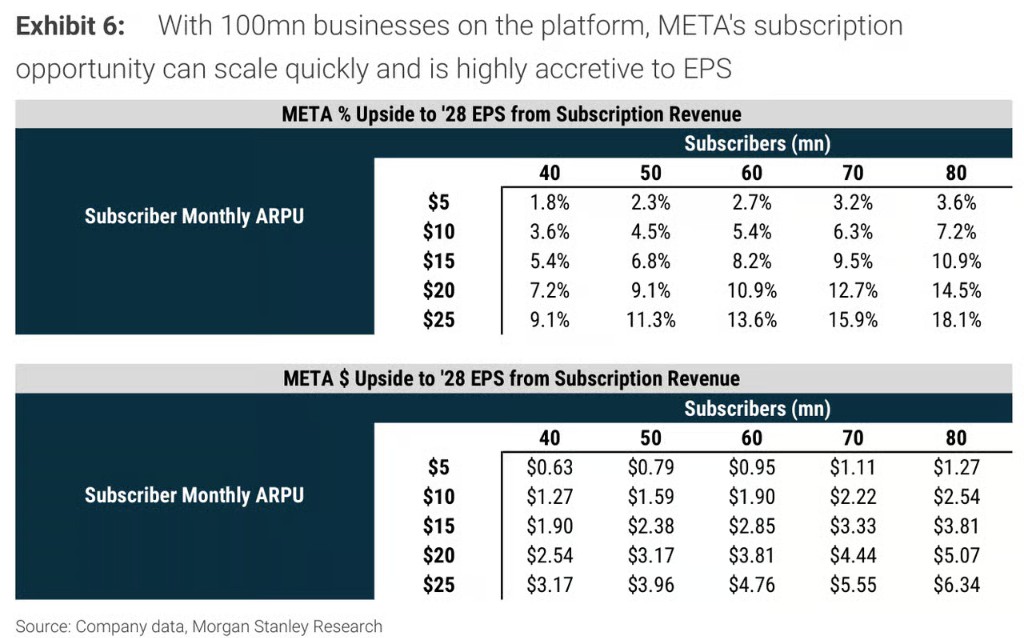
Meta One Subscription Package (launched globally on September 17): Consumer version at $2.99 to $19.99 per month, creator and enterprise versions at $14.99 to $499 per month. Morgan Stanley's sensitivity analysis shows: 50 million subscribers at $20/month could boost 2028 EPS by 9.1% (approx. $3.17); 80 million users at $25/month could boost it by 18.1% (approx. $6.34).
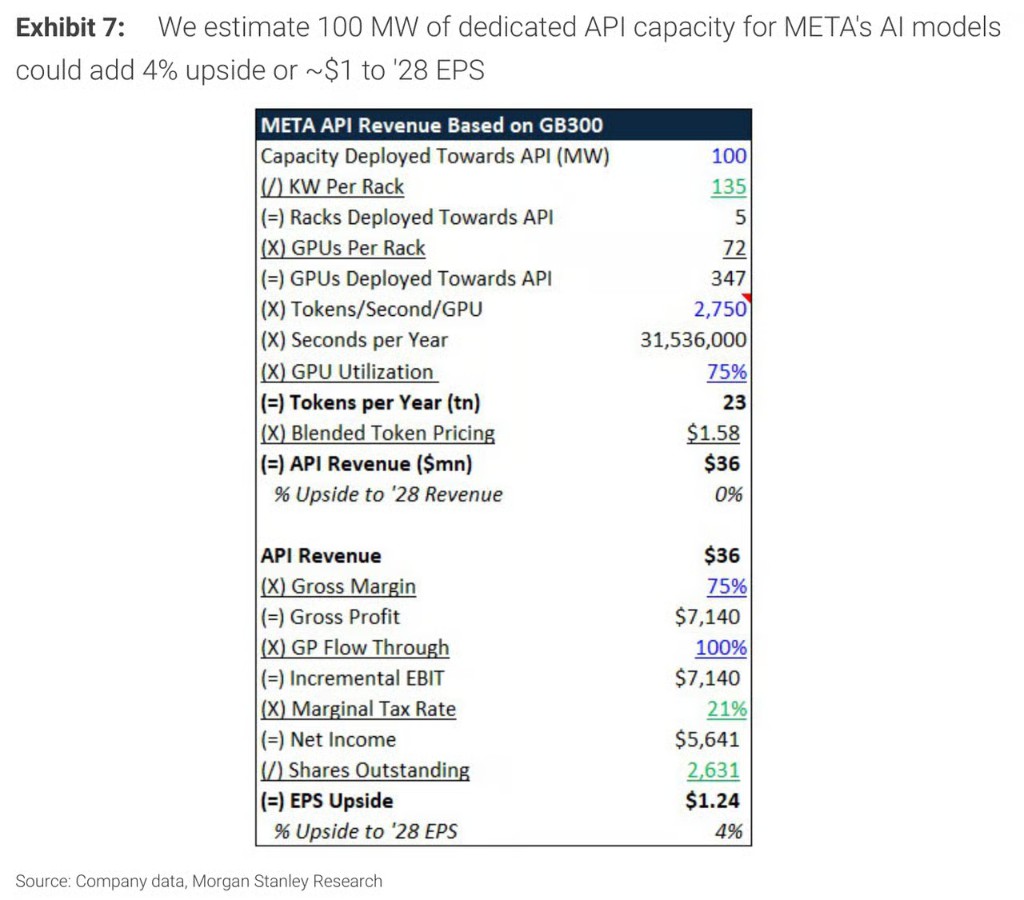
API Business: 100 megawatts of GB300 computing power dedicated to selling Meta models could boost 2028 EPS by about 4% (approx. $1).
Collateral Damage: Needham analyst Laura Martin estimated on October 1 that if 20% of App Store sales migrate to Muse Connectors, Apple could lose up to $10 billion in annual service revenue (about $7.5 billion in EBITDA). Within 168 hours of Muse Connectors opening, Meta received over 1,500 developer applications.
Amazon and Meta—A Love-Hate Community of Interests
Amazon's official reason for blocking Muse is that third-party apps "should operate openly and respect the decisions of service providers" when shopping on behalf of customers, accusing Muse of not identifying its AI identity and storing user credentials without proper disclosure.
Morgan Stanley interprets this as a negotiation: “Amazon holds about 40% of the US e-commerce market and wants to ensure this position is maintained against the rise of horizontal agents.” The negotiation focuses involve merchant record rights, control over the shopping experience (Prime benefits, retail media, product display, upsell opportunities, etc.), and data feedback to Muse agents.
Nowak points out the uniqueness of this negotiation:
“1) This is likely the first agent cooperation agreement with Amazon, setting a potential precedent for subsequent agreements; 2) Meta needs Amazon's logistics and delivery capabilities, AWS cloud computing power (CPU and GPU), and model distribution channels (access to Watermelon model APIs via Bedrock).””
Slowing Growth Changes Negotiating Chips: An agent adding 200,000 users daily is a threat retailers must face; an agent adding 74,000 users daily can be asked to wait. Amazon's stock price fell 2% since the Muse launch but has since recovered to +2.1%.
China's Competitive Landscape: Can Tencent "Reverse-Muse" Meta?
Notably, the launch of Muse has also drawn investor attention to similar products in China. Bernstein and Bank of America Merrill Lynch analyst Winnie Wu's core judgment is that the true prize in agent competition is “contextual lock-in”—the deeper an agent understands user habits, history, and workflows, the more valuable and irreplaceable it becomes.
Tencent's Structural Advantages:
- Closed Ecosystem as a Moat: China's mobile internet is dominated by "closed" ecosystems, where external agents may never access tasks within WeChat or Alipay—this is the problem Muse faces with Amazon, Costco, and Netflix, but in China, it is the default state of the entire internet;
- No Download Required: WeChat agents do not require independent downloads and are accessible with one click within an app that most Chinese smartphone users open daily, bypassing the slowing download growth problem Muse is experiencing;
- Mini-Programs as Ready-Made Pipelines: Tencent already possesses the structured interfaces that Morgan Stanley says "Web 1.0 internet must build to scale agents";
- Closer Monetization Path: WeChat Pay processes trillions of RMB in transactions annually, allowing Tencent to take a cut directly from transactions completed by agents—this is the model Morgan Stanley believes Meta will not achieve until late 2027 to 2028;
- Computing Constraints: Export controls limit China's computing power on the GPU side, and GPU inference costs are the main cost driver in heavy-use scenarios. However, agents calling Mini-Program APIs should require significantly less CPU sandbox computing power than agents driving browsers.
In summary, analysts believe Morgan Stanley's report is the most valuable Muse research to date because it provides real numbers:
Muse's monthly service cost per user is $3 to $130, with a base case of $37 (viewed by Morgan Stanley as the upper bound); Meta has purchased enough CPU computing power to serve 1 billion daily active users, with related costs included in the 2027 operating expense forecast of $209 billion; true agent ad auction monetization will occur no earlier than late 2027 to 2028.
The Current Reality Is: Meta has the computing power to serve 1 billion users, but actual users are only about 1.8 million to 2.7 million, growing at one-third the speed of the September peak, while more websites and carriers are deciding whether to allow this agent through.
The valuation re-rating from 14x to 21x was exchanged for a growth story, and this story received its first real negative data point on Friday—from an institution that has disclosed a short position. Meta's Q3 earnings report on November 4 will be the true test, at which point the market will demand Meta provide its own Muse user data.