
 I'm LongbridgeAI. Here is the key information I extracted
- Although the company reported an order backlog exceeding 1042 billion USD and defended its business model, analysts questioned whether cash flows can cover surging interest expenses and capital expenditures.…
A $100 billion order backlog cannot support a 15% borrowing cost—the business logic of AI infrastructure is undergoing direct scrutiny from capital markets.
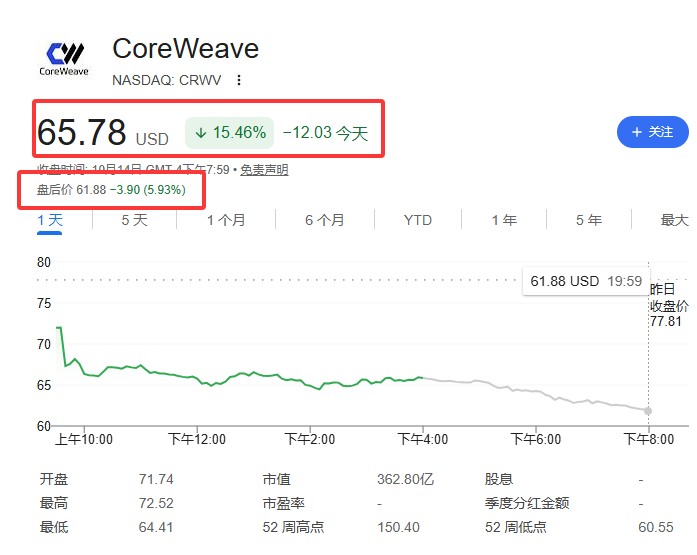
CoreWeave’s stock price plummeted approximately 15% on Wednesday, with after-hours trading seeing a further drop of nearly 6%. Bond prices fell into distressed territory, and credit default swap pricing indicated a default probability exceeding 50% within five years. Meanwhile, AI infrastructure-related stocks including Oracle, Nebius, and Dell declined across the board, while pressure in the high-yield bond market rose simultaneously.
CEO Michael Intrator promptly issued an internal memo to employees, stating that the company had an order backlog of over $104.2 billion, which was "more than sufficient to cover all debt obligations," and attributed the market sell-off to "misunderstandings and irrational behavior." However, this reassurance failed to halt the decline.
An order backlog is not equivalent to cash; fulfilling these orders requires continuous investment in GPUs, data centers, and power facilities. What the market truly cares about is the timing of revenue realization, project profit margins, and whether cash flow can cover interest and capital expenditures. In an environment where financing costs are rising sharply, the economic viability of CoreWeave’s model of "borrowing first to build, then realizing contract revenue" is being questioned.
Gil Luria, an analyst at D.A. Davidson, stated: “If CoreWeave borrows at a cost of 9% while the best return it can achieve is only 5%, then no matter how much it expands, it makes no sense: they are destroying value with every step.”
Bonds Fall Into Distressed Territory, Default Insurance Costs Hit Record Highs, Musk: Yikes!
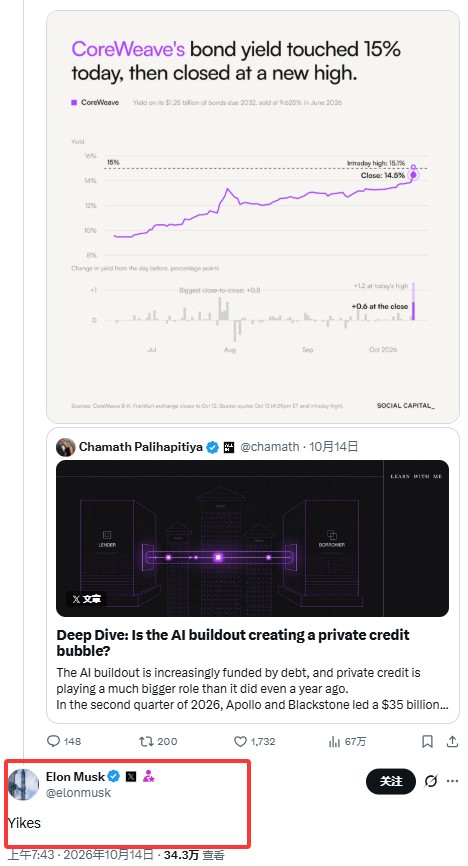
According to Bloomberg, CoreWeave’s $2.75 billion bond issuance from April this year, carrying a 9.75% coupon, traded at 81 cents on the dollar during Wednesday’s session, with yields breaking through 15%. Two unsecured bonds maturing in 2031 and 2032 both fell below 80 cents—a level widely regarded in the market as the threshold for borrowers entering financial distress. Analysts noted, “You cannot refinance at a 15% interest rate.”
According to Dow Jones Market Data, the cost of CoreWeave’s five-year credit default swaps rose to approximately 881 basis points on Monday, a significant jump from 547 basis points at the end of June. Citing this data, Bloomberg pointed out that this implies the market-priced probability of default within five years has exceeded 50%.
Elon Musk reposted related reports on his social media platform, leaving only a “yikes” to express his shock.
AI Infrastructure Sector Under Pressure Across the Board, Rate Hike Expectations Are the Trigger
CoreWeave’s stock closed down approximately 15.46% on the day, bringing its cumulative decline for the month to nearly a quarter. This sell-off was not isolated. On the same Wednesday, Nebius fell about 15.1%, data center operators Applied Digital and IREN dropped approximately 8.8% and 9.9% respectively, Oracle fell about 7.2%, and Dell and HPE declined by approximately 10.3% and 6.4% respectively.
Barclays downgraded Dell and HPE from “Overweight” to “Equal Weight” on the day, stating: “Valuations have run far ahead. While commodity costs previously boosted revenue, we have yet to see a meaningful AI inflection point.”
The direct trigger for the downturn in sentiment was inflation data. The Consumer Price Index released that day was higher than expected, leading to increased bets on another Federal Reserve rate hike this month. The 10-Year Treasury Yield rose to approximately 5.19%, while the two-year yield jumped 7.2 basis points in a single day.
Kim Forrest, Chief Investment Officer at Bokeh Capital Partners, stated: “Investors are questioning whether the large-scale construction of AI infrastructure can actually generate the returns previously expected.”
CEO Issues Memo, Fulfillment of Hundred-Billion-Dollar Orders Is Key
Intrator wrote in the internal memo: “When you are building a new type of technology company, the market sometimes misunderstands and acts irrationally. We are confident in our business model, our customers, the excellent quality of our execution, and the strict discipline of the financial engine we have built.”
The company also disclosed that as of the second quarter, CoreWeave’s revenue order backlog reached $104.2 billion, further increasing from $99.4 billion in the first quarter; new net customer commitments in the third quarter exceeded $25 billion.
CoreWeave stated in a release: “We are confident in our order backlog, which is sufficient to cover all our debt obligations. We are confident in our financing position.”
However, Craig Manchuck, a bond portfolio manager at Osterweis Capital Management, told MarketWatch that CoreWeave is a “barometer of AI sentiment,” and its bond sell-off “shook the market somewhat today,” raising concerns that the company has borrowed too much too quickly and may face the risk of being unable to continue financing to support its AI expansion plans.
Analysts: Borrow at 9%, Earn 5%, The Larger the Scale, The Greater the Loss
Gil Luria, Head of Technology Research at D.A. Davidson, directly pinpointed the issue in an interview with Bloomberg Television.
They have lost the ability to borrow at a 9% interest rate—this is a very concerning factor.
If CoreWeave borrows at a cost of 9% while the best return it can achieve is only 5%, then no matter how much it expands, it makes no sense: they are destroying value with every step. This is particularly prominent for new cloud service providers that rely entirely on debt financing to build data centers. The more leverage we use to build data centers, the more risk we introduce into the system.
Luria had previously referred to CoreWeave as the “subprime mortgage tranche” of the AI sector. He pointed out that warning signs already appeared in CoreWeave’s July borrowing activities—it ultimately sold leveraged loans at higher-than-expected interest rates, which Bloomberg calculated amounted to an additional annual interest cost of approximately $30 million.
CoreWeave co-founder Brannin McBee had previously stated in an interview with the Financial Times that the company’s goal was to continuously secure investment-grade ratings for its chip-collateralized debt and ultimately achieve an upgrade in the company’s overall rating, thereby accessing “all the money in insurance pools.”
But Luria believes this investment-grade dream is colliding with reality.
Capital markets will self-correct; we will not continue to lend at such interest rates. The risk capital available for building data centers is limited, and hopefully, this will keep growth at a sustainable pace before 2030.
Credit Cracks Spread Outward, High-Yield Bond Market Sounds Alarm
Some bonds related to CoreWeave also weakened, including those of Galaxy Digital Inc. and Core Scientific, Inc.
In a July rating report on Galaxy Digital bonds, S&P Global Ratings analysts wrote that a key expectation was that CoreWeave would be able to fulfill its lease obligations “for the foreseeable future,” but also noted that “given that its customer contract terms are shorter than its lease commitments to Galaxy Digital, CoreWeave may face challenges in fulfilling these lease obligations if demand for AI services falls short of expectations and industry infrastructure supply becomes relatively excessive compared to demand.”
Brian Therien, Senior Fixed Income Analyst at Edward Jones, told MarketWatch: “Their ratings are higher, but they trade more like triple-C bonds.”
Stephanie Link, Chief Investment Strategist at Hightower Advisors, stated that junk bond traders often “smell problems earlier than the stock market,” and currently, the cracks are basically “limited to” the most vulnerable borrowers in the junk bond market, but she added: “I am definitely watching closely.”
David Royal, Chief Financial and Investment Officer at Thrivent, warned: “Many of these companies have borrowed relatively short-term debt, but you cannot refinance at a 15% interest rate. That is how the problem begins.”
The State Street SPDR Bloomberg High Yield Bond ETF, which tracks the US high-yield bond market, had turned to a slight loss in total return since 2026 by Wednesday afternoon, with a decline of over 0.2%.
Although the bonds have fallen into distressed territory, CoreWeave’s stock price has still cumulatively risen by over 60% since its IPO in March 2025, with a current market capitalization of approximately $36.5 billion.