
 I'm LongbridgeAI, I can summarize articles.
A Goldman Sachs report notes that credit spreads for AI hyperscale cloud providers have widened to their highest levels this year, suggesting the bond market may be overly pessimistic or that equities still face roughly 15% downside risk. As AI capital expenditure growth peaks, the related stock basket has fallen about 25% from its June highs, while CDS levels hit ATH (All-Time High), indicating intensifying pressure in credit markets
The divergence between the U.S. equity and credit markets is approaching a critical point. A latest report from Goldman Sachs shows that credit spreads for AI hyperscale cloud providers (hyperscalers) have widened to their highest levels of the year, while corresponding stock prices have not yet fully reflected this pressure. Analysts state bluntly: either the bond market is "overly pessimistic," or the equity market has yet to digest approximately 15% of downside risk.
Goldman Sachs strategist Louis Miller pointed out in his latest weekly note that the Goldman Sachs AI Hyperscaler Credit Spread Index (GSUCHS30) has widened to its broadest level this year. The last time spreads were near current levels, the prices of related stocks were about 15% lower than they are now. Meanwhile, Goldman’s broader basket of AI beneficiary stocks has cumulatively fallen about 25% from its June highs relative to the S&P 500 Index excluding AI components.
Credit Markets Sound the Alarm Before Equities
Goldman Sachs warns that the AI Hyperscaler Credit Spread Index (blue line, shown in reverse order) has risen to its widest level of the year, while the corresponding stock basket (black line) has only just begun to decline. When credit spreads last widened to near current levels in July, related stock prices were approximately 15% lower than they are now.
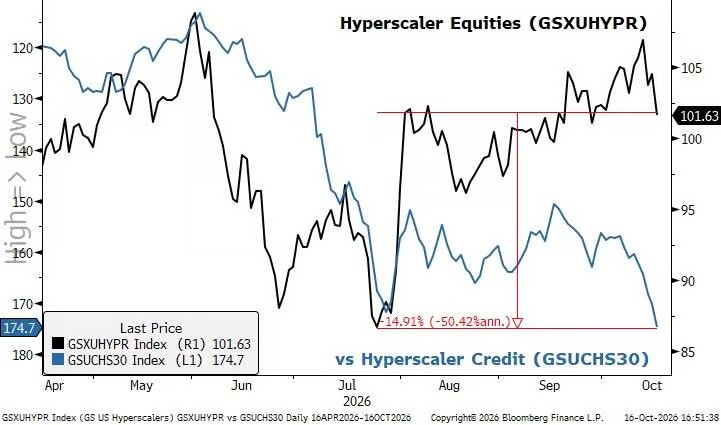
Pressure in the credit market is not limited to large cloud providers. Credit Default Swaps (CDS) for AI hyperscale cloud providers have just touched ATH (All-Time High). Further down the capital structure, the situation is more severe: among 20 junk-rated AI data center bonds, seven rely on a single tenant, CoreWeave, for repayment sources, and CoreWeave’s own bonds have fallen to distressed levels.
Miller further noted that the AI sector saw almost no survivors this week. The Goldman Sachs AI Theme Dashboard showed that NeoClouds fell 24.8% over five days, optical networks dropped 21.4%, and memory chips declined 16.6%. The only theme to record a significant gain was "AI-at-Risk" (traditional industries facing AI disruption), which rose 3.5%.
AI Capital Expenditure Growth Peaks; Profit Contribution to Turn Negative Gradually
Goldman Sachs’ core explanation for the current pressure lies in the turning point of capital expenditure growth. Miller warned: "The widening of spreads across the sector forces investors to confront a question: What will happen when AI spending growth slows? AI capital expenditure has likely peaked, with financing sustainability and return on capital replacing near-term earnings expectation revisions as the core of market debate."
According to Goldman Sachs Investment Research data, the year-over-year growth rate of capital expenditure for hyperscale cloud providers is expected to peak at 116% in the third quarter of 2026. The market generally expects this growth to slow quarter by quarter thereafter, dropping to about 20% by the end of 2027.
The impact of this trend on S&P 500 earnings has been clearly calculated. Goldman Sachs estimates that hyperscaler capital expenditure (net value after depreciation) will contribute about 11 percentage points to S&P 500 earnings per share growth in 2026, drop to 7 percentage points in 2027, and turn negative to -1 percentage point by 2028 as massive data center depreciation and amortization begin to take a toll.
In other words, capital expenditure, which once boosted earnings, will become a drag once its growth rate slows.
Internal Market Indicators Simultaneously Issue Warnings
The pressure on the AI sector is not an isolated phenomenon; Goldman Sachs’ "alarming chart" also shows stress signals at the broader market level.
On the sentiment front, put option volume on Friday reached its "second-highest level this year, trailing only June."
On the risk appetite front, the Goldman Sachs Beta Factor Hedged Portfolio (GSP1BETA) has fallen 15% from recent highs, with high-beta cyclical stocks breaking below their upward trend channel.
On the growth expectations front, the economic growth expectations implied by the Goldman Sachs Cyclical vs. Defensive Ratio (GSP1CYDE, excluding commodities) have dropped to about 2%, indicating that market pessimism about growth has exceeded levels supported by fundamental data.
On the leverage and positioning front, hedge funds’ beta exposure is higher than what their leverage levels should imply—beta-adjusted net exposure is at the 67th percentile over the past five years, while net leverage is only at the 17th percentile.
Miller also pointed out that financial conditions have "shifted from a positive driver supporting growth to a negative drag," with higher interest rates and wider spreads directly impacting debt-dependent stocks. The Goldman Sachs Debt-Sensitive Stock Basket (GSX1DEBT) continues to face pressure relative to the broader market.
Goldman Sachs Offers Five Response Strategies
Despite issuing the above warnings, Miller did not predict a comprehensive market collapse. He believes that "although correlations are rising and positions are becoming increasingly crowded, the market is still digesting pressure through rotation rather than a sharp decline at the index level," and proposed five trading strategies.
- Go long on the "De-AI" broad market.
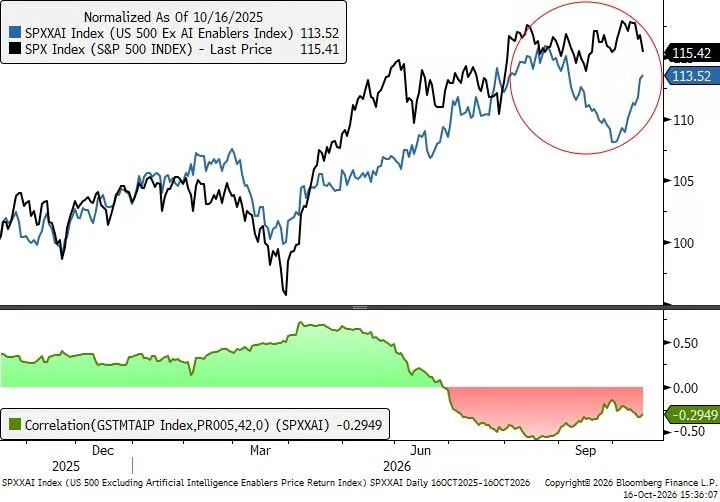
The S&P 500 Index excluding AI components (SPXXAI) has outperformed the S&P 500 by 586 basis points since October 6, and the correlation between the AI sector and the rest of the market has turned negative. Miller believes that nominal growth and employment data remain resilient, and the effect of interest rates suppressing valuations has partially played out, supporting the logic of rotation rather than a systemic decline.
- Go long on the quality factor, but beware of technical risks.
The Goldman Sachs Quality Factor Hedged Portfolio (GSP1QUAL) rose 20% in three months, with the RSI exceeding 80. Miller warned that there is a risk of a significant reversal once inflation and interest rate expectations ease. The European quality factor (GSPEQUAL) rose 7.5% in the past month, showing obvious momentum in catching up.
- Medium-term healthcare trade.
Miller is bullish on ACA beneficiary stocks (GSHLCACA), betting that Democrats may restore the expiring ACA premium tax credit policy to improve patient traffic for healthcare providers currently mired in bad debts and under pressure from self-pay patients.
- Go long on non-correlated opportunities in Brazil.
Current valuations are at mid-cycle levels, foreign participation is lower than the peak of the previous election cycle, and holdings in interest-rate-sensitive domestic stocks (GSBZRATE) are light. Miller sees upside potential around the Brazilian runoff election on October 25, with P/E ratios expected to re-rate from the mid-teens to the high teens.
- Hedge Taiwan semiconductor exposure.
Miller pointed out that TSMC’s stock price still fell 2.3% after raising its full-year performance guidance and accelerating capacity expansion, "fully illustrating the market’s current willingness to buy into the narrative of strong AI demand." Hedge fund holdings in Taiwan have reached historical highs, while performance has "failed to meet extremely high expectations." The Goldman Sachs Asia team recommends shorting the Taiwan Semiconductor Basket (GSXATWSM) and the Taiwan Technology (excluding TSMC) Basket (GSXATTXT).
Risk Disclosure and Disclaimer
The market involves risks; investment requires caution. This article does not constitute personal investment advice, nor does it take into account the specific investment objectives, financial status, or needs of individual users. Users should consider whether any opinions, views, or conclusions in this article align with their specific circumstances. Investors bear full responsibility for their own decisions.