
 I'm LongbridgeAI, I can summarize articles.
The Australian data center industry is facing a trust crisis triggered by community protests. Amid the investment boom in AI infrastructure, the "triple bottleneck" of land, capital, and power permits is bringing the high-growth narrative on paper back down to reality.
NextDC, often referred to as "Australia's CoreWeave" and a bellwether for AI infrastructure, disclosed on Wednesday that due to continuous obstruction by residents in Melbourne's inner city against the construction of high-voltage transmission lines, the power supply plan for its key M3 project has been postponed to fiscal year 2028, leading to a substantial downward revision of its FY2027 performance guidance by more than one-third. The company also announced the suspension of all new development projects and land acquisitions and is currently assessing whether it can invoke force majeure clauses in relevant contracts.
Following the announcement, Nextdc's stock price fell by as much as 45% to AUD 5.07 on the Sydney market after a two-day trading halt, retreating to 2019 levels and dragging down local peers collectively.
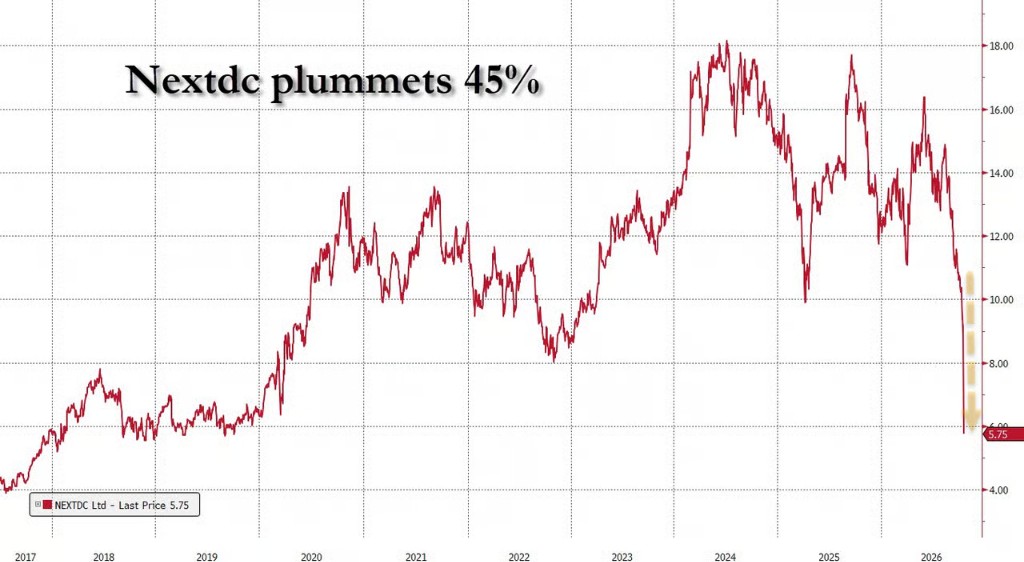
This event further confirms the delivery dilemmas widely faced by the global data center industry—GPUs are in place, and customer contracts are signed, but what truly stalls projects are often grid access permits and opposition from surrounding residents. According to Bloomberg, at least 106 data center projects in the United States were blocked or delayed due to community opposition in the first half of this year alone, involving an investment scale of approximately USD 198 billion.
Bulldozers Blocked by Residents: The "Low-Tech" Collapse of the M3 Project
The trigger for Nextdc's stock collapse was a rather dramatic scene of community confrontation.
To supply power to the M3 project, grid operator Jemena Electricity Networks needed to install high-voltage transmission poles on residential streets in Maribyrnong, an inner-western suburb of Melbourne. In September this year, local residents used private cars to block construction vehicles and refilled trenches that had already been excavated. Jemena subsequently suspended construction citing "safety concerns and restricted site access," stating that there was no hope of resuming work before February 2027 at the earliest. As a result, the next grid capacity expansion supply for M3 has slipped into FY2028.
The local council is still waiting for further community consultation before issuing planning approval, and planning decisions for phases six and seven of M3 have been pushed to 2027—coinciding with the period when the Victorian government will enter a caretaker mode before the election on November 28.
The financial impact on Nextdc became apparent quickly. According to documents submitted by the company to the Australian Securities Exchange (ASX): the FY2027 net revenue guidance was lowered from AUD 615–640 million to AUD 475–500 million; the FY2027 underlying EBITDA guidance was cut from AUD 385–410 million to AUD 245–265 million, representing a median decrease of approximately 36%; and the FY2027 capital expenditure guidance was narrowed from AUD 5.25–5.75 billion to AUD 4.5–5.0 billion.
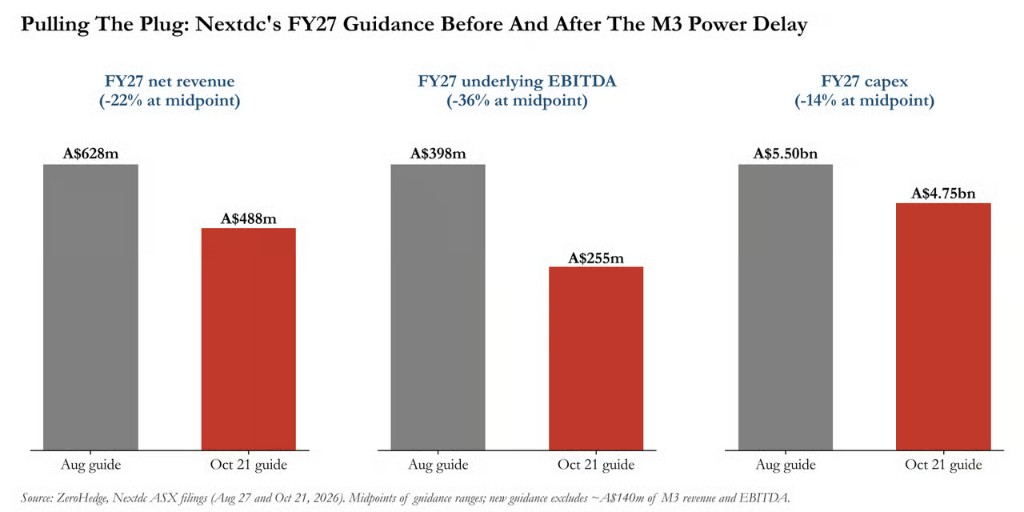
The new guidance excludes approximately AUD 140 million in revenue and EBITDA related to contracts affected by M3, including some capacity that had already begun billing. The company also warned that EBITDA could face further pressure if it needs to pay service level agreement (SLA) breach compensation to customers. CEO Craig Scroggie stated in an investor conference call:
"We will not continue any work at any site without existing customer commitments."
Goldman Sachs Had Previously Warned That Capital Remains the "Handbrake"
Just eight days before this crash, a team of analysts led by Chris Boulus at Goldman Sachs released a major report covering digital infrastructure in Australia and New Zealand, predicting that IT load demand in the Australia-New Zealand region will expand to 5.2GW by 2030, leaving a supply-demand gap of 0.7GW, and characterizing the overall data center capital expenditure cycle scale as AUD 50–65 billion.
Notably, Goldman Sachs had already assigned a cautious rating to Nextdc in the same report. At that time, Goldman initiated coverage of Goodman Group and Megaport with a "Buy" rating but started tracking Nextdc with only a "Neutral" rating and a target price of AUD 11, reasoning that "the market loves the macro demand narrative, but capital is the true handbrake." The report set Nextdc's FY2028/2029 EBITDA forecasts 3–5% below market consensus and highlighted a potential financing gap of over AUD 1 billion for the company, questioning whether "de-risked capital joint ventures" or "potentially dilutive equity financing" would be its path forward.
Currently, Nextdc still holds AUD 8.7 billion in liquidity on its balance sheet, including AUD 6.7 billion in undrawn senior debt, and the company states it remains compliant with covenant terms. However, the company also warned in its filings that substantive changes in billable configurations—such as the revenue gap caused by the M3 delay—could limit its ability to draw down the aforementioned senior debt. Citing UBS predictions, Market Index noted that Nextdc is not expected to achieve profitability until at least FY2031, with long-term debt peaking at AUD 11.2 billion in FY2030. Based on the current stock price, Nextdc's FY2027 EV/EBITDA valuation is approximately 37x, while according to Goldman Sachs data, the average valuation for comparable pure-play data center operators globally is 22x, and this comparison does not yet include the latest AUD 1.1 billion in convertible notes. Therefore, Market Index pointed out that Nextdc "would only be returning to global peer valuation levels even if it fell another 40%."
"Force Majeure" Is Becoming a New Buzzword in the Data Center Industry
Nextdc's invocation of force majeure clauses is not an isolated case.
On September 24 this year, Oracle issued a force majeure notice for its large "Project Jupiter" campus in New Mexico, again due to permit delays and hindered power access. It was later revealed that the company had to transport natural gas to the data center to maintain operations. In early October, Finnish authorities ordered Google to suspend construction on two data centers. Now, the same scenario is playing out again in Melbourne.
According to Bloomberg, Morgan Stanley had previously estimated that globally, USD 156 billion worth of data center projects had been cancelled or delayed in 2025 alone, with this figure reaching USD 130 billion in the first quarter of 2026. Texas has directly ordered a suspension of new data center construction.
RBC explicitly stated that the M3 delay event is strong evidence that "community opposition poses a real risk to the delivery timeline of contracted data center capacity." Mark Luet, Head of Investment Banking for Japan, North Asia, and Australia at Citigroup, told Bloomberg Television that investors would become "more discerning" in the future, adding, "We have no doubt that the theme of AI infrastructure will continue to advance."
Self-Generated Power or No Entry
In the view of the industry, the fundamental solution to breaking the grid access deadlock lies in "self-generated power." The Australian government introduced mandatory national regulations in July this year, requiring data center operators to "fully self-fund their power needs and provide guarantees for new generation projects."
Goldman Sachs also adjusted its forecasts in its Carbonomics report. Analyst Michele Della Vigna raised the forecast for global data center "behind-the-meter" power supply to 67GW by 2030. By then, on-site gas turbines, reciprocating engines, and fuel cells will meet 25% of the global data center power demand, a proportion that was "almost zero" in 2025. The underlying logic is that the waiting time for grid access has extended from historically about two years to now over seven years, while the construction cycle for data centers themselves takes only two to three years.
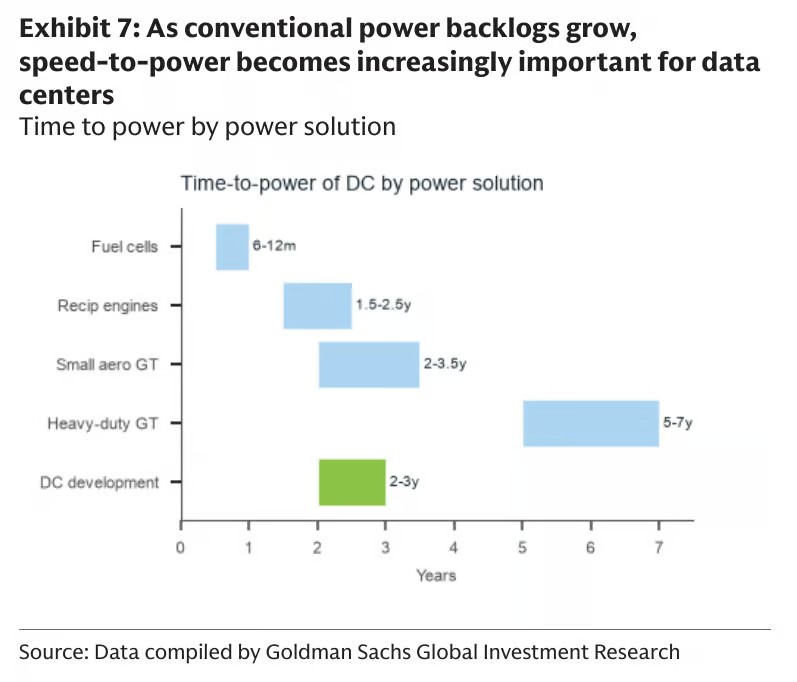
The M3 project is a microcosm of this contradiction: the main building structure is largely complete, and customer contracts are in hand, but what is missing is a 66-kilovolt grid expansion line—a line blocked outside the street by a few private cars and a few shovels.
Meanwhile, Reserve Bank of Australia Deputy Governor Andrew Hauser recently listed the "data center construction boom" as one of the three major upside risks to inflation in Australia, prompting Goldman Sachs' Australian economists to revise their previous expectation of a pause in rate hikes, instead predicting that the RBA will raise rates by 25 basis points to 4.85% in November. This means that the data center investment boom is raising the financing costs for the data center industry itself—for an industry where Goldman Sachs had already pointed out that "capital is the biggest constraint," this feedback loop is far from ideal.
The Nextdc board will announce the results of its capital expenditure review at the annual general meeting on November 20. Whether "selling off development land not needed in the near term" will mark the beginning of a series of asset sales is something the market will watch closely.