
 I'm LongbridgeAI. Here is the key information I extracted
- Goldman Sachs reduced its 12-month target from 435 USD to 385 USD while maintaining a buy rating, whereas JPMorgan adjusted its target from 425 USD to 375 USD.…
Following the release of Alphabet's third-quarter earnings report, major Wall Street institutions promptly lowered their price targets. Search revenue fell short of expectations, and combined with foreign exchange headwinds and persistently high capital expenditures, market concerns regarding the company's free cash flow outlook have significantly intensified.
According to Zhuifeng Trading Desk, JPMorgan lowered Alphabet's price target from $425 to $375. Goldman Sachs also reduced its 12-Month Price Target from $435 to $385, a decrease of approximately 11.5%, but maintained its Buy rating. Based on the closing price of $324.89 on October 28, the new target implies an upside potential of about 18.5%.
The earnings report showed that Alphabet's Q3 search and other revenues amounted to $63.35 billion, missing Goldman Sachs' expectation of $64.2 billion and the market consensus of $64.895 billion. Meanwhile, the company maintained its capital expenditure guidance of $195 billion to $205 billion for 2026 and indicated that capital spending would increase substantially in 2027, putting pressure on the free cash flow outlook and becoming a core focus for investors.
Search Revenue Under Pressure, FX and Base Effects Pose Dual Drag
Alphabet's Q3 search and other revenues grew 12% year-over-year, missing market expectations. Management attributed the primary reasons to foreign exchange headwinds and noted that the company is facing a challenging revenue comparison base—the acceleration in search revenue growth began in Q3 2025, weighing on this quarter's year-over-year figures.
Additionally, Goldman Sachs analysts pointed out several sector-specific factors: some retailers in the Asia-Pacific region were affected by the EU's removal of minimum tax exemption policies, while media and entertainment advertising spending normalized and declined after the 2026 World Cup. Management stated that foreign exchange headwinds in Q4 are expected to be slightly larger than in Q3, and base effect pressures will continue.
Looking at the full quarter, Google Services' overall revenue was $96.3 billion, below Goldman Sachs' estimate of $97.575 billion. YouTube ad revenue was $11.207 billion, also missing expectations. GAAP earnings per share (EPS) were $2.12, significantly lower than Goldman Sachs' expectation of $2.96, impacted by an approximately $8.7 billion loss due to fluctuations in the fair value of equity assets held by the company.
Strong Cloud Business, AI Demand Drives Revenue Beat
The cloud business was the biggest highlight of this quarter's earnings. According to Goldman Sachs data, Google Cloud's Q3 revenue reached $30.709 billion, a year-over-year increase of approximately 103%, beating Goldman Sachs' expectation of $29.556 billion by about 3.9% and exceeding market consensus by about 5.7%. Operating margin expanded by approximately 1,250 basis points year-over-year to 36.2%.
Management disclosed that Google Cloud's remaining performance obligations (backlog) have now reached $561 billion, a 256% year-over-year increase, with about 55% expected to convert into revenue within the next 24 months. Goldman Sachs' report highlighted strong enterprise AI demand—with significant contributions from TPU system sales. Nearly 100 customers are currently using TPUs, with volumes expected to further ramp up in Q4 and 2027. Management also stated that insufficient computing resource supply remains a key bottleneck constraining further acceleration in cloud business growth.
In terms of subscription business, management revealed that YouTube Premium subscribers have exceeded 150 million. Overall subscription revenue growth is faster than advertising business growth, and demand for Google One AI packages remains strong.
High Capital Expenditures, Negative Free Cash Flow Draws Attention
Alphabet maintained its capital expenditure guidance of $195 billion to $205 billion for 2026, with Goldman Sachs' updated estimate at approximately $203 billion. For 2027, the company has not provided specific guidance but explicitly stated that spending will "increase substantially," with Goldman Sachs estimating it at approximately $350.4 billion.
Against this backdrop, Goldman Sachs adjusted its 2027 free cash flow estimate for Alphabet to -$40.567 billion. Free cash flow for 2026 has turned negative (-$12.62 billion), marking a significant reversal from $73.266 billion in 2025. Depreciation and amortization expenses have also surged, with Goldman Sachs estimating $38.774 billion for 2026 and a jump to $75.017 billion for 2027.
Management stated that they expect Return on Invested Capital (ROIC) to remain well above the cost of capital but acknowledged that the divergence between current free cash flow and large-scale investments will persist temporarily until computing constraints are alleviated.
Goldman Sachs Lowers Price Target, Maintains Buy Rating
Goldman Sachs lowered its 12-Month Price Target from $435 to $385, primarily reflecting downward revisions to forward earnings estimates and a slight contraction in valuation multiples. In terms of valuation methodology, Goldman Sachs uses an equal-weighted mix of 50% EV/GAAP EBIT and 50% adjusted DCF (EV/FCF-SBC). The EV/GAAP EBIT multiple was lowered from 26x to 24x to reflect lower forward earnings estimates, while maintaining the multiple-to-growth ratio at approximately 0.80x.
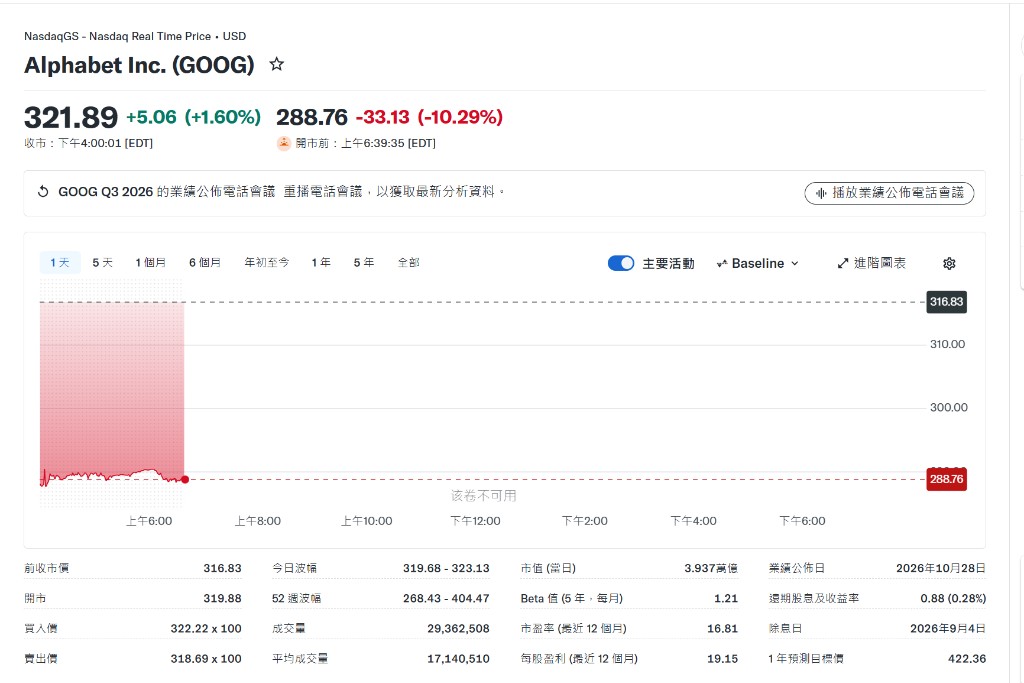
Regarding earnings estimates, Goldman Sachs lowered its 2026 EPS estimate from $20.54 to $19.76, 2027 EPS from $15.50 to $15.01, and 2028 EPS from $19.15 to $18.53. Based on the current stock price, GOOGL trades at approximately 18x Goldman Sachs' 2027 GAAP EPS estimate (excluding net cash) and about 15x for 2028.
Goldman Sachs analyst Eric Sheridan's team pointed out in the report that they remain bullish on Alphabet's strategic positioning in AI consumer and enterprise computing in the long term. They believe the company possesses both AI scaled distribution capabilities (an application matrix with over 1 billion users) and advantages in large-scale computing power investment. This represents a dual narrative logic currently undervalued by the market as AI monetization evolves from the "infrastructure layer" to the "platform layer" and "application layer." Key downside risks include: disruption to the search business from industry shifts, long-term margin pressure from heavy asset investments, tightening regulatory scrutiny, and the impact of the macro environment on growth stock valuations.