
 I'm LongbridgeAI, I can summarize articles.
According to Zhitong Finance APP, semiconductor giant Astera Labs (ALAB.US), which focuses on intelligent connectivity solutions for AI data centers, received an immediate bullish research report from Wall Street financial powerhouse Morgan Stanley after announcing its earnings. The institution's analyst team stated that Astera Labs is converting AI interconnect demand into revenue and profits, but whether the stock price trend can shift to a new bull market trajectory depends on whether the market sufficiently believes that growth in 2027 can transcend single-customer and single-product cycles.
The Morgan Stanley analyst team, led by Joseph Moore, wrote in the report that it maintains its "Overweight" rating for Astera Labs and its "Attractive" investment strategy judgment for the industry, raising the target price from $382 to $389. This implies a potential upside of 74.2% relative to the closing price on November 4. The overall bullish logic of Morgan Stanley's analysts and the narrative of massive AI infrastructure expansion permeate the entire research report: Trainium 3 is driving the volume ramp-up of Scorpio switch chips, followed by customer and platform expansion, increased value per accelerator, and subsequent growth in CXL memory, optical interconnects, and platform solutions, positioning the company to consistently outpace the overall investment growth rate in AI infrastructure.
Astera Labs' third-quarter revenue increased by 153.7% year-over-year to $584.9 million. The midpoint of the fourth-quarter revenue guidance provided by management was approximately 12.8% higher than market expectations. However, these impressive results have not reversed the pressure of a sharp stock price decline amid shrinking valuations in the semiconductor sector, surging AI financing costs, and significant cash flow pressures on cloud computing giants.
The team led by Morgan Stanley analyst Joseph Moore emphasized in the report their high confidence in the continuity of the company's growth through 2027: As Scorpio switch chips ramp up in volume, customer and application platforms expand, and memory connectivity, optical interconnects, and rack-level solutions gradually contribute to revenue, Astera Labs is poised to evolve from a high-speed signal conditioning vendor into an AI interconnect platform provider. The key support for Morgan Stanley's bullish view is the company's ability to translate AI infrastructure expansion into sustainable growth that transcends single-customer procurement cycles by increasing the product value attached to each AI accelerator.
From "Connecting Chips" to "Connecting Entire Racks": Where Lies the Growth Relay for 2027?
What Morgan Stanley values most is the expanding scope of value capture by Astera Labs within large-scale AI computing cluster systems. In its early days as a public company, Astera Labs primarily addressed high-speed signal transmission issues; today, Scorpio has entered the switching network, which determines the communication efficiency of accelerator clusters. The report attributes recent growth mainly to the volume ramp-up of Amazon's Trainium 3 and believes that the evolution of next-generation platforms toward UALink and NVLink Fusion is likely to further increase the value of switch chips.
Astera Labs' conference call provided a clearer revenue foundation: The annualized revenue of the entire Scorpio family has exceeded $1 billion, with X-series revenue surpassing P-series revenue. It should be noted, using the company's methodology, that the $1 billion cannot be entirely attributed to the more robust demand for the X-series at this stage. Company management stated that in existing high-configuration systems, the combined value of switch chips and copper interconnect signal conditioning can exceed $1,000 per accelerator, with next-generation switch chips alone expected to reach this level. Morgan Stanley stated that revenue growth thus comes from both an increase in the number of accelerators and the inclusion of more Astera Labs products per accelerator.
The transition from "connecting chips" to "connecting entire racks," highlighted in Morgan Stanley's report, specifically reflects the expansion of capabilities provided by Astera Labs, extending from signal assurance for single high-speed links to the coordination of computing, switching, and memory resources across entire racks. Morgan Stanley noted that early products, represented by Aries retimers, primarily addressed signal integrity issues in high-speed PCIe/CXL transmissions; today, Scorpio switch chips are responsible for connecting multiple accelerators, Leo memory controllers expand available memory, and COSMOS software extends management scope from single devices to the entire switching network and AI server racks.
Building on this foundation, Astera Labs' Orion series integrates chips, boards, compute trays, switch trays, and memory trays into rack-level reference architectures, delivered through OEM/ODM partners to help customers reduce redundant design, verification, and system integration efforts. The company's business model has also expanded: In addition to chip and board sales, the company has begun generating revenue through software and reference design licensing; management estimates that a fully configured single rack with 80 GPUs can carry approximately $100,000 in Astera Labs-related value. With Orion expected to enter the market in 2027, the company is poised to simultaneously increase product attachment rates and revenue sources within each AI system, transforming interconnect device advantages into rack-level platform growth opportunities.
The basis for Morgan Stanley's belief that "strong growth in 2027 will not stall" is the succession of multiple product and customer curves, rather than repeating this year's explosive quarter-over-quarter growth rates. The second Scorpio X hyperscale cloud customer is still in the pre-production phase, with other new customers expected to undergo development and certification in the first half of 2027 and contribute revenue in the second half; Leo memory products are expected to ramp up mid-year, Near-Packaging Optics (NPO) related products are expected to start contributing revenue in the second half, and custom solutions are mainly targeted for volume ramp-up in 2028.
Morgan Stanley's quantitative analysis model has actually reduced the projected quarter-over-quarter revenue growth rates for the first two quarters of 2027 to approximately 4.1% and 3.6%, respectively, but still predicts full-year growth of 67.5%. These dynamic forecasts also reveal the report's true stance—namely, that growth can shift from a steep climb to sustained expansion, with the key being whether new customers, new platforms, and new products can sustain the momentum after the initial deployment; the migration from copper interconnects to optical interconnects therefore involves both the replacement of existing products and provides incremental opportunities for optical drivers, transimpedance amplifiers (TIAs), and higher system value.
Why AI Agent Workloads Need Astera Labs: Reducing Wait Times and Boosting Output for Expensive Compute! Morgan Stanley Significantly Raises Profit Forecasts
Astera Labs' core business can be summarized as data interconnect, switching, and memory connectivity between AI servers and racks: Aries handles PCIe/CXL high-speed signal conditioning, Scorpio manages the switching network, Taurus serves high-speed Ethernet connections, Leo provides memory expansion, and COSMOS handles diagnostics, telemetry, and system management. Its economic value lies in reducing waits caused by data transmission, improving accelerator utilization, and shortening the time from design to deployment for complex systems. Orion further integrates these capabilities into rack-level reference architectures that allow for the selection of different GPUs and CPUs, enabling the company to extend from single-chip sales to boards, software, and design licensing.
The nearly endless incremental demand brought by the global AI agent frenzy stems from longer contexts, more frequent inference, and more complex multi-accelerator coordination. Long contexts and concurrent requests increase the capacity requirements for Key-Value Cache (KV Cache), while multi-card inference increases communication and synchronization pressure; if data supply cannot keep up, expensive GPUs cannot be fully converted into Token output.
Astera Labs reduces communication hops through switching networks with higher connectivity scales, accommodates part of the KV cache via connected memory, and establishes a hierarchy between limited HBM and larger capacity memory. Orion promotes this capability to new cloud service providers and enterprise inference markets; management cited that a fully configured single rack with 80 GPUs can include approximately $100,000 in Astera Labs products, software, and licensing value. Its investment logic is therefore linked to both the continued large-scale expansion of AI computing demand and the improvement of return on investment for existing computing power.
Regarding customers and partners, Amazon's AWS cloud computing business unit is the company's publicly confirmed long-term major customer. NVIDIA, AMD, Arm, and Intel are important platform ecosystem partners, and system partners include Gigabyte, Ingrasys (under Foxconn), Inventec, QCT (under Quanta), and Wiwynn. Cooperation with AI chip leader NVIDIA covers PCIe connectivity across multiple generations of platforms and extends to the NVLink Fusion ecosystem; these relationships support ALAB in serving different processor architectures.
In terms of PCIe, Astera Labs is effectively the connectivity chip supplier: Aries retimers have been deployed in bulk in NVIDIA's Hopper, Blackwell, and related server platforms, and Scorpio P-series switch chips are also integrated into the MGX platform, completing PCIe 6 interoperability verification alongside NVIDIA GPU computing clusters. In the NVLink Fusion aspect, Astera Labs is an officially announced partner of NVIDIA, developing custom interconnect solutions supporting NVLink connectivity with NVIDIA and hyperscale cloud customers to help customers integrate self-developed accelerators into rack-level computing architectures; the company also disclosed that relevant custom solutions have already secured customer Design Wins.
Regarding earnings expectations, Morgan Stanley has significantly raised its revenue forecasts for Astera Labs for 2026–2028 to approximately $2.03 billion, $3.401 billion, and $4.412 billion, corresponding to year-over-year growth of 138.1%, 67.5%, and 29.7%, respectively. Adjusted earnings per share forecasts are $4.37, $7.00, and $8.64, representing increases of approximately 9.5%, 20.1%, and 24.7% from previous estimates.
In Morgan Stanley's latest quantitative model, adjusted gross margin decreases from 73.2% in 2026 to 70.5% in 2028, while adjusted operating margin remains around 42.5%–43.4%, reflecting the dilution of R&D, sales, and administrative expenses by revenue expansion. Operating cash flow forecasts also rise from approximately $598 million in 2026 to $1.815 billion in 2028. These adjustments highlight that Morgan Stanley's research report recognizes the total profit volume and cash creation capability driven by product portfolio expansion, rather than requiring gross margins to remain at early high levels.
In terms of valuation, Morgan Stanley's base target price of $389 uses a 2028 Enterprise Value/Sales (EV/Sales) multiple of 16.5x, supported by a revenue compound annual growth rate of approximately 47% from 2026 to 2028 to justify a premium relative to peers. The significant increase in profit forecasts coupled with only a 1.8% increase in the target price indicates to some extent that Morgan Stanley's analyst team is more positive about the business outlook while still constraining valuation expansion.
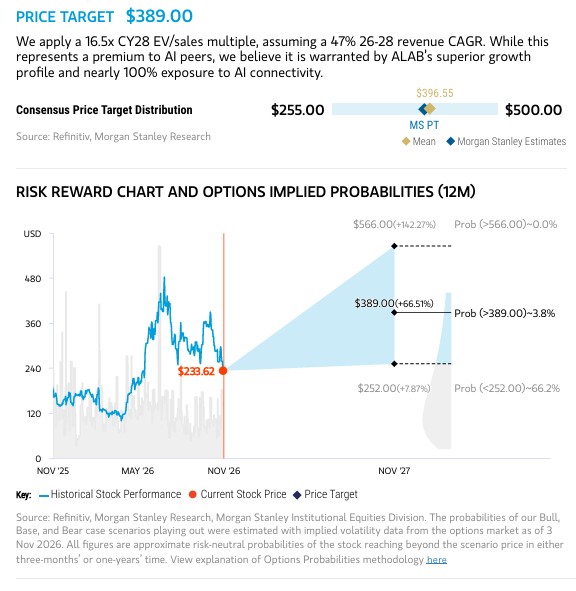
Regarding bull market target prices, Morgan Stanley's most optimistic scenario target price is $566, corresponding to stronger new product volume ramp-ups and maintenance of existing market share; the bearish scenario target price is only $252, corresponding to losses in Aries market share and Scorpio and new business contributions falling short of expectations, using 2028 revenue valuation multiples of 20.6x and 12.4x, respectively. Calculated based on a uniform closing price benchmark, the bull and bear target prices correspond to potential upside spaces of approximately 153.5% and 12.9%, respectively.
Wall Street Post-Earnings: Bullish on Astera Labs' Growth Prospects, but Inclined to Lower the Purchase Price for Growth Amid Heavy AI Financing Cost Pressure
Continuing upward pressure on AI computing infrastructure financing will affect the valuation of the entire AI computing infrastructure supply chain through the cost of capital, deployment pace, and investor-required returns for customer infrastructure projects (especially new cloud players with high leverage and high loads like CoreWeave), ultimately leading to continued contraction of valuation multiples for AI computing and technology-themed stocks. This is why, after the earnings release, the main divergence among Wall Street analysts regarding Astera Labs centers on how much valuation premium they are willing to pay for high growth.
Some analysts remain bullish on the company's growth prospects—specifically the growth space brought by Scorpio volume ramp-up, memory, optical interconnects, and rack-level solutions—but under the heavy pressure of AI financing costs, they place greater emphasis on the speed at which these opportunities convert into profits and cash flows, thus demanding a lower valuation premium to buy into this growth.
Based on the closing price of $223.27 on November 4 and a disclosed static share count of approximately 173.49 million, RBC maintains its "Outperform" rating, lowering its target price from $500 to $400, which still corresponds to a potential gain of 79.2%; Stifel maintains its "Buy" rating, lowering its target price from $460 to $370, corresponding to a potential gain of 65.7%; Jefferies also maintains its "Buy" rating, lowering its target price from $450 to $350, corresponding to a potential gain of 56.8%. Jefferies analyst Blayne Curtis believes that the volume ramp-up of Scorpio X drove the company to deliver another strong quarter, thus maintaining a positive outlook on the company's prospects. These latest adjustments indicate that institutions remain positive about operational growth, but valuation pricing is more restrained.
Northland upgraded its rating from "Market Perform" to "Outperform" and adjusted its target price from $350 to $315, corresponding to a potential gain of 41.1%; the institution believes that Scorpio, which has become the largest product family, will continue to bear the main growth burden in 2027. Evercore ISI maintains its "Outperform" rating, lowering its target price from $452 to $311, corresponding to a potential gain of 39.3% and a market capitalization of approximately $54 billion.
Needham's adjustment particularly explains the divergence between earnings and stock price performance: The institution raised its profit forecasts but lowered its target price from $425 to $300 due to the contraction of valuation multiples in the AI sector, maintaining its "Buy" rating, which corresponds to a potential gain of 34.4%. These adjustments also mean that analysts at these top Wall Street institutions recognize revenue and profit growth but are not willing to continue granting the previously high valuation multiples.
More cautious institutions are focused on how much sustainable profit growth can ultimately be generated. UBS maintains its "Neutral" rating, lowering its target price from $300 to $290, corresponding to a potential gain of 29.9%; although it raised forecasts for 2026–2028, it remains concerned about the impact of AWS's future architecture choices on ALAB's switch chip market share and value per accelerator. Susquehanna maintains its "Neutral" rating, lowering its target price from $310 to $258, corresponding to a potential gain of 15.6%, believing that Orion can expand long-term growth space but needs to convert R&D and operational investments into increased revenue and profits. TD Cowen maintains its "Hold" rating, lowering its target price from $300 to $225, corresponding to a potential gain of approximately 0.8%. These views collectively point to the key pricing factors for the next stage: the mass production entry of new Scorpio customers, the formation of revenue from Leo and optical interconnects, and Orion's expansion of system value and contribution to profits will determine whether earnings revisions can further translate into stock price recovery.