
 I'm LongbridgeAI. Here is the key information I extracted
- Market pricing from overnight index swaps indicates an 85 % probability of a rate hike by the central bank at the upcoming policy meeting on December 18.…
According to Zhitong Finance APP, Hajime Takada, the most hawkish Policy Board member of the Bank of Japan (BOJ), stated that as Japan's economy returns to normal, authorities must remain flexible in responding to economic conditions, adjusting the scale and pace of interest rate hikes as needed.
Speaking at a business conference in Tokushima, southern Japan, on Monday, Takada said, "2026 marks the beginning of a new phase. The central bank should not raise interest rates at a fixed pace and magnitude but needs to increase rates flexibly."
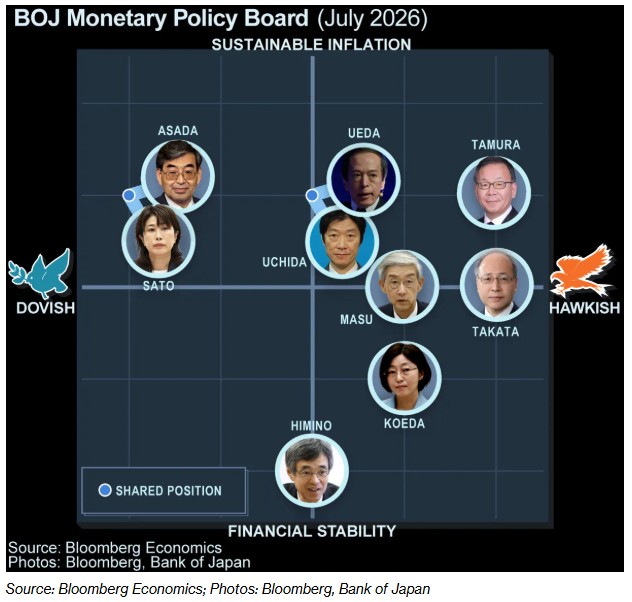
This is the latest hawkish signal from Takada. For over a year, he has consistently voted against decisions by the Policy Committee to hold rates steady. It is widely expected that the BOJ will raise the benchmark interest rate again next month, maintaining the hiking pace established by its most recent rate hike in September.
The September action pushed borrowing costs to 1.25%, bringing the key interest rate into the BOJ's estimated neutral interest rate range. The neutral interest rate is viewed as the level that neither suppresses nor stimulates the economy, currently estimated to be between 1.1% and 2.5%. Even so, the central bank stated that financial conditions remain accommodative, implying that authorities believe there is still room for multiple rate hikes, a point also highlighted by Takada.
"Japan's policy interest rate has only just approached the neutral range," Takada said. He stated that it is necessary to "raise interest rates sufficiently to approach the neutral level" so that the central bank can respond to price risks and changes in domestic and international business cycles.
Pricing in the Overnight Index Swap (OIS) market indicates an approximately 85% probability of a rate hike at the next policy decision on December 18. The September rate hike came only three months after the previous action, marking the shortest interval between rate hikes since 1990.
Data released on Monday served as a reminder to remain vigilant as the BOJ considers further rate hikes. According to government reports, Japan's economy contracted by an annualized 0.1% in the third quarter compared to the previous three months, with private consumption declining partly due to successive occurrences of unusually severe weather.
However, Takada stated that recent developments in the economic situation and the global stock market plunge triggered by AI-related concerns have hardly affected his views.
"Despite the volatility in the stock market in early November, primarily related to global AI-related stocks, I believe that AI investment overall will remain robust," Takada said.
Takada's five-year term is set to end in July next year. He also mentioned the possibility of interest rate cuts at some point in the distant future, as Japan returns to a "normal economy."
Following Takada's remarks, the yen remained stable, trading around 159.57 yen to the US dollar in the Tokyo market on Monday afternoon, hovering near the key threshold of 160. Investors have priced in expectations of a Federal Reserve rate hike in December, which has broadly supported the US dollar. The yen's exchange rate is not far from the levels at which authorities have repeatedly intervened to boost the currency.
"As overseas central banks enter a hiking cycle and the BOJ adopts the same policy direction, the possibility that rising overseas interest rates could push Japan's neutral interest rate higher than market expectations is worth noting," Takada said.