
 I'm LongbridgeAI, I can summarize articles.
Subscription enthusiasm for SINOTAUPHARMA-B (09941, hereinafter referred to as SINOTAUPHARMA) is rapidly heating up during its IPO window. The company is globally offering 6.561 million H shares, with an offer price range of HK$52.00 to HK$68.00 per share. The minimum lot entry fee is approximately HK$3,434.29, and listing is expected on November 24.
As of the evening of the first day of subscription on November 16, brokers had cumulatively lent out approximately HK$2.018 billion in margin financing, corresponding to an oversubscription of more than 45.23 times for the public offering portion. By 10:14 on November 17, the margin amount further rose to HK$4.273 billion, with the margin multiple increasing to approximately 96 times. If subsequent capital continues to pour in, the public offering portion is highly likely to trigger substantial oversubscription, leaving room for further upside in subscription enthusiasm. This intensity of subscription reflects the market's focus on the scarcity of the "first nuclear medicine stock."
Discount Rate Compared to Primary Market Valuation Reaches 39.2%
According to data compiled by Zhitong Finance APP regarding SINOTAUPHARMA's historical financing details, the company's post-money valuation was pushed to approximately RMB 87.86 per share during the final two Pre-IPO sprints (capital increase in January 2025 and share transfer in May 2025), equivalent to a RMB valuation of approximately RMB 5.188 billion. The comprehensive holding cost for the last investors to enter (Wuxi Shangxing and Moutai Jinshi Fund) in the primary market was highly unified at RMB 70.29 per share.
However, it is worth noting that there was a situation of "same shares, different prices" when Moutai Jinshi Fund acquired shares in May 2025. The transfer prices for Qiming Rongxin and Qiming Rongchuang were both RMB 70.29 per share, consistent with the consideration for the initial share transfer in May 2025; whereas the transfer price for Huaqing Bencao was RMB 65.90 per share, a difference of RMB 4.39 per share, or approximately 6.25%. Calculations show that the overall weighted cost for Moutai Jinshi Fund was approximately RMB 69.70 per share.
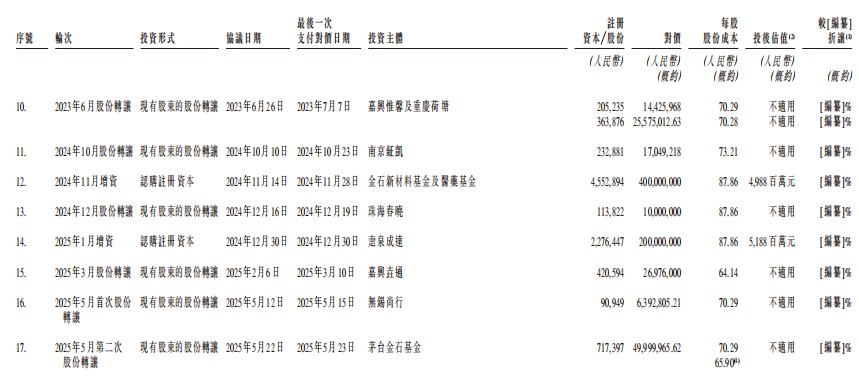
Comparing this with the primary market valuation data of RMB 5.188 billion (approximately HK$5.6 billion), the valuation inversion phenomenon is obvious. Even if the company prices at the lower limit of HK$52.00, the discount rate compared to the primary market valuation is as high as 39.2%. Pricing at the upper limit of HK$68 still results in a discount rate of 20.7% compared to the primary market valuation. Even if issued at the highest price, Wuxi Shangxing, which entered in the last round, still faces a paper floating loss of approximately 11.2%, and the state-owned capital (Moutai Jinshi) also has a floating loss of 9.67%.
In addition to pricing, whether SINOTAUPHARMA can be included in the Stock Connect after listing has become the most concerning issue for the market. Public information shows that SINOTAUPHARMA-B's global offering consists of only 6.561 million shares. Based on median estimates, the net funds raised are approximately HK$329 million, with a total market capitalization after issuance of approximately HK$3.4 billion to HK$4.5 billion, and an H-share market capitalization of approximately HK$2.1 billion to HK$2.8 billion. Due to the absence of cornerstone investors, a greenshoe option of only 15%, and a low proportion of public offering, the chip base is thin in the early stages of listing. Furthermore, with valuation inversion among Pre-IPO existing shareholders, natural entry into the Hong Kong Stock Connect is difficult in the short term. If main forces wish to promote inclusion in the Stock Connect, they must naturally find ways to lift the market capitalization tier. In particular, they need to maintain trading activity around events such as the approval of TR008, BD milestones, and commercial volume ramp-up.
Explosive Growth in Self-Generated Revenue
The prospectus shows that SINOTAUPHARMA has deeply cultivated the nuclear medicine field, building a pipeline of 13 items covering three major areas: oncology, neurodegenerative diseases, and cardiovascular diseases. Its core products include: XTR008, a treatment drug for neuroendocrine tumors currently in the NDA stage, expected to be approved in December 2026; as well as PET myocardial perfusion imaging diagnostic drug XTR004, myocardial fatty acid metabolism imaging agent XTR003, and AD diagnostic drug XTR006.
From the revenue perspective, the company's core diagnostic products are in a stage of accelerated volume release. Revenue reached RMB 44.064 million in 2024, growing significantly by 125% year-on-year to RMB 99.21 million in 2025, and further recording RMB 61.254 million in the first half of 2026 (a year-on-year increase of 66%), demonstrating strong commercial self-generation capability. Net losses for the same periods were RMB 156 million, RMB 618 million, and RMB 534 million, respectively. The expansion of losses needs to be analyzed in detail: of the RMB 534 million loss in the first half of 2026, approximately RMB 310 million came from changes in the fair value of equity share redemption liabilities, which is a non-cash accounting treatment. After listing, this liability will be transferred to equity and will no longer affect the income statement. Excluding this factor, operational losses mainly stem from upfront R&D investments (R&D expenses of RMB 157 million in the first half) and sales team construction.
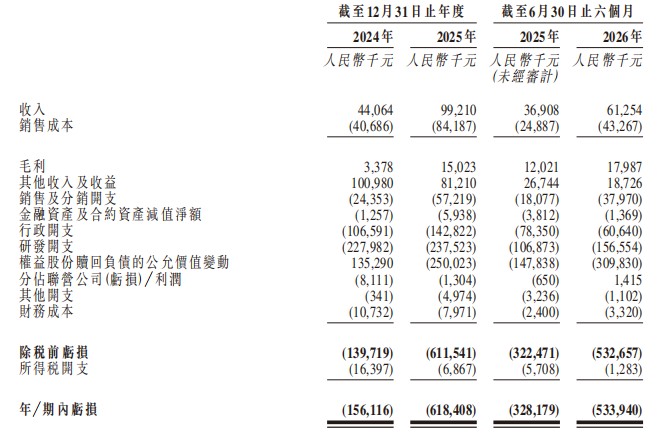
In terms of core business composition, CRO/CDMO services have long served as the cornerstone of the company's cash flow. In 2024 and 2025, revenue from this segment accounted for 61.6% and 43.2% of total revenue, respectively, providing stable financial support for early company operations and pipeline R&D. Meanwhile, the high-margin goods sales business achieved a leapfrog structural explosion, with goods sales revenue soaring from RMB 3.742 million in 2024 to RMB 38.009 million in 2025 (an increase of over 9 times), and further climbing to RMB 39.825 million in the first half of 2026. It has completely replaced CRO/CDMO services as the core engine driving the company's total revenue growth.
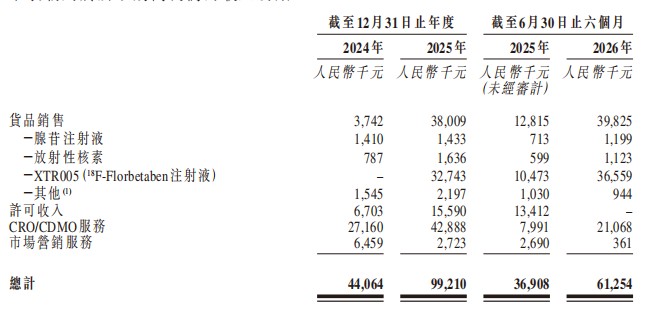
In the diagnostic product matrix, the core blockbuster product XTR005 (19F-Florbetaben Injection) demonstrates strong commercial momentum. As a breakthrough product in the field of Alzheimer's disease (AD) diagnosis, its sales reached RMB 32.743 million in 2025 and rapidly climbed to RMB 36.559 million in the first half of 2026, contributing more than 90% of the goods sales revenue in the same period, officially entering the stage of scaled volume release. In addition, traditional radionuclides such as Adenosine Injection have maintained steady annual growth of over 10%, forming a stable foundation for the basic business. In contrast, licensing revenue shows significant volatility. After recording RMB 15.59 million in 2025, there were no new entries in the first half of 2026, indicating that the company is switching from a passive income model reliant on BD milestone payments to an active self-generation model centered on terminal drug sales.
It is worth noting that with the comprehensive acceleration of the commercialization process, the company's marketing strategy and resource allocation are undergoing marginal changes. Marketing service and distribution expenses increased significantly to RMB 57.219 million in 2025, but marketing service revenue sharply decreased to RMB 2.723 million during the same period. This scissors difference reveals a comprehensive shift in the company's current strategic focus, moving from exporting marketing services externally to concentrating internal resources and funds to fully build an independent sales network, in order to cope with the impending commercial volume release and terminal coverage of core products like XTR005 and subsequent pipelines (such as XTR008).
XTR008, the First Domestic Generic SSTR-Targeted Nuclear Drug, Catalyzes Revaluation of Integrated Diagnosis and Therapy
SINOTAUPHARMA's core pipeline is presenting a strategic depth of "dual-wheel drive for diagnosis and therapy." The diagnostic end has already validated commercialization, while the therapeutic end's core product, XTR008, possesses significant investment elasticity in terms of advantages and market space.
The core advantages of XTR008 lie in the triple overlay of clinical progress, efficacy data, and indication expansion. Firstly, as a generic of Lutathera, XTR008 is the first candidate product in its class to submit an NDA as a Class 3 chemical drug. The NDA has been accepted by the National Medical Products Administration, and approval is expected in December 2026, potentially making it China's first SSTR-targeted therapeutic radioligand. Secondly, Phase III data shows that the median PFS in the XTR008 treatment group was not reached, compared to 5.8 months in the control group; the ORR reached 43.4%, significantly superior to the 1.0% in the control group. Thirdly, the company has not stopped at being the first generic but is further expanding into new indications such as G3 GEP-NET, PPGL, and meningioma. The Phase III trial for new indications started in June 2026, and the Phase II clinical trial for meningioma is planned to start in March 2027, forming a dual growth curve of "first generic volume release + new indication extension."
After establishing core barriers, the market space for XTR008 is quite optimistic. Overseas markets have verified that SSTR-targeted radioligands have the potential to be blockbuster products. Novartis's Lutathera achieved global sales of USD 816 million in 2025, a year-on-year increase of 13%. Previously, no similar therapeutic radioligands were approved in China in this field, with penetration rates close to zero in 2025. However, the patient base for late-stage SSTR-positive G1/G2 GEP-NET in China is expected to increase from 18,400 cases in 2025 to 22,100 cases in 2036, with the penetration rate expected to rise to approximately 40% by 2036. Frost & Sullivan predicts that the global market for SSTR-targeted therapeutic radioligands will reach USD 4.3 billion by 2036, with the relevant market size in China expected to reach USD 800 million.
Looking further ahead, the core significance of XTR008 lies in promoting the revaluation of the company from a "diagnostic nuclear medicine enterprise" to an "integrated diagnosis and therapy platform." The diagnostic end has already validated commercial capabilities. Once the therapeutic end is approved, it will significantly raise the value per patient and the revenue ceiling. Considering that the company has laid out three production bases and 21 commercial production lines in Wuxi, Zhongshan, and Mianyang, possessing end-to-end capabilities in nuclide production, formulation preparation, and distribution, the volume release of XTR008 is expected to convert into revenue relatively quickly. The speed of commercial realization of XTR008 will be the key anchor for the market to grant a valuation premium.
In summary, the subscription intensity of SINOTAUPHARMA, with margin oversubscription exceeding 96 times, reflects capital's rush for the scarcity of the "first nuclear medicine stock." However, the high discount of 39.2% in the primary market, the paper floating losses of old shareholders, and the uncertainty of Stock Connect inclusion due to the lack of cornerstone investors and thin chip base collectively constitute the valuation game in the early stages of listing.