
 I'm LongbridgeAI. Here is the key information I extracted
- Alphabet's success is driven by its proprietary TPU chips and Gemini models, while Apple benefits from lower AI capital expenditures via external partnerships.…
Cailianshe, November 18 (Editor Xiaoxiang) The latest market comparisons show that as investors become increasingly stringent in their stock selection criteria for the technology sector, most of the US stock market's "Magnificent Seven" stocks have struggled to outperform the broad market since the beginning of last year.
Among these mega-cap technology leaders, Google's parent company Alphabet and Apple are currently the only two companies whose percentage gains have surpassed the S&P 500 Index. Analysts attribute this to the differentiated strategic paths these two companies have taken in advancing AI integration.
As shown in the figure below, from the beginning of 2025 to Monday's close, Alphabet's percentage gain reached 50.8%, and Apple's was 42%. Meanwhile, the other members of the "Magnificent Seven" group—Amazon, Meta, Microsoft, NVIDIA, and Tesla—all underperformed the S&P 500 Index, which rose by 29% over the same period.
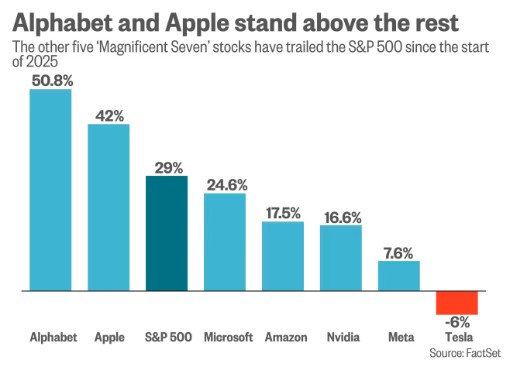
Charlie Bilello, Chief Market Strategist at wealth planning firm Creative Planning, highlighted this market divergence in a post on social media platform X this week.
William Kerwin, an analyst at Morningstar, stated that the market is currently "selecting winners in the AI race."
Google has regained investor favor, partly due to its self-developed Tensor Processing Units (TPUs)—which Kerwin believes are competitive enough to rival NVIDIA's products. Furthermore, he pointed out that Google's cutting-edge large language model, Gemini, can also compete with the top models from OpenAI and Anthropic.
Meanwhile, although Apple has not developed its own foundational large language models, it has explored implementing AI as a "tool to enhance end-user experience." Kerwin noted that by extensively building external partnerships, Apple's capital expenditure on AI research and development is significantly lower than that of its peers.
On the other side of the scale, Kerwin pointed out that Microsoft, Amazon, and Meta are being "penalized by the market" for their massive capital expenditures on AI infrastructure.
Ben Carew, Co-Chief Investment Officer at Tandem Investment Advisors, also stated that Apple made a "wise decision not to play the same game as the other companies in the 'Magnificent Seven'." He noted that the other companies in the group are investing "huge" amounts in the artificial intelligence race, which may be viewed as offering "lower returns."
Craig Moffett, an analyst at MoffettNathanson, said that Apple's appeal lies "precisely in its lack of association with the broader AI investment boom." He said that when investors worry about whether major competitors can generate returns from infrastructure spending, they "retreat to Apple, viewing it as a 'safe' alternative."
Of course, Apple is not without its own concerns. Moffett believes that Apple's iPhone 18 cycle is "pale in comparison" to last year's iPhone 17 cycle. He also stated that there is a risk that AI agents could "bypass Apple" and weaken the company's control over its systems.
And as the best-performing stock among the Magnificent Seven since the beginning of 2025, Alphabet has benefited from a "sharp reversal" in investor sentiment. Carew pointed out that thanks to the rise of its TPU business, Alphabet has successfully repositioned itself as a "strong contender in the AI field," a business that "is seen in the industry as substantially eroding NVIDIA's dominance and share in the chip market."
Nevertheless, the recent stock performance of Apple and Alphabet is also showing a diverging trend.
Apple's stock price has fallen less than 2% from its closing high recorded last week, while Alphabet's stock price has dropped about 30% from its closing peak hit in May.