
 I'm LongbridgeAI. Here is the key information I extracted
- The company leverages its proprietary IsoDDE engine to pursue an end-to-end generative drug discovery route based on large models and intelligent agents.…
Shanghai STAR Market Daily, November 18 (Editor: Song Ziqiao) On November 17 local time, Isomorphic Labs, the AI-driven drug research and development enterprise under Google's parent company Alphabet, officially announced the completion of a $5 billion (approximately RMB 33.3 billion) Series C financing round. The round was oversubscribed, setting a new global record for the largest single financing amount in the AI drug development industry.
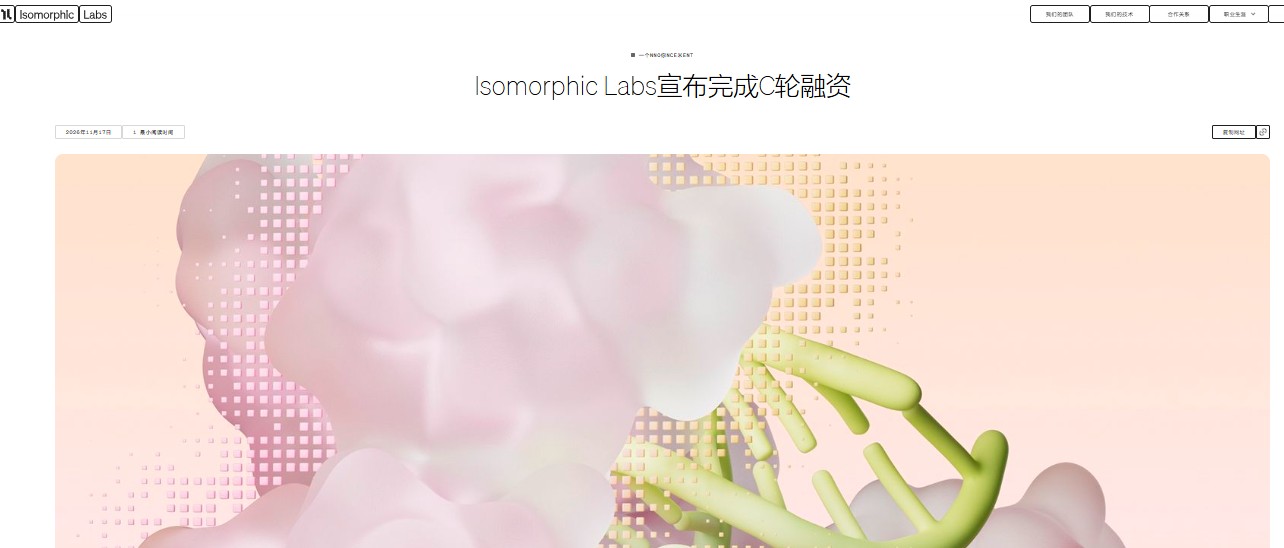
This round was co-led by Greenoaks and Sequoia Capital, with Andreessen Horowitz (a16z) participating as a new investor. Alphabet continued to make significant additional investments, while all existing shareholders, including Thrive Capital, MGX, GV, Capital G, Temasek, and the UK Sovereign AI Fund, continued their follow-on investments.
Notably, despite having reached major new drug R&D collaborations with multinational pharmaceutical companies such as Eli Lilly, Novartis, and Johnson & Johnson, Isomorphic Labs currently has no candidate drugs entering clinical trials.
Why is a pharmaceutical company without any clinically validated drugs favored by numerous star investors?
Spun out from Google DeepMind, Isomorphic Labs was founded in February 2021. Headquartered in London with offices in Cambridge and Lausanne, it operates as an independent AI new drug R&D entity within the Alphabet ecosystem. It is led by CEO Demis Hassabis, co-founder of Google DeepMind. Hassabis was awarded the 2024 Nobel Prize in Chemistry for his research on protein structure prediction using the AI model AlphaFold2.
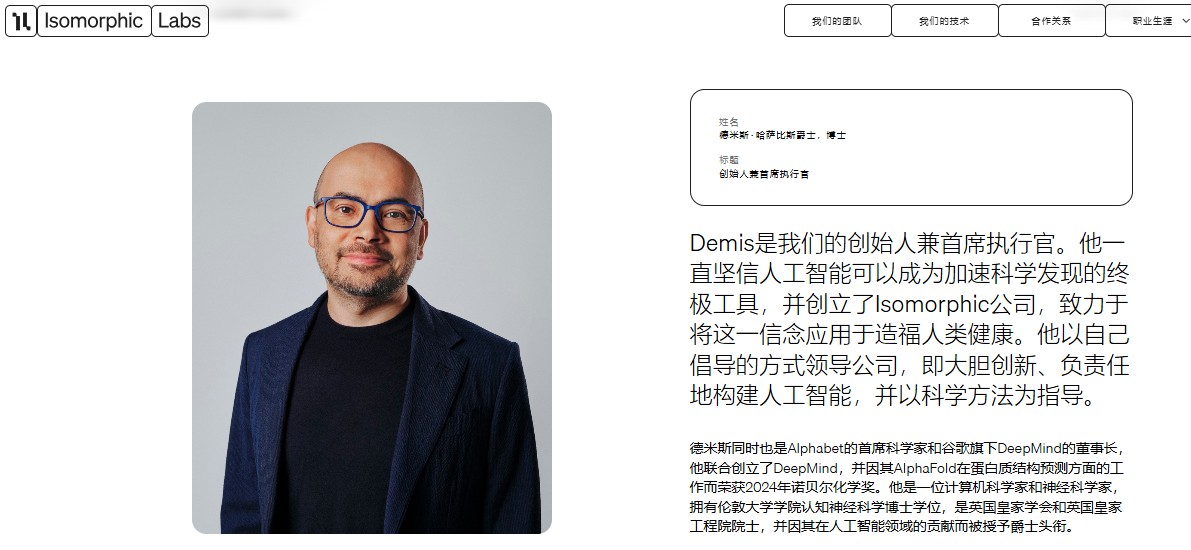
Demis Hassabis
The company's President, Max Jaderberg, also comes from DeepMind. The core executive team brings together talent in AI fundamental research, computational biology, medicinal chemistry, and clinical development commercialization. This includes senior pharmaceutical R&D leaders such as Chief Scientific Officer Miles Congreve and Chief Medical Officer Ben Wolf. The team is composed of machine learning scientists, structural biologists, medicinal chemists, and translational medicine experts.
Additionally, its Scientific Advisory Board includes multiple Nobel laureates, such as CRISPR gene-editing pioneer Jennifer Doudna, chemist David MacMillan, as well as Paul Nurse and Venki Ramakrishnan.
Isomorphic Labs' technological foundation stems from the breakthrough in AlphaFold's protein structure prediction, but it did not stop at protein structure analysis. It developed its own AI drug design engine, IsoDDE, adopting an end-to-end generative drug R&D route of "large models + intelligent agents."
Unlike most AI drug companies that only use AI for single-point auxiliary tasks such as target screening and molecular docking, IsoDDE integrates multiple AI models. It can operate natively across various therapeutic areas and drug modalities, attempting to precisely simulate biological behavior at the molecular level.
This means the platform can leverage AI agents to autonomously explore vast chemical spaces, simultaneously evaluating druggability, selectivity, and toxicity risks. It covers various drug modalities, including small molecules and antibodies, spanning multiple therapeutic areas such as oncology and immunology, thereby designing molecules with ideal druggable properties.
Hassabis previously stated his goal of using AI to shorten the new drug development cycle from years to months.
In the latest financing announcement, he stated that based on IsoDDE, the R&D team achieves reproducible scientific progress every week. These advances directly translate into improved molecular characteristics, potentially becoming new drugs and solving some of the most thorny problems in drug development.
Looking back at the company's financing history, Isomorphic Labs completed its first external financing round in March 2025, raising $600 million. The round was led by Thrive Capital, with participation from Alphabet and GV. In May 2026, the company closed a $2.1 billion Series B financing round, which also set a new high for single-round financing in the AI drug sector at the time. New investors included sovereign capital and global renowned growth funds such as Temasek, MGX, and the UK Sovereign AI Fund, further expanding its investor lineup.
The $5 billion raised in this round will be primarily invested in iterating the IsoDDE model, exploring new biological mechanisms, advancing internal proprietary pipelines, and building a partner ecosystem. Meanwhile, Isomorphic Labs is constructing the global infrastructure needed to support the future of AI-driven bioengineering, aiming to push its drug candidates into clinical trials.
From an industry perspective, tech giants including Google, Microsoft, OpenAI, and Anthropic have all entered the life sciences field. Major pharmaceutical companies like Eli Lilly are choosing to collaborate with AI drug development companies. AI biotech firms such as Fauna Bio, Blank Bio, and Twist Bio are continuously making new progress.
China Merchants Securities pointed out that AI drug development has entered the clinical validation stage, with initial signs of commercialization opportunities emerging. As the demand for training vertical AI models grows rapidly, it is driving increased prosperity in the upstream life sciences industry.
The firm further stated that the "iron triangle" of "computing power - models - wet lab data" outlines the full landscape of the AI drug development industry chain. Computing power forms the foundation of AI drug R&D, vertical models constitute the technical core, and wet lab data, as the bottleneck step, has become the current core of competition. Upstream segments such as life science tools, protein expression, high-throughput validation, and preclinical CROs are expected to realize their logic and performance first.
Huaxin Securities stated that while most companies currently laying out AI for Science (AI4S) are overseas large model manufacturers, enterprises with complete capabilities from gene to protein (Gene-to-Protein) in the verification service industry chain are mainly concentrated in China. Moreover, leading companies are actively responding by expanding supporting production capacity to undertake more overseas orders. It is expected that AI will accelerate new drug development, driving an increase in demand for wet lab verification, with orders increasing quarter by quarter.