
 I'm LongbridgeAI. Here is the key information I extracted
- Stablecoins and blockchain networks provide essential programmable settlement options for high-frequency, small-amount machine-to-machine (M2M) transactions like API calls and computing power leasing.…
Re-examining the relationship between traditional payment networks, stablecoins, and the Agentic Economy.
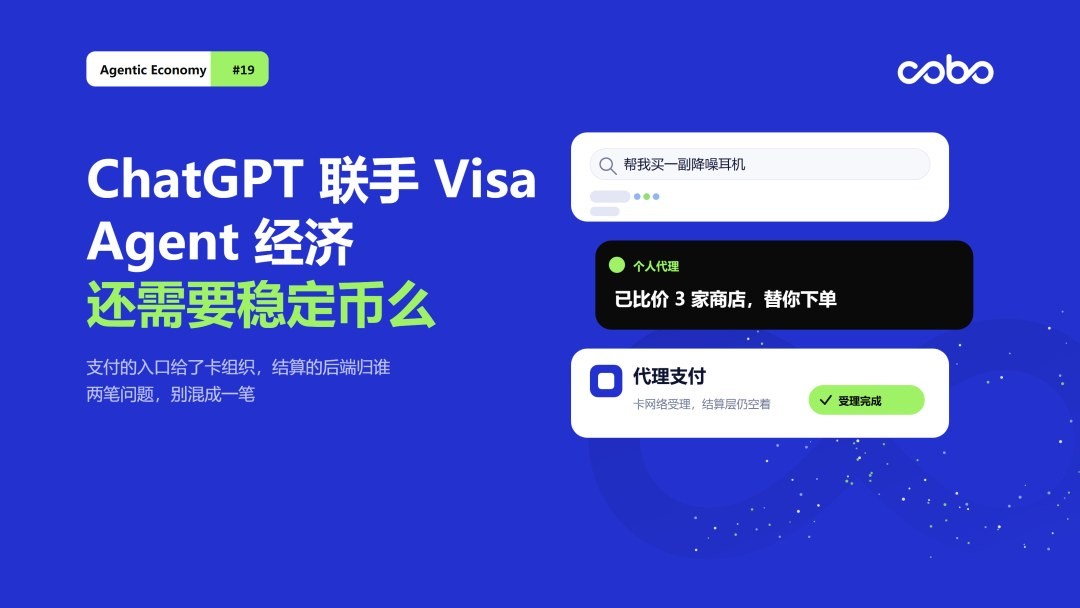
The narrative of the integration of AI Agents and Web3 is sparking a debate.
On November 13th, OpenAI announced the launch of ChatGPT Wallet and partnered with American Express, Mastercard, and Visa to enable agents to complete purchases and payments on behalf of users.
On November 13th, OpenAI announced the launch of ChatGPT Wallet and partnered with American Express, Mastercard, and Visa to enable agents to complete purchases and payments on behalf of users.
Previously, AI agents were considered the most promising emerging use case for stablecoins. However, OpenAI chose to integrate with traditional bank card networks as its first step in implementation, leading many to question, "If even ChatGPT is integrated with Visa and similar services, do agents really still need stablecoins?" This questioning is not without merit, but it actually confuses two different concepts: "Agentic Commerce under human authorization" and "Agentic Economy of machine autonomous collaboration." For current agent applications primarily focused on shopping, booking, and daily consumption, funds still originate from human users' bank accounts. Transactions heavily rely on the mature merchant networks, identity verification, and consumer protection mechanisms of the bank card system. Traditional payment networks clearly possess a more mature commercial infrastructure. However, the boundaries of the Agentic Economy extend far beyond this. When AI begins to autonomously purchase data, call APIs, lease computing power, and even engage in continuous value exchange with other agents, payment needs may no longer be limited to traditional consumption scenarios. Therefore, the key question is that the Agentic Economy is not equivalent to Agentic Commerce, especially when AI transforms from a human consumption assistant into a participant in economic activities. What kind of payment and financial infrastructure is truly needed? I. Why Traditional Finance as the First Stop for Agent Payments? To understand why OpenAI chose Visa and Mastercard, it's essential to clarify two often confused concepts: Agentic Commerce and Agentic Economy. The former primarily refers to AI replacing humans in consumer behaviors such as product discovery, price comparison, ordering, and payment; the latter is a broader concept, meaning that AI agents can not only execute tasks assigned by humans but may also operate independently of individual human instructions, engaging in continuous transactions with other agents, businesses, and service providers. From the current implementation progress, Agentic Commerce is clearly leading the way, while traditional card organizations still hold an unshakeable advantage in this field. Taking ChatGPT Wallet's design as an example, it is actually quite restrained and pragmatic. Users pre-link eligible bank cards. When the agent finds the target product and is ready to pay, the user views the product, total price, and selected bank card, and confirms the transaction through security verification such as Face ID or fingerprint. Subsequently, the payment network will provide a set of payment tokens to replace real bank card information to complete the transaction. Merchants and agents do not need to directly access real bank card information, and users can continue to enjoy their original bank card rewards and eligible transaction dispute protections. The biggest advantage of this design is that it does not require users to change their existing payment habits, nor does it require merchants to build a new payment system. After all, for AI products targeting mass consumers, directly reusing Visa and Mastercard's global merchant acceptance network, acquiring system, and anti-fraud risk control is far more realistic than educating ordinary users to "buy stablecoins first, then create an on-chain wallet, and finally manage gas fees." More importantly, traditional payment systems not only handle fund transfers but also provide a complete commercial dispute resolution mechanism—when goods have quality issues, consumers can file a chargeback appeal, and merchants can continue using existing refund and customer service processes. This is a capability that on-chain payments currently lack in the global retail sector. However, there is a detail that is easily overlooked: ChatGPT Wallet has not yet achieved completely unattended autonomous payments; users still need to manually check and verify each transaction beforehand. According to OpenAI's initial design, users still need to confirm the goods, total price, and bank card before each purchase and complete authorization through biometrics. Future plans include further opening up pre-authorization capabilities, allowing users to pre-set spending limits, purchase categories, and validity periods, enabling agents to complete transactions autonomously within a defined scope. This precisely illustrates that consumer-grade agents are still in an early stage of "human-led, AI-assisted" development. AI merely assists humans in purchasing goods; therefore, the existing bank card system can already solve most problems. However, if an agent needs to call APIs thousands of times daily, purchase real-time data, lease GPU computing power, and pay service fees to other agents, then it faces no longer a simple shopping problem. II. Penetrating the Agentic Economy: Where are the Opportunities for Stablecoins and New Protocols? When AI Agents evolve from "assistants that help people buy things" to "economic entities that autonomously conduct business," the transaction structure will undergo a qualitative change. Imagine a company deploying an AI research agent. To complete a deep analysis task, it might need to perform a series of actions in parallel within minutes: purchasing real-time market data from a data service provider, leasing GPU computing power from a cloud computing platform, calling third-party AI models to complete the analysis, purchasing professional data processing services from other agents, and finally delivering the results. Throughout the process, the Agent needs to establish payment relationships with multiple different service providers. Compared to traditional consumer payments, this type of transaction exhibits several distinct characteristics: **Fineer Transaction Granularity:** In the past, enterprises typically purchased APIs, data, and computing resources using subscription, pre-paid, or package models. However, when the Agent can dynamically invoke different services based on task requirements, pay-per-use and pay-per-call billing become more natural; **Higher Transaction Frequency:** An Agent can run continuously for hours, or even remain online for extended periods, transacting with multiple service providers. It cannot wait for manual payment information to be entered by humans every time a service is invoked; The transaction relationships are becoming more open: different agents may operate on different companies, in different countries, and on different technology platforms, without traditional account relationships, and may not share the same bank or payment service provider; Cobo's Head of Sales and Solutions, Lucas, previously shared a sampling study of the Base and Solana networks at the 4th Cross-Border Digital Finance Compliance Conference: in a sample covering 35 days and over 6 million transactions, over 90% of AI-related payments were only a few cents, or even less than 1 cent (further reading "When AI Agents Begin Autonomous Payments: Cobo Lucas Talks about Stablecoin Payments and Security Infrastructure"). This data reflects that some early machine payments have already shown a clear characteristic of small amounts. Similar practices are emerging: weather query APIs charging less than 1 cent per use have appeared on the Solana network, along with token security screening services charging a few cents per use; on the internet content side, infrastructure giants like Cloudflare are also promoting pay-per-use mechanisms based on the x402 protocol, allowing AI crawlers to settle accounts with content providers in real time for each webpage crawled. Traditional bank cards are not incapable of handling small transactions, but when payments shift from occasional consumption to high-frequency, automated API calls, the costs associated with authorization, payment processing, and settlement for each transaction can become a bottleneck to business efficiency. In other words, only blockchain networks and stablecoins can make this high-concurrency, extremely small-amount machine-to-machine (M2M) settlement economically viable. In addition, stablecoins also offer a more programmable settlement method suitable for the Agentic Economy. In this model, payments can be directly embedded into the Agent's automated task flow via smart contracts and APIs. Agents can hold stablecoins in their wallets and, upon authorization, make payments to designated addresses. They can also interact with smart contracts to complete more complex fund management operations, without relying on traditional bank card accounts and merchant acquiring processes for every machine-to-machine transaction. For example, in computing power or API scenarios where fees are charged per second, stablecoins support 24/7 circulation. Enterprises can also combine them with payment flow protocols (such as Superfluid) to achieve continuous settlement on a per-transaction, timed, or per-second basis, without having to wait until the end of the month for unified reconciliation. Of course, this doesn't mean that stablecoins are cheaper or more efficient than bank cards in all scenarios. On-chain transactions still involve issues such as network fees, liquidity, fiat currency deposits and withdrawals, compliance screening, and merchant acceptance. What's truly important is that stablecoins provide an internet-native, programmable way to transfer value, enabling payments to integrate more naturally into automated machine collaboration. Overall, the industry has recently developed several clear protocol routes surrounding machine-based autonomous payments, and even traditional card organizations are actively embracing this dual-track approach. These include Coinbase's x402, Stripe and Tempo's Machine Payments Protocol (MPP), and Google's AP2. While their focuses differ, they all attempt to solve a common problem: how to enable agents to initiate and complete payments autonomously, much like calling an API. Several noteworthy developments have occurred this year: On March 18, Visa released dedicated payment specifications and an SDK, enabling agents to use tokenized bank card credentials in machine payment processes, signifying that traditional card payments are also beginning to adapt to API calls and inter-machine transactions; On June 3, Mastercard announced the addition of the option to use regulated stablecoins for on-chain settlement in its existing global payment network, involving assets such as USDC, PYUSD, USDG, USDP, and RLUSD, as well as multiple networks including Ethereum, Solana, and Base; On October 10th, Visa launched its AI-powered business infrastructure, including Agent Score and Agentic Directory, at the Payments Forum, while also expanding its stablecoin settlement pilot program. On October 15th, Visa Direct and Mastercard both advanced the commercialization of stablecoins—Visa moved its USDC pre-deposit capability from pilot to commercial deployment for cross-border payments; Mastercard, along with its acquired stablecoin infrastructure company BVNK, launched the Global Money Platform, integrating fiat and stablecoin accounts through a single API, enabling real-time exchange, stablecoin-linked bank card transactions, and local bank withdrawals. From October 19th to 20th, Mastercard further penetrated stablecoin risk control and automated payments, launching Stablecoin Security, which combines payment data with blockchain analytics to provide financial institutions with pre-transaction risk identification, and showcasing Agent Pay for... Machines, based on x402, allows agents to purchase digital services and uses digitally signed payment credentials to achieve authorization, execution, and settlement. These actions demonstrate that traditional payment networks and blockchain are not simply in competition. Visa, at the 2026 Payments Forum, summarized this trend with the statement: "AI is changing the front end of commercial transactions, while stablecoins are reshaping the back end of fund flows." The future of the Agentic Economy may not be about one payment method replacing another, but rather the gradual integration of different payment tools, protocols, and settlement networks.
III. Stablecoins are not the only option, but programmable trust infrastructure is a must
Returning to the initial debate: Do agents still need stablecoins?
The answer is actually very clear: stablecoins are not the "only" way for agents to make payments, but when transactions become open, high-frequency, and cross-entity collaborative, they provide a programmable settlement option suitable for the agentic economy.
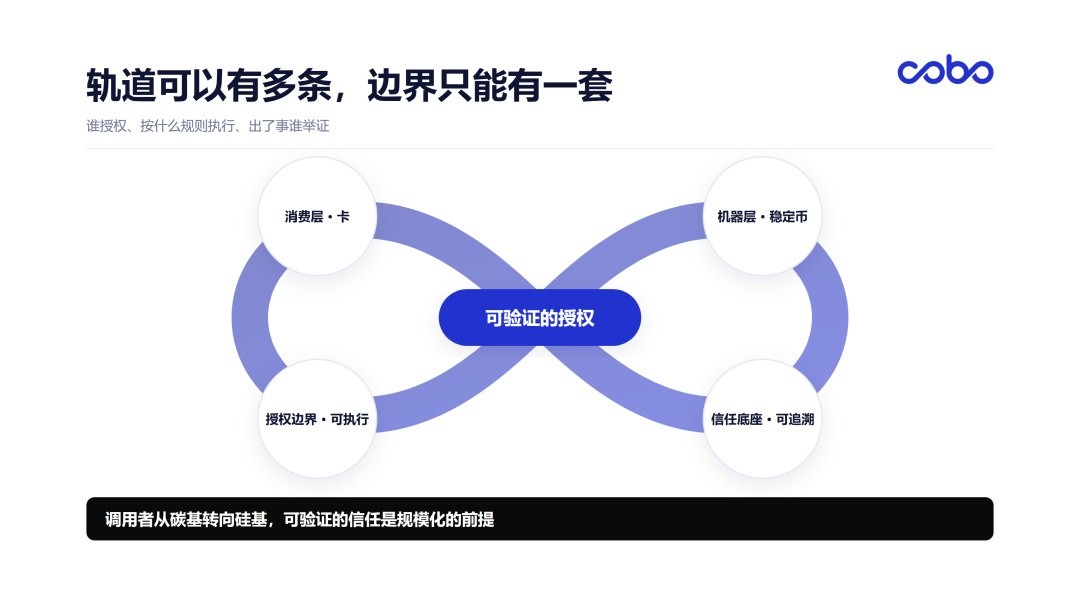
A more fundamental question than payment methods is: when AI gains the ability to use funds, who ensures it doesn't exceed its authorized scope? This may be more important than choosing a payment method. Ordinary consumers using bank cards only need to manage their own accounts and spending habits, but future businesses may deploy multiple agents simultaneously, each responsible for procurement, transactions, fund allocation, supplier payments, and risk management. If each agent has unrestricted wallet access, the enterprise is effectively distributing control of funds among multiple automated programs. More complexly, even if the server isn't compromised and the private key itself isn't leaked, an agent influenced by misinformation or malicious instructions could still initiate payments beyond the user's true intent within a legitimate transaction process. Therefore, the core of Agentic Wallet isn't simply assigning a wallet or bank card to AI, but rather separating the AI's autonomous execution capabilities from the enterprise's control over funds. Taking Cobo Agentic Wallet as an example, to allow multiple agents to autonomously use funds within controllable boundaries, a layered mechanism from key management to transaction authorization needs to be established. First, there's MPC (Multi-Party Computation), which separates signing authority to avoid single points of control. Cobo Agentic Wallet further designs two signing participation mechanisms: Agent + Cobo handles automated transactions within the authorized scope, while Human + Cobo handles high-value approval and governance operations. No single participant can independently complete a signature. Second, there's Pact, which defines the boundaries of Agent action through task contracts. Cobo's Pact authorization framework transforms each task into an executable authorization protocol for the underlying infrastructure, primarily comprising four elements: operational intent (what goal the agent is authorized to achieve), execution plan (the steps the agent intends to take to complete the task), policy constraints (allowed budget, transaction objects, chains, tokens, contracts, and approval rules), and completion conditions (automatic termination of authorization upon task completion, budget exhaustion, or expiration of the valid time). The agent first generates a Pact draft based on user instructions, which is then reviewed and approved by the user. After the task is initiated, each transaction is verified according to the rules in the Pact; only operations fully complying with the authorized scope will trigger the Cobo collaborative signature node to release them. This fundamentally changes the traditional approach of AI security relying on natural language instructions. In the past, we were accustomed to telling AI what it could and couldn't do through prompts, but large models' understanding of natural language always had uncertainties. By implementing permission constraints at the wallet and signature infrastructure level, security rules are no longer just "suggestions that AI should follow," but become hard prerequisites for transactions to execute. Finally, in addition to key management and permission constraints, agents also need reliable execution paths. Cobo encapsulates common on-chain tasks into predefined execution templates through Recipes, covering contract interactions, parameter restrictions, and operational processes—for example, an agent can use the corresponding Recipe to complete Uniswap transactions, Aave deposits, Superfluid continuous payments, and call paid APIs that support x402. If MPC addresses who can sign, and Pact addresses what the Agent can do, then Recipe addresses how the Agent should reliably complete its tasks. These three aspects correspond to key security, access control, and execution reliability, respectively, collectively forming the basic security framework for Agents using funds. Of course, from Agent wallets to enterprise payments, a complete financial operations system is also required. Lucas has also proposed a practical approach for enterprise integration: enterprises can choose stablecoin payment infrastructure from two dimensions. One dimension is the asset management method, namely third-party custody or self-custody; the other dimension is the system access method, namely standardized payment page, or embedding into existing business systems via API or SDK. These two options can be flexibly combined according to the company's business needs, technical capabilities, and compliance requirements. This modular approach means that traditional payment institutions do not have to choose between completely relying on third-party service providers and building their own on-chain system from scratch. Instead, they can retain their existing payment systems and key business processes while simultaneously accessing the necessary on-chain asset management and payment capabilities. From this perspective, the financial infrastructure needed by the Agentic Economy is no longer just a wallet or payment channel, but a system comprised of key management, access control, payment protocols, fund settlement, compliance screening, and financial operations. In conclusion, the emergence of ChatGPT Wallet is actually a signal that the Agentic Economy is beginning to enter the real-world business system. In the consumer market, bank cards and established card organizations still possess irreplaceable advantages in terms of experience and trust. However, for API calls, data purchases, computing power leasing, and machine-to-machine transactions, stablecoins and other programmable payment methods offer new possibilities. Future agents will not be limited to a single payment tool; they may complete transactions via bank cards, purchase on-chain services using stablecoins, and complete corporate settlements based on bank accounts. Therefore, stablecoins may not necessarily replace Visa, and Visa and similar entities may not monopolize everything. However, as long as agents begin to participate in economic activities, the programmability provided by blockchain will become an optimal settlement option outside of Visa's existing system. However, regardless of the channel through which funds flow, when the users of assets shift from "carbon-based humans" to "silicon-based intelligent agents" on a large scale, verifiable identity authorization, programmable risk control boundaries, and a traceable foundation of trust will always be prerequisites for the Agentic Economy to achieve large-scale development. About Cobo Founded in 2017 and headquartered in Singapore, Cobo builds trustworthy wallets and payment infrastructure for humans and AI agents, with licensed entities in Hong Kong, Canada, and the United States. Cobo has passed SOC 2 Type II (Big Four audits) and ISO 27001 certifications, has had zero security incidents since 2017, and has protected billions of dollars in customer assets.