
 I'm LongbridgeAI. Here is the key information I extracted
- The new model reduces single-task costs by about 17% and shortens completion time by 40% compared to the previous Carbon generation.…
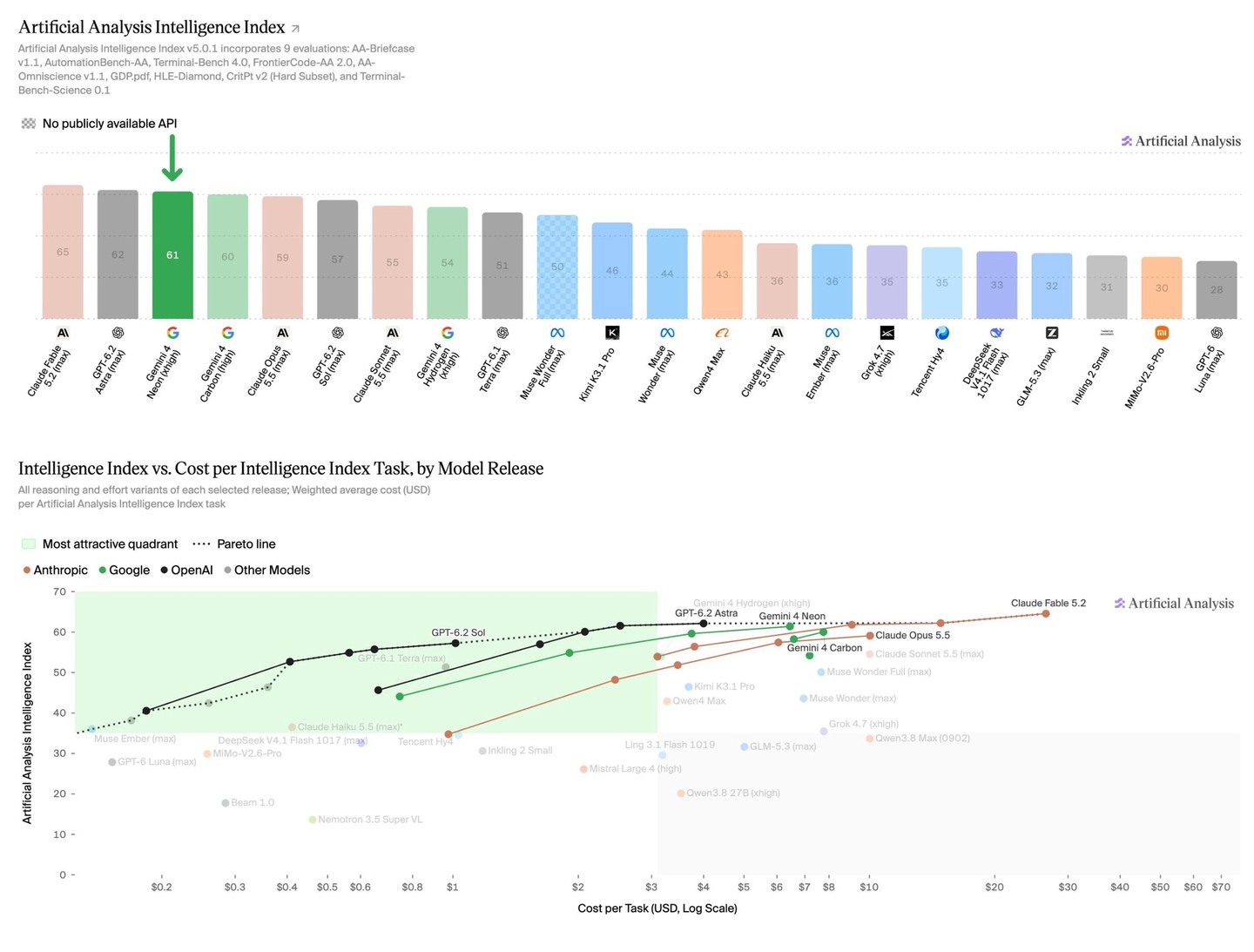
Google officially released the new Gemini 4 series model, Neon, on Wednesday. Evaluations by the independent assessment firm Artificial Analysis show that Neon scored 61 on the Intelligence Index, ranking third globally. The cost per single task decreased by approximately 17% compared to the previous generation, Carbon, while completion time was reduced by about 40%.
On the same day, Google also launched Stitch Loop, a long-running product agent, made the Gemini App available for low-memory Android devices, and officially opened access to the world model Genie 4 for select users.
Neon's Single-Task Cost Is Only $6.44, with Time Reduced to 21 Minutes
Koray Kavukcuoglu, Senior Vice President of Google DeepMind and Chief AI Architect, stated in the official blog that Gemini 4 Neon is targeted at complex software engineering, knowledge work, and research tasks. It focuses on enhancing the model's end-to-end execution capabilities in complex workflows while balancing speed and cost.
According to the evaluation results published by Artificial Analysis, Neon scored 61 on the Artificial Analysis Intelligence Index under the highest thinking tier (xhigh), which is 1 point higher than Gemini 4 Carbon's high tier, ranking third globally, just behind GPT-6.2 Astra and Claude Fable 5.2. Neon showed slight improvements in agent-based knowledge work, visual reasoning, and programming.
Efficiency improvement is a major highlight of this upgrade. Artificial Analysis calculated that the average cost for Neon to complete an Intelligence Index task is $6.44, approximately 17% lower than Carbon's standard price of $7.76. The average time taken is about 21 minutes, roughly 40% shorter than Carbon's approximately 36 minutes.
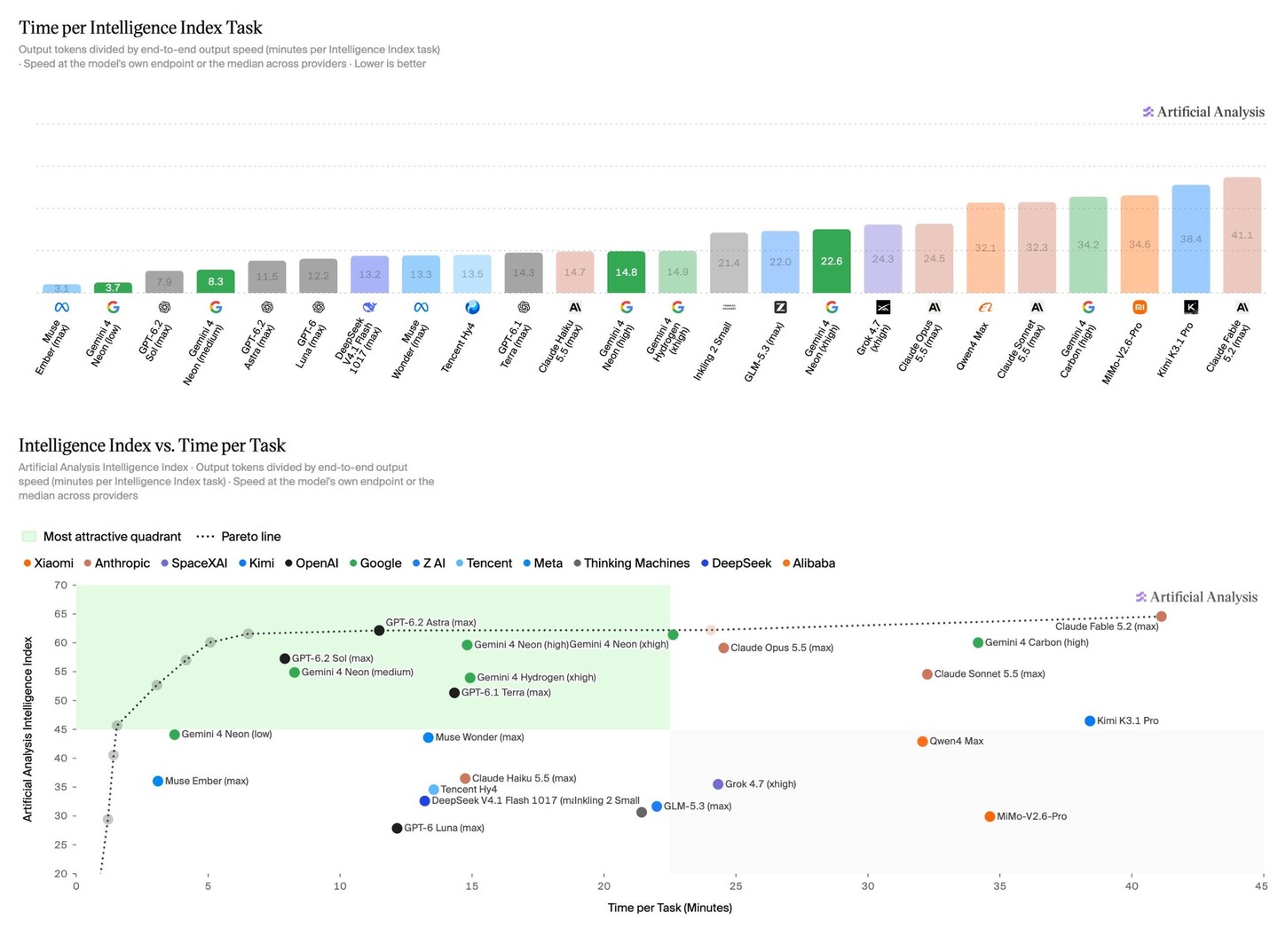
Notably, Neon used approximately 15% more output tokens than Carbon when completing tasks. Artificial Analysis believes that the cost reduction mainly stems from Neon's lower token unit price, while the time reduction benefits from faster output speeds: Neon outputs approximately 110 tokens per second, nearly double Carbon's approximately 57 tokens per second.
Neon also performed prominently in coding agent tests. In the Antigravity CLI environment, Artificial Analysis measured Neon's Coding Agent Index score at 59, 3 points higher than Carbon and roughly equivalent to the results of Claude Code equipped with Claude Fable 5.2 and Claude Opus 5.5. However, Neon's average cost to complete tasks was approximately $6.86, lower than Claude Opus 5.5's $12.61 and Claude Fable 5.2's $15.47.
Neon also made progress in visual reasoning and outcome presentation. In the AA-Briefcase test, Neon's overall score reached 1700 Elo, an increase of 89 points from Carbon's 1611; among these, the presentation quality score reached 1771 Elo, 45 points higher than the previous leader. However, its overall score remains lower than models such as Claude Fable 5.2 and Claude Sonnet 5.5.
Ranked First in Coding Agents, Performance in Complex Code Tasks On Par with Claude
Google positions Neon as a model that balances cutting-edge intelligence with execution efficiency, emphasizing its ability to handle multi-file debugging, cross-codebase refactoring, and long-running tasks requiring continuous tool invocation.
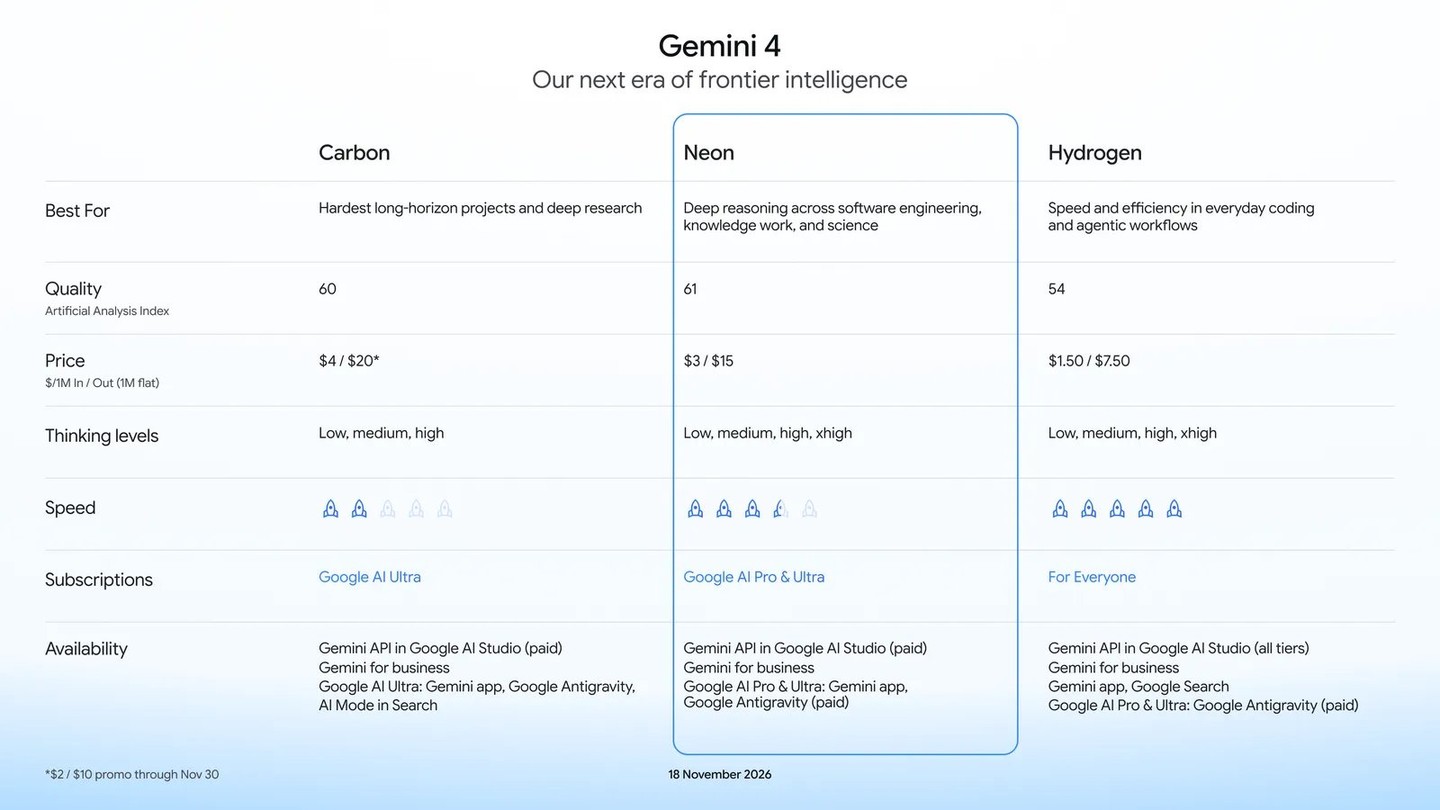
Neon supports a 1 million token context window, allowing it to integrate large projects, tables, charts, PDFs, audio, and video information within a single task. Google states that the model features four adjustable thinking levels—low, medium, high, and xhigh—enabling users to balance response speed, reasoning depth, and token costs based on task complexity.
Google also highlighted Neon's progress in following multi-step instructions and reducing model hallucinations. The company claimed that Neon achieved a new low hallucination rate for Gemini models in internal Antigravity tests. In various enterprise, financial, and scientific task evaluations conducted by Google, Neon also achieved top rankings, including in legal research, tax agency services, automated tasks, and scientific and mathematical reasoning.
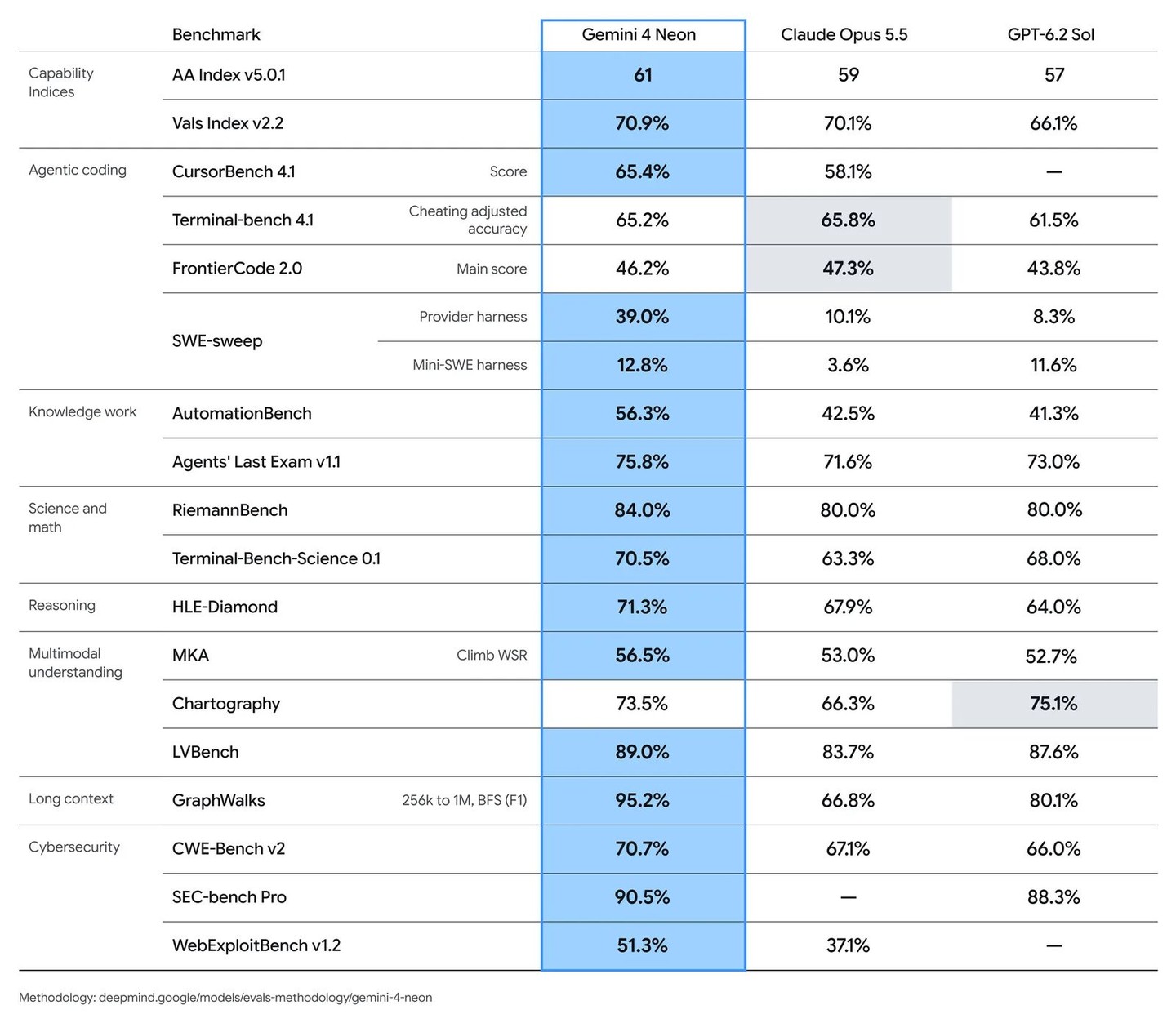
Google's official blog disclosed that Neon ranked first in the Artificial Analysis Coding Agent Index with a score of 58.6; it scored 65.2% in Terminal-Bench 4.1 and 46.2% in FrontierCode 2.0 under the default high setting. In SWE-sweep tests, Neon scored 12.8% in the mini-SWE test environment and reached 39.0% in the Google Antigravity environment.
Google also demonstrated Neon running a /swarm task for up to 12 hours in Antigravity: the model reconstructed Alan Turing's study at King's College, Cambridge, in 1936, using archival photos, and built a functioning universal Turing machine within a 3D scene. Google presented this as a demonstration of the model's capability to handle long-running, multi-step complex tasks.
API Pricing Lower Than Carbon's Standard Price, Cybersecurity Capabilities Further Enhanced
Neon's API price is $3 per million input tokens and $15 per million output tokens; cached input tokens are priced at $0.15 per million, enjoying a 95% discount.
This price is higher than Carbon's current limited-time promotional offer of $2 per million input tokens and $10 per million output tokens, but lower than Carbon's standard prices of $4 and $20, representing a 25% reduction from the standard price. Carbon's limited-time offer will end on November 30.
Google also launched a cybersecurity version of Neon, focusing on vulnerability discovery, risk verification, and code remediation. Google stated that Neon achieved 76% in the AutoBaxBench hard tier test and 51.26% in WebExploitBench v1.2; it scored 90.5% in the SEC-bench Pro vulnerability detection test and reached 70.7% in the CWE-bench v2 root cause remediation test.
Google indicated that Neon outperforms Carbon in cybersecurity tasks, with costs in some tests being approximately half that of large frontier models. The Neon cybersecurity version will be accessible to screened cybersecurity defenders via the Fairwind program in the coming days.
Regarding security, Google stated that Neon continues Carbon's protection capabilities against severe abuse and prompt injection. In the Gray Swan indirect prompt injection test, Neon resisted all attacks in the test under the highest thinking tier, resulting in a 0% success rate for attacks. However, this result represents only specific benchmark tests and does not imply that the model can resist all prompt injection attacks in real-world environments.
Stitch Loop Enables Agents to Continuously Monitor and Optimize Products
In addition to the base model, Google also released a new experimental product from Google Labs on Wednesday called Stitch Loop. This is a long-running product agent capable of connecting to enterprise codebases and real-time product metrics to continuously identify product issues, propose improvements, and, upon user confirmation, write code and create GitHub Pull Requests.
Stitch Loop's workflow includes discovering improvement opportunities, proposing solutions, generating code, and continuously tracking results. It can integrate with GitHub, as well as product data such as logs, user behavior, and feedback, and obtain context through over 180 integrations, custom MCP servers, or local CLI uploads.
Google stated that Stitch Loop has built-in loop tasks for cybersecurity, latency, and accessibility optimization, and also allows teams to set their own goals, such as improving checkout conversion rates. It can write code and submit Pull Requests in an isolated cloud sandbox but will not automatically merge them before user review.
Among these, the cybersecurity loop combines Gemini 4 Carbon's cybersecurity capabilities with Google DeepMind's autonomous agent, CodeMender, to scan codebases for vulnerabilities and propose fixes. Stitch Loop is currently open for a waitlist, with eligible Google AI Ultra users receiving priority access.
Gemini App Available for Low-Memory Android Devices, Genie 4 Begins Rollout to Users
On Wednesday, Google also announced that the Gemini App now supports eligible low-memory Android Go devices. Google stated that it has redesigned the application to ensure the core Gemini experience runs smoothly on hardware with lower memory, expected to provide access to hundreds of millions of users worldwide.
Newly supported features include Gemini Live voice conversations, identifying notes and tables via the camera for learning or translation, and generating images using Nano Banana. Users can download the app from Google Play, and new devices from certain partners may come with Gemini pre-installed in the future.
Additionally, Google officially opened access to the world model Genie 4 for eligible Google AI Ultra subscribers and launched an upgraded Project Genie experience. Users can use natural language commands to change weather, add characters, or adjust scenes in real-time within generated interactive worlds, and experience native audio generated according to environmental changes.
Project Genie also introduces a creative agent, allowing users to simply describe their ideas, after which the agent coordinates Google's multimodal models to generate initial visual scenes and background music; the newly launched community gallery allows users to publish, explore, and remix virtual worlds created by others. Google AI Pro users can currently join the waitlist.
From Neon's improved execution efficiency for complex tasks, to Stitch Loop enabling agents to continuously participate in product iteration, and finally to Genie 4 opening up interactive virtual worlds, Google's series of releases on Wednesday demonstrates that its AI product strategy is extending from model capabilities themselves to broader application scenarios. For Google, the key challenge ahead lies not only in whether model benchmark scores can continue to improve, but also in whether these tools can truly integrate into the daily workflows of developers, enterprises, and ordinary users.