
 I'm LongbridgeAI. Here is the key information I extracted
- The company offers tokenized stock trading on Solana and regulated derivatives globally, aiming to provide U.S. traders with unified liquidity and leveraged perpetual contracts.…
Author: insights4vc Source: insights4vc (Substack) Translation: Shan Ouba, Jinse Finance
When FTX collapsed in November 2022, the Backpack team had $14.5 million trapped in the exchange, approximately 88% of its operating capital. Four years later, this company, which started as a digital wallet, has received approval in the United States to operate a futures exchange, clear trades, and serve clients through its own brokerage business.
The most intuitive way to understand what Backpack is building is to follow the path of Micron stock. In eligible markets, clients can buy this stock through Backpack, transfer the digital certificate representing it to their own wallet, and then use this certificate as collateral for loans.
Clients continue to have exposure to Micron stock while borrowing from lenders outside of the brokerage business. On November 18th, Backpack's official account tweeted that following obtaining exchange and clearinghouse licenses this Monday, the company has received NFA approval to operate as a Futures Commission Merchant (FCM), becoming the first CFTC-regulated exchange to introduce leveraged perpetual contracts with unified global liquidity to the United States. Investors are already trading these tokens. In the third quarter of 2026, Backpack's securities accounted for 44% of the tokenized stock trading volume on the Solana decentralized exchange. These trades occurred in other venues, and fees were collected by those venues. As Backpack prepares to open its US futures exchange, the question becomes: what can transfer these orders, and the client balances behind those orders, into its own ledger?
Before the Exchange
Backpack started in 2022, betting on how people would use Solana applications. Armani Ferrante had previously developed the Solana development framework Anchor and also participated in Serum's on-chain order book. He and Tristan Yver developed a wallet that allows applications to run within executable NFTs (xNFTs): developers put an application into a customer's wallet, and the customer opens it directly from there. In September 2022, the team behind the wallet, Coral, announced the completion of a $20 million strategic round, co-led by FTX Ventures and Jump Crypto, with participation from Multicoin Capital, Anagram, K5 Global, and Frictionless.
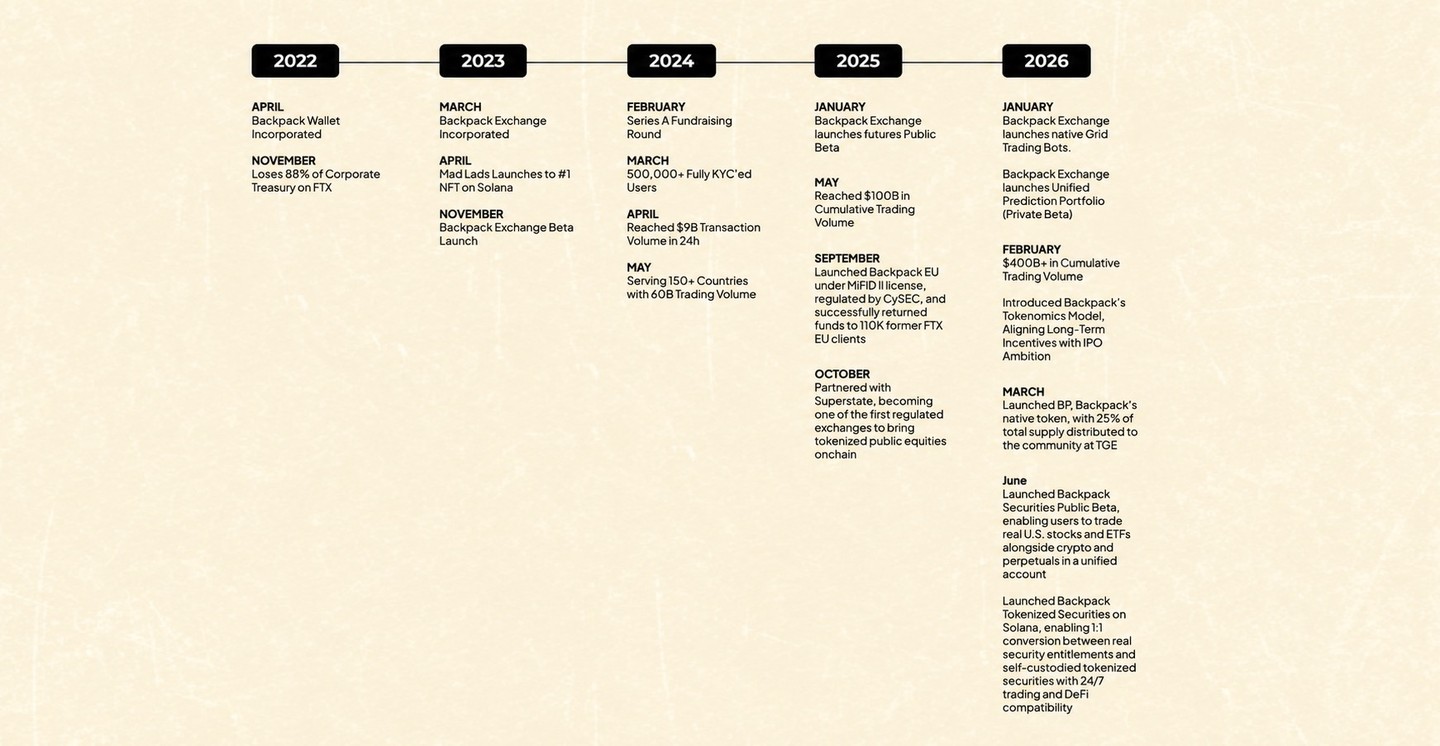
Backpack Milestones
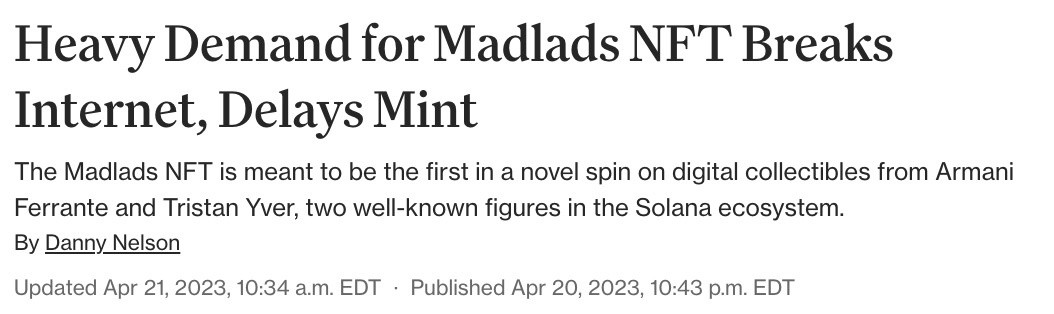
Two months later, FTX went bankrupt. According to Backpack itself, $14.5 million of its operating funds, equivalent to 88% of its reserves, were tied up in FTX. The team subsequently launched Mad Lads in April 2023 and a beta version on an exchange in November of the same year. This NFT series gave the founders a directly reachable audience when the exchange opened. In March 2024, TechCrunch reported that 560,000 users had completed identity verification. Backpack did not specify how many of these people later actually deposited funds and continued trading.
The exchange's public contract beta version went live in January 2025. By September, the group was offering regulated derivatives in Europe. In January 2026, private testing of grid trading and prediction market products followed; BP tokens were issued in March; and the securities business was launched in June. Along the way, the additions to the team also made the changes in the business visible: CTO Thomas Linton, Chief Compliance Officer Can Sun who previously served as General Counsel of FTX International, became the CTO. Former CFTC Commissioner and Acting Chairman Mark Wetjen became President of Backpack US, and former SEC Commissioner Michael Piwowar joined its US Board of Directors.
Who funded Backpack and what did they acquire?
The two funding rounds usually associated with Backpack actually invested in different things. Coral's 2022 investors were betting on an app wallet; Jump's Kanav Kariya was talking about how developers could combine apps, while FTX's Ramnik Arora saw an opportunity in an app store. By February 2024, investors were able to price a fully operational exchange. Placeholder led the first tranche of a $17 million Series A funding round for companies in the Backpack ecosystem, valuing the company at a total of $120 million. The announcement listed investors including Hashed, Robot Ventures, Amber Group, Wintermute Ventures, Selini Capital, and Delphi Digital, as well as founders from Solana, Tensor, Jito, Zeta, Marginfi, Drift, Monad, and Galxe. The investors' public statements reveal where the changes occurred. Placeholder's Joel Monegro emphasized performance and the auditability of the exchange, Hashed's Baek Kim valued customer experience, and Wintermute founder Evgeny Gaevoy stressed the team's understanding of crypto trading culture from a market-making perspective. Solana co-founder Anatoly Yakovenko also gave a positive review of Backpack, listing him as a supporter in the announcement, but without specifying whether he personally funded the round. Similarly, Jump's involvement was clearly stated in the 2022 announcement, but the 2024 announcement did not list Jump as a named institution in that round. Kyle Samani disclosed his exposure in more detail. In an article dated September 2, 2026, he wrote that he agreed to join the board before making his personal investment; he then invested $1 million and added another $3 million in the following two months, calling the total $4 million his largest angel investment. Backpack announced his U.S. board appointment on the same day. Samani's logic is that regulated derivatives will return to the U.S., while securities issued on Solana will find use in DeFi. His personal investment is separate from Multicoin's earlier investment in Coral. A shareholding structure chart submitted to the CFTC in July 2026 provides a more precise view of the shareholdings of the exchange's parent company, Trek Labs Ltd: Ferrante holds 36.74%, Linton holds 11.25%, Jump Trading holds 6.07%, and FTX Recovery Trust holds 5.86%. The document assigns 9.85% to Series A investors and 13.77% to employees and others. Can Sun's 16.46% voting rights include its own 6.82% and an irrevocable proxy for Jingjing Sun's 9.64%, meaning the FTX Trust remains a shareholder years after the collapse. This chart is merely a snapshot of the parent company in July and does not disclose the economic terms of the individual Series A securities. In February 2026, Axios reported that the company was in talks to raise $50 million at a pre-money valuation of $1 billion. We were able to verify the negotiations mentioned in the report, but as of November 18, no announcement confirming a closing under those terms had been found. The 2024 consolidated valuation remains the latest pricing and closing we can verify. BP's market capitalization is based on a circulating token price with conditional equity features, used to value Trek Labs or wallet companies, which is a different instrument. What does the US approval cover? On November 13, the CFTC registered TLD Clearing as a Derivatives Clearing Organization (DCO). The wording of this order is crucial: TLD can clear margin futures, and its license also covers fully collateralized futures, futures options, and swaps. This distinction determines which instruments can use leverage under this order. On November 16, the CFTC designated TLD Markets as a contract market, authorizing it to operate a trading venue. On November 18, Backpack announced that its affiliated futures commission merchant (FCM) had received NFA approval and become an NFA member. This intermediary is TLC Technologies, operating under the name Backpack Derivatives US. When clients place futures orders, the FCM handles account opening and margin, TLD Markets handles matching, and TLD Clearing acts as the counterparty after clearing. Placing these three functions under the same ownership allows Backpack to directly reach clients while also taking responsibility for the actual operation of each business. Backpack plans to accept eligible fiat and crypto assets as margin, hedge risks between different positions, and provide US traders with 24/7 access to global liquidity. Its own filings describe a phased launch: starting with a limited set of contracts after system testing, clearing member onboarding, and regulatory review. As of November 18, the company was still using the future tense when discussing US trading. The specifications of the initial contracts will be as important as the launch date; they will tell clients what collateral they can submit and which positions can be hedged. The rulebook also explains who bears the losses in the event of a clearing member default. Rule 815 stipulates that the defaulting member's own resources are used first, followed by the clearinghouse's guarantee fund share, and then specific apportionments to surviving members; if these resources are still insufficient, the clearinghouse may terminate the contract in whole or in part. Segregated client margin cannot be used to cover proprietary trading defaults, nor can it be used to cover losses across client account categories. Rule 825 requires public disclosure of the size and composition of funds, as well as contract volume and open interest. These disclosures will allow readers to track the US operations separately from international exchanges.
Where can clients access these products?
In Europe, the two subsidiaries hold different licenses. Trek Labs Europe Ltd (formerly FTX EU Ltd) holds Cyprus Investment Company License 273/15, and its European derivatives platform will launch in September 2025.
What the Trading Data Tells
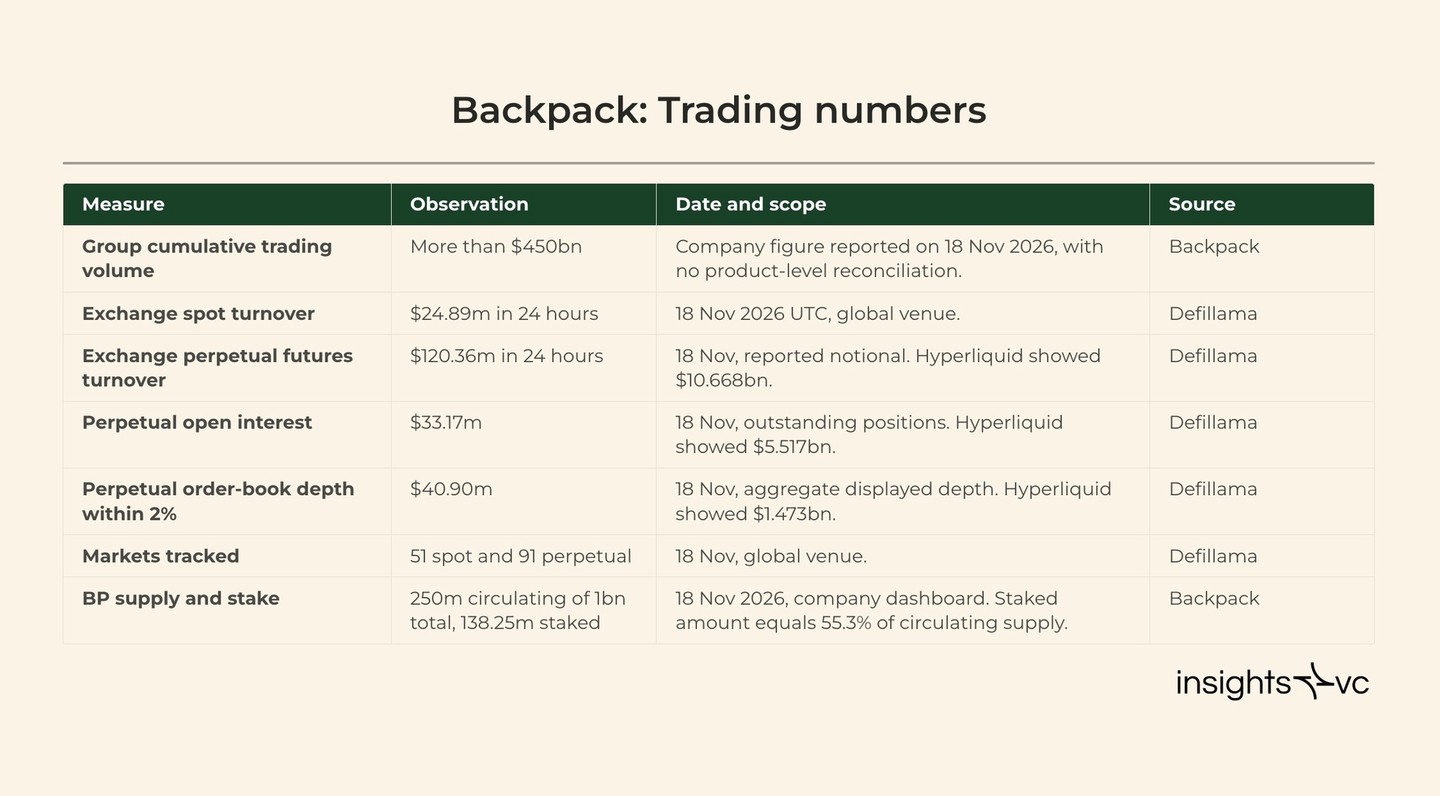
Perpetual contracts account for approximately 83% of Backpack's daily combined spot and perpetual trading volume. Its perpetual trading volume is equivalent to 1.13% of Hyperliquid's, with an open interest of 0.60% and a perpetual order book depth of 2.78%.
The order book depth metric provides a benchmark for comparing apparent trading volume: Backpack's share of the liquidity in its competitors' quotes is higher than its share of their trading volume, although the absolute difference is still significant. This summary also spans Backpack's 91 perpetual markets and Hyperliquid's 352. A large Bitcoin order at its limit price requires precisely the depth of that contract. Backpack pays for liquidity. Its market maker program invests $325,000 monthly, including $250,000 in perpetual and $75,000 in spot, plus commission rebates. Starting in November, the program's depth multiplier rewards participants who consistently place orders on both sides of the midpoint. The Perps Open from November 12th to 25th also distributed $2,500 daily to traders based on qualified trading volume; the data for November 18th falls within this period. Comparing open interest and market depth after the rewards expire provides a better indication of how much of the demand can be repeated.
How much revenue can these transactions generate? Backpack's entry-level perpetual transaction fee is 2 basis points for limit orders and 5 basis points for takers. VIP rates can be as low as zero for some limit order holders, and market makers also receive rebates. Assuming the venue retains a net 2 basis points for every dollar of reported perpetual trading volume (after deducting fee rebates, excluding separately paid promotional rewards), based on $120.36 million per day and 365 days a year, the fees would be approximately $8.8 million; if it were 1 basis point, it would be approximately $4.4 million. The publicly advertised perpetual reward pool alone would require $3 million to be fully paid out over 12 months. We cannot verify the realized fee revenue, actual incentive expenditures, or group profitability in publicly available financial statements.
More robust data adoption on the stock side
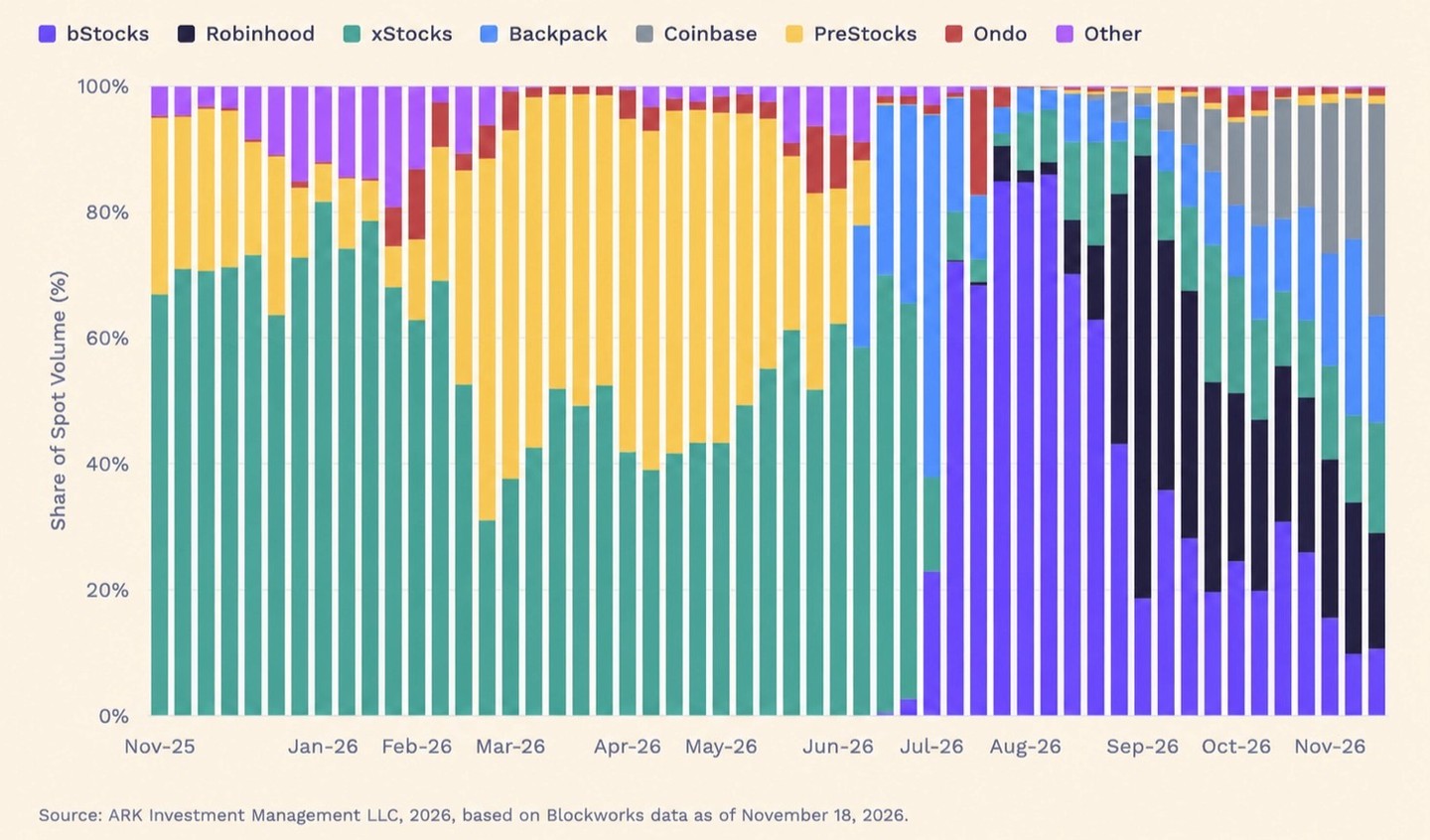
Global tokenized stock spot trading volume, data from Blockworks
Backpack Securities, launched in June, allows eligible clients to hold exposure to the same stock in two ways. By staying with the brokerage, clients hold a security interest through a multi-layered intermediary custody chain; by moving eligible positions to Solana, clients hold transferable tokens representing the underlying asset.
These two forms are easily confused within the application, but the distinction becomes crucial if a customer wants to vote, transfer positions to another brokerage, or redeem purchased tokens on a decentralized exchange. On the brokerage side, accounts are opened by Backpack Securities Global Limited in New Zealand, Atomic Vault Securities is a US-based intermediary brokerage, and RQD Clearing is a clearing brokerage. Backpack states that eligible holdings are eligible for cash dividends. As of November 18th, customer voting functionality remains limited. Eligible whole shares can be transferred in from supported brokerages via free DTC payment, but transfers out from Backpack to other brokerages are not yet available. Therefore, transfers between brokerages and withdrawals to the Solana wallet are two completely different instructions. On the token side, Trek Nexus Markets Ltd or an issuing affiliate acts as trustee. Article 1.18 of the issuance terms stipulates that during the period Backpack Exchange supports these tokens, the issuer recognizes Trek Forge or its designee as the sole beneficiary. Withdrawals give wallet holders control over on-chain transfers, while regular redemption of tokens for brokerage securities still requires a qualifying Backpack account. Direct confirmation under the trust terms is subject to contractual conditions and verification requirements, therefore tokens can change hands on decentralized exchanges even if the new holder is not eligible for redemption through a brokerage. Backpack's tokenized SpaceX stock used Sunrise's issuance infrastructure, one of the earlier listed companies. In November, two new ETFs, SPY and QQQ, and TKO Group Holdings were added. Most brokerage securities trade from 8:00 PM ET Sunday to 8:00 PM ET Friday, with some underlying assets also having weekend order books. When the stocks underlying the tokens are closed on their respective exchanges, the token market continues to trade; therefore, market makers quoting prices on Sundays may continue to bear price risk until the underlying market reopens. Bitwise and Allium analyzed all Solana tokenized stocks and found that regular US trading hours accounted for only 19% of the total trading hours in the quarter, yet contributed 39% of the DEX trading volume in the third quarter, with trading significantly lighter on weekends and holidays. The strongest evidence for product adoption also comes from this third-quarter data. Across all issuers, Solana tokenized stocks traded $6.93 billion on DEXs, with $669 million in outstanding shares at the end of the quarter. Backpack accounts for approximately 44% of trading volume and 4% of outstanding balance, while xStocks' corresponding figures are 50% and 77%, respectively. In terms of value, Backpack's rounded share corresponds to approximately $3.05 billion in quarterly turnover, with approximately $27 million in outstanding balance at the end of the quarter. The latter figure represents the balance at a specific point in time; dividing the two doesn't indicate the typical investor's holding period, but it does show the scale of trading volume attracted by these instruments relative to their outstanding balance. Trading within a third-party liquidity pool benefits the pool's liquidity provider without incurring fees for Backpack Exchange. Kamino provides holders with a reason to continue holding these assets after trading. On November 4th, the partner described a segregated lending market where clients can borrow USDC using tokenized Micron, SK Hynix, SpaceX, or SanDisk as collateral. Allez Labs sets the collateral ratio and liquidation parameters for each asset, and loans may still be liquidated when the underlying stock market is closed. In the same announcement, the partner stated that the cumulative on-chain transaction volume of Backpack's issued shares has exceeded $7 billion, with over 590,000 holders. Outstanding USDC loans secured by one of these shares serve as evidence of the financing purpose, but the number of holders alone cannot determine the prevalence of this use. Who is already serving these customers? Payward agreed to acquire Bitnomial for up to $550 million in cash and stock. This consideration corresponds to an operating business including technology, customers, and years of regulatory work; to convert it into the value of the Backpack license, these assets must first be divested. On Kraken Pro, clients can already trade Bitnomial contracts with funding fees settled every 8 hours, and can compare execution costs between the two after Backpack launches. ICE is betting on two different fronts simultaneously. An agreement reached on October 29 with Trade[XYZ] plans to establish a new regulated derivatives market on Hyperliquid, with ICE acting as the exclusive operator of the Trade[XYZ] regulated market (pending approval). On the securities front, the independent OKXICE joint venture announced that starting November 23, it will offer 24/7 trading in over 70 digital securities to eligible U.S. clients, a planned launch at the time of research closing. One move is vying for derivatives orders, the other for stockbroker clients. ICE expects brokers and platforms, including its joint venture with OKX, to distribute the proposed derivatives contracts. What to Look For in the First Batch of US Trading Data These November approvals have changed what investors can finally measure. The most compelling evidence today comes from traders buying and selling Backpack shares on Solana, while the least transparent figure is how much Backpack actually earns from this use. On international exchanges, publicly available fees and published reward budgets explain why cumulative trading volume doesn't answer the profitability question. The number of active accounts with funds, repeat borrowing, and revenue after deducting rebates are what make existing businesses easier to value. For US futures, the first meaningful comparison will be contract-by-contract: How much BTC or ETH can be executed in a single order near the quoted price? How much open interest remains at the end of the month after the referral rewards expire? Clearinghouse rulebooks require disclosure of trading volume and open interest by contract, and the CFTC will also publish some of FCM's financial data monthly. Reported positions and client funds will be a better indicator of adoption than trading volume records from the first day of launch. Backpack has already secured the right to compete for these balances; whether traders will leave their balances there is another half of the story that begins after launch.
Main Information Sources
- CFTC, TLD Clearing Registration Documents and Attachments
- CFTC, TLD Markets Designated Documents
- Backpack, November 18th FCM and NFA Announcement
- CFTC Filing Documents, Trek Labs Equity and Organizational Structure
- DefiLlama, Backpack Exchange Data
- DefiLlama, Hyperliquid Exchange Data
- Bitwise and Allium, Q3 Solana Tokenized Equity Data, Pages 34–36
- Kamino and Backpack Securities, Tokenized Equity Lending and Adoption
- OtterSec, Backpack Proof-of-Reserve Archive
- Backpack, Brokerage Business, Token Issuer and BP Program Contract Documents