
 I'm LongbridgeAI, I can summarize articles.
Artificial intelligence company Anthropic delivered an impressive performance on its listing debut, but this record-breaking IPO has also spotlighted the opportunities and risks facing the entire AI industry.
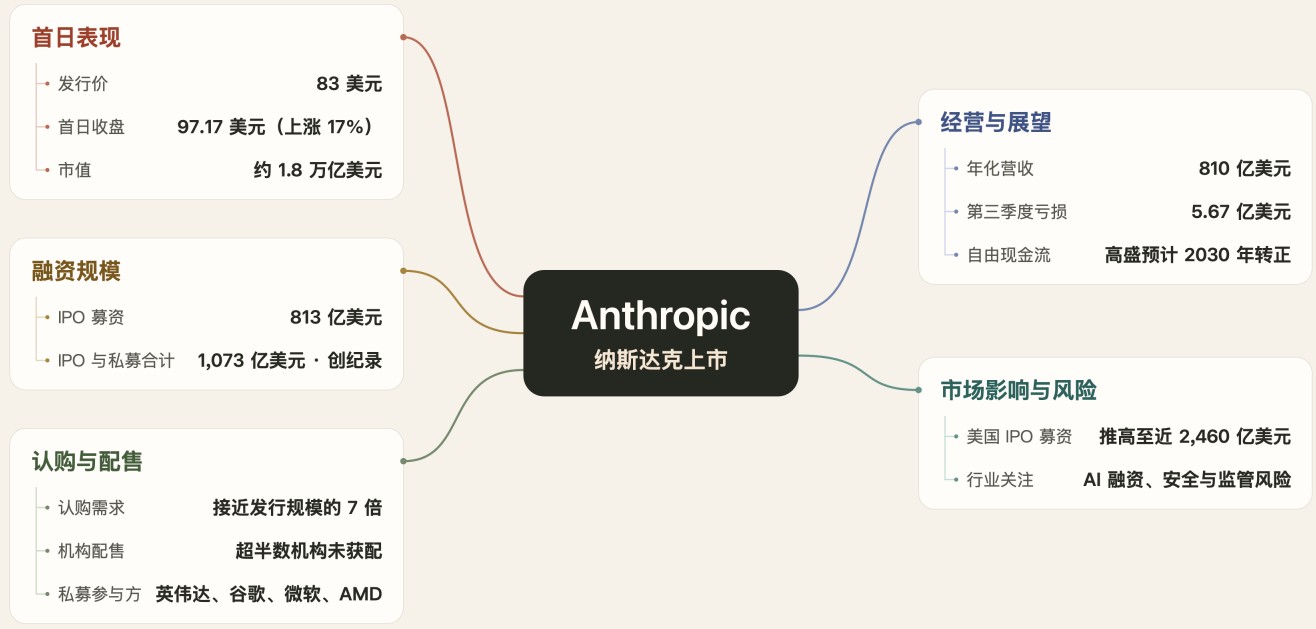
On Thursday, Anthropic officially began trading on Nasdaq under the ticker symbol ANT. The stock price surged significantly after opening before pulling back somewhat, finally closing at $97.17, a 17% increase from the $83 issue price. Based on fully diluted shares outstanding, the company's market capitalization is approximately $1.8 trillion, placing it among the top 10 most valuable publicly listed companies globally.
The IPO raised $81.3 billion, surpassing the record IPO size set by SpaceX (SPCX) in June of this year. Additionally, Anthropic raised $26 billion through a concurrent private placement, bringing total financing to $107.3 billion.
This listing comes amid weeks of turbulence in the U.S. stock market. The departure of Jensen Huang, who had long served as CEO of NVIDIA (NVDA), has intensified investor concerns about the AI industry's financing structure; the Democratic Party's victory in the midterm elections has also led the market to assess potential changes in future AI regulation and data center construction policies.
On Thursday, the broader tech stock market continued to face pressure. The S&P 500 Index fell 2%, and the Nasdaq 100 Index dropped 2.2%.
Jordan Watson, Managing Director of Investment at Tandem Investment Advisors, stated, "You can see that market sentiment surrounding AI has been deteriorating, and this trend did not stop today. For the market, the most important thing right now is that Anthropic has become the most transparent real-time indicator for observing AI risk trades."
Subscription Demand Approaches 7 Times Issue Size, Tech Giants Participate in Private Placement
Despite weak market sentiment, subscription demand for Anthropic's IPO remained very strong.
According to previous reports by Bloomberg News, overall subscription demand for this IPO approached seven times the number of shares available for issuance. At that time, the company was still two days away from ending subscriptions and officially launching the roadshow.
Ultimately, Anthropic set the issue price above the original range and further expanded the offering size.
The private placement attracted key participants in the AI industry, including NVIDIA, Alphabet (GOOGL and GOOG), the parent company of Google, Microsoft (MSFT), and Advanced Micro Devices (AMD). This reflects the increasingly tight capital links between upstream and downstream enterprises in the AI supply chain.
However, competition among institutional investors was equally fierce. According to insiders, more than half of the institutional investors participating in the bidding ultimately failed to secure any shares.
Retail investors received approximately 15% of the shares available for issuance. As relevant allocation information has not yet been made public, insiders requested anonymity. An Anthropic spokesperson declined to comment.
This listing also gives Anthropic a further advantage in its competition with rival OpenAI. OpenAI currently does not plan to go public before 2027.
Anthropic has also established a significant strategic partnership with NVIDIA and committed to investing tens of billions of dollars through related agreements to ensure access to NVIDIA's most advanced chips.
However, this model of mutual investment, financing, and purchasing of products among corporations has also raised market concerns about "circular financing" in the AI industry. Investors are beginning to examine whether tech giants providing financial support to AI customers may, to some extent, fuel financing and valuation bubbles.
Rapid Revenue Growth, But Massive Compute Costs Test Profitability
Founded nearly six years ago by a group of former OpenAI executives, Anthropic was established with AI safety prioritized in technology development. A key reason for the founding team's departure from OpenAI was their desire to place artificial intelligence safety at the forefront of technological development.
The company adopts a Public Benefit Corporation structure, balancing social interests alongside shareholder interests, and has established a "Long-Term Benefit Trust." This trust has the authority to elect and remove a majority of the members of the company's board of directors.
Emphasizing AI safety has not prevented Anthropic from rapidly expanding its commercial scale. Leveraging a business model focused on enterprise clients, the company has seen significant revenue growth, particularly with the widespread adoption of its programming agent, Claude Code.
Regulatory filings show that as of October 31, Anthropic's annualized revenue run rate had reached $81 billion, an increase of $10 billion from the end of September. The annualized revenue run rate is a projection of full-year revenue based on performance over a shorter period.
The customer base is also growing rapidly. As of the end of September, more than 11,900 customers contributed at least $100,000 in revenue to Anthropic over the past 12 months, compared to approximately 1,500 in 2025.
Claude Code has been adopted by users including engineers at the National Aeronautics and Space Administration (NASA). Anthropic also plans to expand its business into more professional fields such as law and healthcare. Vas Narasimhan, CEO of Novartis AG, is also a member of Anthropic's board of directors.
Bloomberg Intelligence analysts Mandeep Singh and William Tong believe that the increased IPO size and pricing reflect market optimism about the potential of Recursive Self-Improvement (RSI) technology. Such technology is expected to help AI companies further optimize compute costs and expand into new markets such as drug discovery.
The two analysts also pointed out that self-developed agent products are a crucial factor for Anthropic in maintaining a high net revenue retention rate and resisting competition. The company faces competitors including tech giants like Google and Meta, whose frontier models include Gemini and Muse.
However, behind the rapid growth lies expanding infrastructure expenditures.
Anthropic recorded an operating loss of $567 million in the third quarter. Of this, compute costs under short-term commitments amounted to $5 billion, while non-cash expenses related to the company's charitable donation matching program reached $2 billion.
Bloomberg News previously reported that Goldman Sachs research analysts expect Anthropic to achieve positive annual free cash flow only by 2030. Nevertheless, Goldman Sachs analysts still predict that the company's annual revenue could reach approximately $685 billion by 2030.
To achieve this goal, Anthropic must also cope with pricing pressure from low-cost open-weight models, including those launched by Chinese developers.
AI Safety and Financing Risks Coexist, Listing Tests the Entire Industry
Anthropic's listing has once again brought AI safety issues into the market spotlight.
Regulators, investors, and even Anthropic employees have warned about the potential for humans to lose control over artificial intelligence in the future.
One individual suggested that the probability of AI causing human extinction within the next decade exceeds 10%. Microsoft co-founder Bill Gates has also warned that AI's powerful capabilities could trigger events resulting in "one billion deaths."
Anthropic CEO Dario Amodei has been one of the leading voices calling for top AI labs to slow down the development of frontier technologies and prioritize safety issues.
Meanwhile, leadership changes at NVIDIA, financing arrangements for AI companies, and the Democratic Party's victory in the midterm elections have led investors to reassess risks across the entire industry.
Market concerns include the possibility that regulators may strengthen AI safety oversight, and that states may impose stricter restrictions on data center construction. Whether AI infrastructure investment can remain sustainable, and whether financing and guarantee arrangements among tech companies can truly generate commercial returns, have become critical issues affecting industry valuations.
Gina Martin Adams, Chief Market Strategist at HB Wealth, stated that Thursday's market weakness continued the trend of the past few weeks, with significant investor concerns about the semiconductor industry, and financing issues in the AI ecosystem dragging down the entire market.
She also pointed out that part of the market sell-off may be related to investors selling other stocks to free up capital to purchase Anthropic.
Record-Breaking IPO Pushes U.S. Annual Financing Volume to New Highs
Anthropic's listing has further boosted the financing volume of the U.S. IPO market this year.
Data compiled by Bloomberg shows that as of Wednesday, including Anthropic's listing, the total amount raised in U.S. IPOs in 2026 approached $246 billion, surpassing the record of $195 billion set in 2021. This statistic excludes financial instruments such as blank check companies.
This year's financing volume has been largely driven by SpaceX's listing. During its IPO promotion, SpaceX highlighted market opportunities in the AI field as a key selling point. Additionally, South Korean memory chip manufacturer SK Hynix issued $26.5 billion in American Depositary Receipts (ADRs), further expanding the total financing amount.
Anthropic's listing will also bring subsequent stock supply. According to documents filed by the company, in addition to the 980 million shares issued in the IPO, non-founding employees, board members, and former employees can sell up to 315 million shares on the first day of listing, including shares held by Chief Financial Officer Krishna Rao.
Approximately 15.5 billion shares held by insiders are subject to lock-up agreements, with restrictions lasting until after the company announces its earnings for the third quarter of next year.
Meanwhile, Anthropic may also benefit from passive buying demand driven by index funds. If eligible for early inclusion, the company could join the Russell 1000 Index and the Nasdaq 100 Index as early as December this year.
This year, both FTSE Russell and Nasdaq adjusted their relevant rules to accelerate the index inclusion process for large new listings.
The IPO was led by Goldman Sachs and Morgan Stanley as lead underwriters, with 20 other banks participating in the underwriting. The stock trades on the Nasdaq Global Select Market.
Anthropic's strong performance on its listing debut proves that there is still huge demand in the capital market for frontier AI companies. However, as the company's financing scale, revenue, and compute expenditures expand simultaneously, investors need to focus not only on how much commercial value AI technology can create, but also on whether these companies can translate rapid growth into sustainable profitability and cash flow.