
 I'm LongbridgeAI. Here is the key information I extracted
- This historical adjustment shifts the index focus from internet platforms to pan-hard technology, covering sectors like advanced hardware, artificial intelligence, and semiconductors.…
On November 20, Hang Seng Indexes Company announced the results of the third-quarter review for the Hang Seng Index Series this year. Changes to the constituents of the Hang Seng Index, Hang Seng China Enterprises Index, Hang Seng TECH Index, and Hang Seng Composite Index will be implemented after the market close on December 4, 2026, and will take effect from December 7, 2026.
The constituents of the Hang Seng Index remain unchanged, with the number of constituents maintained at 95. The number of constituents in the Hang Seng China Enterprises Index remains at 50, with Zhipu and MINIMAX-W added, while Postal Savings Bank of China and Shenzhou International are removed.
The number of constituents in the Hang Seng TECH Index will expand from 30 to 50, adding KINGBOARD HLDG, AAC TECH, LUXSHARE ICT, VGT, HESAI-W, INNOSCIENCE, Zhongji Innolight, XUNCE, CATL, KINGSOFT CLOUD, BIREN TECH, Montage Technology, YOFC, UBTECH ROBOTICS, and others.
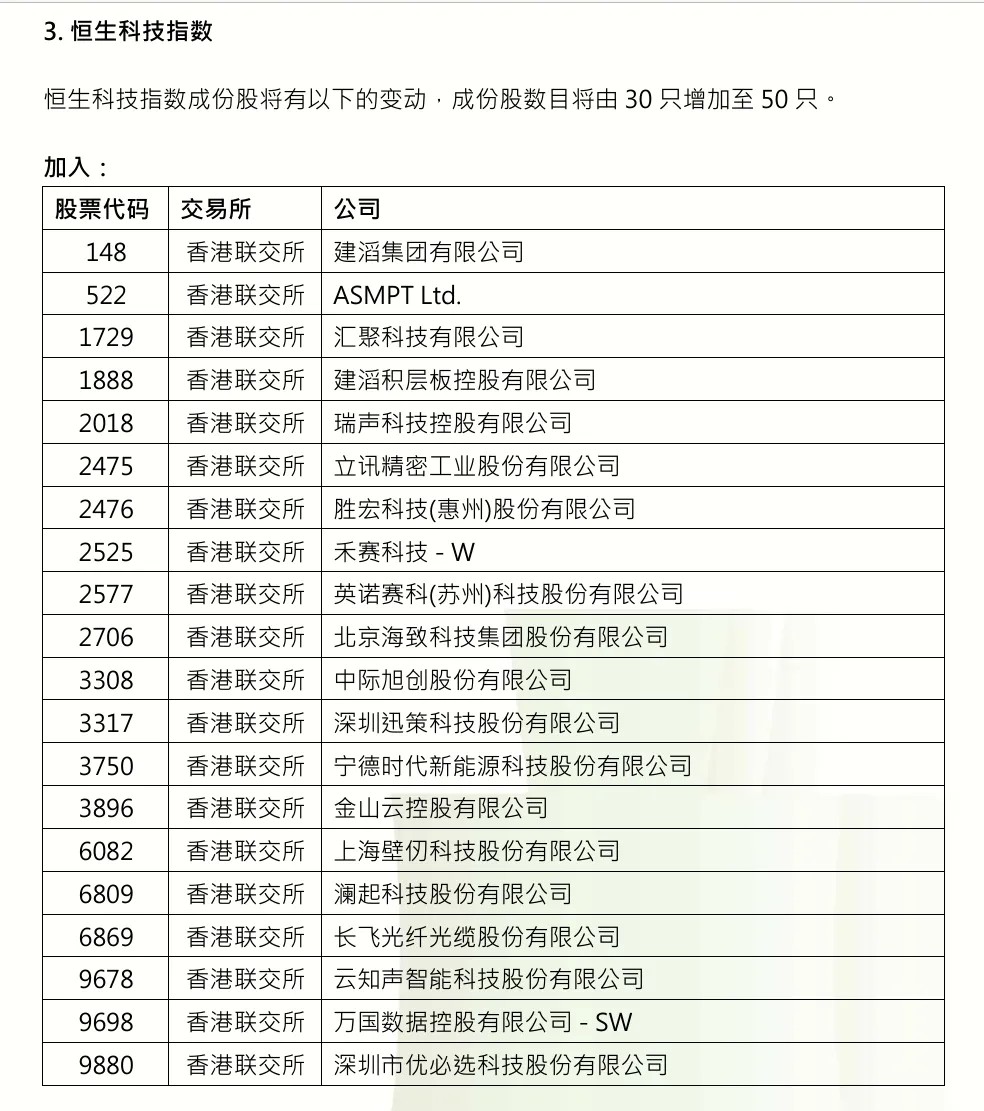
In response, industry insiders believe that the one-time expansion of the Hang Seng TECH Index constituents from 30 to 50, with the new list covering sectors such as advanced hardware, optical communication, computing power, semiconductors, intelligent driving, and robotics, may signal a shift in the underlying positioning of the Hang Seng TECH Index.
A senior figure in the Hong Kong stock market told reporters that the Hang Seng TECH Index has shifted from an "internet platform index" to a "broad hard tech index." "In the past, the consumer discretionary sector accounted for a relatively high proportion of the Hang Seng TECH Index, lacking exposure to AI, computing power, and chip stocks. The newly added stocks are primarily focused on advanced hardware and artificial intelligence themes. These adjustments are expected to further reflect the full landscape of the current technology industry in the Hong Kong stock market," the individual stated.
On October 7, Hang Seng Indexes Company published a summary of market consultations regarding the proposed revisions to the calculation methodology of the Hang Seng TECH Index. Hang Seng Indexes Company stated that the index would be revised in two aspects: expanding technology theme coverage and introducing a grouped stock selection mechanism. Industry insiders indicated that this is the most significant revision since the Hang Seng TECH Index was launched in 2020.
Regarding the expansion of technology theme coverage, Hang Seng Indexes Company stated that it would adopt the previously proposed revision plan, removing the requirement that eligible candidate companies must belong to five designated industries under the Hang Seng Industry Classification System.
Building on the adoption of the previous revision plan, Hang Seng Indexes Company has consolidated and expanded the themes of the Hang Seng TECH Index and added a frontier technology theme. The six major technology themes after the adjustment include: Digital Platforms & Solutions, Artificial Intelligence, Advanced Hardware, Robotics & Automation, Cloud Computing, and Frontier Technology. Meanwhile, the number of technology sub-themes in the Hang Seng TECH Index has increased from 16 to 24.
In terms of stock selection mechanisms, the Hang Seng TECH Index has introduced a grouped stock selection mechanism. Hang Seng Indexes Company adopted the previously proposed revision plan, revising the stock selection scope from main board listed companies to constituents of the Hang Seng Composite LargeCap & MidCap Index, and formally introducing a dual-group stock selection mechanism. The new mechanism uses market capitalization ranking and revenue growth ranking as selection criteria. Non-existing constituents must meet the condition of having a daily average turnover of no less than HK$100 million over the past three months. Stocks selected based on revenue growth ranking must have achieved annual revenue of at least HK$500 million in each of the last two consecutive fiscal years, setting clear entry thresholds from the dimensions of liquidity and fundamentals.
Among the 50 constituents of the Hang Seng TECH Index, the first 40 are selected based on market capitalization ranking, focusing on covering large-cap leaders; the remaining 10 are selected based on revenue growth ranking over the past 12 months, providing inclusion space for technology enterprises with high growth potential. This adjustment not only expands the representativeness of the index but also strengthens the growth attributes of technology-themed investments.
CITIC Securities issued a research report stating that the revision of the Hang Seng TECH Index calculation scheme was mainly driven by structural changes in the Hong Kong stock market's technology sector. The Hong Kong stock market's technology sector was initially highly concentrated in internet businesses, but in recent years, the number of listed companies related to advanced hardware and artificial intelligence has significantly increased, and specialized and new technology companies have also successively entered the market.
"At the same time, companies in the Hong Kong stock market's technology sector with strong revenue growth often have smaller market capitalizations. Under a stock selection framework based solely on market capitalization, high-growth but relatively small-scale companies might not be included in the index. The core essence of this revision to the Hang Seng TECH Index calculation scheme lies in making it a broader and more forward-looking benchmark index for Hong Kong-listed technology stocks," CITIC Securities stated.
The most direct impact of this revision on the market is the large-scale reallocation of passive funds. Data from Hang Seng Indexes Company shows that as of the end of September 2026, the total assets under management (AUM) of products passively tracking the Hang Seng Index Series were approximately US$105.5 billion. Among these, the AUM tracking the Hang Seng TECH Index has grown from US$1.5 billion at its initial launch in 2020 to US$37.1 billion. In October this year, GF Securities issued a research report stating that the allocation demand corresponding to the new constituents of the Hang Seng TECH Index is approximately HK$29.1 billion.
Source: Shanghai Securities News
Risk Warning and Disclaimer
The market involves risks, and investment should be approached with caution. This article does not constitute personal investment advice, nor does it take into account the specific investment objectives, financial status, or needs of individual users. Users should consider whether any opinions, views, or conclusions in this article align with their specific circumstances. Investment decisions made based on this content are the sole responsibility of the investor.