
 I'm LongbridgeAI. Here is the key information I extracted
- The severe market reaction triggered a broader AI sector downturn that erased 4.0 trillion dollars in Nasdaq market value, driven by controversies over heavy share allocation to existing investors and immediate employee stock sales.…
The largest IPO in history faced intense selling pressure on its second day of listing.
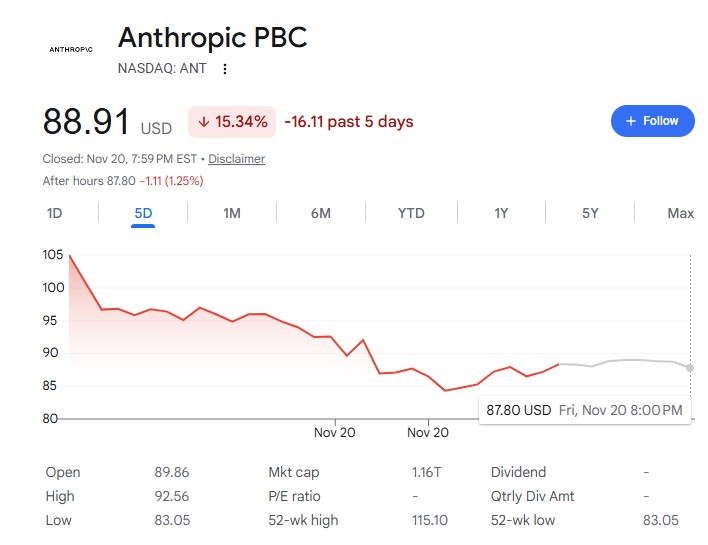
Shares of AI giant Anthropic (ANT) plummeted as much as 15% during Friday's trading session, at one point trading just 5 cents above its IPO issue price. The decline narrowed to 8.5% by the close, with the stock settling at $88.91, wiping out approximately $109 billion in market capitalization in a single day.
This severe volatility dampened market expectations that Anthropic could reverse the downturn in the AI sector. On Friday, core AI stocks such as Nvidia, Meta, and Oracle declined in tandem with Anthropic, erasing $4 trillion from the Nasdaq's market capitalization. The market turmoil also rippled over to Anthropic's main competitor, OpenAI, which is advancing a massive new funding round valued at $1.25 trillion and is eager to go public next year.
However, sources close to Anthropic and the lead underwriters insisted that the IPO remained successful, emphasizing that the company raised over $100 billion through the IPO and a concurrent share sale. They noted that the stock held above its issue price even amidst one of the most intense market sell-offs in history, closing 7% higher than the issue price on Friday.
Allocation Skewed Toward Existing Shareholders, Leaving 60% of Institutional Applicants Empty-Handed
Anthropic showed signs of weakness on its first day of listing.
Before noon on Thursday, the stock opened more than 30% above its issue price, but buying enthusiasm quickly faded. The shares fluctuated downward throughout the day, ultimately closing up 17%.
Some investors questioned the allocation arrangements for the $81 billion IPO shares made by the company and investment banks. According to insiders, more than half of the IPO shares were allocated to existing investors who already held equity in the company, including Altimeter Capital, Lightspeed Venture Partners, and Menlo Ventures. This unusually high proportion reflects Anthropic executives' desire to reward early supporters.
Some of these early supporters are venture capital firms whose existing holdings are subject to lock-up periods and cannot be sold. By industry convention, VC firms typically do not receive large allocations of new shares in an IPO, as such shares can be immediately sold in the secondary market to lock in profits. Additionally, insiders stated that Anthropic allocated a significant portion of IPO shares to large institutional investors such as Citadel, leading some unsuccessful applicants to speculate that the company prioritized major clients of its Claude model.
Typically, listed companies and their investment banking advisors carefully screen subscription demand, spending days selecting the optimal shareholder register to ensure robust post-listing stock performance and a stable ownership structure. However, according to estimates from some insiders, about 60% of institutions that applied to subscribe at the IPO issue price received no allocation, including numerous hedge funds and large mutual funds. Many other institutions received only partial allocations—according to The Wall Street Journal, asset management giant BlackRock submitted a subscription request for approximately $10 billion but was allocated only about half.
Opening Pricing Questioned; Immediate Employee Cash-Outs Exacerbate Selling Pressure
In addition to the allocation controversy, Wall Street is also scrutinizing the issue pricing and lock-up release arrangements.
One hedge fund manager questioned whether the investment banks, which assisted in determining the timing and price of the opening, set the opening price too high, thereby creating downward momentum that is difficult to reverse. However, delaying the opening also carries risks, as the stock price could continue to rise during the interim.
Meanwhile, Anthropic's IPO included a rare clause: allowing certain current and former employees to immediately sell approximately 300 million shares, valued at about $26 billion based on the IPO issue price. In conventional IPOs, employee shareholdings are typically subject to lock-up periods lasting several months. The reduction of these holdings likely increased downward pressure on the stock price.
Unlike the anxiety on Wall Street, many AI practitioners in San Francisco stated they largely ignored Anthropic's stock price correction.
On Friday, they were more focused on another piece of news—an Anthropic mathematician claimed that Claude had solved a "Millennium Prize Problem" that had perplexed humans for 167 years. Many viewed this as a signal of AI surpassing human intelligence. Furthermore, these employees noted that even at the current stock price, the value of shares held by many Anthropic employees remains millions of dollars higher than it was at the beginning of the week.
AI Trades Mired in Turmoil; "Greenshoe Option" Exercised
Anthropic and its advisors were well aware that proceeding with the listing amid the most severe turmoil yet seen in AI trades carried extremely high risks, but they did not expect to encounter this "perfect storm."
In recent weeks, rising borrowing costs for cloud computing companies and the aftermath of the Nvidia controversy have continued to exacerbate market anxiety. Investors had hoped that Anthropic, as a pure-play AI giant, would turn the tide and restart the rally, but this scenario did not materialize.
From the perspective of the underwriting investment banks, as long as Anthropic's stock price does not fall below the IPO issue price, the listing is still considered successful. However, once the issue price is broken, a key tool originally available to the banks for stabilizing the price becomes ineffective.
Anthropic announced on Friday morning that the "Greenshoe Option" (Overallotment) for this IPO had been exercised.
The "Greenshoe Option" allows underwriters to additionally allocate shares equivalent to 15% of the issuance size to investors. The underwriters can then either purchase these shares from the company at the issue price or repurchase them from the open market if the stock price falls below the issue price to support the price.
With the early exercise of this option, subsequent price-support measures have diminished. Furthermore, approximately 300 million Anthropic shares will become tradable on December 15, potentially subjecting the stock to further selling pressure.