
 I'm LongbridgeAI. Here is the key information I extracted
- This sell-off was driven by a sharp drop in major stock indexes, weakening market liquidity, and rising funding competition from massive AI infrastructure financing, such as a 40 billion dollar GPU-backed transaction.…
The divergence between equity and bond markets, which has persisted for several weeks, is converging. The US credit market, which had previously reacted relatively slowly to the decline in US stocks, came under significant pressure last week. High-yield bond (junk bond) spreads recorded their largest single-week widening of the year, and selling pressure began to spread from lower-rated bonds to higher-rated segments.
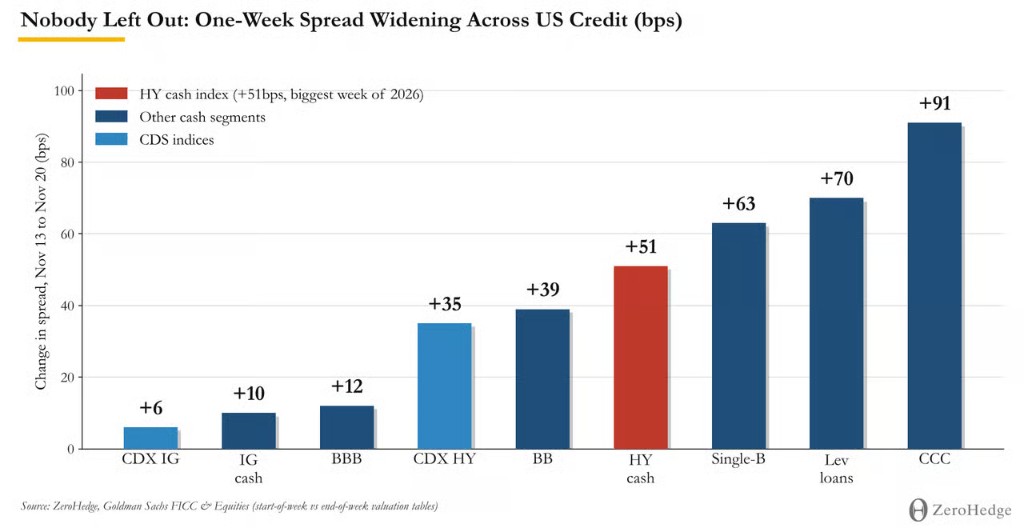
Last week, the S&P 500 Index fell 8.6%, and the Nasdaq Index dropped 10.4%, wiping out all of its year-to-date gains. Meanwhile, US high-yield bond credit spreads widened by 51 basis points to 367 basis points, marking the largest single-week increase since 2026 and nearly double the previous record set in late September.
According to Goldman Sachs data, 1,753 out of 1,934 component bonds in the US high-yield bond index declined last week. The year-to-date return for high-yield bonds thus turned from a positive 0.54% to a negative 0.32%. At the same time, investment-grade bond credit spreads also widened by 10 basis points to 96 basis points, indicating that selling pressure has spread from the junk bond market to bonds with higher credit ratings.
However, market views on the future of credit assets are divided. Within Goldman Sachs, one camp believes that valuations have become attractive after the spread widening, while the other worries that the credit market has not adjusted sufficiently and that the current sell-off may only be the beginning of a catch-up decline.
Credit Spreads Widen Rapidly, Partially Pricing in Expectations for Next Year's Adjustment
Last week's sell-off caused US credit market spreads to widen rapidly. Investment-grade bond spreads widened by 10 basis points to 96 basis points, while high-yield bond spreads widened by 51 basis points to 367 basis points. Bonds of various ratings were impacted: CCC-rated bond spreads widened by 91 basis points to 1,174 basis points, B-rated spreads widened by 63 basis points to 374 basis points, and BB-rated spreads widened by 39 basis points to 221 basis points.
This round of adjustment has brought the credit market close to Goldman Sachs' spread forecasts for 2027. Goldman Sachs strategist Amanda Lynam previously predicted that by the end of 2027, investment-grade bond spreads would reach 105 basis points, and high-yield bond spreads would reach 410 basis points. Before last week began, these figures were 86 and 316 basis points, respectively.
In other words, in just one week, investment-grade and high-yield bond spreads have already accounted for a significant portion of the expected adjustment magnitude for next year.
In terms of total return, declining interest rates partially offset the impact of widening credit spreads. Last week, US Treasury yields fell by 24 basis points, driving a positive return of 0.84% for the investment-grade bond index; the high-yield bond index, however, fell by 0.86%. This indicates that current pressure in the credit market is concentrated mainly on credit risk premiums rather than rising risk-free rates.
Cash Bond Declines Exceed Credit Indices, Liquidity Pressure Emerges
Notably, the price declines of actually traded bonds significantly exceeded the adjustments reflected by credit derivative indices. Goldman Sachs data shows that last week, the performance of the high-yield cash bond index was weaker than that of the CDX high-yield index, with cash bond spread widening for BB-rated bonds approximately twice that of the synthetic index.
Goldman Sachs credit strategist KC O'Connor pointed out that historically, for every 1% drop in the S&P 500 Index, high-yield bond spreads typically widen by about 4.5 basis points. Based on the S&P 500's 8.6% drop last week, spreads should theoretically have widened by about 39 basis points, but they actually widened by 51 basis points, with the excess primarily driven by widening spreads in BB-rated bonds.
The divergence between cash bonds and derivatives reflects weakening market liquidity and risk absorption capacity. Credit derivatives such as CDX allow for rapid adjustment of risk exposure through index trading, whereas cash bond trading relies more on the actual demand from buyers and sellers. When investor risk appetite declines and buying interest diminishes, cash bond prices are more susceptible to shocks.
Last Friday, dealers net absorbed approximately $1.3 billion in credit risk, reflecting the market's need for more intermediary capital to digest selling pressure. However, the net asset value discount for investment-grade bond ETFs remained below 1 basis point, indicating that the pressure has not yet evolved into a comprehensive liquidity failure.
Sell-Off Broadens, Pressure Spreads Upward from Low-Rated Bonds
This adjustment was not confined to bonds with the poorest credit quality. Last week, 65 high-yield bonds from 37 issuers fell by at least 5 percentage points, 45 of which were B-rated or BB-rated bonds; in the previous week, only 18 bonds reached this level of decline.
Since October 6, CCC-rated bond spreads have cumulatively widened by 188 basis points, B-rated spreads by 90 basis points, and BB-rated spreads by 44 basis points. The spread difference between CCC-rated and BB-rated bonds has reached 953 basis points, with CCC-rated spreads rising to 1,174 basis points, the highest level since April 2025.
Bond prices for some issuers have seen significant declines. For example, a bond with a 9.125% coupon issued by mining company Tronox fell by more than 26 percentage points due to restructuring concerns; a bond from Icahn Enterprises maturing in 2029 with a 10% coupon fell by more than 10 percentage points, dropping to 73% of face value; and several Navient bonds also fell by approximately 9 to 10 percentage points.
Meanwhile, the market is pricing high-yield bonds more cautiously. The proportion of high-yield bonds with spreads below 200 basis points fell by 12.4 percentage points to 44.5% last week, down from 64.8% in mid-September. This means the range of bonds investors are willing to hold at lower risk premiums is narrowing.
Rising AI Financing Demand, High-Yield Bonds Face Capital Competition
Another pressure on the credit market comes from AI infrastructure financing. As large tech companies and AI firms continue to expand capital expenditures, related financing demand is increasing, potentially competing with traditional high-yield bond issuers for limited investor capital.
Recently, the market focused on a "Saturn" transaction related to SpaceX for GPU financing. The overall scale of this financing exceeded $40 billion, with the $2.52 billion public bond portion receiving an A rating, an average maturity of about 3.5 years, collateralized by chip assets, and yielding 8.26%, which is 345 basis points higher than US Treasuries. This yield is only about 30 basis points lower than the high-yield bond index and even higher than the overall yield of the high-yield bond index.
Goldman Sachs estimates that AI chip financing volume in 2027 could reach approximately $320 billion. Goldman Sachs investment-grade bond trader Brad Shelofsky estimates it at around $300 billion. Such massive financing demand could attract funds originally allocated to traditional high-yield bonds toward AI-related debt, thereby increasing financing pressure on other issuers.
Bonds from some AI infrastructure companies have also been affected by the market adjustment. Four high-yield bonds issued by CoreWeave fell by approximately 4.25 to 4.6 percentage points last week, with prices dropping to 77 to 82 cents on the dollar. Since October 6, technology sector investment-grade bond spreads have widened by 30 basis points, exceeding the 16 basis point widening seen in the overall investment-grade bond market.
However, Shelofsky believes that the recent weakness in tech bonds is more a result of macro factors and a general decline in market risk appetite, rather than investors repricing the AI sector in isolation. The correlation between tech bonds and the investment-grade bond index has risen from 0.74 to 0.93, indicating that their performance is increasingly influenced by the broader credit market.
Divergent Market Views: Is Credit Already Attractive for Allocation, or Has It Not Adjusted Enough?
Despite the recent significant sell-off, there is still divergence within Goldman Sachs regarding judgments on the credit market.
Credit strategist Avishek Biswas believes that current spreads have returned to near historical medians, and valuations are beginning to look reasonable. He points out that overall investor positioning is not crowded, fund flows remain stable, and bond issuance is typically low in December, providing some market support.
Shelofsky also holds a tactical optimistic view on the credit market, but he reminds investors that if the market rebounds, they should consider reducing positions at higher levels rather than simply viewing spread widening as a buying opportunity. He prefers gaining returns by selling volatility rather than directly buying bonds.
In contrast, Goldman Sachs cross-asset credit expert Alisha Pasi believes it remains to be seen whether the credit market has fully reflected the stock market adjustment. She notes that the Nasdaq 100 Index has given back 86% of its previous gains, and the S&P 500 Index has given back about 59%; however, in the credit derivatives market, investment-grade bond spreads reflect only 21% of the widening seen in Q4 2018, and high-yield bonds reflect only 31%.
This means the credit market may have already priced in some risks of slowing AI investment, but it may also be lagging behind the stock market and has not yet completed repricing. If AI capital expenditure slows, related debt financing demand may decrease, and interest rates may also fall, so borrowers' debt servicing capabilities may not be significantly affected; however, if the slowdown in AI investment further evolves into concerns about economic growth, the risks in the credit and stock markets will be difficult to distinguish.
Spreads Return to Historical Medians, Credit Risk Not Yet Cleared
From a historical valuation perspective, US high-yield bond spreads are currently at 367 basis points, around the 33rd percentile since 2007, below the historical median of 431 basis points; investment-grade bond spreads are at 96 basis points, at the 20th percentile, also below the historical median of 129 basis points. Leveraged loan spreads are at an even lower historical percentile, while CCC-rated bond spreads have risen to the 92nd percentile.
Default risk remains a focus of market attention. Goldman Sachs expects the US high-yield bond default rate to reach 4% in 2027; Morgan Stanley's forecast is slightly higher, expecting default rates for high-yield bonds and leveraged loans to be 4.5% and 4.75%, respectively. Morgan Stanley currently maintains an underweight position on high-yield bonds while maintaining its highest level of overweight on equities.
Federal Reserve meeting minutes also showed that almost all officials believe further interest rate hikes are necessary in the future, with some expressing concern about opaque debt risks in AI financing. Bank of America strategist Michael Hartnett pointed out that investment-grade bond spreads breaking above 100 basis points could signal rising recession risk; this indicator has currently risen to 96 basis points.
O'Connor reminded that spread widening does not mean all high-yield bonds have become investment-worthy. Investors need to focus on issuer credit quality and debt repayment ability, rather than simply chasing high yields. As the adjustment magnitude in the cash bond market exceeds that of credit derivatives, selling pressure spreads to higher-rated bonds, and AI financing demand may continue to increase, the current improvement in credit market valuations is insufficient to indicate that risks have been cleared.