
 I'm LongbridgeAI. Here is the key information I extracted
- Hedge fund net leverage has dropped to cyclical lows and momentum trades have reversed, yet historical oversold rebounds have not materialized following the recent correction.…
Zhitong Finance APP learned that last week's sell-off in US and Asia-Pacific stock markets completed a qualitative upgrade: it began as risk reduction by hedge funds and evolved into "systematic selling" at the index level. According to Morgan Stanley's latest weekly hedge fund report, estimated monthly losses for Asia-Pacific long-short equity funds had widened to 2.9% as of November 19, while their US counterparts likely suffered losses of 1.6% during the same period. This weekly report, released on November 20, missed the tail end of the action—it failed to capture the largest single-day percentage drop in the MSCI World Index in a year and a half, which occurred last Friday.
Beyond the numbers, more noteworthy is the overall shift in the position coordinate system: long bets on momentum stocks were at multi-year highs in June, but hedge funds have now collectively turned bearish, with holdings in artificial intelligence companies dropping to an underweight status below their market capitalization. Morgan Stanley strategists stated that both the S&P 500 Index and the Dow Jones Industrial Average have entered correction territory, providing investors with a buying opportunity that cannot be missed.
The Ebbing Tide of Momentum
Over the past two years, from the US and China to South Korea and Japan, momentum stocks drove wave after wave of gains as investors flocked to AI and robotics concepts. This enthusiasm has cooled significantly in recent weeks, triggered by two factors: rising concerns over tighter AI regulation following the US midterm elections, and growing skepticism in the market about the sustainability of massive AI expenditures.
Morgan Stanley's weekly report provides a clear breakdown by region and industry: last week, the Asia-Pacific region led the global sell-off, with selling pressure almost evenly distributed among China, Japan, and Taiwan Province of China. The semiconductor, hardware, and internet sectors combined accounted for 75% of the selling volume. This round of selling reduced hedge funds' net exposure to the Asia-Pacific region by 11 percentage points since mid-year, bringing it down to 22% of global levels—below the ten-year average. As defined in the report, net exposure measures the dollar difference between long and short bets.
Semiconductors, hardware, and the internet happen to be the three main strongholds of hedge fund momentum holdings—in other words, this selling was not scattered risk control, but a targeted dismantling of momentum positions itself. Looking at the market context since 2026, this momentum line extended from US AI giants to Chinese tech, South Korean robotics, and Japanese semiconductor equipment, representing the most consistent trade in global stock markets over the past two years. When such a consistent trade begins to unravel, its exit path is often not a uniform gradual decline, but a rapid unloading concentrated on the most crowded names—the fact that 75% of selling was concentrated in three industries is direct evidence of this "concentrated clearing" pattern. This also explains why Asia-Pacific became the epicenter: over the past two years, Asia-Pacific momentum stocks accumulated the highest gains and crowding, resulting in the steepest slope during the clearing process.
The Nature of the Sell-Off Has Changed: From Individual Stocks to Indices
Interestingly, the method of selling has changed: although hedge funds ended the week with net selling again, their impact on prices was less severe than in October—selling pressure shifted from individual stocks to index products. In other words, position cutting is transforming from "active clearing at the stock selection level" to "passive risk reduction at the systematic level."
Another set of data on position structure also points to extremeness: the net leverage of US stock-picking hedge funds has plummeted to 41%, and Asia-Pacific long-short equity funds have dropped to 48%—both falling at the lower end of the observation range since 2010.
JPMorgan's Comparison: Historically, a Rebound Should Have Occurred, But It Hasn't Yet
On the same day, JPMorgan's Asset Data and Alpha team provided a historical comparison in their research report: "Historically, periods where large-scale net selling by hedge funds coincides with market sell-offs are often followed by a rebound in the next month—but so far, this has not been the case."
JPMogan added a quantitative judgment: the speed and magnitude of the decline in net leverage from its 12-month high are "comparable to some of the most extreme scenarios since 2018." Reading the two reports together leads to a harsh conclusion: position reduction has been deep, but the market decline has not yet delivered the "oversold rebound" reward historically expected—either because the macro drivers of this sell-off (AI regulation and AI spending narratives) are more structural than before, or because the rebound is still waiting for a trigger.
Looking at the longer timeline, this round of clearing occurred at a node where several narratives were simultaneously shaken: uncertainty over AI regulation after the midterm elections, debates on the sustainability of AI capital expenditure, and the impact of the leadership change at NVIDIA on confidence in the entire AI supply chain—multiple investment bank research teams listed these as common triggers for sector selling. Hedge funds' position reduction is less a vote on fundamentals and more a repricing of the "narrative uncertainty premium": when the core narratives driving two years of market performance simultaneously enter a verification phase, the corresponding action in positions is to first reduce leverage, then reduce exposure, and finally turn to systematic risk reduction at the index level—this aligns perfectly with the three stages of selling described by Morgan Stanley.
What Does This Mean for Investors?
For readers tracking capital flows, this weekly report offers at least three actionable signals. First, the reversal in momentum stock positions is "dramatic"—moving from multi-year highs in June to overall bearishness today completes a full long-short cycle within half a year, indicating that the risk release from crowded trades is quite sufficient; second, the switch in AI holdings from overweight to underweight suggests that hedge funds are not "bottom-fishing in AI" but "waiting for the narrative," consistent with Morgan Stanley's previously cautious tone on the AI infrastructure sector; third, index products absorbing selling pressure while individual stock selling pressure weakens is usually interpreted as a signal that panic is nearing its end—but JPMorgan's historical comparison precisely reminds us that this time "the rebound that should have happened hasn't," indicating that the triggering conditions have not yet aligned.
Overall, this set of data depicts a textbook-style position clearing: momentum reversal, leverage dropping to ten-year lows, and selling pressure shifting to the index level. Historically, this combination often corresponds to the eve of a rebound—but both reports admit that this "historical pattern" has not yet materialized this time. For observers, rather than betting on the timing of a rebound, it is better to monitor two leading variables: the pace of AI regulation implementation and whether net leverage stops declining.
There is another easily overlooked detail worth highlighting separately: Morgan Stanley's weekly report admits it "missed Friday"—meaning the largest single-day percentage drop in the MSCI World Index in a year and a half occurred after the data cutoff date for both reports. This means the market movements on November 21 likely further deepened all the aforementioned indicators: larger monthly losses, lower net leverage, and more thorough momentum clearing. In other words, all the figures cited in this article are likely "intermediate values" rather than "final values" of this round of clearing—the next weekly report will be the first complete sample to test whether "systematic selling has peaked."
Morgan Stanley's Wilson: After Seven Consecutive Drops in the S&P, It's a "Fat Pitch," Forward P/E Falls Below Long-Term Average, Buying Opportunity Cannot Be Missed
While the S&P 500 and the Dow Jones Industrial Average both fell into correction territory last week, Morgan Stanley strategists believe this round of selling has delivered a buying opportunity that investors cannot miss. The team led by Michael Wilson stated that both earnings and valuations support a rebound, and the recent capitulation-style selling in the market provides the backdrop. The team's tactical bullishness is at its highest level since early April this year.
"This is the fat pitch we have been patiently waiting for, and we will not miss it," Wilson's team wrote in a report released on Monday. "Markets always bottom out amidst bad news and deleveraging. We have experienced plenty of both recently."
S&P 500 futures strengthened in pre-market trading on Monday. Prior to this, the spot index had fallen for seven consecutive trading days, the longest streak since the outbreak of the pandemic in February 2020; compared to the previous record high in early October, the S&P 500 has dropped 12%, entering correction territory amid violent rotation in technology stocks.
Wilson's team stated that valuations have fallen back to levels supporting increased equity exposure. As analysts continue to raise earnings expectations, the forward P/E ratio of the S&P 500 has dropped from a peak of nearly 23 times in late October to the current 16.5 times, below the long-term average of 17.4. The forward P/E ratio of the Nasdaq 100 Index, dominated by technology stocks, is less than 17 times, also below its trough during the pandemic.
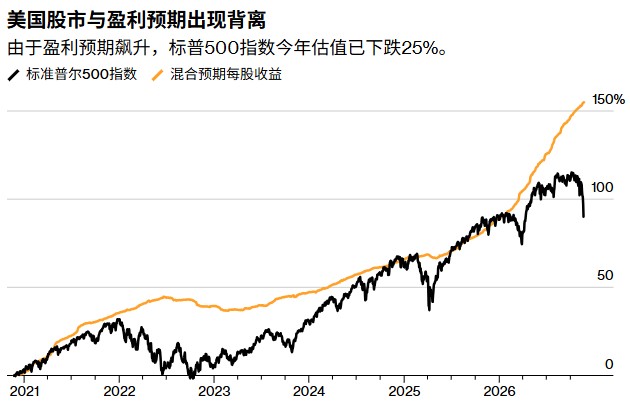
"This sell-off has improved entry points for hyperscale cloud providers, industrial stocks, high-quality cyclical stocks with rising earnings expectations, and beneficiaries of AI applications," the team wrote.
Wilson and his colleagues believe that current stock prices imply a roughly 6% decline in 2027 earnings, whereas Morgan Stanley's own forecast is for 14% growth, and the market consensus is for 17% growth. They listed positive factors including: the diffusion of industrial activity, resilience in high-end consumption, advancement of AI applications, lower energy prices, and the prospect of decreased interest rate volatility.
In the view of the Morgan Stanley team, the primary risk facing the stock market remains a hawkish Federal Reserve, but they believe investors have already priced this in.
"In our view, market pricing is much more hawkish than the Fed's final path," they wrote. "A faster tightening cycle could bring credit and growth risks, but we expect the Fed to pay attention to these risks, and the information released at the December meeting will be more restrained than some investors expect."