
 I'm LongbridgeAI. Here is the key information I extracted
- Although Goldman Sachs data indicates panic and de-leveraging are nearing an end, the current Federal Reserve rate hike cycle and short gamma positioning create conditions similar to 2018.…
The sell-off in US stocks has pushed the market to an extremely oversold state, but historical experience shows that a rebound after a sharp drop does not necessarily mean the market has bottomed out; the Nasdaq may still face a new round of pullbacks.
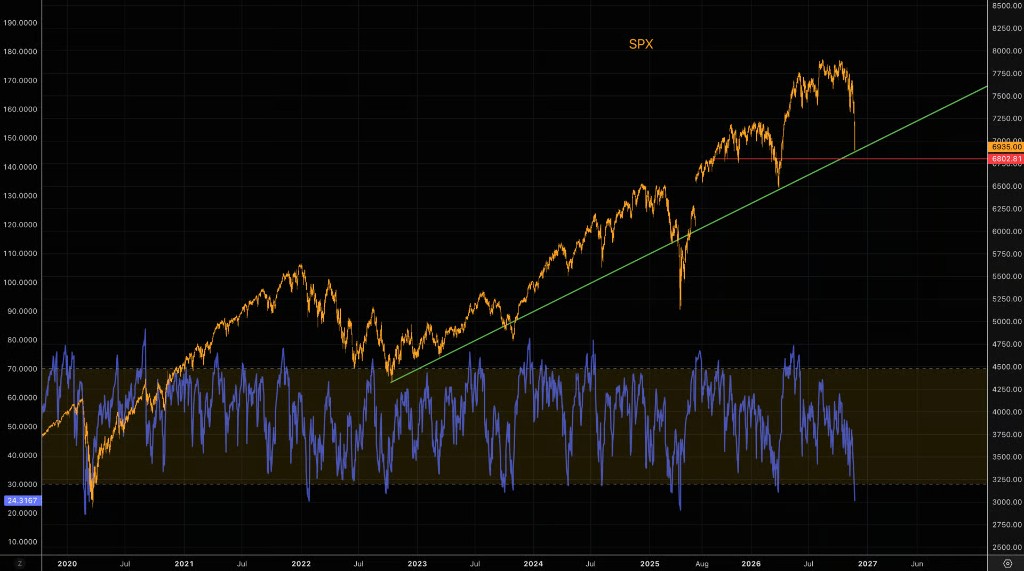
The S&P 500 Index has fallen into an extremely oversold range, tech stock volatility has surged to its highest level since 2020, and hedge funds are also cutting positions at the fastest pace in nearly a decade. The level of market panic and the scale of capital withdrawal have both reached rare levels.
Goldman Sachs data shows that its Vol Panic Index closed at 9.8 last weekend, on a scale of 10. Historically, this level is usually a strong signal for contrarian buying. However, the current situation is different as the Federal Reserve remains in a rate-hiking cycle: in the past, when the panic index exceeded 9 while the Fed was simultaneously raising rates, the S&P 500 Index rose by an average of only 0.4% over the following three months.
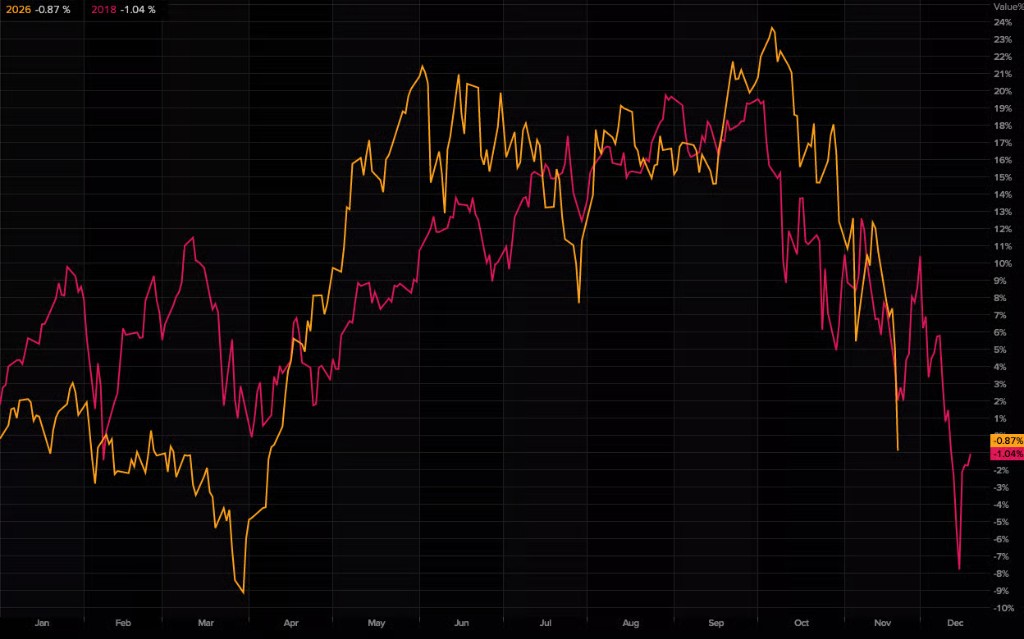
More alarmingly, current market trends bear a striking resemblance to a correction in the Nasdaq in 2018. At that time, the market experienced a rapid rebound after a sharp drop, but subsequently fell again to hit new lows. Today, as selling pressure on tech stocks intensifies, this similar historical script is once again drawing market attention.
Tech Stock Panic Reaches Extreme Levels, Conditions for a Rebound Are Maturing
The oversold condition of the current S&P 500 Index is at an extreme level, and it is currently testing the long-term trend line formed since the low point in late 2022.
Pressure on tech stocks is even more pronounced. The Nasdaq Volatility Index (VXN) has risen to its highest level since April 2020, surpassing peaks seen during previous periods of intense market adjustment. The Semiconductor Volatility Index (VXSMH) has hit a record high, although data for this index only begins in 2022. Last Friday, the single-day plunge in the Philadelphia Semiconductor Index (SOX) and the subsequent surge in volatility were described by market participants as "historic."
From a valuation perspective, some tech stocks have also seen significant corrections. Peter Callahan of Goldman Sachs pointed out that the forward P/E ratio of the Nasdaq 100 Index has dropped to 17 times, while the semiconductor sector is even lower at 12 to 13 times, with clear technical oversold signals.
However, the decline in valuations has not yet brought about obvious bottom-fishing demand. Callahan noted that current market movements already reflect expectations of downward earnings revisions, but actual fundamentals remain relatively robust, and earnings forecasts are still being revised upward. The divergence between market prices and earnings trends indicates that this round of selling is driven to some extent by declining risk appetite for funds and position adjustments, rather than a comprehensive deterioration in corporate earnings.

Hedge Funds Significantly De-leverage, Is Selling Pressure Nearing Exhaustion?
Changes in investor positions further highlight the severity of this adjustment.
Data from Goldman Sachs' Prime Brokerage business shows that short-selling volume for individual US stocks last week reached the highest weekly level since June 2022, and the third highest in nearly a decade; short positions in ETFs increased by 11% in a single week, marking one of the largest weekly increases in five years. The above data only covers up to last Thursday and does not include Friday's sell-off.
The net leverage ratio of hedge funds has also dropped to extremely low levels. The net leverage ratio for fundamental long/short (L/S) strategies dropped to 42.3%, sitting at the 1st percentile of the distribution over the past year; the beta-adjusted net leverage ratio has cumulatively dropped by more than 22 percentage points since early October to 48.2%, hitting a five-year low.
Goldman Sachs believes that this round of de-leveraging may be nearing its end, rather than just beginning. However, the market has not completely shaken off potential selling pressure: CFTC non-commercial trader holdings remain near high levels, meaning there is still room for further adjustment in some crowded positions.
Meanwhile, CTA strategy positions in Nasdaq 100 futures are approaching the bottom of their range over the past decade. Over the past six weeks, the speed at which systematic funds have sold off tech stocks has set a historical record. Simultaneous position reductions by active hedge funds and quantitative funds have also kept tech stocks under continuous passive selling pressure.
Short Gamma Amplifies Two-Way Volatility, 2018 Trends Warrant Caution
Even if de-leveraging is nearing its end, the market may not stabilize immediately. Current large Short Gamma positions mean that market makers may be forced to sell when the market falls and buy when it rises, thereby amplifying two-way market volatility. With volatility already at extreme levels, this position structure could make market movements even more intense.
The historical trend of 2018 is one of the risks the current market needs to watch. That year, after experiencing a rapid decline, the Nasdaq saw a strong rebound, but the rebound failed to reverse the market trend, and the index subsequently fell again to hit new lows. Goldman Sachs and market observers are currently closely monitoring the similarities between this historical trend and the current market situation.
This means that while extreme oversold conditions and position clearing have created conditions for a rebound, they are not sufficient to prove that the market has bottomed out. Especially against the backdrop of the Federal Reserve still being in a rate-hiking cycle and risk appetite for funds not yet recovering, even if the Nasdaq rebounds in the short term, another pullback cannot be ruled out.
What the market truly needs to verify now is not whether oversold signals can trigger a rebound, but whether the rebound can gain sustained support from fundamentals and capital flows. If bottom-fishing capital fails to enter the market, the 2018 scenario of a sharp rebound followed by new lows may well repeat itself.