
 I'm LongbridgeAI. Here is the key information I extracted
- Despite this surge, Citadel Securities warned that current market conditions mirror the 2018 playbook, where resilient economic data masked a slowing growth outlook while the Federal Reserve continued monetary tightening.…
Zhitong Finance APP learned that on November 23 (US Eastern Time), Jensen Huang returned to NVIDIA as President and CEO, driving a significant rebound in leaders of the US AI computing power industry chain and a broad range of AI computing hardware stocks. The most intense capital replenishment was undoubtedly seen in the AI computing and semiconductor themes that had previously led the decline: the Nasdaq-100 Index rose 6.86% in a single day, with the total market capitalization of its component companies recovering by over $2 trillion; the Philadelphia Semiconductor Index rose 14.03%, marking its largest single-day gain since April 9, 2025. Even so, core indices remain significantly below their previous historical highs. The warning issued recently by Citadel Securities highlights the major uncertainty left by this rebound: while Jensen Huang's return has boosted investor confidence in the AI industry chain, the Federal Reserve still has reasons to continue raising interest rates, and the macroeconomic situation may further deteriorate.
Just before the collective surge in US tech stocks on Monday, Citadel Securities warned over the weekend that this round of stock market adjustment may not have fully reflected the significant macroeconomic risks of a notable slowdown in US economic growth. At the close on November 23 (US Eastern Time), the "AI Chip Super Hegemon" NVIDIA (NVDA.US) soared 31.48% to $165.05 due to Jensen Huang retaking the helm, marking its largest single-day gain since May 2003. Its market capitalization increased by approximately $952 billion, setting a new record for the single-day market cap increase of a single US company. The three major US stock indices also surged together: the Dow Jones Industrial Average rose sharply by 3.01%, the S&P 500 Index rose sharply by 4.73% to 7,237.17 points, ending a seven-day losing streak, and the Nasdaq Composite Index (Nasdaq) rose sharply by 6.51%.
Even so, the S&P 500 remains about 7% below its historical closing high in early October. As of the close on November 23 (US Eastern Time), calculated against their respective historical highest closing prices, the Nasdaq-100 Index is still down 14.34%, and the Philadelphia Semiconductor Index is still down 34.48%. In other words, although the US semiconductor sector led this round of rebounds, the Philly Semi is still down by more than one-third from its peak, with a drawdown magnitude more than twice that of the Nasdaq-100.
Frank Flight, Head of Macro Strategy at Citadel Securities, recently reminded investors that the most cautionary scene in 2018 was when US economic data still appeared resilient, yet a strengthening US dollar and declining cyclical stocks had already begun to reflect weakening growth prospects, while the Federal Reserve continued to tighten monetary policy. In the current macroeconomic context, the interest rate futures market expectation for a 25 basis point rate hike by the Fed in December is still priced in at nearly 100% certainty. Furthermore, expectations for a 50 basis point hike in December and continued hikes in early next year are heating up, further raising the return threshold for new projects and compressing the valuation premium investors are willing to pay for future profits.
Currently, Jensen Huang's return has alleviated investor concerns about whether NVIDIA can proceed with its new generation of AI computing clusters as planned and coordinate customer AI computing project progress and investment. However, core inflation remains above 3%, and the pressure on the Federal Reserve to continue raising interest rates persists. If high financing costs further slow down data center construction, and the US macroeconomy moves towards the pessimistic trajectory of a "hard landing" under the rate hike cycle, the market will once again sharply downgrade overall earnings expectations for the AI computing industry chain and the valuation multiple premium capital is willing to pay for these earnings. This is why Citadel Securities' recently released "2018 Script Warning" research report remains worthy of attention even after the surge.
Citadel Securities Warns: 2018 Market Trajectory Indicates Market May Face More Pressure
Citadel Securities strategists recently warned that financial markets are sending signals of weakening growth prospects, while the Federal Reserve's stance is becoming increasingly Hawkish. This is quite similar to the market environment before the sharp decline in risk assets at the end of 2018.
Frank Flight, Head of Macro Strategy at Citadel Securities, wrote in a report dated November 20 that there are similarities between the current situation and that of eight years ago. At that time, the resilience of the US economy masked the deterioration in growth prospects, which subsequently spread weakness across various markets.
He stated that, as in those days, the US dollar is strengthening, cyclical stocks are continuing to fall, and the Federal Reserve is determined to maintain tight policy, keeping bond yields at high levels. Traders expect the Federal Reserve to raise interest rates next month to curb inflation. Before the market's sharp rebound on Monday, this outlook had suppressed stocks closely related to economic growth, such as industrials, materials, and energy, for the past three months.
Flight wrote: "In both periods, the relative advantage of the US economy and the resilience of domestic economic activity masked the deterioration in future growth prospects. The trade war with China back then and the war with Iran now have further exacerbated this pressure. It is easy to think that the recent adjustment has largely reflected the worsening outlook, but the experience of 2018 makes it difficult to feel reassured by this."
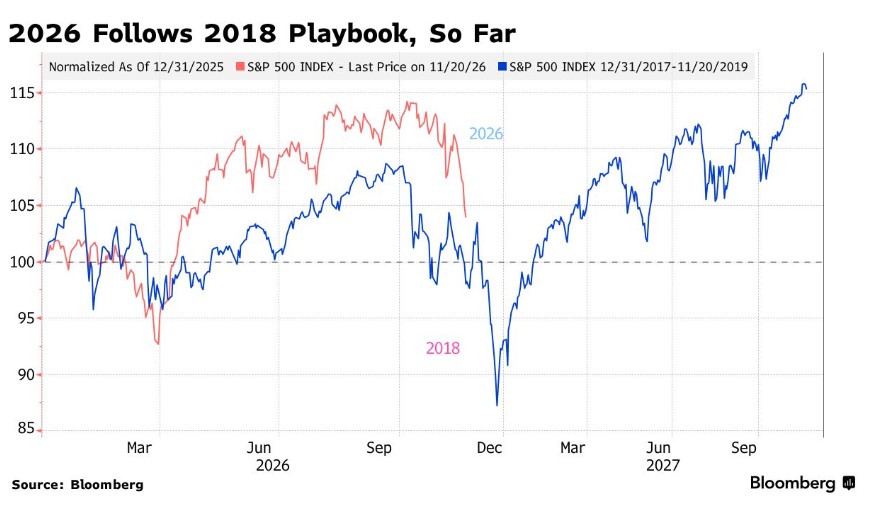
As shown in the chart above, the market trend in 2026 so far is very similar to that of 2018.
The S&P 500 Index rebounded on Monday after falling for seven consecutive trading days and entering correction territory. NVIDIA's unexpected announcement on Monday of reappointing Jensen Huang to lead the company helped fuel this reversal. However, as investors become increasingly wary of the AI boom and the prospect of Federal Reserve rate hikes, the S&P 500 Index remains about 7% below the historical closing high set in early October.
In 2018, the Federal Reserve was also in a tightening cycle. Then-Chairman Jerome Powell stated that interest rates were still "a long way from neutral," shocking the market. By December of that year, the S&P 500 Index had fallen nearly 20% from its September high. This sell-off prompted investors Stanley Druckenmiller and Kevin Warsh to call on the Federal Reserve to pause its monetary tightening.
Today, Warsh took charge of the Federal Reserve in May this year and is facing a similar dilemma. The Fed implemented its first rate hike in three years in September, committing to faster efforts to bring inflation back to the 2% target. Even during last week's stock market plunge, two Federal Reserve officials reiterated the need to further increase borrowing costs.
Nohshad Shah, Head of Fixed Income Sales for Europe, Middle East, and Africa at Citadel Securities, stated that investors should not take for granted that "stock market weakness will lead to monetary policy easing." Unlike in 2018, current core inflation has remained above 3%, significantly exceeding the Federal Reserve's 2% target.
Shah stated in another research report that the key market risk lies in the possibility that the AI investment cycle supporting US economic growth may slow down as the Federal Reserve further tightens policy. He believes that as fiscal support weakens, financing conditions tighten, and the AI boom cools, the economy is entering a phase with "less room to absorb shocks."
Shah wrote: "This implies an unsettling possibility: the Federal Reserve continues to focus on curbing inflation, while market expectations for future growth continue to deteriorate. The initial adjustment is likely to manifest as a flattening yield curve and further pressure on risk assets."
Buying Power Had Already Entered Before Jensen Huang's Return; Reappointment News Pushed Nasdaq Futures to Limit Up
Monday's crazy market action can be divided into two phases. Before the news of Jensen Huang's reappointment was announced, S&P 500 and Nasdaq-100 index futures in the Asian session had already rebounded by about 2% and 3% respectively, and spot gold also rose by 2.9% at one point. Asian stock markets showed significant divergence: the Taiwan Weighted Index rose 2.16% to 36,811.89 points, while the Korea Composite Index fell 3.31% to 4,708.54 points, dragged down by Samsung Electronics and SK Hynix, the two large-cap stocks that collectively account for over 50% of the index weight.
At approximately 8:55 AM US Eastern Time, NVIDIA announced that the Board of Directors had unanimously agreed to restore Jensen Huang to the positions of President, CEO, and Director. By 9:02 AM, Dow Jones, S&P 500, and Nasdaq-100 mini futures had risen by 2.45%, 4.07%, and 6.53% respectively. Nasdaq-100 futures subsequently touched the 7% overnight gain limit. When Jensen Huang returned to headquarters, hundreds of employees applauded to welcome him. He told the employees, "Serving as CEO for the second time, I will do better."
At the close on November 23 (US Eastern Time), NVIDIA soared 31.48% to $165.05 due to Jensen Huang retaking the helm, marking its largest single-day gain since May 2003. Its market capitalization increased by approximately $952 billion, setting a new record for the single-day market cap increase of a single US company. The rally in US tech stocks also extended from chip manufacturing to cloud computing leasing, with Micron Technology, TSMC ADR, and CoreWeave all closing up more than 10%.
The Dow Jones rose 3.01%, the S&P 500 rose 4.73% to 7,237.17 points, ending a seven-day losing streak, and the Nasdaq Composite Index rose 6.51%. At the index level, the most intense capital replenishment was still seen in tech stocks where AI computing and semiconductors hold major market cap weights, which had previously led the decline—the Nasdaq-100 Index rose 6.86%, with the market capitalization of component companies recovering by over $2 trillion; the Philadelphia Semiconductor Index rose 14.03%, marking its largest single-day gain since April 9, 2025.
How Far Can the Tech Stock Rebound Go? Bulls Favor AI Earnings Resilience, While Cautious Parties Worry About Tightening Financing and Slowing Growth
Tech stock bulls are focusing on the gap between earnings expectations and stock prices. Mike Wilson, Chief US Equity Strategist at Morgan Stanley (hereinafter referred to as "Morgan Stanley"), stated on Monday that according to his team's model, the stock prices after last week's sell-off implied a 6% contraction in US corporate earnings for 2027, whereas Morgan Stanley expects earnings growth of 14%. He raised his short-term view on US stocks to the most optimistic level since early April, favoring opportunities such as hyperscale cloud providers.
Bernstein semiconductor analyst Stacy Rasgon focused his judgment on NVIDIA: he remains very bullish on the continuation of the global AI computing infrastructure construction boom until around 2030. Since Jensen Huang's departure was a main reason for the previous rating downgrade, he upgraded NVIDIA's stock rating back to "Outperform" after the reappointment news was announced.
The rebound potential for popular Asian AI infrastructure stocks closely linked to NVIDIA's AI computing cluster supply depends on how much earnings forecasts need to be cut. JPMorgan's Asia Technology Hardware Analyst team, led by Gokul Hariharan, believes that previous stock prices had already priced in a 25% to 30% downward revision in earnings per share forecasts for the next three to four months, while they expect the actual revision to be only about 5% to 10%. If orders and computing rental revenues withstand the test, Asian technology hardware stocks could rebound by more than 20%.
Mark Haefele, Chief Investment Officer at UBS Global Wealth Management, takes a longer-term view: he expects global AI investment to increase from $1 trillion in 2026 to $1.4 trillion in 2027. However, to generate sufficient returns on such a scale of investment, the annual industry revenue for AI models and applications may need to reach at least $1.5 trillion by 2030. The market had previously worried about cloud providers cutting computing purchases. Once investors believe that chip orders and profits may be better than the pessimistic expectations already reflected in stock prices, heavily battered chip stocks have reason to rebound quickly. Whether the rally in tech stocks dominated by global AI computing and semiconductor weights can continue after Jensen Huang's return to NVIDIA depends on how much corporate customers are willing to continuously pay for AI application subscriptions and model calls, and whether these revenues can provide sufficient returns for cloud providers' next round of data center investments.
Those remaining cautious about tech stocks continue to ask who will provide the funding and how long capital will remain expensive. Goldman Sachs analyst James Schneider pointed out on Monday that it remains to be seen whether NVIDIA will continue to lead industry partners in multi-party investments on the same scale as in the past after Jensen Huang's return. Frank Flight, Head of Macro Strategy at Citadel Securities, emphasized in his November 20 report that the strengthening US dollar and weakening cyclical stocks indicate that financial markets have reflected slowing growth earlier than current economic data.
Nohshad Shah, Head of Fixed Income Sales for Europe, Middle East, and Africa at Citadel Securities, further warned that core inflation remains above 3%, making it difficult for a stock market decline to quickly translate into monetary easing. The bond market gave signals consistent with this judgment on Monday: the yield on 2-year US Treasuries rose by about 7.4 basis points to 4.69%, while the 10-year yield rose by only about 2.4 basis points to 4.94%, narrowing the spread between the two by about 5 basis points. Stocks in the AI computing infrastructure and semiconductor sectors can indeed surge due to the dissipation of management uncertainty. However, when data center operators seek substantial financing for the next batch of AI GPUs, they may still face high benchmark interest rates and continuously rising credit spreads under the Federal Reserve's rate hike cycle.