
 I'm LongbridgeAI. Here is the key information I extracted
- The massive short squeeze inflicted an estimated 112 billion dollars in paper losses on short sellers, wiping out their previous week's profits and causing leveraged short products to plunge by up to 92%.…
NVIDIA's stock price soared more than 31% in a single day on Monday, catching short sellers who bet against it off guard—leveraged short products plunged by as much as 92%, and short sellers incurred paper losses of approximately $11.2 billion in one day.
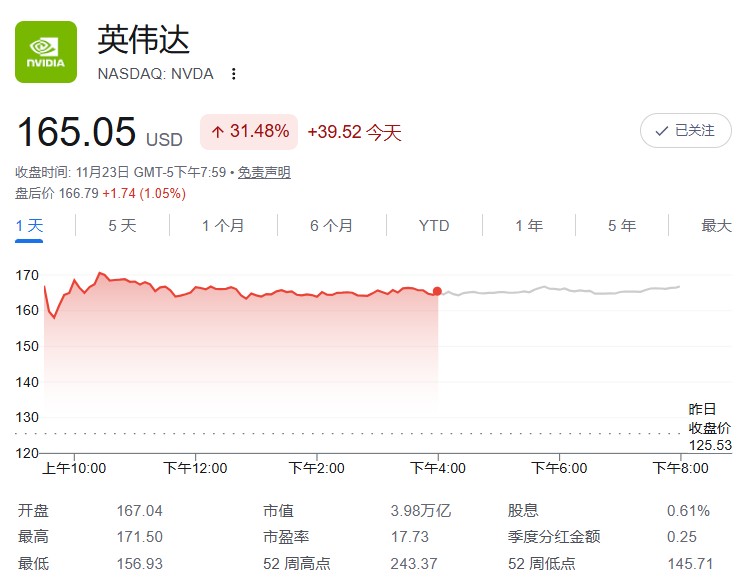
The trigger for this short squeeze was the announcement by NVIDIA's board of directors to reinstate Jensen Huang as Chief Executive Officer. Upon the news, NVIDIA's stock price rose by as much as 37% during the day, closing at $165.05, a gain of 31.5%, with its market capitalization increasing by about $950 billion in a single day. According to Peter Hillerberg, co-founder of ORTEX, speaking to MarketWatch, this was the largest single-day increase in market capitalization for a single stock in the history of the U.S. stock market.
For traders who had been shorting the stock in line with the trend, this reversal was particularly severe. NVIDIA had cumulatively fallen 23% last week, and its decline reached 39% for the month as of last Friday, leaving short sellers with substantial floating profits. However, the news of Jensen Huang's reinstatement completely reversed the situation within hours.
According to ORTEX data, short sellers in NVIDIA suffered paper losses of about $11.2 billion on Monday, the most brutal single-day loss since 2019, "more than double the previous worst single-day loss," said Peter Hillerberg.
Monday's losses wiped out all the profits short sellers had accumulated last week. However, Hillerberg pointed out that since October 29, short sellers overall remain in a profit position of approximately $15 billion.
Leveraged Short Products Hit Hard, Dropping Up to 92%
For traders using leveraged short products, the impact was even more intense.
In the U.S. market, the GraniteShares 2x Short NVDA Daily ETF (ticker: NVD), which seeks to provide twice the inverse daily return of NVIDIA's performance, plummeted 63% in a single day. According to Bloomberg, this fund, with assets of about $100 million, had previously benefited from NVIDIA's continued decline, accumulating a year-to-date gain of 46% as of last Friday.
Losses were even heavier in the European market. The GraniteShares 3x Short NVIDIA Daily ETP (ticker: 3SNV) plunged 92% in a single day, while a similar product under Leverage Shares (ticker: NV3S) fell 80%.
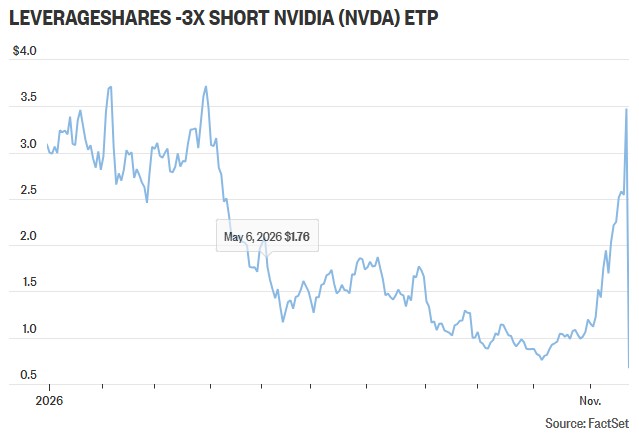
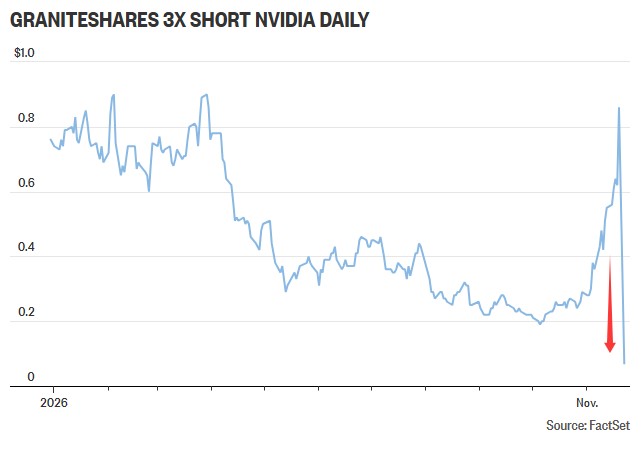
Meanwhile, leveraged long products experienced a surge. The GraniteShares 2x Long NVDA Daily ETF (ticker: NVDL) soared approximately 62% in a single day.
"Airbag" Mechanism Prevents Products from Going to Zero
Although the declines were shocking, neither of the two European products was forced to liquidate, as built-in risk control mechanisms played their role.
According to Bloomberg, theoretically, if the underlying stock rises more than 33% in a single day, a 3x short product faces the risk of being completely wiped out if its exposure remains unchanged. Oktay Kavrak, Head of Communications and Strategy at Leverage Shares, stated that NV3S paused trading for about 15 minutes to recalculate exposure before resuming trading. "The 'airbag mechanism' did what it was supposed to do: it cut off the risk of going completely to zero in extreme market conditions."
Will Rhind, Founder and CEO of GraniteShares, stated that 3SNV uses a "stop-loss" feature to prevent the product from going to zero. "It is precisely because of the stop-loss mechanism that 3SNV was able to continue existing without being forced to close."
Structural Risks of Leveraged Products Warn Market Again
This event once again revealed the inherent risks of single-stock leveraged products. According to Bloomberg, these products typically use derivatives and reset their exposure daily, meaning that returns over longer periods may differ significantly from the indicated multiples. They are trading tools, not traditional buy-and-hold investments.
Notably, as of Monday, both of GraniteShares' NVDL and NVD products had recorded losses of over 40% year-to-date, while NVIDIA stock itself had declined only about 11% since the beginning of the year.
Eric Balchunas, Senior ETF Strategist at Bloomberg Intelligence, told MarketWatch bluntly: "Whether it's liquidation or reset, it doesn't change the fact that you just lost 90%. This is a wipeout—if you hold these products, you basically have nothing left."
Mohit Bajaj, Managing Director of ETFs at WallachBeth Capital, stated: "Any leveraged ETF carries risks, along with potential rewards. Traders must ensure they closely monitor their positions."
Drew Pettit, Chief Investment Strategist at Roundhill Financial, also pointed out: "This is the danger of shorting something in a high-volatility environment."
This market move also reminded investors of the "Volmageddon" event on February 5, 2018—when the CBOE Volatility Index (VIX) doubled in a single day, leading to the liquidation of several short-volatility products.